You face five primary German Shepherd types: West German show, American show, DDR, Czech, and West German working lines. You’ll find American show lines have sloped backs and calmer temperaments, while working lines show straighter backs and high drive. Health risks vary by structure, so you should screen hips and spines carefully. You can distinguish types by coat and body shape. Continue here to identify look-alikes and breeders.
Swift Summary
- German Shepherds are categorized into West German, East German (DDR), Czech, and American lines based on functional purpose.
- Show lines prioritize aesthetics with sloped backs, while working lines focus on utility with straighter backs and high drive.
- Temperament and energy levels vary significantly, with American lines suited for families and working lines requiring intensive daily activity.
- Distinct coat patterns like black-and-tan or solid white help differentiate German Shepherds from look-alikes such as White Swiss Shepherds.
- Reputable breeders ensure health by performing rigorous testing for hips, elbows, and genetic conditions across all bloodlines.
What Are the Main German Shepherd Types?
If you seek clarity on German Shepherd classification, understand that breeders and registries commonly organize the breed into five primary bloodline groups. You’ll explore german shepherd varieties including West German, East German (DDR), Czech, West German show, and American show lines.
When examining types of german shepherd breeds, you note distinct purposes, structures, and temperaments. Different german shepherd breeds serve varying roles from protection to conformation.
You might ask how many german shepherd breeds are there, but the answer centers on these five functional lines.
Popular german shepherd breeds like West German working dogs excel in protection. Best german shepherd breeds for protection include Czech and DDR working lines. Dogs from the DDR line carry a working-line history rooted in East German breeding programs, combining sturdy physical structure with a steady temperament that appeals to working owners.
You should study a list of german shepherd breeds with pictures to distinguish types of german shepherd police dogs. Security protocols
Ultimately, understanding these types of shepherds helps you serve others effectively by matching dogs to their intended service roles.
Understanding the American Show Line German Shepherds
As you explore the American show line, you find it prioritizes AKC-style conformation over working ability, with breeding centered on ring appeal, structure, and appearance rather than functional tasks.
You observe distinct physical traits like extreme rear angulation, a sloping topline, and a refined silhouette featuring finer bone and narrower bodies. These dogs typically display lighter tan or cream coats with black saddles, creating an elegant visual impression suitable for conformation competitions.
Their temperaments remain calmer and softer, offering lower prey drive and enhanced stability in crowded environments. This selection creates a companion animal well-suited for family life rather than police or military work. Like all German Shepherds, they still need consistent daily exercise to stay healthy and mentally balanced.
Breeders emphasize aesthetics and show-ring movement, producing a type fundamentally different from original working-focused German Shepherds while maintaining breed standards for height and color within North America. The AKC prioritizes conformation show ring.
Exploring the West German Show Line Shepherds
You’ll observe the West German show line’s balanced aesthetics and temperament through its classic structure and stable character.
This breed emphasizes moderate rear angulation and hip health under SV breeding controls.
You see a versatile companion that meets show standards while retaining working soundness.
The breed’s temperament, as defined by standards, should be approachable, placid, and curious.
The German shepherd is highly trainable, excelling in obedience and working roles with positive reinforcement.
Socialization in the first 4-6 months is crucial for confidence and appropriate responses.
Exercise should match the dog’s age, avoiding high-impact running before 18 months to protect joints. Owners taking their dog on outings should pack water, food, and waste bags in a dog travel bag so essentials are always ready.
Responsible breeding and health monitoring are essential to mitigate genetic issues like hip dysplasia and degenerative myelopathy.
Regular grooming is necessary to manage heavy shedding that occurs year-round with seasonal coat blows.
Balanced Aesthetics and Temperament
While the West German show line emphasizes balanced conformation under SV and FCI standards, you’ll note its characteristic sloping topline and fluid movement distinguish it from working lines.
You’ll observe their heavier build and softer silhouette, often featuring rich red or orange tan over black saddles.
Their temperament offers calm, trainable stability with moderate energy.
You’ll find they possess lower prey and defense drive, making them adaptable household companions.
These dogs balance protective instincts without excessive reactivity.
You’ll appreciate their loyalty and affectionate behavior toward familiar children and pets when properly socialized.
They settle earlier in adulthood, suiting active family homes needing daily but not extreme exercise.
You’ll see they remain versatile, earning working titles while excelling in conformation rings.
Their balanced drive supports stable integration into average households.
You’ll recognize this line serves as an ideal companion offering both visual elegance and functional athleticism without the intensity of working lines.
Conformation-focused breeding often links show lines to higher incidences of orthopedic issues like hip dysplasia.
Moderate Structure and Health
Because the West German show line adheres to SV/FCI standards, you’ll observe a moderately angulated, sloping-topline structure that seeks a compromise between conformation and working ability.
You see males stand 60–65 cm at the withers, with trunks 10–17% longer. The back remains firm, strong, and well-muscled. Shoulders sit at 45° incline.
Hindquarters target 120° stifle angles to balance propulsion with an uninterrupted topline. You must note that these structural choices correlate with elevated but controllable orthopedic risk, especially hip dysplasia.
Research shows coxofemoral angles 20–30° greater than working lines, increasing lumbosacral stress. The breed’s classification emphasizes its working qualifications and multifaceted utility.
You can mitigate these risks by prioritizing systematic health testing.
While excessive angulation causes joint degeneration, quality breeding reduces real-world dysplasia incidence. You guarantee soundness for serving others.
Comparing Working Line German Shepherd Types
Working line German Shepherds split into three primary subtypes: West German, DDR/East German, and Czech. You prioritize working utility over show-ring appearance with these dogs. Their working focus traces back to Max von Stephanitz and the breed’s sheep-herding origins.
West German lines balance moderate structure with high-drive temperament suitable for versatile roles. DDR lines offer blocky builds with heavy bone, bred for demanding military service. Czech lines present agile frames with intense protection drives for patrol work.
All maintain straighter backs than show lines. You find sable and black coats dominate. These dogs possess strong nerves and high energy.
Consider hip health risks when selecting West German lines. DDR dogs exhibit stable temperaments. Czech dogs remain focused despite harsh conditions.
Lifespan typically ranges from ten to thirteen years. Your service requirements dictate the best subtype choice. Match the dog’s physical and mental attributes to your specific working needs.
Avoid overemphasizing appearance during selection.
Training Intensity Required by German Shepherd Type
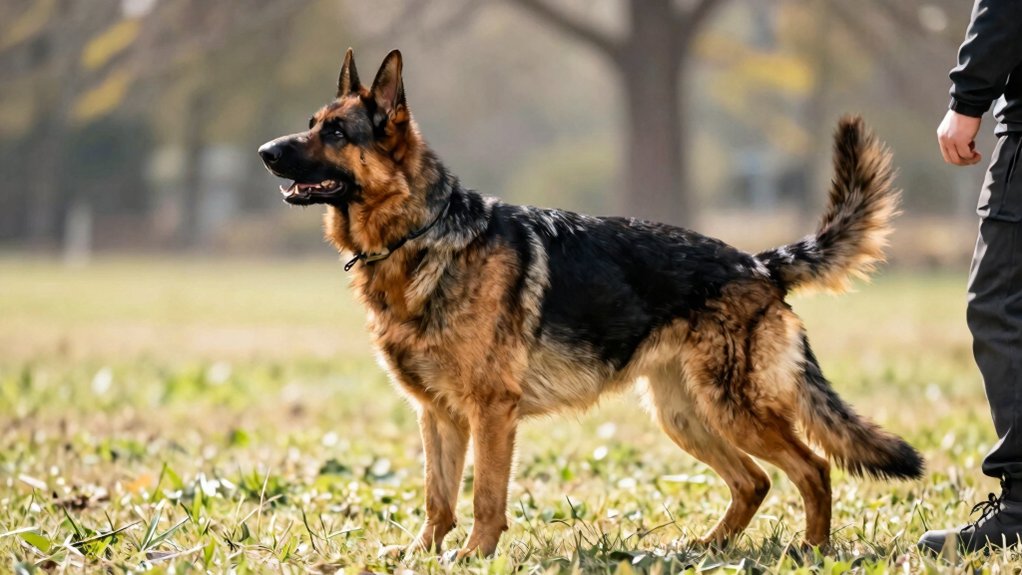
Unless you account for breeding purpose, you risk underestimating the daily training intensity required by different German Shepherd types. Average adults need 60–120 minutes combining aerobic work and mental stimulation. Break sessions into 15–20 minutes, two to three times daily.
Working lines demand 90–120+ minutes of hard physical exercise plus significant mental challenges like tracking or scent games. Aim for two hours of real activity daily; this isn’t a ceiling.
Show and pet lines manage with less intensity, needing 30–60 minutes daily exercise plus structured obedience. Yet, even calmer dogs require daily mental stimulation through puzzle feeders or agility.
Prioritize purposeful activities over mere quantity. Guarantee you provide sustained movement and engaging tasks. This structure prevents behavioral issues and fulfills their genetic drive effectively. Because German Shepherds are generally responsive to training, their intelligence and drive make structured daily sessions especially rewarding for beginners.
Which German Shepherd Type Fits Your Home?
When evaluating which German Shepherd type fits your home, recognize that high-drive working lines demand rigorous daily tasks and structured outlets to prevent destructive behavior. These dogs exhibit strong prey and defense drives, making them ideal for homes requiring serious protection or work capability rather than casual companionship.
If you seek an alert but manageable protector, consider West German show lines, which balance structure with moderate drive and offer an off-switch after exercise. Compared with working lines, West German show lines typically display a moderate drive and a more structured temperament, which makes them easier to manage in everyday settings. These dogs distribute affection broadly, fitting multi-person households seeking balanced watchdog behavior.
For suburban settings prioritizing companionship, American show lines provide calmer temperaments and lower prey drive, increasing suitability for homes with existing pets.
Match your environment and service goals carefully to ensure a compatible partnership.
Key Health Differences Across German Shepherd Lines
You must recognize that show-line German Shepherds face higher risks of hip dysplasia and spinal disorders than working lines.
While Czech and DDR lines offer better structural integrity, they still demand significant energy and rigorous training.
These orthopedic realities directly influence the physical demands you’ll need to meet across each lineage.
Beyond orthopedic concerns, German Shepherds of every line can also develop food and environmental allergies, which often show up as skin irritation or digestive upset.
Orthopedic Issues By Line
While German shepherd health varies across lines, distinct orthopedic risks emerge from selective breeding goals. You should know that West German show lines suffer high hip dysplasia rates due to excessive rear angulation and sloped toplines. These structural imbalances place abnormal stress on coxofemoral joints, often causing chronic pain.
American show lines face even greater orthopedic loads from extreme conformation exaggerations. Their steep backs and long hind limbs weaken the pelvis and hocks, reducing functional longevity to just eight to ten years.
Working lines generally offer straighter backs and moderate angulation, which lowers joint disease risks. However, you must still screen for dysplasia, as it occurs across all lines.
Moreover, degenerative myelopathy remains a genetic threat throughout the breed. You need individual radiographic evaluations to ensure true structural soundness before breeding.
Energy And Training Needs
To keep German Shepherds healthy, you must match their training and exercise to their specific line’s energy profile. Working-line dogs demand extreme drive outlets, requiring two-plus hours of structured physical and mental work daily. Without precise outlets, they develop destructive behaviors.
Show-line companions possess moderate-high energy, needing roughly ninety minutes of combined exercise and obedience training for stability.
High-drive sublines like DDR and Czech require integrated endurance work paired with precise task training to prevent behavioral issues.
You should prioritize early socialization and consistent short training sessions for better retention across all lines. Professional guidance helps manage reactivity in high-drive dogs.
Ultimately, aligning your lifestyle with the dog’s specific energy needs ensures their behavioral health and allows you to serve them effectively. Proper matching prevents behavioral health issues while enabling you to provide ideal care for these working breeds.
How to Identify a German Shepherd Type
Identifying a German Shepherd type requires evaluating structural traits like topline shape and hindquarter angulation alongside coat patterns and temperament. You must assess body structure, movement, and drive levels to distinguish working from show lines.
Working lines show straight backs, compact bodies, and intense work focus. Show lines feature exaggerated topline angulation and softer temperaments.
West German show dogs have roached backs and classic red-and-black coats. American show dogs present sloped backs, extremely angular hindquarters, and elegant outlines.
West German working dogs possess moderate athletic builds with extreme drive and high stamina. Look for sable or blanket coats on working lines.
Evaluate temperament closely; working lines exhibit sharp nerves while show lines remain calmer. These markers help you select dogs suited for service, sport, or family roles. When transporting a dog for evaluation or a breeder visit, a hard-sided dog carrier provides a rigid, protective enclosure that keeps the animal secure and calm.
German Shepherd Look-Alike Breeds to Know
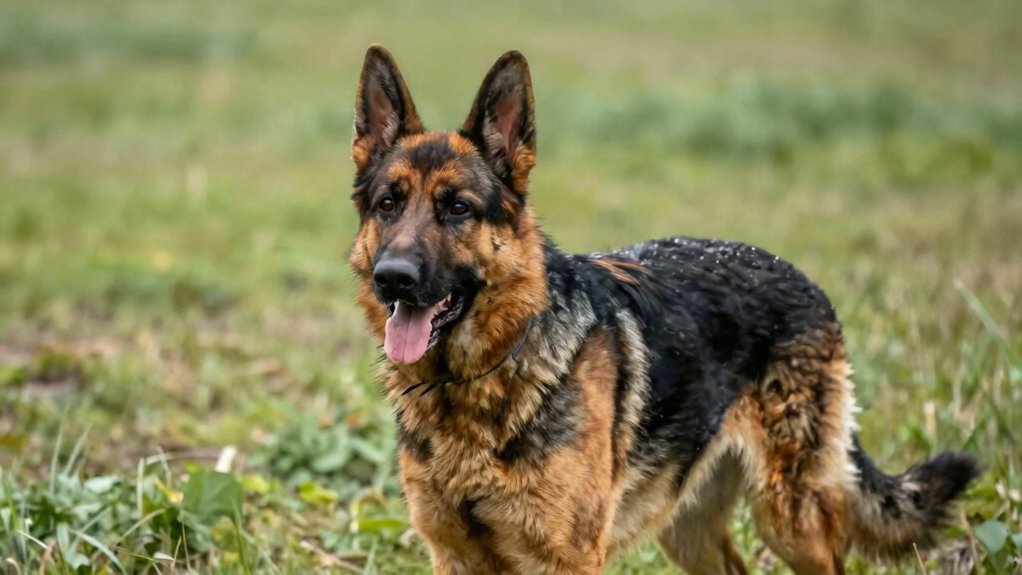
You’ll recognize German Shepherd look-alikes by their shared erect-ear silhouettes, athletic herding builds, and striking black-and-tan coat patterns.
You must distinguish these breeds by tracing their separate herding lineages—Belgian, Dutch, and designer hybrids—despite their visual similarities.
Compare their coat textures, sizes, and colorations to accurately identify each breed’s unique characteristics. Because German Shepherd puppies often have floppy ears that don’t stand up until several months of age, ear development is a useful clue when telling young puppies apart from their look-alikes.
Identify Visual Breed Resemblance
While several breeds share the classic German Shepherd silhouette, coloration, and size, you can reduce confusion by recognizing key distinctions in their build and coat.
Look for leaner frames on Belgian Malinois and Dutch Shepherds, noting their distinct fawn and brindle coats.
Identify long-haired look-alikes like Belgian Tervurens and Groenendaels by their silky textures and black overlays.
Observe oversized variants like King and Shiloh Shepherds, which display heavier bone and denser coats than standard German Shepherds.
Notice robust East European Shepherds with weather-resistant fur and saddle markings.
Differentiate white shepherd-type dogs like Berger Blancs and White Shepherds by their identical structures but solid pale coats.
Finally, distinguish fluffy spitz breeds like Samoyeds and Keeshonds by their wedge heads and distinct double coats when you encounter these similar canines.
Distinguish Similar Herding Lineages
When comparing herding lineages, you’ll find that Belgian Malinois, Dutch Shepherds, and Belgian Tervurens share continental working roots with German Shepherds but prioritize speed, independent problem-solving, and endurance over versatility.
You’ll observe Malinois possess lighter frames tailored for explosive deployment, while Dutch Shepherds emphasize resilient problem-solving in security roles. Tervurens maintain multipurpose herding and obedience focus despite companion popularity.
You’ll note Bohemian Shepherds function as agile border guardians with moderate mass, whereas White Swiss Shepherds emphasize stable temperament for family-compatible herding.
East European Shepherds derive from Soviet crossings, prioritizing cold resistance and heavier bone for sustained service work.
You’ll recognize all these lineages preserve distinct functional aptitudes from German Shepherds’ broader versatility. Each breed’s specialized development supports specific service demands, allowing you to match dogs precisely to their intended working environments.
Understanding these distinctions ensures ideal placement for those serving others.
Compare Coat Color Patterns
Beyond distinguishing herding lineages, you should recognize how coat color patterns define visual similarities among German Shepherd look-alikes. Belgian Malinois typically display fawn or mahogany bases with black masks and overlays, creating visual confusion despite their shorter coats. Their sable patterns produce a shaded appearance distinct from German Shepherd saddle markings.
Dutch Shepherds feature restrictive brindle patterns across the body, utilizing gold, silver, or blue-gray bases to distinguish themselves clearly. While standard German Shepherds maintain recognizable black-and-tan saddle patterns, look-alike breeds often exhibit unique color distributions like brindling or solid shades.
You must analyze these specific coat characteristics carefully to accurately identify each breed during service evaluations. Understanding these distinctions ensures precise breed identification for working environments requiring specific visual recognition skills.
Choosing a Reputable German Shepherd Breeder
To guarantee a healthy, temperamentally sound German Shepherd, you must prioritize breeders who rigorously test breeding stock and maintain transparent operations. Verify OFA or PennHIP hip and elbow evaluations alongside degenerative myelopathy DNA testing for both parents. Confirm cardiac and thyroid screenings meet German Shepherd Dog Club of America standards. Review annual eye clearances to mitigate heritable ocular risks.
Confirm testing utilizes certified schemes like SV or FCI rather than informal opinions. Evaluate breeding goals focused on structure, working ability, and stable temperament. Seek detailed descriptions of bloodlines and formal temperament assessments.
Visit clean, well-ventilated facilities; avoid multi-breed operations. Request written contracts outlining health guarantees, return policies, and spay requirements. Assure routine veterinary care, vaccinations, and parasite prevention are documented.
These steps ensure responsible stewardship and ethical production of service-quality German Shepherds. Puppies raised by responsible breeders thrive when new owners commit to lifelong German Shepherd care from puppyhood through the senior years.
Frequently Asked Questions
What Is the Lifespan of Different German Shepherd Line Categories?
You see working lines live 10–13 years, while show lines average 9–11. American lines often reach only 8–10 due to structural issues. Proper care extends their lives across all German Shepherd categories considerably.
How Much Does a German Shepherd Puppy From a Working Line Cost?
You’ll pay $1,500 to over $6,000 for a working-line German Shepherd puppy, depending on pedigree and titles. Fully trained working dogs often exceed $10,000.
Do Working Line German Shepherds Get Along Well With Other Pets?
Working-line German Shepherds often struggle with other pets due to high prey drives, but early socialization, structured introductions, and consistent management can help them coexist safely with cats and smaller animals.
What Is the Best Age to Start Training a German Shepherd?
Start training your German Shepherd at eight weeks. Focus on basic commands, socialization, and routine during this critical window. Early, prevents behavioral issues and builds a strong foundation for future obedience and impulse control.
How Do German Shepherd Lines Differ in Shedding and Grooming Needs?
Most German Shepherds shed heavily year-round with two seasonal coat blows. You’ll find working lines need less brushing than show or long-coat lines, which demand daily grooming to prevent matting and manage intense undercoat loss.