You’ll raise a healthier German Shepherd if you plan each stage. Start by feeding large-breed puppy food, measure with an 8‑oz cup, and track weight through the first 6 months—feel ribs (not see them) for body condition. Crate and potty train right away, keep crate time short (under 6 months: age in months + 1 hour), and do 3–5 minute recall games. Socialize from ~8 weeks with low-risk, calm meet-and-greets. For exercise, use short, low-impact walks (~5 minutes per month of age). Want the full 25-step roadmap?
Swift Summary
- Feed large-breed puppy food for controlled growth; monitor body condition and ribs-to-waist appearance to avoid overweight and excess calcium.
- Use a structured feeding schedule: measure portions, split into 3–4 meals early, and remove leftovers within 15–20 minutes.
- Start crate training and potty routines immediately with short sessions, quiet handling, and crate time limited to age-in-months + 1 hour.
- Socialize safely from about 8 weeks with low-risk, guided exposures to people, surfaces, and sounds; avoid risky nose-to-nose dog meetings.
- Progress nutrition by life stage—aim ~95% adult weight by 12 months, then fill out gradually through 2–3 years, supporting hips and joints.
Plan Your German Shepherd Life Milestones
Start planning your German Shepherd’s milestones now, because a little structure makes every age stage easier to manage. If you’re wondering how do you take care of a german shepherd, map your year by life stages: puppy 2–15 months, adult 15 months–5 years, mature 5–8 years, senior 8+ years. During german shepherd puppy care, track weight growth, fast through 6 months. 22–40kg German Shepherds are large dogs, so it’s important to use appropriate large-breed feeding and keep an eye on healthy growth rates. At 12 months, aim for 95% adult weight, then fill out until 2–3 years. From 7–8 years, schedule more vet checks for joints, calories, and slower activity. These german shepherd facts and tips help guide to owning a german shepherd. Checking body condition regularly, such as feeling the ribs without seeing them, helps you confirm your dog is at a healthy weight at every stage.
Pick a Large-Breed Puppy Food & Feeding Cups
Pick a large-breed puppy growth formula, because it has controlled calories and the right calcium level (about 1.8% max on a dry-matter basis) to support steady bone development, not fast, risky growth. Correct also keep your puppy’s growth pace consistent by feeding only the recommended amount for their age.
Then, measure with precision using the standard 8-oz measuring cup, and follow the feeding chart for your age—at 8–10 weeks you’ll often start around 1.5–2 cups per day, then adjust as your puppy grows. Puppy formulas differ from adult and senior foods in their life-stage nutritional needs, so the right choice changes as your German Shepherd ages.
But don’t “eyeball” it—weigh your puppy and check body condition often, because cups can vary, and grams don’t lie.

Diamond Naturals Large Breed Puppy Lamb and Rice dry dog food; REAL PASTURE-RAISED LAMB is the #1 ingredient; specially formulated with carefully determined protein and mineral content to support the needs of LARGE BREED PUPPIES

Real chicken is the number 1 ingredient in this dry puppy food to help provide the protein he needs for strong, growing muscles, including a healthy heart

Veterinarians Recommend IAMS: IAMS large breed dog food recipe is made with real chicken as the #1 ingredient and contains no fillers or artificial flavors; ingredients are natural as defined by the Association of American Feed Control Officials (AAFCO)
Choose Growth-Controlled Formula
Most of the time, you’ll want to feed your German Shepherd a large-breed puppy growth formula—not the regular kind that aims for fast, extra weight. These diets support controlled skeletal growth, so you reduce risk of developmental orthopedic disease.
Look for labels saying “large-breed puppy” or “for growth of large-size dogs.” They use lower energy density, so your pup gains weight slowly, stay lean, and supports bone and joint development.
Aim for a tidy Ca:P ratio around 1.1–1.3:1, since too much calcium can harm growing plates.
Feed this until about 80% adult size, often 18–24 months.
Measure Cups With Precision
Measuring out food with precision helps your German Shepherd grow at the right pace, not the rushed, joint-stressing one.
First, pick large-breed puppy food with clear kcal per cup, and gram details.
Typical “one cup” varies, often around 104–122 g.
So grab a digital kitchen scale, and weigh the grams from the kcal-per-kilogram label.
Then split the daily amount into your set meals, usually 3–4.
If you must use cups, use one dedicated cup, level it, never heaping.
Don’t “wing it” with mugs.
After 15–20 minutes, remove leftovers to prevent grazing.
Consistency is caring.
Control Growth Rate for Strong Joints
To help your German Shepherd’s joints stay strong, you want to control growth rate—not speed it up.
Control your German Shepherd puppy’s growth rate, not speed it up—healthy joints start with the right nutrition and feeding plan.
Use large-breed puppy food with controlled energy and calcium, ideally tested in AAFCO or FEDIAF trials. Brands such as Royal Canin, Purina Pro Plan, and Eukanuba offer formulas commonly considered for German Shepherds, so compare their calcium and energy levels before buying.
Avoid generic puppy or adult food that can push extra calories, and set a lean body condition.
Keep ribs easily felt, not prominently seen.
Feed measured meals, not free-choice, to cut hip dysplasia risk.
Start with 3–4 small meals under 12 weeks, then 3 meals until ~6 months, then 2.
Between 3–8 months, control portions tightly during the big growth spurt.

Growing bones and teeth supported by balanced minerals

Formulated to support an appropriate growth rate for large breed puppies

Real chicken is the number one ingredient in this dry food for puppies to help provide the protein he needs for strong, growing muscles, including a healthy heart
Start Socializing at 8 Weeks (What to Do)
At 8 weeks, you’ll want to build a safe social exposure plan: pick clean, low-risk places (like an indoor training center or private yard), keep each new person/dog at a comfy distance, and reward calm with high-value treats. For walks to these spots, a dual-clip harness with both front and back leash attachments gives you flexible control during greetings.
Next, teach meeting etiquette right away, so you guide “greeting” by letting your puppy sniff briefly, then practice a quick sit or “look at me” before the next intro.
But if you hit the early fear period (often 8–11 weeks), handle it gently, move farther back, lower the intensity, and let your puppy watch first—comfort beats forcing.
Create Safe Social Exposure Plan
Start socializing your German Shepherd puppy as soon as they hit about 8 weeks, because this sensitive window (roughly 3–14 weeks) strongly shapes how they handle new people, places, and sounds later on.
Confirm their vaccination plan before public ground contact, and skip nose-to-nose meetings with unknown dogs.
In busy areas, use a carrier or stroller, and do calm visual “watching” visits to vet clinics, parking lots, and parks.
Do 10+ different people per day, aim for 21–30 total during socialization.
Practice short, positive sessions with new surfaces, umbrellas, and vacuum sounds.
Keep intensity low until they look relaxed.
Continue structured exposure through at least 16 weeks.
Teach Calm Meeting Etiquette
When you’re ready to teach calm meeting etiquette, begin right in that early socialization window, because German Shepherd puppies learn greeting manners fast.
During 8–16 weeks, practice 2–3 times weekly, keeping it low-pressure after the 8–11 week fear period.
Start with a default cue: sit, touch, or go to mat.
In a quiet room, mark calm posture with a click or “yes,” then reward.
Set the puppy in a sit slightly away from the doorway.
Reward staying seated as the visitor enters, move closer only after success, then add “say hello.”
Stop jumping fast: ignore, say “off,” ask “sit,” and reward four-on-the-floor.
Handle Fearful Encounters Gently
Even though your German Shepherd puppy is curious, you still need to treat fear like a signal, not a problem to fix.
In the 8–16 week window, start at 8 weeks after DHPP and deworming, then expose you puppy to new places twice weekly.
Use quiet streets, calm parks, and distant low-volume sounds.
Carry your pup so direct contact stays off-limits.
Make a checklist, and add only 1–2 new stimuli per session, always with high-value treats.
Watch for fear signs: freezing, cowering, trembling, or escape attempts.
Move farther away or lower the trigger fast.
If panic hits, leave to a quiet spot—never force proximity.
Use Puppy Training From Day One
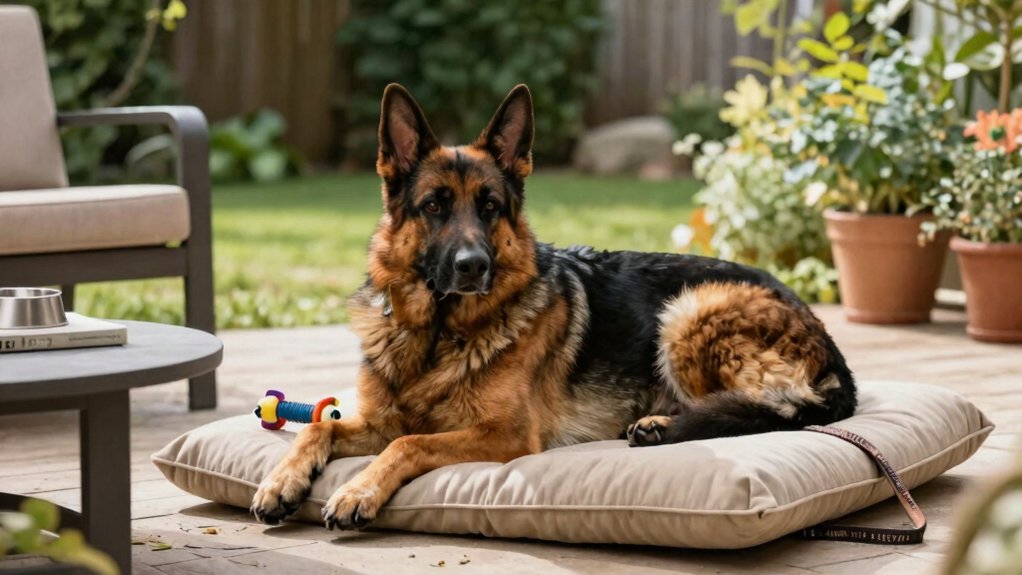
Training works best for your German Shepherd when you begin the very day your puppy comes home. Start with gentle, reward-based sessions from 7–8 weeks old, so good habits form early. Between 9 and 12 weeks, puppies are ready for early socialization with people, sounds, and new environments, which helps them grow into confident adults.
Keep the first day focused on attention, frequent handling, and introducing your home routine.
Then potty train immediately: take them to your chosen spot every time, use the same exit door, and reward right after they go.
Add crate training right away, with comfy bedding and the door open at first.
Do 30–60 second entry and exit sessions.
For under 6 months, limit crate time to age in months plus one hour.
Keep Exercise Short: Low-Impact Puppy Play
Because German Shepherd puppy growth plates stay open until about 16–18 months, you’ll want to keep exercise short and low-impact from the start.
Aim for about 5 minutes of structured walking per month of age, up to twice daily.
For a 3-month pup, try 15 minutes of gentle play, for a 5–6-month pup, 25–30 minutes max, with rest breaks.
Let them roam and sniff on grass or sand.
Keep free, self-paced fun. Short sessions of mental stimulation, such as scent games and simple training, can tire a puppy without adding strain to its developing joints.
Avoid forced running, jumping, hard-surface ball chasing, and lots of stairs.
Little sessions protect cartilage and may help prevent later hip and elbow issues.
Build Recall and Loose-Lead Walking First
And for loose-lead walking, try the “red light/green light” rule, walk until the leash tightens, stop like a “tree” for a few seconds, wait for slack, then move on and reward near your side. Keep every session consistent, since consistent training across all family members helps your dog learn these cues faster at every life stage.
Early Recall Training Games
How do you turn “come” into a reflex your German Shepherd loves? Start at 8–10 weeks, indoors or in an enclosed garden, and use one cue only, once per recall. Give tiny, high-value rewards every time: food bits, a toy, or a quick play burst. Keep sessions 3–5 minutes, repeat daily, and never punish slow returns.
Now play ping-pong: toss to one side, say “come” as they turn, reward, then switch sides.
Try bounce-back, too: toss away, cue fast after they eat, then reward near you.
Add gentle collar-touch at the end for safety.
Loose-Lead Walking Habits
Once you’ve taught early “come,” you’ll get a big payoff by building loose-lead walking right away—so your German Shepherd learns that being near you feels rewarding, not restrictive.
Start in a low-distraction place. Use “Let’s go” as your permission cue. Keep the leash slack, about 6 feet long. If it tightens, stop instantly, then use the “tree” (wait for slack) or “red light/green light” (resume when slack returns).
Mark with “Yes” or a click, deliver treats by your knee or hip within 1 second.
Do 10 minutes, 2–3 times daily. Reward proximity, then slowly use variable treats.
Add Daily Mental Games to Prevent Boredom
To keep your German Shepherd from getting bored, add short daily brain work—because a “tired brain” often prevents the chewing, barking, and restlessness you’d rather not deal with. Pair these sessions with physical activities designed to help German Shepherds use their energy and avoid boredom.
Do 10–20 minutes each day, consistently. That small routine beats rare, long sessions.
Use nose games. Hide treats, then let your dog “find it.” Try a simple scent trail with a strong-smelling toy.
You’ll see faster focus, less anxiety, and better confidence, from puppy to senior.
Next, use puzzle feeders, like muffin-tin games, and rotate difficulty weekly.
Finish with 5 minutes of tricks and impulse-control cues.
Stop Destructive Chewing With Enrichment Plans
Rotate chew-safe toys every few days, and keep 3–5 options out at once so your German Shepherd doesn’t get bored or overwhelmed.
Then schedule a calm “chew session” after meals or in the evening for 15–20 minutes, using a food-stuffed toy or frozen chew to make the right choice the easiest choice.
If chewing still happens on the wrong stuff, you trade the item for an approved chew right away, and you reward the good chewing so your routine sticks. When you reward good chewing, choose training treats suitable for German Shepherds, since they are small enough to give often without interrupting the session.

Treat Dispenser Puzzle Toy: Stuff food or treats into the toy to create mentally stimulating treat puzzles for your dogs. They will have fun flipping and tossing it to get the treats out, which keeps them busy and entertained with endless treating fun and keeps them away from destructive chewing.

Satisfy Instinctual Needs: The KONG Classic red rubber toy helps satisfy dogs' instinctual needs and provides mental stimulation; toy helps solve chewing, teething, boredom, crate training, digging, barking and more

Dog Chew Toys for Healthier Teeth: The hammerhead shark interactive dog toys for aggressive chewers are built to last, perfect for dogs from 20 to 80 pounds. Its unique design ensures a stable three-point contact, allowing your pup to chew and gnaw freely. The shark's head bump, lively tail, and protruding fins make it easy to chew, clean teeth, and reduce tartar. You can also apply toothpaste or peanut butter to the surface for extra hygiene and fun!
Rotate Chew-Safe Enrichment Toys
Even though it sounds simple, you’ll get big results when you rotate chew-safe enrichment toys instead of leaving the same ones out all day.
Keep 3–5 chew toys available at a time, and store the rest.
Rotate them at least twice per day in kennel or high-use areas, or swap every few days at home.
This keeps novelty high, so your German Shepherd doesn’t get bored and start chewing household items.
Use a written calendar, and include puzzle and fetch days too.
Inspect daily for cracks, loosened parts, and clean or replace weekly.
Choose heavy-duty rubber or thick rope, never rigid, hard chews.
Schedule Calm Chewing Sessions
A simple chew plan can work wonders, and it pairs nicely with the toy rotation you’re already doing.
Schedule chew sessions at consistent times daily, so your German Shepherd learns calm predictability.
Try 15 minutes after breakfast, 20 minutes after a walk, 10 minutes mid-afternoon, and 30 minutes before bedtime.
Keep sessions 10–30 minutes, adjusting for age and energy.
Give one long-lasting chew item at the same mid-afternoon time to anchor rest.
Offer chews after meals, after exercise, and before alone time, especially during high-risk moments like dinner or work calls.
Set a designated chew zone, then remove tempting items.
Manage Working Drive With Structured Training
To manage a German Shepherd’s working drive, start with structure, not chaos.
Begin right after arrival, during the 3–12 week window, with short 5–10 minute, reward-based lessons: sit, down, recall, and mat settles.
Start right after arrival (3–12 weeks) with short 5–10 minute reward lessons: sit, down, recall, and mat settles.
Keep sessions daily, about 10–20 minutes, so your dog learns self-control fast, not just “work” sometimes.
Teach leash manners early, and swap high-impact play for low-impact neuromuscular games and calm “wait” near triggers.
For adult dogs, offer 1–2 hours of structured exercise plus training, using sit-and-wait, drop-it, and end-of-game cues.
For seniors, use nosework, tracking, and trick chains to protect joints.
Beyond these basics, teaching essential commands and useful tricks gives a German Shepherd a clear way to communicate and a steady source of mental stimulation.
Set Feeding, Crating, and Naptime Routines
Set up scheduled meals and stick to measured portions, because your German Shepherd does best when food hits the bowl on a steady clock.
Feed puppies 4 times a day at 8–12 weeks, then shift to 3 meals at 3–6 months, and finally 2 meals for adults, with about 2.5–4 cups total for most adults split across the day.
For crating and naptime, start with 2–3 minute crate sessions and toss treats inside, then build up—aiming for crate naps after potty breaks, and keeping daytime crating under 3 hours at first (and closer to 4–6 hours max for adults) so sleep stays calm and predictable.
Scheduled Meals And Portions
When you feed your German Shepherd on a schedule, you make life easier for both of you, and you prevent the “grazing all day” habit. Use age-appropriate portions.
In puppyhood, start with dam’s milk or formula, then add puppy mush. From 6–8 weeks, feed 4–5 small meals daily.
By 8–12 weeks, offer 3–4 meals, about 1–2 cups total per day.
In 3–6 months, move to 3 meals, 2–4 cups total.
For 6+ months, switch to two measured meals, morning and evening, feeding within 10–15 minutes. Keep outdoor potty breaks before and after.
In adult years, 3–5 cups/day, and adjust.
In senior years, often 2–3½ cups/day, plus joint-friendly or weight formulas.
Crate Training Naptime Routine
First, you’ll make crate naptimes work by giving your German Shepherd a simple, predictable routine all day long—wake, potty, a measured meal near the crate, then a short play or training burst before crate time. Keep it calm. Use a cue word for crate entry, handle quietly, and wait for drowsy calm, not high excitement.
Next, schedule midday crate naps for 1–2 hours, then adjust: puppies under 12 weeks often do 1–2 hours, while 12–16 weeks may reach 2–3 hours.
Offer a safe chew or stuffed toy, then wind down before evening.
Always do final potty.
Spot Health Risks Early: Screening Checklist
To spot health risks early, you should start with a simple screening checklist for your German Shepherd, because catching problems sooner often means easier treatment later.
Each week, check gait, look for stiffness, and watch how your dog rises.
If you notice hind-limb lameness, hesitation, or a changed walk, ask about hip and elbow X-rays, plus spine films to assess lumbosacral transitional vertebra (LTV, type 0–1).
You should also request DNA testing for degenerative myelopathy (DM) if hind weakness or paw knuckling starts.
Watch for GDV signs like retching, swelling, restlessness, or collapse.
Track weight, and get eye and heart checks annually.
Follow a Vet Schedule by Life Stage
Follow a vet schedule by life stage, because German Shepherds can age faster than some smaller breeds, and prevention works best when you stay ahead of problems.
Follow a vet schedule by life stage—German Shepherds may age faster than smaller breeds, and prevention works best when you stay ahead of problems.
You start at 6–8 weeks with an exam, core vaccines, and parasite planning.
Then you go every 3–4 weeks until 16–20 weeks, finishing DHPP at 6–8, 10–12, and 14–16 weeks.
Rabies typically lands once between 12–16 weeks, per your area.
After that, plan a 6-month check, usually around spay/neuter, then boosters at 12 months.
As an adult, aim yearly, or twice yearly for large-breed risk.
Review parasite prevention, plus fecal and heartworm checks.
Brush and Groom to Handle Seasonal Shedding
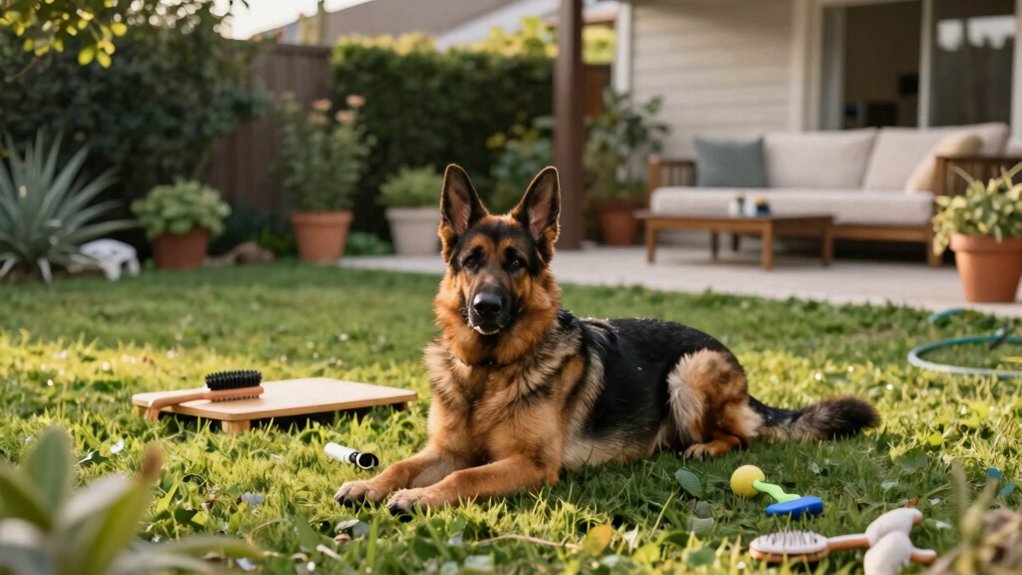
Once you’ve lined up your vet visits by life stage, you can keep the day-to-day stuff just as organized—starting with grooming.
And German Shepherd shedding gets easier when you match the coat’s rhythm. Their double coat has a dense undercoat, and that undercoat releases most loose hair in spring and fall blowouts.
During heavy seasons, brush daily, sometimes even twice, using an undercoat rake for 10–15 minutes.
Outside blowouts, brush 2–4 times weekly.
Use a slicker brush first, then a wide-tooth comb for tangles.
Be gentle, follow hair growth direction, and bathe only as needed.
This keeps fur healthy, reduces mats, and helps your home stay calmer.

DUAL-SIDED DESIGN: Our Undercoat Rake Dog brush is perfect for deshedding your pet's coat. Designed with a dual-sided design, start with a 9-teeth side to tackle stubborn mats and tangles, and finish with a 17-teeth side to thin out and deshed after.
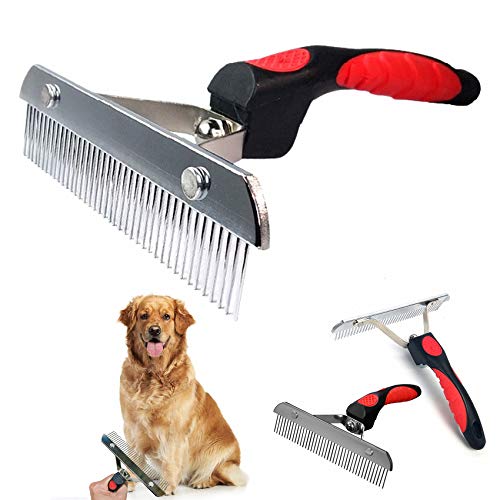
ROUNDED PIN : The long tooth undercoat rake brush has smooth rounded pins that make it easier for pets to accept grooming. The 0.94 foot long steel teeth of the rake penetrate deep into the dog's hair to remove loose fur and remove all mats, tangles and knots. Long tooth undercoat dog rake brush Not suitable for cats, puppies or short-haired pets.

Use it to trim out the undercoat, trim out dead hair, unravel & demat the coat
Maintain Healthy Weight to Protect Hips
Feed your German Shepherd for controlled growth, because extra calories during puppyhood can speed up weight gain and add extra stress to growing hip joints.
Aim for a body condition score of about 4–5 out of 9, so you can feel ribs easily without a thick fat layer, and you’ve got a visible waist from above.
Weigh and check weekly, then adjust portions early—catching weight creep fast helps protect hips and slows the slide toward hip osteoarthritis.
Feed For Controlled Growth
When you choose food for your German Shepherd’s early growth, you’re setting the pace for their hips for years to come.
Pick a large-breed puppy formula made for slow, steady growth.
Feed controlled calories and fat, not a “grow fast” diet.
Aim for about 3 meals a day from weaning until around 6 months, then switch to twice daily from 6–12 months.
Use balanced, AAFCO-style growth nutrition, with adjusted calcium and phosphorus to support bones.
Avoid extra calcium or vitamin D supplements.
Too many calories can speed growth, and that extra weight-load can worsen hip dysplasia later.
Monitor Weight And Body Condition
Regularly monitor your German Shepherd’s weight and body condition, because a few extra pounds can quietly stress their hips.
Start monthly by weighing, then assess Body Condition Score (BCS), which checks fat and muscle on a 5- or 9-point scale.
Aim for about 4–5 out of 9.
You should feel ribs easily, see a waist from above, and spot an abdominal tuck from the side.
Adult males often land around 29.5–40.8 kg, females 22.7–31.8 kg, but frame and muscle matter.
During puppy growth, watch rapid gain—study pups heavier at 2 months had higher hip dysplasia rates.
Adjust Food Amounts as Activity Changes
As your German Shepherd’s activity changes, you should adjust food amounts so their weight stays healthy and their energy matches their day. Start with their calorie needs tied to activity.
As your German Shepherd’s activity changes, adjust portions to keep weight healthy and energy matched to the day. Start with calorie needs.
A ~70 lb adult resting or sedentary usually eats about 1,100–1,500 kcal/day. Active dogs may need 1,600–1,900 kcal/day, and working athletes can rise about 20–50%.
Use feeding charts by body condition, then tweak 200–300 kcal down for senior or low days, or 200–400 kcal up for hard workloads.
Split meals to serve steady energy—two for adults. Check ribs weekly.
Train Consistently Through the Adolescent Stage
After you dial in food amounts as your German Shepherd’s activity level changes, you’ll want to keep training steady too—especially during adolescence. This phase, often 6–18 months, brings selective listening and boundary testing.
You’ll prevent problems by training with consistent, reward-based rules every day. Keep a predictable schedule for meals, walks, training, and rest, and make sure everyone in your home uses the same cues.
Practice impulse control with 5–10 short reps: wait at doorways, do leave-it, and hold still while distractions pass.
When cravings and chewing peak, lower your difficulty and use higher-value treats, plus manage space with gates and indoor leashes.
Use Obedience Classes for the First Two Years
When you choose obedience classes wisely, you give your German Shepherd the best chance to grow up calm, confident, and manageable.
Enroll during the 8–16 week critical socialization period, especially at 8–12 weeks when they learn fast.
In group puppy classes, you practice sit, stay, lie down, and “come,” plus polite leash walking.
You also get supervised “puppy play hours” for safe dog-to-dog communication, and new people exposure.
But don’t stop.
Many dogs start formal classes at 6–12 months, so add follow-up.
Aim for classes every 1–2 years, max 3.
Choose Activities That Match GSD Working Drive
Match your German Shepherd’s working drive to the right kind of “job,” and you’ll see calmer behavior at home almost right away.
If your GSD loves scent, lean into tracking and scent games. Try snuffle mats, hidden treats, or IGP-style scent discrimination, then let them search, decide, and succeed.
For high speed and jumping drive, build agility with tunnels, low jumps, balance work, and handler cues.
Want teamwork? Add fetch rules—sit, wait, release—then tug with clear boundaries.
Rotating fetch, tug, and disc keeps boredom down.
For service-minded dogs, consider therapy work, Canine Good Citizen, or qualified IGP protection.
How Much Exercise (Minutes) for Each Age?
Once you know your German Shepherd’s age, you can put exercise on a simple “minutes” plan that supports growth, endurance, and joints.
For puppies 0–12 months, use 5 minutes of structured exercise per month of age per session, up to twice daily. It’s structured exercise, not free play, so you still let them self-pace.
A 2-month pup does about two 10-minute sessions.
At 3–6 months, aim roughly 15–30, 20–40, 25–45, then 30–60 minutes daily.
Avoid high-impact running until growth plates close, around 12–18 months.
For adults 1–7 years, budget 60–120 minutes daily, plus 15–30 minutes of mental work.
For seniors 7+, do 30–90 minutes, split into shorter outings, and keep it gentle.
Handle Reactivity With Clear Management Steps
Reactivity won’t improve by hoping it doesn’t happen, so you manage it on purpose first—then you train.
Start by logging every incident, note the trigger, and find your threshold distance where your dog sees it but stays calm enough to eat or take cues.
Pick quieter routes and times, and use visual barriers when you can’t keep distance.
During walks, use a 5–6 ft non-retractable leash, ideally a front-clip harness or head halter.
Keep a loose leash, with a “valley,” not constant tension.
Scan early, turn away fast, cross streets, and never rehearse lunging.
Then train with “watch,” counterconditioning, and rewards.
Plan for Senior Slowdowns and Energy Drops
By the time your German Shepherd hits about 7 years, you’ll often notice a real shift—less energy, fewer bursts of activity, and more health stuff that needs attention. Plan for it.
By around age 7, expect a shift: less energy, fewer activity bursts, and more health needs—so start planning now.
At 7, watch for hesitation before jumping in the car, more lying down, and shorter exertion.
By 9, you may see joint pain, reduced mobility, and less play interest.
At 10, slowing, weakness, and sleep changes can show up. Track endurance, longer recoveries, and more napping.
Note stiffness, trouble rising, shorter stride, and new bumps.
Also watch for confusion, nighttime pacing, and “stuck” moments, and get a vet check if breathing issues or coughing appear.
Set Safe Senior Exercise: Walks and Swimming
After you’ve planned for the slower days and lower energy from senior life, you can keep your German Shepherd strong with safe, gentle movement—especially walks and swimming.
Aim for 30–60 minutes total per day, split into two 15–20 minute walks, or three 10–15 minute walks.
Stay on soft surfaces like grass, dirt, or sand, and move at a leisurely pace.
Schedule outside in cooler hours, and skip icy or hard ground, using booties if needed.
Start swimming with 10–30 minute sessions, then build slowly.
Watch for limping, stiffness, or labored breathing, and adjust fast.
Support Joint Health With Vet-Guided Options
Supporting your German Shepherd’s joint health works best when you team up with your vet from the start. Ask for joint screening and lifelong monitoring, especially since German Shepherds face hip dysplasia and arthritis risks.
Regular exams catch problems early. Next, keep your dog lean. Extra weight adds stress to joints, and even a 1–2% body-weight loss per week can improve comfort.
Your vet may prescribe a joint-support diet to help both calories and nutrients. Omega-3s help pain and signs, and some options like green-lipped mussel, collagen, or cannabinoids may help too.

[Dog Joint Pain Relief] Dog joint and hip supplement provides relief for dogs from joint discomfort they may be facing. Dog joint chews are rich in natural ingredients. The ingredients in dog glucosamine chews can reduce discomfort and dog joint pain relief in dogs by reducing swelling and redness. Joint supplements for dogs are gentle on dog's joints and improves dog's comfort. Joint health supplement for dogs allow dogs to enjoy a happy life

Perfect tasty blend of Glucosamine, Chondroitin, Perna Canaliculus, and Omega-3 Fatty Acids. Dogs love the taste. They think it is treat time!

Perfect tasty blend of Glucosamine, Chondroitin, Perna Canaliculus, and Omega-3 Fatty Acids. Dogs love the taste. They think it is treat time!
Know Warning Signs: When to Call the Vet
When you notice something feels *off*, don’t wait around hoping it’ll pass—German Shepherds can go from “maybe nothing” to “serious” fast. Call the vet now for any breathing trouble, choking, sudden collapse, or severe weakness.
Check gums too, pale or blue gums with a rapid or weak pulse can mean shock, a life-threatening state.
Check gums—pale or blue with a rapid or weak pulse can signal shock, a life-threatening emergency. Call the vet immediately.
Also act fast if your dog can’t stand, seems paralyzed, faints, or looks extremely confused.
For upset stomachs, treat continuous vomiting over 1 hour, vomiting blood, or repeated retching with a swollen, bloated belly as emergency bloat.
If you can’t pass urine, see seizures, or notice sudden blindness or wobbling, get same-day care.
Frequently Asked Questions
When Should I Begin Leash Training and How Long per Session?
Begin leash training as soon as your pup arrives, around 8 weeks. Start with indoor, low-distraction sessions 1–3 minutes several times daily. Aim 3–5 minutes per session until 4 months. Afterward, do 5–10 minutes.
How Much Mental Stimulation Is Too Much for a Growing German Shepherd?
About 1 in 3 dogs shows stress signs during training, so you should watch closely: keep sessions short, stop at first lip-licking or looking away, and cap structured work to age-appropriate minutes.
What’s the Best Way to Prevent Fear or Aggression During Adolescence?
To prevent fear or aggression during adolescence, socialise early, manage fear periods with calm, controlled exposure, and train consistently using reward-based cues. Watch body language, redirect before reacting, avoid stressful events, and intervene promptly. You’ll build trust fast.
At What Age Should I Transition From Puppy to Adult-Sized Feeding Portions?
You should switch to adult-sized feeding portions around 12–18 months for many German Shepherds; larger-breed guidelines can extend to about 18–24 months. Base the timing on weight, growth slowdown, and your vet’s guidance.
What Senior Mobility Signs Mean We Should Adjust Exercise Immediately?
What if your dog can’t help showing pain mid-walk? You should adjust exercise immediately when you see new limping, sudden weakness, trouble rising, stiffness after rest, refusal to bear weight, swelling, fever, or worsening gait. Stop, rest, and call your vet.