Set a CGC goal and build public manners fast. Start with calm control: teach “sit” using a lure that moves up and back, say “sit” as the bottom touches, and mark within 1 second. Then “down” by luring between front paws, mark when elbows hit. Train “stay” beside you indoors first, 1–2 seconds, add “stay” near 5 seconds. Practice recall in a fenced area, then 10–15 m with a 10–30 ft long line. Add “Watch me,” “leave it,” and loose-leash turns, then track pass/fail weekly—keep going for more.
Swift Summary
- Train core calm-control cues first: sit, down, and stay with precise timing and fast rewards to build public manners.
- Build reliable leash skills for CGC: loose-leash walking, polite greetings, and moving through crowds without overreacting.
- Practice recall using distance steps and long lines, rewarding immediately upon arrival and managing failures by stepping back.
- Add distraction drills for calm curiosity (e.g., a dropped chair) to prevent panic and keep the dog engaged.
- Teach quick readiness tricks alongside obedience—using the same cue/marker/reward approach to generalize manners outdoors.
Set a German Shepherd CGC Goal and Plan
A clear CGC goal, mapped out on a simple plan, helps your German Shepherd succeed with confidence. Set CGC as your benchmark for well-mannered public behavior, then build your german shepherd training tricks around it.
CGC has 10 leash skills: greet politely, sit for petting, handle grooming, walk loose, move through crowds, sit/down/stay, come when called, react well to dogs and distractions, and supervised separation. Pass all 10 to earn an AKC title.
Then, practice in modules—leash work, stays, recalls—until your dog stays calm. Early on, follow a week-by-week plan that covers socialization, house training, and manners so your puppy builds the foundation it needs before advancing to CGC modules.
Don’t worry: can you only talk to a German Shepherd in German? Not required.
Teach German Shepherd Sit With Fast Rewards
Now that you’ve set your CGC goal and mapped your plan, it’s time to teach Sit in a way your German Shepherd can nail fast and with calm control.
Now that your CGC goal is set, teach Sit with calm control—quickly and consistently—using precise timing and immediate rewards.
Hold a high-value treat at your dog’s nose, then move it slightly up and back so the rear lowers. Say “sit” right before the bottom touches down. A slip lead offers quick handling and controlled guidance, which helps keep your German Shepherd focused during sit practice.
Mark instantly with “yes” or a click, then deliver the treat within one second. Reward while your dog stays seated, not after they pop up.
Keep sessions to 3–5 minutes, 3–4 times daily. Mark and reward almost every success, then fade the lure, slowly.
Before you start training, give your German Shepherd plenty of exercise so they’re ready to focus (exercise first).
Teach German Shepherd Down: Use Calm Lure Timing
Practicing the down with a calm lure works every time you set it up right—so do it in a quiet, familiar spot first. Start from sit or stand, on a soft mat or grass. Prepare small, high-value treats, then keep your body relaxed and your motions smooth, slow. Do 10–20 reps. Because a German Shepherd puppy’s early physical development shapes its later movement, keep lure sessions brief and gentle so growing joints are never strained. Place the treat at your dog’s nose, then move it straight down between front paws, so they don’t jump or break position. After the floor, draw it slightly forward to bring elbows and chest down. Mark “Yes” or click exactly when elbows touch, deliver low. After several wins, add “Down” about one second before the hand signal. In most cases, timing the “Yes” precisely when the elbows hit the floor helps your German Shepherd connect the cue to the behavior.
Build Stay at Home Before Adding Distractions
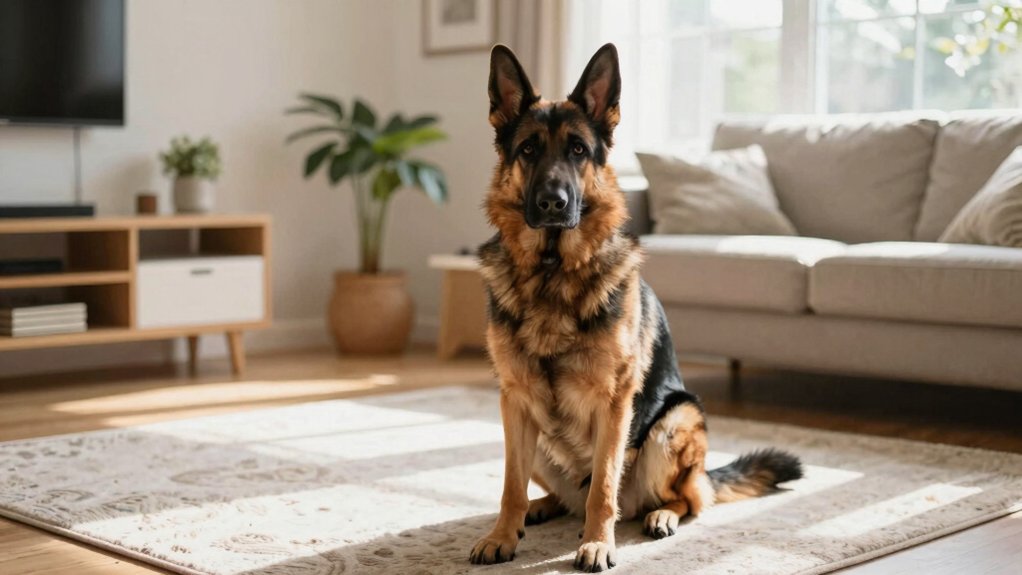
Start in a calm home space, and keep your first stays short, like 1–2 seconds, right at your dog’s side. A consistent daily routine helps your puppy settle and focus during these sessions. You’ll keep the session easy—5 to 10 reps—then reward after the stillness is there, before you ever add distractions. Add the cue word “stay” only once your dog can reliably hold position for about 5 seconds while you stand next to them. But once your German Shepherd can hold a 30–60 second stay indoors, you can gradually introduce small, controlled distractions at home, one at a time.
Start With Short Stay
Before you add distractions, you’ll get the best results by building a short stay right at home—where nothing pulls your German Shepherd’s focus away from you.
First, confirm your sit or down works every time. Then pick a quiet indoor space, use a leash or house line, and keep sessions to 3–5 minutes.
Ask for sit or lie down, say “Stay,” and lift an open palm stop-sign.
Stay close. Step only one pace away. Hold 1–2 seconds, reward while your dog stays still. Return calmly, reset, and repeat.
Increase seconds gradually. Set a clear release like “Okay.”
Add Distractions Gradually At Home
Once your German Shepherd can hold a sit or down in a quiet room, you’re ready to add distractions step by step.
First, prove stays with you standing close, for at least 30 seconds, in a calm living room.
Then change one variable at a time.
Start with mild, controlled cues, like hand claps, bending down, or small body movements beside your dog.
Next, add sound—cough once, knock lightly, drop an object—then reward fast.
Use waves or a slow, single jump-jack for visuals.
If they break, you reduce intensity right away.
Later, increase distance, duration, and distractions together—“3 Ds.”
Train German Shepherd Recall Using Distance Steps
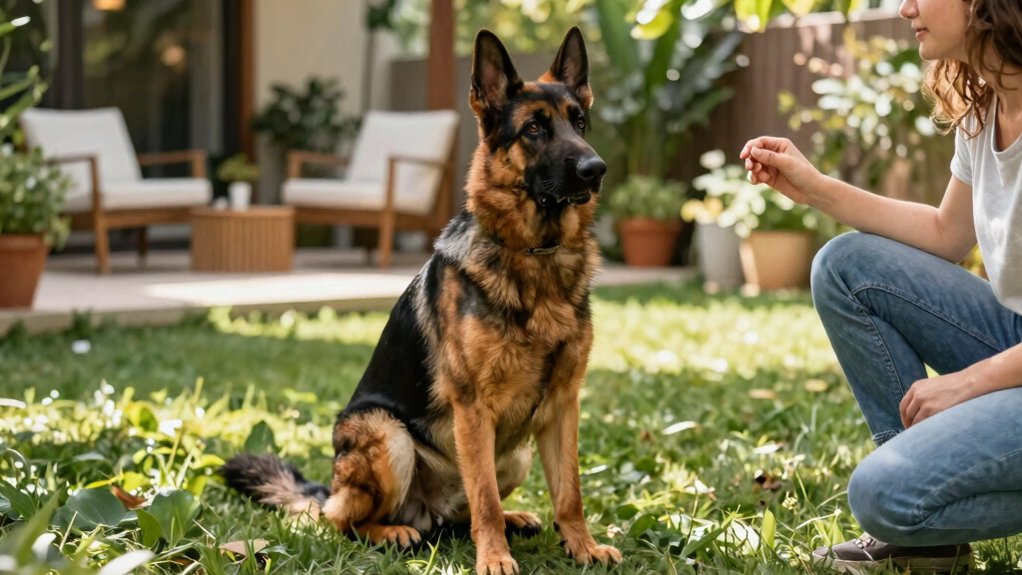
Start in a quiet enclosed area, like a garden or courtyard, at about 5–10 m, and keep the recall cue and high-value reward pattern the same as your indoor work—reward right when your dog reaches you.
But don’t jump distances fast; use clear distance steps, add a little at a time, and if recall fails twice in a row at the new distance or distraction, drop back one stage for about a week.
When it’s reliable in the enclosure, move it to a longer line for 15–30 ft builds, so you can guide safely while your German Shepherd learns that coming back from far away always pays.
If your dog also enjoys water, practice recall near a pond or pool only after they are comfortable with gradual water introduction, since German Shepherds can swim but still need supervision to stay safe.
Build Recall In Enclosures
After you’ve set up a safe, quiet fenced yard and you’ve checked there are no escape routes, you’re ready to build recall in small distance steps.
Choose the smallest space you can, with non-slippery footing and few distractions.
Check gates and gaps before every session.
Use management tools.
Attach a 10–15 m long line to a well-fitted harness.
You call once, with a clear recall cue, and back it up.
Reward fast, every time, for several weeks.
Offer 3–10 tiny pieces, then release back to fun.
Do about five reps daily.
If you get two misses, step back for days.
Increase Distance With Steps
Now you’ve got reliable recall close up, so you’ll grow it by adding distance in tiny, controlled steps.
Start indoors or in a quiet garden, about 2–3 m away. Use one cue, like “come,” and reward every single success.
Repeat 3–5 recalls per session, and do 3–4 sessions per day, for several weeks. Many programs begin at 8–10 ft, then only increase when your dog hits near-perfect.
Next, add just a few feet session by session, first 5–10 m, then 30–50 ft with mild distractions.
Use a 20–30 ft long line for safe distance.
Create Loose-Leash Walks With Turn Practice
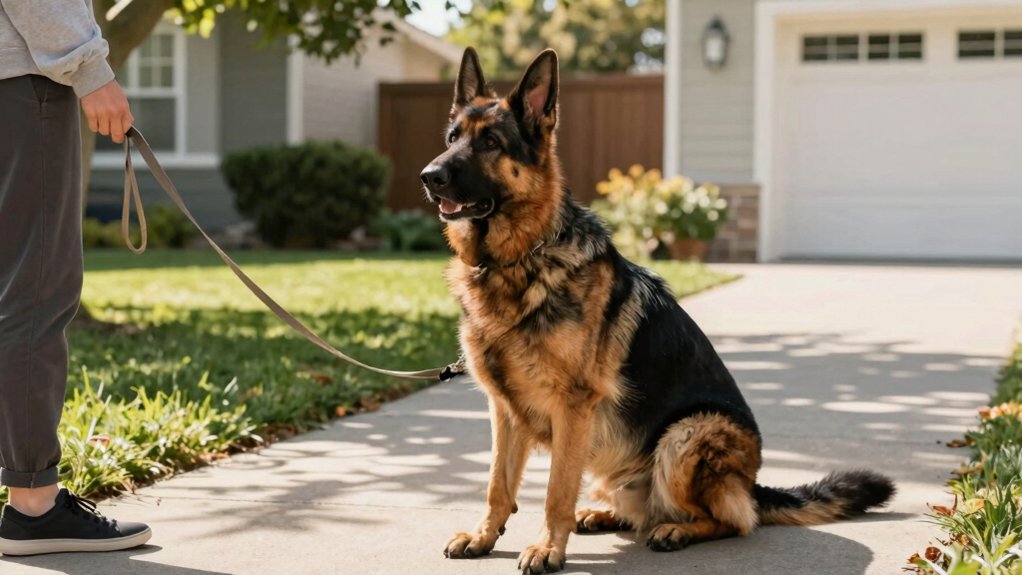
To build loose-leash walks with turn practice, begin in a low-distraction spot—an indoor room, a quiet hallway, or a fenced yard—so your German Shepherd can focus without seeing big triggers.
Use about a 12-foot line in safe space, then walk straight 10–15 feet.
The moment leash tension starts, cue your turn, like “This way,” “Let’s go,” then do an easy 90–180° U-turn by reversing direction.
Keep the dog on the outside, move fast into the new path, and mark the moment they return with “good” plus high-value treats.
Repeat short “pull = turn” drills daily. A dog that is calm after a gentle bath and brush routine often focuses better during leash work.
Master Heeling With Stops, Turns, Pace Changes
When you heel on a loose leash, teach the stop cue first, then make your turns clean, and time everything so your German Shepherd nails position.
Start with 2–5 step heel bursts, say “Stop,” wait for the moment they settle at your left, then reward within 1 second and keep the leash slack before you move again. A no-pull dog harness can help you maintain this slack leash while your dog learns position.
Next, add pace commands—”Slow,” “Fast,” and back to normal on cue—so your dog matches your speed, stays lined up through 90-degree turns and about turns, and keeps focus through each change.
Heeling With Stop Cues
Build your stop cue into heeling from day one, because it’s the difference between “good walking” and true obedience work.
Start with your dog in heel position, usually left.
Before you move, ask for a sit, then begin with a short heel segment, 5–10 steps.
When you stop, say your clear halt/stop cue, then ask sit, mark, and reward.
Soon, fade the sit word, keep the timing, and reinforce a fast, automatic sit.
Practice at normal pace first, then add slow and fast, including turnabouts.
Use a release cue like “off” or “free,” so your dog relaxes.
Turns On Loose Leash
Turns can take your loose-leash heeling from “pretty good” to truly dependable.
Practice left, right, about, U-turns, 270s, and 360s, using shoulder alignment at your left leg. Set up with a glance over your right shoulder, then shift your shoulder and hip toward the turn. Use smooth, counterclockwise left pivots.
Make about-turns with a “T” foot pattern, right foot angled, then heel-to-heel, then step out on the new line.
For right about turns, do step-turn-step. Change direction immediately to stop pulling, use a marker, then reward as your dog re-heels beside you.
Pace Changes At Commands
Once your dog holds reliable heel position, you can start teaching pace changes right from the command. Keep the right shoulder even with your left knee, on a loose leash. Begin with the dog already sitting at your left side, then lure near your left hip to maintain focus and parallel alignment.
Next, use clear slow, normal, and fast cues. Train gradual shifts first, like five steps slow, five steps fast, then return to normal between. Avoid abrupt speed jumps; they make creeping, forging, or lagging likely.
When you halt, say the stop, then reward the automatic sit, whether you just walked slow or briskly ran. In trials, vary the order.
Practice Polite Social Manners in Crowds
When you practice polite social manners in crowds with your German Shepherd, you’re setting them up to stay calm, safe, and focused around busy people. Start early, before 14–16 weeks, with short, structured trips to parks, school playgrounds, and shopping centers.
Keep the first visits low-intensity, repeat neutral calm, and rotate sounds and surfaces so they stay flexible.
Build public-proof obedience: sit, stay, come, down, heel, then practice in parks, stores, and transit stations.
Use a short, non-retractable leash, keep loose-leash walking near tables, and wait in lines without blocking.
Teach sit-and-wait greetings, ask permission first, and respect space.
If you plan outings during dusk or evening hours, a reflective dog harness helps keep your German Shepherd visible to crowds, cyclists, and drivers in low-light conditions.
Handle Grooming and Exams Without Fuss
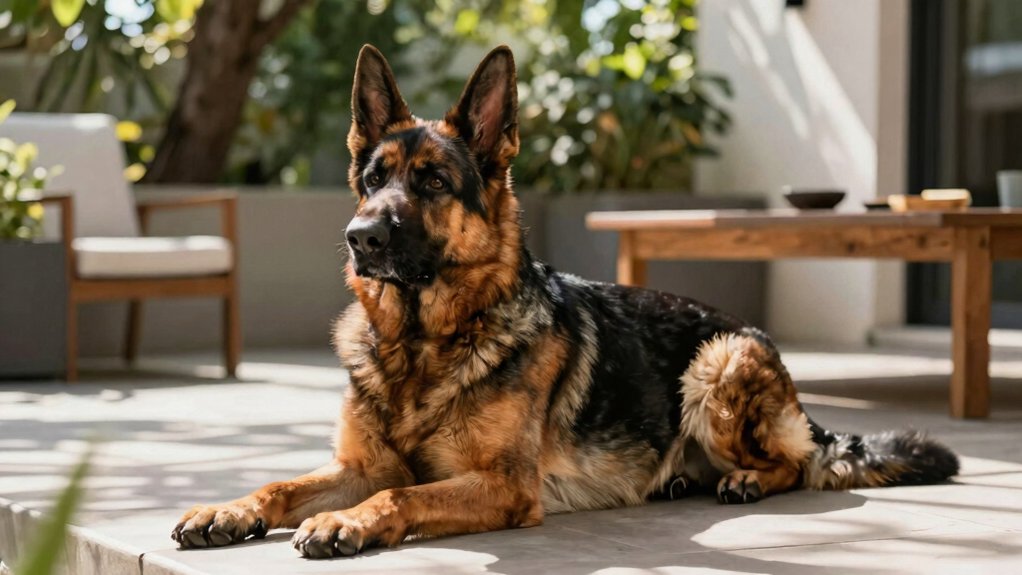
First, set your German Shepherd up for grooming and vet care the same way you set them up for manners in crowds—by making it feel safe and predictable. Because working-line German Shepherds often have higher drive and intensity than West German Showline dogs, they may need shorter sessions and extra patience during handling.
Use a reward-based, cooperative-care routine, so your dog chooses to help.
Set a mat station, and let them start and pause procedures.
Practice at home daily, for 30–60 seconds, touching ears, paws, face, belly, and tail, then reward.
Introduce tools slowly, so brush, comb, and clippers appear, get closer, and touch without doing anything first.
For nails, lift one foot, rotate, then trim only the tip.
Do short mock exams: ears, mouth, legs, belly.
Use “Watch Me” to Boost German Shepherd Focus
“Watch me” is your German Shepherd’s attention on-ramp, and it pays off fast. You teach this cue to switch focus from the world to you, by triggering direct eye contact. You also use it as a reset when other dogs, people, or traffic steal attention. For a high-drive GSD, this builds reliable obedience and sport skills. Because PSI estimates for a German Shepherd’s bite strength are often used to compare it with other breeds, keeping the dog’s attention on you is a practical way to maintain control in high-pressure moments.
Start indoors, low distractions, for 2-3 minutes. Lure with a treat near the nose, then raise it between your eyes. Mark “yes” or a click the instant your gaze locks on. Add “Watch me” only after hand signals work.
Then increase time, up to 3-5 seconds, and slowly add mild distractions.
Teach “Leave It” to Prevent Snatching and Chasing
Once your German Shepherd can lock onto you with “Watch me,” you can put that same focus to work for self-control with “Leave it.” This cue helps your dog stop themselves from grabbing food, snatching toys, or lunging at tempting targets, even when their brain yells, “Go!”
You’ll train it with a simple rule: you show a low-value treat, you say “Leave it” once, and you wait until your dog backs off—then you reward them from your other hand with something better.
Repeat closed-fist reps 10+ times. Cover bait so it never self-rewards.
Progress from hand-level to floor-level, calm tone only. Then add slow-moving targets.
Add Delayed Rewards to Cut Barking and Lunging
After your German Shepherd stops barking or lunging, you can teach them that calm pays, fast and then a little slower, by adding a delayed reward (a treat you deliver a few seconds after the right behavior).
First, praise right away, then wait 2 seconds, then 5, 10, and up to 20 as they get reliable.
Reward complete silence and a relaxed body, not lingering tension.
If they bark, you ignore vocalizing and only pay when the noise fully stops.
Use timing control, so barking never “earns” food, attention, or access.
Avoid jerks or punishment.
Practice CGC Obedience in Public and Track Progress
Start with the CGC Public Obedience basics, because they’ll teach your German Shepherd how to stay calm and controlled in real-life distractions.
Practice on leash, and keep leash handling steady.
Focus on sit, down, and stay, since stationary control matters in crowds.
Then train loose-leash crowd walking, pass three pedestrians close, no leash strain, no jumping.
Add the dog–dog greeting: approach from about 20 feet, stop for your handshake, then move on calmly.
Work distraction drills too, like a dropped chair, aim for mild curiosity, not panic.
Track progress with a 10-item checklist, record pass/fail on each skill.
Frequently Asked Questions
When Should I Start Cgc-Style Obedience Training for My German Shepherd?
Start CGC-style obedience after your puppy completes core vaccines, usually around 3–4 months. Build foundations from 8 weeks, then join formal CGC prep classes around 6–8 months, intensifying through adolescence for best readiness.
How Long Should Sit, Down, and Stay Practice Sessions Be Daily?
Practice sit, down, and stay in short bursts daily: keep each mini-session to about 3–4 minutes (puppies 1–3). Aim for 15–30 minutes total, split into 3–6 sessions. Stop before attention fades.
What Reward Schedule Works Best for Recall in Progressively Harder Environments?
Like a staircase—start with continuous high-value rewards on every recall in quiet spots, then shift to variable ratio (VR-2 to VR-5) as you reach 10–15 straight successes, using jackpots to keep reliability rising.
How Do I Teach Loose-Leash Turns Without Reinforcing Pulling?
Teach loose-leash turns by waiting for slack, cueing the turn early, then stopping instantly if the leash tightens (“be a tree”). U-turn the moment tension appears, mark slack-heel alignment, and reward at your leg. Practice in low distractions.
How Can I Track CGC Progress and Fix Struggling Commands Quickly?
Track CGC progress with checklists, score sheets, and session logs; rate each skill after practice. Spot weak items fast, isolate their foundations, adjust difficulty and distractions, and reshape reinforcement patterns. Then run focused troubleshooting drills until you earn consistent scores.