PSI is pressure at the teeth, not total bite force. For German Shepherds, credible tests usually land around ~220–300+ PSI, with big variation by bite type, tooth position, and angle. That famous 238 PSI number keeps popping up because one measured value got relabeled without the bite-area details. So don’t trust “700+ PSI” claims. Higher pressure can mean worse injury, but temperament and bite inhibition matter just as much—keep going, you’ll see the practical comparisons.
Swift Summary
- PSI is localized tooth-contact pressure (force ÷ contact area), not total bite force.
- Many “German Shepherd PSI” lists repeat a single number (~238 PSI), often from limited or relabeled sensor tests.
- Reported values vary by method and setup; some studies show working GSD median functional bite force around hundreds of newtons.
- Comparing using force (N) is clearer than PSI; PSI needs assumed contact area to convert from measured force.
- Bite pressure peaks change with where teeth land, tooth type (canines vs carnassials), and bite angle, so single PSI figures mislead.
What PSI Means for Dog Bite Strength?
Use what’s german shepherd psi and a german shepherd bite force test to understand the numbers, because bite charts can mix up PSI and force.
In a german shepherd bite force comparison, focus on localized pressure, since higher PSI often links to more crushing at tooth tips.
Also consider where do german shepherds rank in bite force, but interpret any “PSI” using the test method. Owners should also know that German Shepherds are prone to hip dysplasia, a joint condition that can cause limping, stiffness, and reluctance to climb stairs.
German Shepherd Bite Force PSI: The Real Range?
Ever wonder what “German Shepherd bite force PSI” really looks like in the real world?
Most charts put it near 220–291 PSI, with many lists using a single, convenient 238 PSI.
But you shouldn’t treat that as a fixed number.
Some resources stretch the range to about 250–350 PSI for strong individuals.
Some sources suggest strong German Shepherds can reach roughly 250–350 PSI, depending on individual power and training.
In studies, trained working German Shepherds show median functional force around 360.4 N, and measured ranges vary a lot.
Bite force figures can also differ because the measurement method and conditions aren’t the same across sources.
Bigger, fully mature dogs, plus police or sport training, can realize more bite power. Because German Shepherds are intelligent and have a strong work drive, they respond well to the consistent conditioning that police and sport programs use to build bite strength.
Equipment and bite context also change results.
Why the “238 PSI” Figure Keeps Showing Up?
You keep seeing “238” because one famous TV bite test got repeated so often that it started to look like a solid, breed-wide fact. Bite force is hard to measure accurately; Dr. Brady Barr measured bite force in pounds-force during a pressure-sensor sleeve test, then the number got re-labeled as “238 PSI” (pressure = force per area) without the needed bite-area data. Next, listicles and kennel sites copied the figure, often without sources, so the same claim echoed through blogs, forums, and infographics. Accurate sourcing matters in breed health content as much as in strength claims, since errors about bloat in German Shepherds can delay urgent care. If you want to serve others well, pause, check units, and ask, “Where did the data come from?”
German Shepherd PSI vs Human Bite Force?
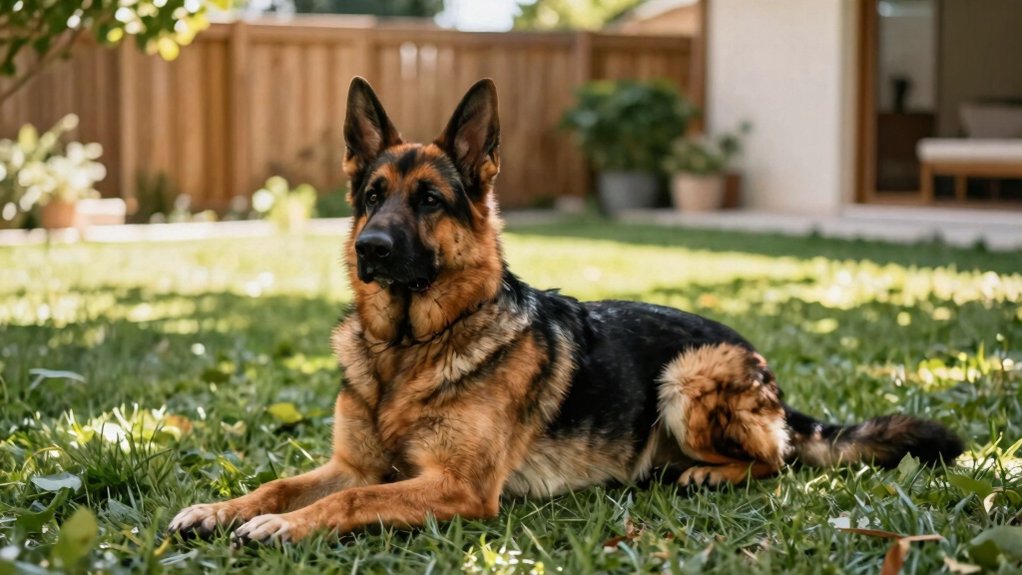
So, how do German Shepherd PSI numbers really stack up against human bite force—and what should you compare, exactly? You should compare molar-to-molar, meaning the back teeth, where humans reach about 120–160 PSI.
German Shepherds often land near 220–238 PSI, with some guides estimating up to ~291 PSI. That’s roughly twice the force in PSI, and it matches Newton tests too: dogs around 740–1,000 N versus human molars about 350–500 N.
But remember, strong human biters can hit ~200–250 PSI, so context matters. For safety, treat a dog’s max clamping as higher risk. Because a large dog’s clamping force can cause serious injury, installing outdoor dog gates to control access to yards and patios is a practical way to reduce close contact between dogs and people.
How German Shepherd PSI Compares to Other Dogs?
If you compare German Shepherd bite force to the common dog range, you’ll often see about 220–291 PSI, which puts you modestly above many average dogs that land near 200–250 PSI.
When you line it up with other working breeds, it usually sits around ~238 PSI, slightly above many Pit Bull–type figures (~230–235 PSI), and close to Doberman charts (~245 PSI), but it often trails the heavy hitters like Rottweilers (~320+ PSI).
But here’s the fun overlap, since it falls in that broad 230–300 PSI band with other strong large dogs, meaning you’ll see plenty of charts where German Shepherd strength looks “strong, not extreme.” Bite force is only one piece of the picture, since canine behavior and training play a larger role in whether a German Shepherd actually bites.
Compared With Common Canine Range
German Shepherds often land near 238–250 PSI, and that puts their bite-force above the common dog range of about 150–200 PSI**** most studies report for typical, non-max conditions.
Now, you should treat those numbers as estimates, not guarantees, because jaw leverage and muscle mass change results, bite angle changes results, and tests vary.
Compared with many pets, you’ll usually see German Shepherds higher.
Labs often land around 200–230 PSI.
Goldens near 190–210.
Huskies may match 230–250.
Medium breeds like Border Collies often sit closer to 150–200.
Keep focusing on behavior, training, and safe handling.
Relative To Other Working Breeds
Looking at German Shepherd bite force next to other working breeds helps you make sense of where “strong” really lands in PSI terms. You’ll often see German Shepherds around 238 PSI, sometimes reported higher, roughly 220–305 PSI.
In most charts, Rottweilers lead—about 328 PSI, up to 350—so their bite pressure usually beats yours by about 15–40%.
Belgian Malinois tend to land lower, near 195 PSI, sometimes 195–250, so you generally outrank them.
Dobermans often match your tier too, about 228–245 PSI.
Overlap With Similar-Size Dogs
Even though a German Shepherd’s bite force is often cited around 220–291 PSI (with ~238 PSI showing up a lot), you’ll notice the real story is overlap.
You’re looking at a range, not a single number.
Compared with many similar-size dogs, you’ll often find ties: Pit Bulls often land near 235–250 PSI, so some dogs match your German Shepherd’s lower-to-mid force.
Dobermans usually sit around 228–245 PSI, very close to 238 PSI.
But Belgian Malinois often reports lower, about 195–250 PSI.
And remember, averages can vary by individual.
Where German Shepherds Land vs Rottweilers and Pit Bulls?
Ever wonder where German Shepherds really land when you line them up against Rottweilers and pit bulls by bite force? Here’s the practical picture. German Shepherd estimates cluster around 220–291 PSI, often near 238.
Rottweilers typically sit higher, around 320–328 PSI, sometimes up near ~350.
Pit bulls usually land close to the Shepherd, about 235–242 PSI.
Beyond raw numbers, German Shepherds are valued for their high intelligence and reliable guarding ability, traits that shape how they train and behave compared to Dobermans.
Convert N to PSI: What the Numbers Really Mean?

When you see German Shepherd bite force numbers written in newtons (N) next to pressure shown in psi, you’re really looking at two different ways to describe impact.
N measures total force.
PSI (pounds per square inch) measures how much force lands on each square inch.
Pressure equals force ÷ area, so you can’t convert N to psi without an assumed contact area.
Use psi = N ÷ 4.448 ÷ area(in²).
For example, 8900 N over ~4 in² gives about 500 psi.
So if areas differ, the psi values will differ too.
Always check the contact area.
Understanding bite force matters most when a German Shepherd shows sudden aggression toward its owner, because even a single bite at high pressure can cause serious injury.
How Tooth Placement Changes German Shepherd PSI?
When you measure a German Shepherd’s bite force, tooth placement can swing the PSI a lot, because pressure (PSI = force ÷ area) depends on both where the teeth touch and how the jaw lines up.
But bite a canines versus a carnassial (the blade-like back grinding tooth), and the contact area and “grab vs grind” shape change, so you often see higher peak PSI at the back.
And if you shift the bite angle even a little—think slightly more toward the molars—you change the contact pattern and lever action, so the same dog can show very different PSI at 0.5–1 cm farther back along the tooth row. Teaching a reliable “release” command is one of the essential obedience commands that helps owners keep a German Shepherd’s bite under control during tug and play sessions.
Canine Versus Carnassial Pressure
You should think about bite force like leverage and “contact point” together, because tooth placement changes how much pressure (force spread over an area) you get in German Shepherds.
When you bite near the carnassial teeth (the M1 “scissor” tooth), the jaw has a shorter lever arm to the joint, so the same muscle effort creates higher peak loads.
Studies show canine teeth often land around 147–926 N, while carnassials jump to 574–3,417 N.
That means localized pressure spikes on the back teeth, helping you understand why protective bites feel so intense.
Tooth Row Contact Effects
Tooth placement changes how your German Shepherd’s bite force shows up, because the jaw doesn’t “press” at one fixed spot.
When your dog bites at the front teeth, you’ll see far less PSI than when the bite lands on the rear teeth.
In one test, the front jaw hit about 170 lb, while the rear jaw reached about 568 lb—over 3×.
That’s because back teeth sit nearer the temporomandibular joint, which boosts mechanical advantage.
Also, more occlusal contacts (touch points) raise peak output, especially in the premolar–molar region.
Bite Angle Changes PSI
Bite angle and tooth placement don’t just change where the force lands, they also change how hard the jaw “aims” at that moment.
When you keep the gape angle low, meaning the mouth is more closed, German Shepherds generate higher PSI, especially with posterior teeth. Wide-open, early grasp bites often show lower canine-only numbers.
Next, notice contact angle: if the tooth meets prey closer to perpendicular, the load turns into strong compression, raising effective PSI. But if the contact is slanted, more shear (side stress) spreads load, and peak pressure can drop.
Sleeve vs Sensor vs Objects: How Tests Differ?
When you compare German Shepherd bite force numbers, you can’t just line them up like they’re all measuring the same thing.
A sleeve test uses an attack sleeve with embedded compression sensors, so you’re tracking real gripping contact. Helpers fit sensors, then long-distance approach (like 25 m) helps standardize engagement.
Standalone sensors, like strain-gauge rods, capture tooth contact during chewing, often from ~13 to 1,394 N, with mean near 256 N.
Instrumented objects—rubber tubes, bones, or toys—measure peak PSI during play or repeated mastication, not a single clamp. Handlers should also watch for a dog experiencing seasonal coat blowing, since loose fur can catch on sensor wiring and sleeve fittings and affect the setup.
How Bite Motivation, Angle, and Target Affect PSI?

Just knowing a German Shepherd’s bite-force “number” doesn’t tell you what PSI (pounds per square inch—pressure) you’ll actually see in a test.
You have to look at motivation, angle, and the target.
First, motivation changes intensity.
A high-arousal, committed bite lets jaw muscles stay locked longer, so you measure higher PSI.
Stress and perceived threat, plus handler cues, can push PSI up versus calm tests.
Next, angle matters.
A perpendicular, full-mouth grip concentrates force on a small spot, boosting PSI.
Oblique bites spread force.
Finally, targets matter.
Thin, soft, or small-compression targets let teeth sink in and raise local PSI.
How Age and Training Change German Shepherd Bite Strength?
As your German Shepherd ages, you’ll usually see bite strength rise fast at first, then level off as the skull and jaw muscles finish developing.
Early on, at 8 weeks–3 months, expect under 100 PSI.
From 3–6 months, teething lifts it to about 100–150 PSI.
Between 6–12 months, skulls fuse and muscles thicken, so bites often reach 150–200 PSI.
From 12–18 months, you’ll see around 200–250 PSI, nearing adult strength.
By 2–3+ years, many reach roughly 238–291+ PSI.
Training mainly improves control, not raw power, though good bite-work can modestly boost applied pressure. Like the Alaskan Shepherd, a German Shepherd’s overall strength depends heavily on exercise requirements, so regular activity during adolescence helps the jaw and neck muscles develop alongside the rest of the body.
What 220–300+ PSI Can Do in Real Attacks?
With 220–300+ PSI, you should expect more than a “scratchy” mark—your German Shepherd’s bite can puncture skin fast, then tear as the teeth pry and spread the wound.
That same pressure can raise bone injury risk, especially when the bite hits an arm, leg, joint, or close to a bone, because small contact points can create big internal damage.
After a bite, get medical help right away, because even if the skin opening looks small, the crushed and torn tissue underneath can still need cleaning, stitches, or X-rays to check for bone injury.
Skin Puncture And Tearing
Feel the impact first—at around 220–300+ psi, a German Shepherd’s bite can punch through your skin in a way that isn’t “just a scratch.”
Those tooth tips act like tiny punches, so even small surface holes can drive deep into the epidermis and dermis, while the surrounding tissue gets crushed and squeezed.
And that’s not all.
You often see multiple puncture tracts, plus tearing, with jagged, irregular edges.
Strong bites rip skin, creating flaps or even avulsion, where tissue partially detaches.
But since deep punctures trap bacteria, you should seek urgent care, especially if bleeding won’t stop.
Bone Injury Risk Levels
A German Shepherd bite in the 220–300+ PSI range can cause real bone damage fast, and it mostly depends on *where* the teeth land and *how your bones are sized and cushioned*.
In real attacks, that force often breaks smaller bones, like fingers, or splinters facial bones around the nose and cheek.
If a bite hits the head or neck in a child, higher fracture risk shows up sooner, because skull bones are thinner.
A forearm usually needs far more than 220–300 PSI for a clean break, but you can still get localized fractures and joint damage, especially with repeated pressure.
Do German Shepherds Ever Hit 700+ PSI?
Let’s tackle the big claim first: German Shepherds don’t have a verified 700+ PSI bite. If you’re trying to inform, and not spread myths, you’ll want solid numbers.
Most data put typical German Shepherd bite force around 238–300 PSI, which is pressure measured in pounds per square inch. Some charts stretch to ~250–350 PSI, but still well below 700.
You’ll also see a police-dog study report 360.4 Newtons, not PSI, during sleeve bites—motivated, not a true max.
The 700+ PSI talk comes from unit mistakes and sketchy extrapolations.
How Temperament and Bite Inhibition Change Risk?
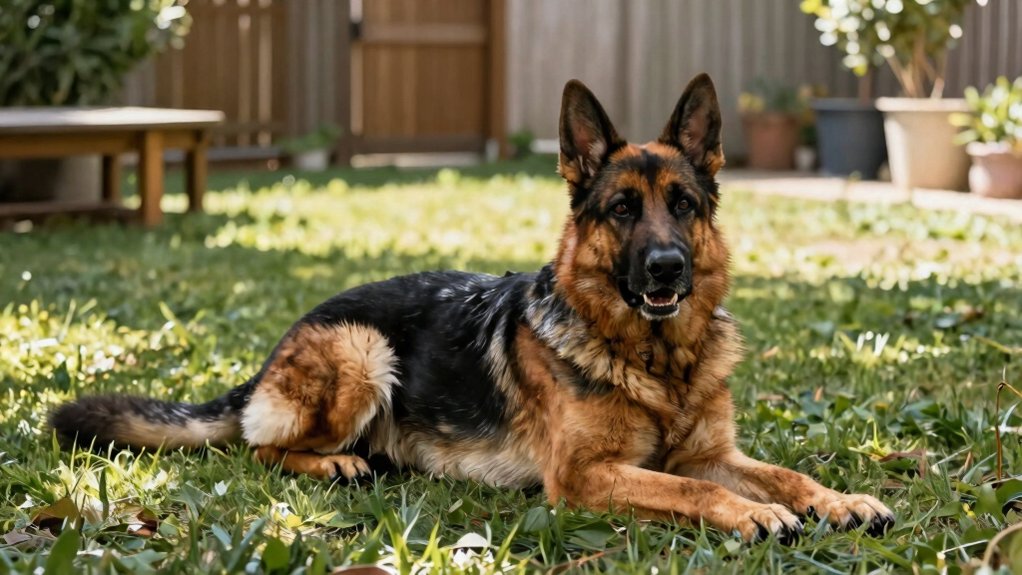
Temperament and bite inhibition usually matter more for real-world bite risk than any single PSI number, and you can use that to judge a German Shepherd’s danger level more accurately.
Temperament and bite inhibition matter more than any single PSI number for assessing real-world bite risk in German Shepherds.
If your dog is confident, controllable, and naturally aloof, they’re less likely to bite without cause.
Sound temperament comes from good genetics and breeding.
But anxiety, shyness, or fear, especially after poor socialization, raises fear-bite risk.
When protective drive teams up with an unstable, anxious mind, your dog may react too strongly to threats.
Also, bite inhibition—gentle control learned in puppyhood—predicts outcomes.
With strong early bite inhibition, severe injury risk drops dramatically.
German Shepherd Bite PSI Takeaways You Can Use Responsibly?
When you see a German Shepherd bite-force number in PSI, treat it as an estimate, not a exact measurement.
Use the whole 220–300 PSI range, because different studies and tools (like instrumented sleeves) can shift results, and repeating one “magic” figure can mislead you.
But keep it responsible—pick gear and training materials rated for strong jaw pressure, and supervise every session like the dog could bite at any moment.
Understand PSI As Estimates
PSI is the pressure unit people use to talk about bite strength, but you should treat it like an estimate, not a guaranteed “number you can bank on.”
PSI means pounds of force per square inch—so if a study reports bite force in newtons, researchers have to convert it, and they also have to guess the contact area of the bite.
Studies also mix real sensor readings with theory from CT jaw models, plus different sleeve designs, bite spots, and setups.
And individual dogs vary by maturity, muscle, jaw shape, and body size.
Use Range, Not Exact Numbers
So you’ll see German Shepherd “bite PSI” claims all over the place, and you shouldn’t treat any one number like a promise.
You’ll help people most by using ranges.
Many sources place German Shepherds roughly around 175–238 PSI, while others estimate wider bands like 220–300 PSI, or even higher for specific scenarios.
Why?
Bite force changes with body weight, skull shape, tooth size, and age, plus testing context like fear, play, or protection work.
Even Newtons-to-PSI math depends on contact area, angle, and tooth position, so a “precise” figure often can’t be truly exact.
Use ranges, and stay responsible.
Frequently Asked Questions
How Is PSI Measured on a Dog During a Real Bite Test?
You strap calibrated force sensors into a bite sleeve, like a knight’s shield, then let an awake dog chomp a standardized rod or block. Sensors log peak force/pressure, software converts using the known contact area to PSI.
What’s the Difference Between Peak PSI and Average PSI?
Peak PSI captures the single highest pressure spike during one bite. Average PSI averages many readings over time or multiple bites, smoothing brief spikes. You should trust average for typical biting performance, and peak for maximum capability.
Can Two German Shepherds With Similar Size Have Different Bite PSI?
Yes—two similar-sized German Shepherds can bite very differently. Like fingerprints, skull shape and jaw leverage vary, and training, muscle conditioning, health, and motivation shift PSI. You should judge each dog’s bite history, not size alone.
Do Front Teeth or Molars Contribute Most to Overall Bite PSI?
You’ll see molars contribute most to overall bite PSI because they sit closer to the jaw joint, giving more mechanical advantage. Their muscles apply force efficiently over shorter lever distance. Incisors mainly provide grip and precision, not peak pressure.
Are There Reliable Studies Measuring German Shepherd PSI Directly?
No—you won’t find reliable studies that directly report German Shepherd bite force in PSI. Researchers usually measure in newtons on transducers, then estimates to PSI involve assumptions. That uncertainty can mislead you serving safety.