If your German Shepherd has bloat or GDV, treat it like an emergency. Go to the ER now if you see nonstop pacing, can’t get comfortable, and especially non-productive retching (dry heaves with little vomit). Watch for a tight, drum-like, hard belly, heavy drooling, and trouble swallowing. These can worsen fast after meals, sometimes within minutes to hours. Feed smaller meals (2–4 a day), use slow feeders, and keep calm for 1–2 hours around food. For prevention and what recovery monitoring looks like, keep going.
Swift Summary
- Know GDV warning signs: sudden restlessness, failed attempts to lie down, dry retching, and a tight, drum-like belly.
- Treat any suspected GDV as an ER emergency—twisting can cut blood flow within minutes and become fatal quickly.
- Red flags after meals include heavy drooling, panting, pacing, and distress with pale gums or weakness.
- Prevent bloat by using smaller, slower meals, avoiding vigorous exercise around feeding, and using anti-gulp strategies if needed.
- Ask your vet about gastropexy for high-risk dogs, since early surgical fixation can greatly reduce future GDV risk.
Spot German Shepherd Bloat Signs: Go to the ER Now
Spot bloat signs early, and you should go to the ER now—don’t wait and “see if it passes.” With German Shepherds, gastric dilatation-volvulus (GDV) can start fast, and once it does, minutes matter. Because GDV involves a twisted, distended stomach that can rapidly cut off blood flow, it is life-threatening within a short time frame. When you check, ask where’s german shepherd stomach, feel for a tight, drum-like abdomen, and notice swelling that grows within minutes to hours. How do german shepherds get bloat? Gas twists the stomach. How to tell if german shepherd has bloat: restlessness, praying posture, drooling, panting, pale gums, weak pulse, or collapse. Call emergency immediately if stomach problems with german shepherds look painful. German Shepherds are also prone to hip dysplasia, a malformed hip joint that causes pain and lameness, but it is a separate condition from bloat.
The First German Shepherd Clue: Non-Productive Retching
Non-productive retching is one of the first “uh-oh” clues you might see, and it deserves instant attention.
Non-productive retching can be an urgent warning—don’t wait. It may signal serious gastrointestinal distress that needs immediate vet attention.
You’ll notice repeated dry heaves, dry gagging motions, and little or no vomit coming out.
Your German Shepherd may drool a lot, pace, whine, or seem unable to get comfortable. Among the common health issues in German Shepherds, bloat is one of the most urgent, so owners should learn these signs early.
In bloat (GDV), a gas-filled stomach can block normal emptying, so your dog can’t expel anything.
The stomach may even twist, partially or fully blocking the esophagus or pylorus.
Episodes can start suddenly, often within minutes to hours after eating, and they may repeat every few minutes.
Without treatment, GDV is fatal, so this “first clue” should trigger an emergency veterinary visit immediately.
Go to ER now.
German Shepherd Bloat Look: A Tight Drum-Like Belly
When your German Shepherd’s belly looks tight and “drum-like,” take it seriously, because that tight, gas-filled swelling (gastric dilatation-volvulus, or GDV) is one of the clearest outward bloat signs. You’ll often see the upper abdomen behind the ribs round up first, and it feels hard, board-like, not soft. one of the clearest outward signs may also include unproductive retching and hypersalivation, which owners commonly report. Tap lightly and you may hear a hollow, drum sound. Your dog may guard the belly, look uncomfortable, and resist moving. Sometimes it grows fast, within minutes to hours. This can cause shock and breathing trouble, so go to an ER vet immediately. German Shepherds are also prone to hot spots, which are painful, moist skin infections often triggered by allergies, and they should not be confused with bloat.
German Shepherd Bloat Drooling and Swallowing Trouble
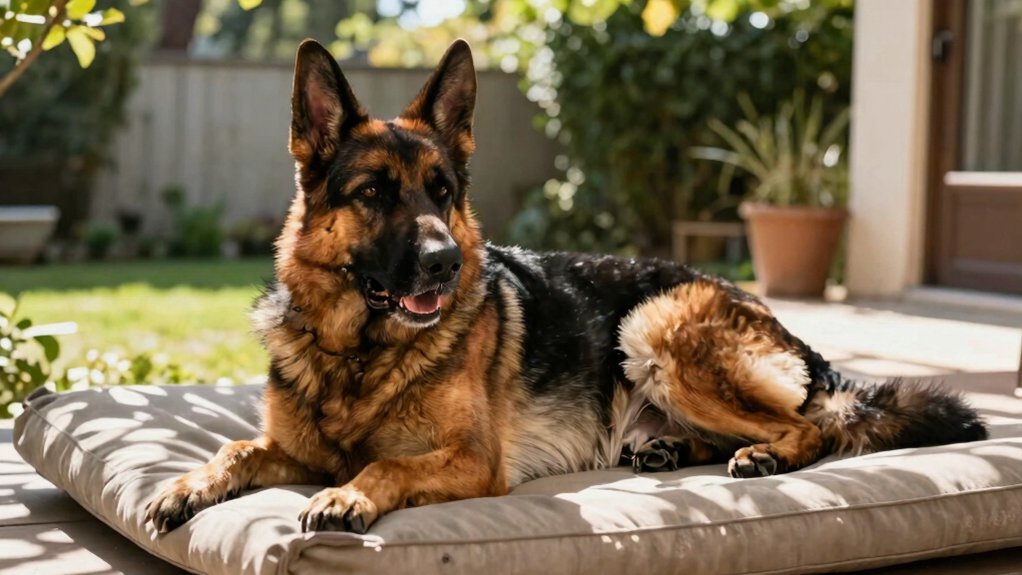
If you notice sudden, heavy drooling right after a meal, take it seriously—especially in German Shepherds with deep chests. Bloat can also cause loss of appetite, since the pain and pressure in the stomach often leave a dog unwilling to eat or drink.
And if you also see lip licking, repeated dry retching (heaving without bringing anything up), or your dog seems unable to swallow food or water, you’ve got a big red flag for bloat/possible GDV.
Don’t wait it out—call your vet or emergency clinic now, because every minute matters when the stomach twists and traps saliva.
Sudden Drooling And Salivation
Sudden heavy drooling and extra salivation can be your German Shepherd’s early “red alert,” because it often shows up before other obvious bloat signs—and in GDV (gastric dilatation-volvulus, a life-threatening twisted stomach), it can’t be ignored.
If you notice sudden, constant, sometimes foamy drool, don’t wait.
You should check for restlessness, pacing, pale or gray gums, and a swollen, tight belly.
Watch for unproductive retching, or bringing up only foamy saliva.
GDV can worsen in minutes to hours.
Go to an emergency vet now.
Your quick action can save their life.
Difficulty Swallowing Warning Signs
Ever notice your German Shepherd struggling to swallow, like food or water just won’t go down? That’s dysphagia, trouble moving food, and it can signal obstructive GDV.
When the stomach twists over 180°, it blocks the esophagus, so saliva, water, and food can’t pass.
You may see repeated swallowing, gagging, and “false swallowing,” with unproductive retching.
Watch for foamy or no output.
Try not to wait.
If you can’t pass a stomach tube through the esophagus, that’s a key indicator.
Also look for a rapidly bloated, painful belly and fast, shallow breathing—seek emergency help now.
German Shepherd Bloat Behavior: Pacing and Can’t Settle
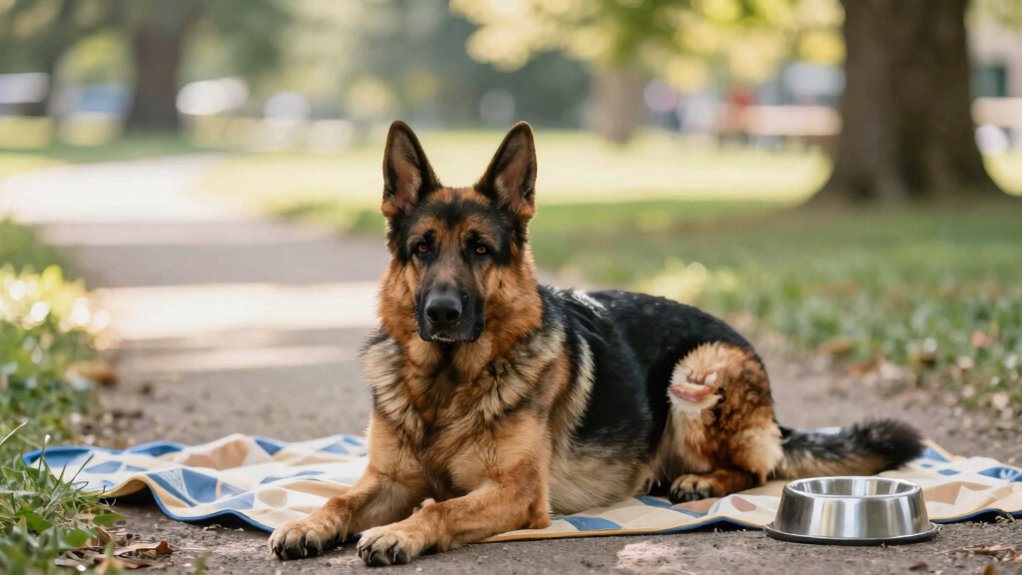
If your German Shepherd starts pacing nonstop, circling, and acting restless like they can’t find “one right spot,” take it seriously—bloat (GDV) can cause sudden, constant discomfort.
Watch for dry heaving or repeated retching with little to no vomit, and when they can’t lie down or settle after a brief attempt, that pattern usually doesn’t improve.
Since this can turn life-threatening fast, if it’s happening within a few hours of eating, call your vet or emergency clinic right away. Persistent excessive panting alongside restlessness can also indicate distress in a German Shepherd, so it should never be dismissed as a normal response to heat or exercise.
Persistent Pacing And Anxiety
When your German Shepherd can’t settle and just keeps pacing, take it seriously—because it can be an early warning sign of bloat (GDV, gastric dilatation-volvulus).
Suddenly, relentless restlessness often starts before any obvious belly swelling.
You may notice brief attempts to lie down, then the pup jumps up fast, due to sharp abdominal discomfort.
And you might see panting, whining, tense eyes, drooling, pale gums, or a hard, distended belly.
But don’t wait for “normal” excitement to pass.
If pacing comes with distension or tenderness, call your vet or emergency clinic now.
Dry Heaving Without Vomit
That tight, can’t-catch-your-breath feeling can show up as dry heaving—repeated retching that produces no vomit, or only a little foam or saliva.
If your German Shepherd does nonproductive retching, treat it as a bloat/GDV emergency.
GDV twists the stomach, distends it, and blocks normal flow, so your dog keeps trying to vomit, but can’t.
Watch for repeated episodes within hours, plus a tight, drum-like belly, drooling, and fast breathing.
Call your vet now, and head in immediately.
Don’t wait, don’t soothe, just act.
Can’t Lie Down Or Settle
Even before you see a bloated, drum-tight belly, you might notice your German Shepherd can’t lie down or settle—because the discomfort is too intense.
And that “can’t get comfortable” look matters.
You may see sudden, relentless pacing, across rooms, in short loops, or down the hallway.
You might also notice failed attempts to lie down.
They lower, shift, then pop back up fast, like nothing eases the pain.
They may whine or pant, lick a flank, or stand hunched, tensing the belly.
This is a go-now veterinary emergency for GDV.
German Shepherd Shock Signs: Pale Gums and Collapse
And if they collapse or can’t stand, that’s advanced shock, often with weak pulses, cold limbs, and dull responsiveness.
Because factors influencing canine behavior can mask pain and illness, a German Shepherd that suddenly seems withdrawn, restless, or unwilling to move should be checked by a vet right away rather than dismissed as a mood or temperament issue.
Start now: call emergency vet, keep them warm, prevent movement, don’t give food or water, and check breathing.
If no breathing, begin CPR immediately.
Why German Shepherd GDV Turns Fatal So Fast
Because the stomach twists and swells so suddenly, GDV in German Shepherds can turn deadly fast.
You must understand what happens in those first hours. Since German Shepherds are energetic dogs with a strong need for regular exercise, owners should avoid vigorous play or running right after meals.
The distended stomach blocks blood flow back to the heart, so your dog goes into obstructive shock.
Then venous blood “pools” in the gut, tissues don’t get oxygen, and organs start to die.
As blood pools in the gut, tissues starve for oxygen—organs can begin to fail, fast.
Within hours, ischemia (starved tissue) and necrosis (tissue death) can spread, and the gut barrier breaks.
Bacteria enter the bloodstream, triggering sepsis, and DIC, a clotting crisis.
Act fast—urgent vet care is lifesaving.
What Vets See on X-Rays in German Shepherd Bloat
When you look at an abdominal X-ray for German Shepherd bloat, you’re hunting for the “double bubble” stomach pattern and other signs that point to a twist, not just a stretched stomach. You’ll often see a gas-filled stomach taking over the cranial abdomen, plus an abnormal pylorus position, often craniodorsal and off to the left, and that twisted “double bubble” or “reverse C” setup is a big X-ray clue of volvulus.
If you notice compartmentalization (gas split into sections), or free abdominal gas and gas in the stomach wall, you treat it as urgent—especially if the right lateral view shows that suspicious twisted stomach right away. Because German Shepherds demand serious training and commitment from their owners, first-time owners should learn these warning signs before an emergency occurs.
Double Bubble Stomach Pattern
If you’re looking at a German Shepherd’s abdominal X-ray during a suspected bloat emergency, you’ll often see a “double bubble” pattern. You’ll notice gas-distended stomach compartments, split by a soft tissue band into two luminal regions, cranial/caudal or dorsal/ventral “bubbles.” The fundus and main body form the larger bubble, and the gas-filled pylorus forms the smaller one.
In gastric dilatation-volvulus, the pylorus shifts craniodorsally and becomes gas-filled. Vets often call this sign pathognomonic for torsion.
On a right lateral view, it’s usually enough, with severe stomach gas, sometimes esophagus air.
Twisted, Gas-Filled Stomach View
On your vet’s x-ray, a twisted, gas-filled stomach in German Shepherd bloat often looks like a big, oddly shaped “gas balloon” that takes up most of the cranial (front) abdomen.
You’ll see a markedly enlarged stomach shadow, with gas filling the lumen, and fluid or ingesta layering below.
The stomach wall margins stand out sharply against gas, on a right lateral view.
The shape shifts from a normal C-curve into an irregular, lobed form.
Organs get shoved back, so the liver and spleen seem less visible.
Sometimes free gas leaks.
And you may see gas split into compartments.
X-Ray Clues Of Volvulus
You’ll often spot GDV (gastric dilatation–volvulus, where the stomach twists) on x-rays by looking past the big gas “balloon” and straight at organ positions.
First, check malposition: the pylorus sits craniodorsal to the gastric body/fundus, gas-filled, and often left of midline on ventrodorsal views.
Next, look for compartmentalization, like a double-bubble or reverse “C,” with a soft-tissue band dividing the lumen.
Then confirm duodenal displacement into the craniodorsal quadrant, sometimes looped between liver and fundus.
And in severe, 360° cases, you may see a caudal esophageal twist sign and heavy caudal esophageal gas.
Emergency Stabilization Steps for German Shepherd GDV
As soon as you suspect German Shepherd GDV (also called bloat, a condition in which gas and fluid twist and trap inside the stomach), treat it like a true emergency and rush your dog to the nearest emergency vet without delay.
At triage, you’ll likely face tachycardia, poor perfusion, and shock.
Next, the team fights shock first, then helps breathe.
They place one or more 16–18 gauge IV catheters, usually in cephalic or jugular veins, and start lactated Ringer’s, about 60–90 mL/kg/hour.
Essential signs get checked every 15 minutes.
You also get oxygen, opioid pain relief, and bloodwork, plus early abdominal X-rays.
Then they decompress fast: an orogastric tube, and if needed trocarization. Once your dog is stabilized, understanding common causes of odor can help you keep their bedding and living space fresh during recovery.
What German Shepherd Surgery and Gastropexy Actually Do
After the emergency team stabilizes your German Shepherd from shock and breathing trouble, surgery takes center stage—because bloat isn’t just “a big stomach,” it’s a twisted, gas-filled emergency that can cut off blood flow fast.
And that’s why GDV surgery decompresses the stomach, corrects the volvulus (the twist), and helps circulation restart.
You also derotate the stomach back to normal, so oxygen can return to the wall, and you check tissue for necrosis (dead tissue).
If needed, you may partially remove damaged stomach or splenectomy. Because German Shepherds are prone to certain cancers, any removed spleen should be sent for pathology to screen for splenic tumors.
Then you do gastropexy, attaching the stomach to the right body wall with sutures, creating permanent scarring that prevents future twisting.
When to Choose Prophylactic Gastropexy for German Shepherds
When you’ve got a German Shepherd over about 5 years, deep-chested, or likely to hit adult weight around 45 kg (99 lb), you should ask your vet about prophylactic gastropexy, a stomach “tacking” procedure that helps prevent bloat from twisting.
If your dog has a first-degree relative (like a parent or sibling) with GDV, or you see high-risk traits tied to genetics and temperament, you shouldn’t wait for an emergency—family history and risk factors matter.
But the best timing is before your dog experiences their first GDV episode, often by scheduling it alongside elective surgery like spay or neuter when they’re already under anesthesia.
High-Risk Age And Size
If your German Shepherd is a big, deep-chested type, you should think about age and size together, not separately. GDV, stomach twisting, rises as dogs age, with about a 20–33% jump in risk each year in large and giant breeds.
In studies, most cases hit ages 5–10, and seniors 9–12 climb fast, about 20% each year.
Size matters too: dogs over 99 pounds face roughly 20% risk.
Deep-chested shapes, plus lean builds, can raise risk further.
If your dog fits, talk to your vet early.
Family History And Genetics
Once you’ve matched your German Shepherd’s risk to their age and body shape, look at the family side too, because bloat (GDV, stomach twisting) can run in bloodlines.
And GDV isn’t just luck—it’s a complex, partly inherited condition.
Large and giant deep-chested breeds, including yours, show much higher rates, about 4.1 times versus mixed dogs.
If any first-degree relative—parent, sibling, or offspring—had GDV, your dog’s risk rises too.
Studies show especially high risk when the dam or sire was affected.
Timing Before First GDV
Rather than waiting for trouble, you can plan prophylactic gastropexy at a sensible life-stage, because GDV risk climbs as deep-chested German Shepherds move into middle age.
Aim for early adulthood, often around skeletal maturity, and think about neutering timing for high-risk males.
Why? GDV hits most in middle-aged to older, especially deep-chested dogs, and lifetime risk stays high in large breeds.
If your male weighs over 40 kg, eats fast, or stays lean, consider the “only major prevention” option before peak years.
Also, if he’d stomach issues or abdominal surgery, don’t delay.
Choose calm, help prevention.
Reduce German Shepherd Bloat Risk With Meal Timing
When you manage meal timing, you help your German Shepherd’s stomach stay calm and less likely to over-stretch.
Aim for 2–3 smaller meals daily, not one big bowl.
Single, once-daily feedings raise bloat risk—twice as much in some data—because large volume distends the stomach.
Feed controlled portions, around 4 equal meals if your vet suggests, and avoid strenuous exercise for 1–2 hours after.
Also, keep excitement low.
Try not to feed right before walks.
Offer moderate water before meals, then prevent huge gulps right after, but don’t starve water.
Slow Down Eating in German Shepherds: Safe Bowls and Puzzles
After you set safer meal timing, you can tackle the next big bloat trigger: gulping.
Slow-feeder bowls and puzzle feeders help you slow your German Shepherd down, by forcing smaller bites, reducing swallowed air, and letting the stomach stretch more gently.
Choose a slow feeder with raised ridges or maze channels that fit your pup’s muzzle, and make sure the base is heavy and non-slip.
Good designs can cut eating speed by up to about ten times.
For extra help, use food puzzle toys that hide kibble, so your dog must “work” for each piece.
They’re not a cure, though.
Exercise Timing for German Shepherds to Prevent Bloat
To help prevent bloat, you should skip strenuous exercise about 1–2 hours before meals, because high-arousal running can increase stomach stretch and GDV risk (GDV is when the stomach twists).
After your dog eats, keep things calm for at least 1 hour—think slow leash walks, not sprints, jumping, or rough play—then gradually return to normal.
But the best move is consistency, so you set a steady exercise schedule, and you time your hardest workouts at least 1–2 hours away from big meals.
Avoid Strenuous Pre-Meal Exercise
You can cut your German Shepherd’s bloat risk right at the source by skipping strenuous exercise in the hour before meals. When your dog gets vigorous activity close to feeding, the stomach can fill, distend, and then twist, blocking both entrances—GDV, a medical emergency, can follow.
Stress and excitement add more strain, and fast breathing makes your dog swallow air. So in those 60 minutes, choose quiet, calm leash walks.
Avoid hard fetch, long runs, and intense training right before food. For higher-risk dogs, some plans use 60–90 minutes of rest. Coordinate routines so exercise ends well before meals.
Rest After Meals Period
Plan for a rest after meals, because that first post-meal window matters for your German Shepherd’s bloat risk.
For large, deep-chested German Shepherds, restrict vigorous exercise for at least one hour.
For higher-risk dogs, stretch it to about two hours before fetch, tug, agility, or rough park chasing.
And remember, bloat can start fast, in just 5–15 minutes, if your dog eats a big meal, then runs and jumps.
Instead, choose calm, casual walking only.
If your meals are large, use slow feeders or smaller portions, and keep feeding-time excitement low.
Follow Consistent Exercise Schedule
Keep a regular, moderate exercise schedule every day, because steady routines lower GDV (gastric dilatation-volvulus, “bloat”) risk in deep-chested breeds like German Shepherds.
You’ll help your dog by balancing outside time and calm indoor rest.
Daily gentle walking counts, it supports digestion and weight control, which both matter.
And avoid sudden jumps in exercise intensity or duration.
Build up slowly over weeks, no surprise long runs.
But timing matters most: skip vigorous workouts for 1–2 hours before and after main meals.
Schedule your hardest sessions mid-morning or late evening, too.
Finally, keep walks calm.
Cut rough play, car stress, and excitement around training.
Your routine protects both body and belly.
Body Condition for German Shepherd Bloat Prevention
Keeping your German Shepherd at a moderate body condition score (BCS—an overall “body fat + muscle” rating from about 1 to 9) helps reduce bloat and GDV risk before an emergency ever happens.
Aim for about 4–5/9, not too thin, not too round. Very low BCS can mean a lean, deep chest shape, and thin dogs often have higher GDV risk.
Extra weight also raises risk, even if your dog still “doesn’t look obese.” Since owners can misjudge BCS, ask your vet to assess it regularly.
Balanced muscle and weight support your dog.
Lower German Shepherd Bloat Risk With Stress Control
Stress can quietly elevate your German Shepherd’s bloat risk, so changing how you manage emotions and daily situations matters. If your dog seems fearful, agitated, or snaps at strangers, you should treat that anxiety as a health signal.
If your German Shepherd seems fearful, agitated, or snaps at strangers, treat that anxiety as a health signal for bloat risk.
In surveys and clinics, higher owner-rated anxiety links to more GDV, a dangerous twist.
Keep kennel, car, and hospital stays brief when you can. Avoid constant panting, high arousal, and rough transitions, since stress can drive aerophagia, swallowing air.
Offer calm, predictable routines, especially before meals.
After exercise, wait 60–90 minutes, then feed.
During change days, reduce excitement and separation fights.
Avoid Common German Shepherd Bloat Triggers (One Big Meal)
Instead of feeding your German Shepherd one big meal, try splitting the daily food into smaller meals.
Aim for 2–3 meals per day, and for puppies, 4 meals. This helps limit stomach distension, meaning swelling, and reduces gas buildup in deep-chested dogs.
And don’t just split—shrink each portion too.
Large volume at once, especially dry food, raises GDV risk.
Feed morning and evening, then keep running and jumping for later.
Slow eating matters.
Use a slow-feeder or puzzle feeder, or hand-feed small portions so your dog swallows less air.
Moderate water right after meals.
German Shepherd Recovery: What to Expect and Monitor
After GDV (gastric dilatation-volvulus) surgery, your German Shepherd’s recovery starts in the hospital, and then it becomes a team effort at home.
In the first 24–72 hours, you’ll see constant monitoring, heart rate, breathing, blood pressure, temperature, and gum color, plus ECG checks for abnormal heart rhythms.
Fluids and injectable pain meds keep things steady.
Once home, you’ll protect the incision daily, looking for redness, swelling, discharge, gaping, or warmth.
You’ll offer small, easy meals, track appetite, and watch stools and pee for diarrhea, constipation, blood, or less output.
Keep leash walks only, no running, jumping, or stairs, and call your vet fast if you notice a tight, bloated belly, restlessness, collapse, or fever.
Prevent German Shepherd GDV Recurrence With a Long-Term Plan
Once your German Shepherd is through GDV surgery, you can keep building protection with a long-term plan—not just “hope and wait.”
Start with the surgery itself as your foundation: gastropexy (stitching the stomach to the body wall) cuts recurrence a lot, with reported rates as low as 0% to 15.4% depending on the method, while surgeries without gastropexy show much higher recurrence risks (about 50% to 80%). Still, not zero.
Feed small meals, split daily portions.
Avoid raised bowls, use floor level.
No big water gulps—offer small, frequent drinks.
Restrict exercise and car travel for 1 hour before and 1 hour after feeding.
Use slow-feeding bowls.
Track outcomes by technique.
Frequently Asked Questions
Can German Shepherds Bloat Without Stomach Twisting?
Yes—German Shepherds can bloat without twisting; sometimes their stomach swells like a balloon. You should watch for restlessness, distension, retching, drooling, and fast breathing, then get urgent vet help to keep your dog safe.
Is Bloat Pain Constant, or Does It Come and Go?
Bloat pain usually isn’t truly on-and-off. In acute GDV, you’ll see sudden, severe, progressively worsening pain with restlessness and nonproductive retching. Chronic or intermittent torsion can wax and wane, but it still needs prompt vet care.
What Household Foods or Treats Can Increase GDV Risk?
You can raise GDV risk with high-fat, oil-heavy household treats; dry kibble with fats listed early; moistening or adding citric-acid foods; and feeding one large, energy-dense meal daily instead of smaller, balanced portions.
Can I Test for GDV at Home Before Vet Care?
Yes, you can’t reliably test for GDV at home. Coinciding signs like nonproductive retching and a hard, swollen belly mean you should act fast—transport your German Shepherd to an emergency vet for imaging and treatment.
How Soon After Surgery Can a German Shepherd Eat Normally?
You can usually feed your German Shepherd a small first meal 4–6 hours after anesthesia recovery, then offer half portions that evening. Most dogs eat nearly normally within 48–72 hours, if your vet approves and they keep food down.