Start by setting daily routines first: potty outside first, one door, one spot, and go within 10 minutes after meals/naps, plus a 45-minute awake schedule. Use positive reinforcement with a marker (click/“yes”) timed to the exact moment they do it, then reward within seconds. Charge the marker 10–20 times. Train name, sit, down, and crate calm in 2–5 minute sessions, then build recall and loose-leash at low distraction. From 6–12 months, add “leave it,” proof stays, and manage 11–14 month fear waves with calm consistency—keep going to learn more.
Swift Summary
- Establish daily potty and calm indoor routines, using one exit door and a consistent outdoor spot, then schedule potty/obedience breaks.
- Build positive reinforcement skills with precise marker timing, clicker-style conditioning, and high-value rewards for early motivation.
- Train core basics early: name response, sit/down using lure-to-mark-to-reward, and short low-distraction recall practice.
- Teach crate calm gradually with the door open first, a comfortable mat, brief closures, and no unsupervised roaming until days are clean.
- Add impulse control and leash skills as they mature: practice “drop it/leave it” with proofing, then start loose-leash at 3–4 months.
Start German Shepherd Training With Daily Routines
In the morning, start your German Shepherd’s training by locking in daily routines, because consistency makes everything easier—potty, obedience, and even calm behavior indoors. Take your pup outside first, then use one exit door and one outdoor spot. After meals, naps, and play, go out within 10 minutes, and add a 45-minute schedule while awake. For adults, plan breaks every 2–4 hours. Increase indoor freedom only after clean days, starting with no unsupervised roaming and adding rooms slowly. This is key for german shepherd behaviour, tips for training a german shepherd, and german shepherd training for beginners at home. German Shepherds thrive with companionship and should not be left alone for long periods, so keep departures short and predictable (not more than 4 hours). Using crate training during the early weeks can also reduce accidents, since puppies are naturally reluctant to soil the small space where they sleep.
Use Positive Reinforcement and Clicker-Style Markers
Choose high-value rewards early, like tiny tasty treats, a quick toy, or a short play session, so your German Shepherd stays motivated. Small, soft training treats work well because they are quick to chew and swallow, which keeps the pace of repetitions up. Next, use a clicker-style marker, and click the exact moment your dog does the right thing, then deliver the reward immediately—consistency matters, and “almost” isn’t enough. But before you ask for any behavior, charge the clicker with 10–20 click–treat pairs in a calm room, so the sound clearly means, “Good job, reward is coming.” Keep in mind that clicker markers function as a secondary reinforcer only after they’ve been reliably paired with primary rewards like food.

High Value, Irresistible Flavor: Pups love the taste and aroma, making training sessions more effective and enjoyable

Wild-Sourced Protein: Our treats are made from all-wild roaming elk and deer protein, sustainably harvested from the Rocky Mountains, offering your dog a unique and premium nutritional experience

BIG MOTIVATION IN EACH MINI BITE. Each of these 3 calorie treats are packed with flavor from pork liver, real bacon, and added botanicals that will keep dogs focused and eager to learn!
Choose High-Value Rewards Early
Start your training with high-value rewards right away, and you’ll speed up learning fast—because your German Shepherd will quickly figure out that cooperating earns something they genuinely want. High-value reward means a reinforcer that strongly motivates repeated behavior. Pick yours individually. Test cooked chicken, cheese, hot dog slices, or special tiny training treats, plus toys and tug games. Build a reward hierarchy: low (kibble) for easy home reps, medium (meaty treats) for yard work, high (salmon/chicken, premium soft bites) for public or tough tasks. Increase value for new behaviors, lower it once your cue works reliably. Pair rewards with “yes” or “good.” For best results, reward within seconds of the desired action using rapid timing.
Use Clicker Markers For Timing
Once you’ve picked rewards your German Shepherd really wants, tighten up the timing with a clicker-style marker. A marker is a signal that tells your dog, “Yes, that exact moment!”
The clicker makes one short, consistent sound, about 100–200 milliseconds, so it stays clear in busy rooms. You click the instant your dog hits the goal, like sit or the first step toward recall.
Then deliver the reward within 1–3 seconds. That gap is your “bridge,” letting you grab treats without slowing learning.
First, charge the click: 10–15 click–reward pairs per session.
Teach German Shepherd Name Response and Crate Calm
To teach your German Shepherd to respond to their name and to settle calmly in the crate, you’ll build two strong, positive habits: one for attention, one for relaxation.
Say their name once, then immediately deliver a small food reward. Do at least 10 quick reps daily, in a low-distraction room. When eye contact happens, mark “yes,” then reward. Never punish missed name responses. Many German Shepherds show unusual habits like head tilting and staring, which often signal that they are paying attention to you.
Next, set up the crate, pick a size that prevents pacing, add a comfy mat, and keep it in the living area.
Keep the door open first. Mark calm sitting or lying, feed meals inside, use “crate” as a cue, then close the door briefly, starting with seconds, and grow slowly.
Train Sit, Down, and Stay With Lures and Rewards
Train Sit, Down, and Stay with lures and rewards, and you’ll set up quick, clear wins for your German Shepherd. Start the lure–reward chain, cue → lure → behavior → marker → food or toy. Use a high-value food lure near your dog’s nose, keep sessions to 5–15 reps, short and friendly.
For sit, move the food in an arc from nose over head, and mark the instant hindquarters hit the floor. Add “Sit” just before the body drops.
For down, lure straight down between front paws, keep it smooth, reward on elbow and chest contact.
For stay, delay reward 1–3 seconds, use “Stay” plus a palm hand signal, then grow distance. German Shepherds are generally responsive to training because of their high intelligence and strong drive to work, so these lure-based cues often click quickly.

PACKED with REAL DUCK: Made with more of the delicious duck your dog loves BLUE Wilderness Wild Bits are the soft and chewy treat made to satisfy their wild side

SHIPMENT CONTAINS: One 3.3 oz resealable pouch of freeze-dried raw lamb liver dog treats, perfect for training or as a healthy reward

Wild Elk & Venison Protein: Crafted from 100% wild roaming elk and deer from the Rockies, these treats deliver premium protein to support strong muscles, stamina, and long-term health.
Build German Shepherd Recall in Low-Distraction Zones
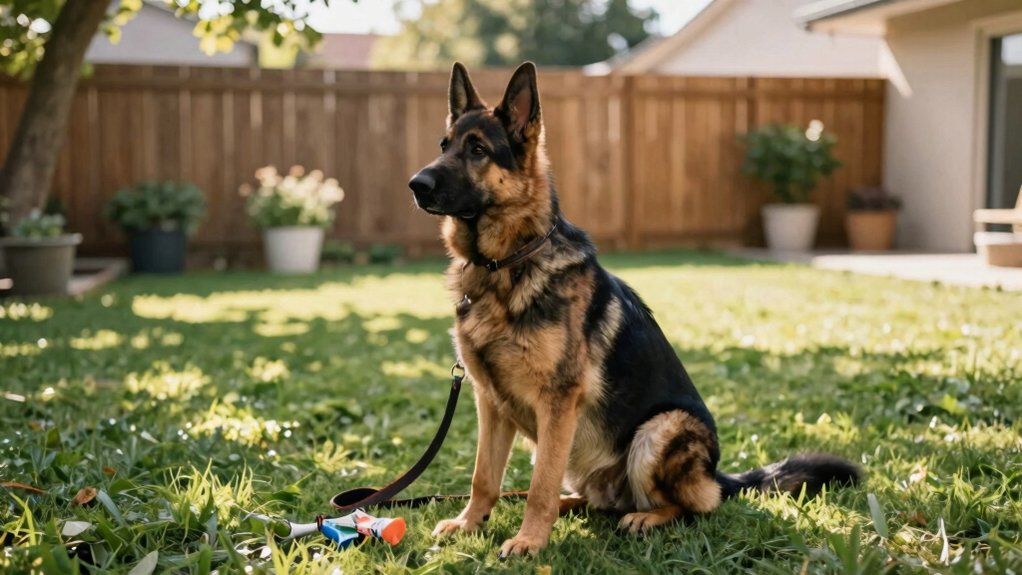
Start your recall training in reliable low-distraction areas, like a quiet indoor room or a fenced yard, because you want your dog to focus when it’s easiest.
Pick a distinct recall cue you’ll use only for “come,” then pair it with high-value rewards, like tiny bits of tasty food, plus quick praise every time you call—no delays, right after your dog takes the first few steps toward you.
Then keep sessions short, about 2–10 minutes, and practice roughly 5 single recalls per day at 2–3 meters, so your dog builds a strong, fast habit before you add distance. Make sure your German Shepherd has had enough daily exercise beforehand, since its needs vary by age and activity level, so it can focus on you instead of its energy.
Choose Reliable Low-Distraction Areas
Pick truly low-distraction places, because your German Shepherd can’t learn “recall” if their brain is busy everywhere else.
Start inside, where walls reduce noise and flooring limits fast escape.
Use hallways, dens, or a single room as controlled corridors, and run 2–3 short sessions daily, at 2–3 m distances.
Aim for quiet times, like early morning or off-peak hours.
Avoid parks, dog fields, and places with wildlife.
When you move outside, choose a fenced yard or enclosed garden, 5–10 m apart, adding only one mild distraction at a time.
Keep control with a long line, and skip sessions if arousal runs high.
Practice Recall With High Value
Once you’ve chosen a quiet spot, you’ll get the fastest recall progress by making “come” worth chasing.
Stock soft, smelly, high-value treats like chicken, cheese, hot dog pieces, or freeze-dried meat.
Rank rewards low, medium, high, and reserve the highest just for recall.
Test 10–20 options in low distraction, then keep the best.
Now, pair your single cue with instant delivery.
Say “come” once, upbeat.
Mark “yes” or click the moment your dog moves, then feed pea-size bites—one at a time.
Do 2–3 short sessions daily, and reward every success for 21 days.
Teach Loose-Leash Walking and Simple Heel Basics
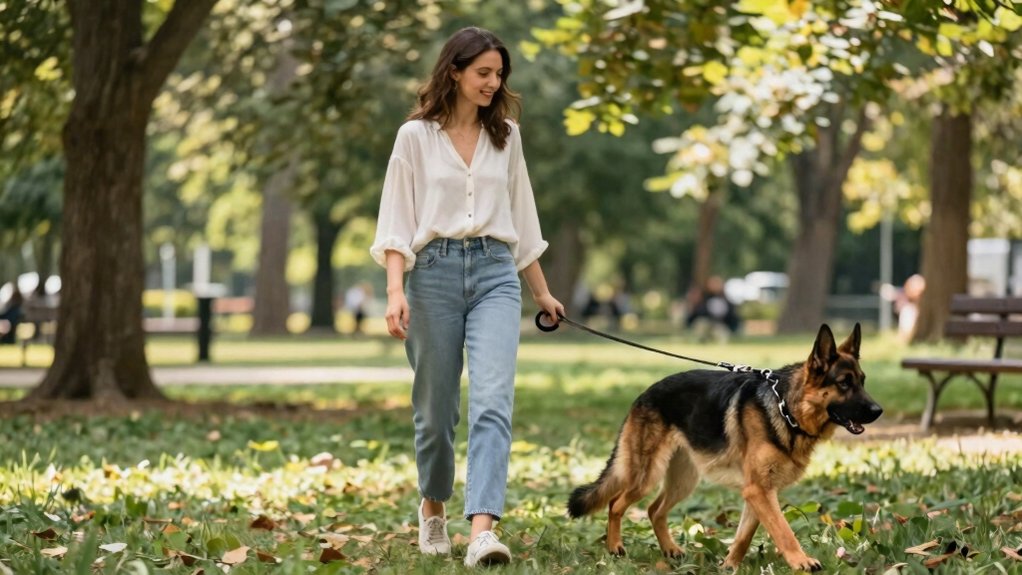
When you begin loose-leash walking, you’re teaching your German Shepherd a simple rule: the leash stays slack, not tight, and that calm walking earns good things. Start at 3–4 months, using a flat collar or harness and a secure leash. A no-pull harness can also provide better control for dogs that pull, which can make early leash training easier.
Start loose-leash training early: teach your German Shepherd that the leash stays slack, not tight, and calm walking brings rewards.
Practice in a hallway or quiet yard, first 1 minute, then build to 5–10 minutes daily. Position your puppy on your left, shoulder near your hip.
Mark and treat the exact moment the leash goes slack. If they pull, stop or change direction.
For heel basics, keep parallel alignment, about 6 inches close, with a steady pace.

No Pull, 2 Clips - With 2 sturdy metal hook loops for leash attachment. Use the front clip to create gentle redirection force, to reduce tugging during walks and training. While back clip is great for casual walks, jogging for well-behaved dogs

Size Instruction: This large dog harness fits chest girth: 27-37 in, neck girth: 19-25 in. Perfect for German Shepherds, Labradors for hiking, walking, or daily outdoor adventures. Breed suggestions are for reference; please measure your dog's chest, neck, and weight for the best fit.

Easy Adjustment - for Ultimate Comfort.Slip into and out of our dog harness effortlessly with the help of 2 quick-release buckles. Experience Unmatched Mobility with 4 Fully Adjustable Meatl Rings, two on the shoulders and two on the chest, which ensure a snug fit that enables unrestricted movement.
Practice “Leave It” and “Drop It” for Impulse Control
Next, you’ll build “drop it” with a trade, start with an easy toy, say “drop it,” mark the release, then pay with a higher-value treat right away—about 1 second after the toy hits the ground.
But don’t stop indoors; proof both cues around distractions by upping distance, using different rooms, and keeping sessions short and daily so your German Shepherd learns these rules even when something tempting shows up. When you move these cues outside, a well-fitted harness and leash keeps your dog controlled while you practice around new distractions.
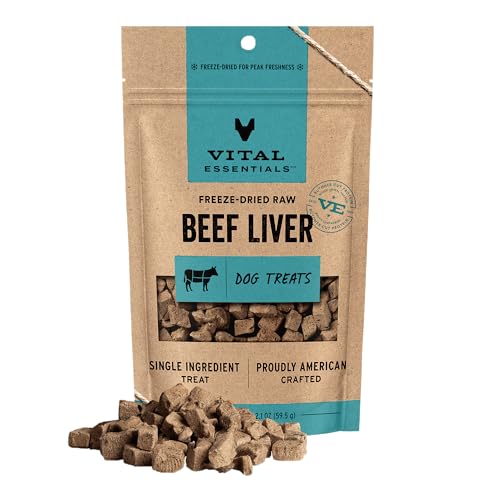
FREEZE DRIED RAW BEEF LIVER DOG TREATS – BITE SIZED FOR TRAINING, 2.1 OZ BAG: High protein dog treats made with beef liver. Perfect as high value dog training treats, puppy training treats, and everyday rewards

Wild-Sourced Protein: Our treats are made from all-wild roaming elk and deer protein, sustainably harvested from the Rocky Mountains, offering your dog a unique and premium nutritional experience Wild-Sourced Protein: Our treats are made from all-wild roaming elk and deer protein, sustainably harvested from the Rocky Mountains, offering your dog a unique and premium nutritional experience

Highly Palatable with natural pork liver base
Teach “Leave It” Lure Control
To teach “Leave it,” start with a lure you can control, then reward the exact moment your dog disengages.
Hold a closed-fist bait, present it, and wait.
Stay silent as your dog sniffs, licks, or paw-starts at the fist.
Then, when your dog turns away, deliver a high-value treat from your opposite hand, immediately.
Start with a boring item, then keep the cue clear.
Add “Leave it” only after the head-turn is reliable.
Do 10–15 reps at an easy level.
Next, open your hand, then place bait on the floor, with leash control.
Build “Drop It” With Trade
Let’s build “Drop It” with a simple trade game, because it teaches your German Shepherd to release items willingly instead of wrestling for them. Start with a low-value toy, then end with a high-value treat at nose level.
Let your dog take the toy for a few seconds, then offer the treat.
When your dog releases, mark it with a clicker or “yes,” then feed. While your dog eats, remove the toy, then re-present it.
Next, add “Drop It” or “Trade” just before release.
Repeat, in short sessions, until your cue—not the lure—wins.
Proof Impulse Cues Around Distractions
Proofing “leave it” and “drop it” around distractions is where the real magic happens, because your German Shepherd learns to choose you—even when something tempting grabs their attention.
Start with stationary, low-value items, 3–5 feet away, then slowly lower distance as success rises.
Use “leave it” for off-limits floor temptations, and “drop it” when the object is already in their mouth.
Keep “leave it” and “drop it” clearly different, so they react fast to new surprises.
Next, add movement, then people or dogs at controlled spots.
If they slip, step back to easier levels, and reinforce the disengage.
Stop Jumping and Biting With Consistent Rules
When your German Shepherd jumps or mouths you, don’t “talk them into it”—use the same simple rule every single time.
Reward attention only when all four paws stay on the floor.
Reward attention only when all four paws stay on the floor—jumping means no interaction until they’re calm.
If they jump, you completely withdraw interaction for 15–20 seconds.
Turn away, avoid eye contact, and stay silent, so you don’t accidentally teach jumping wins.
Practice “sit” or “off” right before greetings, then pay calm behavior immediately with high-value treats.
For biting, tooth-to-skin contact ends play fast, longer if it repeats.
Redirecting puppy biting onto a durable chew toy is an effective way to give your German Shepherd an appropriate outlet for mouthing.
Everyone in your home must follow the same protocol for guests too.

Stop Wasting Money on 2-Minute Toys: Engineered for the crushing jaw pressure of 20-80 lb breeds like Labs and German Shepherds, this dual-material bone features a rock-solid nylon core reinforced with a dense rubber sleeve to outlast standard plush toys. A thoughtful pick among durable dog gifts, it saves you from the hassle of constant toy replacements.

【Real Tug of War Action】This interactive dog toy is designed for medium and large dogs with strong chewing and pulling instincts. It channels their energy into a healthy tug-of-war challenge, keeping dogs focused on play instead of furniture or shoes, while providing mental stimulation and satisfying their natural instincts even when home alone.

✅ AGGRESSIVE CHEWERS, MEET YOUR MATCH — Your search for a toy that can stand up to your dog’s aggressive chewing is over. Goughnuts long lasting pull dog toys make tug of war more fun while saving you money you'd otherwise spend replacing toys.
Ages 8–12 Weeks: Trust, Potty, and First Cues
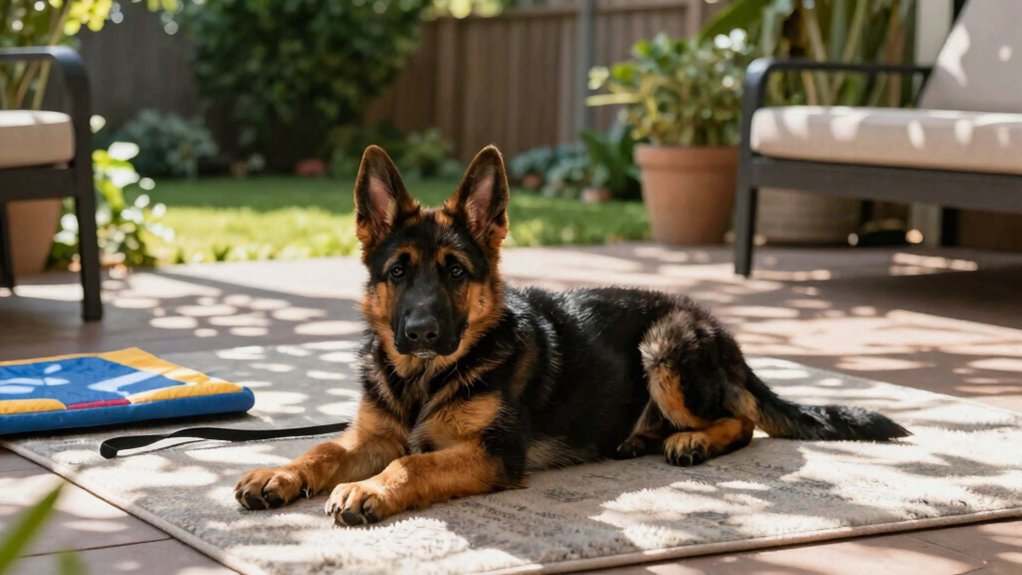
From 8 to 12 weeks, you’re really setting your German Shepherd up for a calm, confident life, not just teaching tricks. Build trust with calm closeness, predictable routines, and daily gentle handling—paws, ears, tail, and a collar check. Keep training to 3–5 sessions, 2–5 minutes, using positive reinforcement (reward). Your puppy’s early development during the first four weeks lays the groundwork for how well it responds to these routines.
Next, follow a tight potty rhythm.
At 8 weeks, go outside every 1–2 hours, right after waking, eating, and play. For 8–10 weeks, expect 30–60 minute awake gaps. By 10–12 weeks, aim 60–90 minutes, reward within 1–3 seconds. Use a single potty cue.
Also, start name recognition gently, and socialize safely.
Ages 3–6 Months: Leash Focus and Reduced Mouthing
Start by introducing a well-fitted collar or harness indoors, then reward your puppy the moment they accept the gear calmly.
Attach the leash, keep sessions short, and mark slack leash—when the leash stays loose, you feed.
When your puppy pulls, you stop or change direction, so pulling never earns the goal.
Do two 15–20 minute outings daily, low distractions first, then yards, then quiet streets.
For mouthing, withdraw attention and end play briefly, about 20 seconds, then redirect to toys.
Once leash manners are reliable, you can gradually introduce essential commands for obedience and communication, while useful tricks can wait until your puppy has better focus.
Ages 6–12 Months: Impulse Control and Stronger Stays
Between 6 and 12 months, you’ll build a reliable “leave it” by practicing 5–10 quick reps in daily life, then reward only when your German Shepherd stops lunging and pauses to think.
Next, you’ll strengthen stay by adding time first, moving from about 5 seconds up toward 1 minute, then adding distance in small steps like 10–20 feet with the same calm body position.
But keep it proofed—use higher-value distractions, and if they break the stay, you lower the difficulty and try again.
Build Reliable Leave It
Practice “leave it” with a simple, high-control drill:
Close your fist with a low‑value treat where your pup can sniff it, then let them investigate and wait for the exact moment they disengage—turn away, pause, or pull their head back.
Click or mark that instant, then pay with a higher‑value treat from your other hand.
Use a calm, cheerful cue tone, no harsh corrections.
Add the verbal “leave it” only after success.
Start closed fist, then open palm, then hand-covered floor.
Keep sessions 3–5 minutes daily.
Every family member repeats the same cue, marker, reward.
Strengthen Duration And Distance Stays
Once your “leave it” cue reliably stops your pup from grabbing, you’ll build on that self-control by strengthening duration and distance stays.
Start age 6–12 months by proofing duration first, 1–2 seconds, then 3–5, then 5–10, aiming for 10–30 seconds, then up to 60 seconds in low distractions.
Reward stays while your pup stays put, and stay close.
Each new spot begins again with 2–3 seconds.
Next, add distance: one step back, return and reward if it holds.
Use a palm “stop” hand.
Gradually build 1, then 2–3, then 5–10 steps over 8–14 days.
Use a three-d rule: increase only one variable at a time.
Mark success with 3:1 reps.
Manage Adolescence and the 11–14 Month Fear Period
That tricky stretch of adolescence—often showing up around 11–14 months—can make your usually confident German Shepherd suddenly act “new” and unsure.
You may see sudden wariness, suspicion, startles, or defensive body language toward once-okay people, places, or surfaces.
Often it comes in waves, 2–3 weeks each, sometimes with an “all better” week, then another dip.
Often it comes in waves—two to three weeks each—with occasional “all better” weeks before another dip.
Your job is to manage, not push.
Keep daily routine steady, reduce strong triggers, increase distance, and stay under your dog’s fear threshold.
Offer a quiet retreat room.
Avoid crowded areas, loud noise, and uncontrolled dog meetings.
If you notice worsening fear or aggression, monitor closely and adjust.
Add German Shepherd Scent Work, Tracking, and Agility
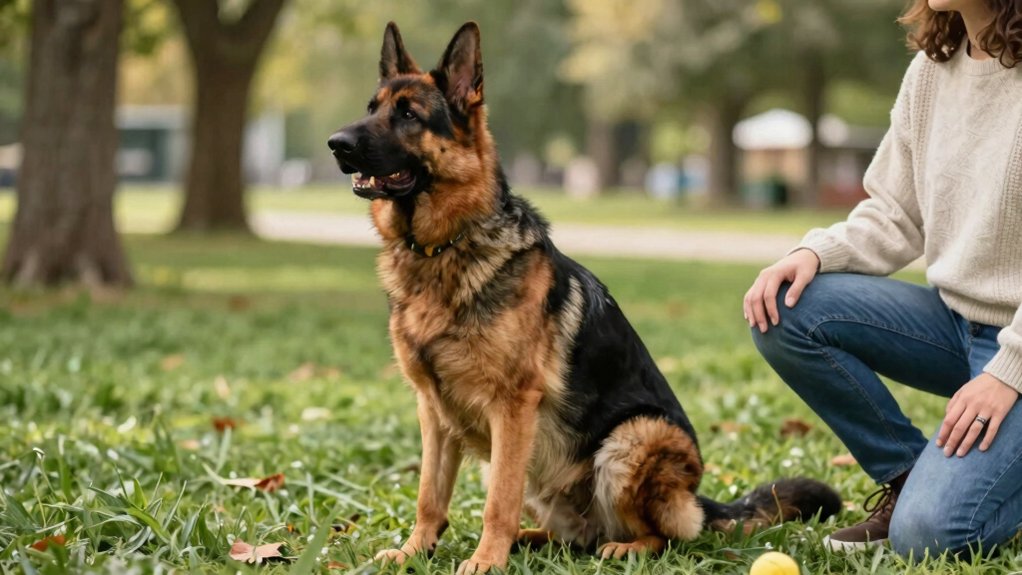
When you add scent work, tracking, and agility to your German Shepherd’s routine, you help them use their superpower—smell—while also building focus and confidence.
First, keep obedience solid, then run 5–10 minute scent sessions, ending on success. Hide a toy or food 1–2 meters away, and repeat a short cue like “find,” then release them to sniff.
Gradually move to 10–20 meters. Next, switch to container searches, using a target odor like birch, and add distractions only after baseline wins.
For tracking, follow nose-to-ground, straight or gently curved tracks in vegetation, ignoring cross-prints.
Add steady agility last, for kind fitness.
Progress Cue Difficulty With 5–10 Minute Practice Plans
Progress cue difficulty by keeping your training in short, repeatable 5–10 minute blocks, because your German Shepherd learns faster when you raise the bar little by little, not all at once.
Plan 2–4 sessions daily, 3–5 minutes for pups under 6 months, then extend to 5–10, and for adults add a longer anchor session plus refreshers.
In each 5-minute block, aim for 5–10 successful reps of one cue, then stop while engagement stays high.
Start in quiet spaces, add mild distractions only after steady success.
Increase stay or wait by a few seconds each session, and move distance step-by-step, one criterion at a time, to build confidence.
End with an easy win.
Frequently Asked Questions
How Do I Choose Treats and Toys That Keep Training Exciting Daily?
Choose small, soft, “stinky” high-value treats for harder reps, and rotate varied toys daily. Mix puzzle, chew, and tug options, using treat-plus-toy rewards. Test safe options, keep portions tiny, and document what sparks the fastest focus.
When Should I Start Scent Work, Tracking, and Agility Safely for My GSD?
Start scent work now: 5–10 minute odor games at 8 weeks, 15 minutes by adolescence (6–12 months). Begin tracking around 6–18 months with short straight tracks on soft ground. For agility, use flatwork early; avoid jumping until growth plates close.
How Do I Tell if My Puppy Is Overwhelmed During Socialization or Training Sessions?
“Better safe than sorry.” You’ll notice overwhelm when your puppy shows tucked tail, pulled-back ears, lip licking, yawning, panting, trembling, freezing, backing away, ignoring treats, whining, or frantic escape. Adjust pacing, reduce distance, and reward calm.
What’s a Simple 5–10 Minute Practice Plan for Increasing Difficulty Without Burnout?
Use 5–10 minute blocks: start with 3–5 easy reps, mark and reward instantly. Add just one step of distance, time, or distraction after success. If you fail, step back, end on a win, repeat a few times daily.
How Can I Correct Stubborn Behaviors Without Punishment or Damaging Recall Reliability?
Correct stubborn behavior without punishment: you prevent rehearsal, reinforce alternatives, and manage distractions. Investigate a “reroute equals better recall” theory: show it by rewarding immediate choices, then releasing back to fun. Keep cue consequences consistently positive.