German Shepherd puppy biting is normal, especially during play. But you’ve got to teach bite inhibition fast: when teeth touch skin, say “Ouch,” then pause for 10–30 seconds and end the fun. Use “gentle” only for soft mouthing, anything harder stops instantly. Keep one rule: skin and clothes never work as chew toys. Redirect to tug or safe chews, offer puzzle toys, and take tiny play breaks every 30–60 seconds. Stay consistent, supervise kids closely, and if it worsens, get help—keep going for more.
Swift Summary
- Teach bite inhibition immediately with a sharp “ouch,” then instantly stop play for 10–30 seconds.
- Apply a consistent rule: skin/clothes never function as chew toys; any tooth contact ends play within 1–2 seconds.
- Redirect mouthiness to appropriate chews and puzzle/tug toys, rotating options and supervising closely.
- Prevent over-arousal during wrestling using short 10–20 second play pauses, calmer games, and time-outs behind a gate if needed.
- Use household supervision with leashes/crates for control, and get professional help if biting escalates or includes fear/aggression.
Why German Shepherd Puppy Bites Are Normal
Even though it feels nonstop when you’ve got a little land shark in your house, German Shepherd puppy bites are usually normal.
Even though it feels nonstop with a tiny land shark, German Shepherd puppy bites are usually normal.
You may wonder, does German shepherd bite, and the answer is yes, often during play.
German shepherd puppy biting is mostly mouthing, chewing, and nipping to explore and learn.
It’s natural, and it builds bite inhibition, meaning you teach the puppy to control jaw pressure.
Feedback from littermates helps too. Even though puppies are hard-wired to chomp on everything, you can still guide them toward safer habits with consistent redirection and bite inhibition teaching.
Teething can also spike nipping around 12–14 weeks. A week-by-week training plan can help you introduce basic commands and socialization during this stage.
You’ll often see it fade as you reach 4.5–5 months.
For guidance, focus on how to stop a german shepherd puppy from biting.
German Shepherd Puppy Biting: Play vs Aggression
When your German Shepherd puppy bites, you can usually tell play from aggression by watching their body first. Play looks loose and wiggly. You’ll see bouncy movement, play bows, and a relaxed mouth with gentle, wide “jaw sparring” bites. The tail stays loose and wagging. Their eyes stay soft, with minimal tension. (aggressive behaviour may require immediate professional help if it causes physical harm.) Aggression looks different. Your puppy may get stiff, weight forward, with raised hackles, a tense tail, narrowed eyes, and lips pulled back. You might hear low growls, snarls, or snapping. They may also show “leave me alone” signals, like lip-licking or turning away. Sudden aggression toward owners is often triggered by circumstances such as pain, fear, or guarding food or toys, so any abrupt change in your puppy’s behavior should be checked by a veterinarian.
Use “Ouch” and Pause Immediately for Bite Inhibition
Use a quick, sharp “ouch” followed by an instant pause, so your German Shepherd puppy learns that biting people ends the fun right away. You yelp high-pitched, like a littermate warning cry. Keep it brief, no anger. give a high-pitched yelp The moment teeth touch skin, say “ouch,” then remove your hands and stop play. Next, step away, turn your body, and give 10–30 seconds of quiet. If needed, use a pen or crate for about 20–60 seconds. No eye contact, no talking, no touching. When your pup settles, resume gently. Be consistent. Every bite gets the same timing. Because German Shepherds are intelligent and quick to recognize patterns, consistent responses from every family member help them understand biting faster than mixed signals do.
Set One Rule: No Biting Skin or Clothes
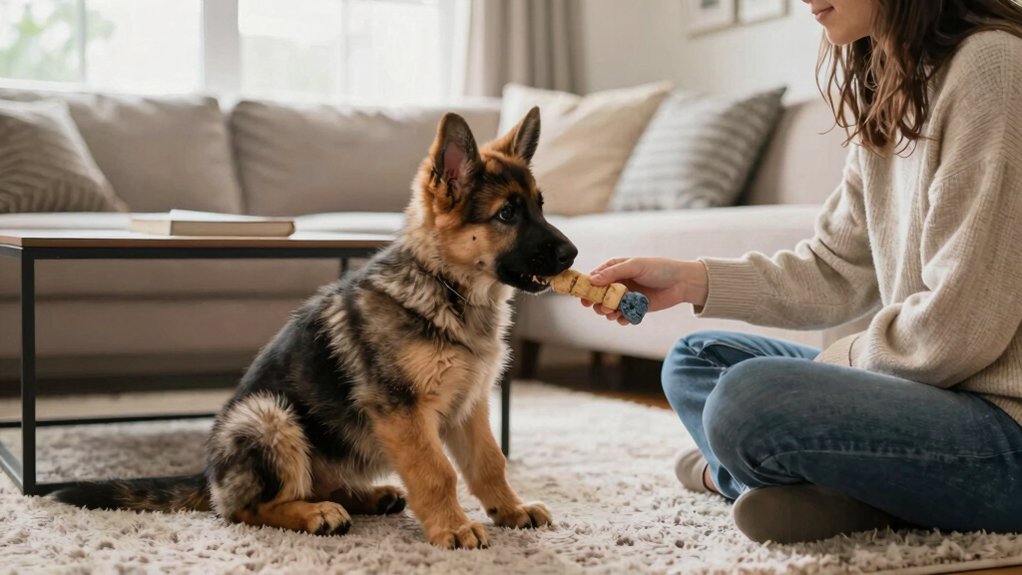
Set one clear rule from day one: your skin and clothes never function as chew toys, and you enforce it every single time.
When teeth touch skin or fabric, you stop the play right away: stand up, turn away, and give a 15–30 second quiet “reset” so biting predicts the end of fun. Because German Shepherds are prone to hot spots, nipping that breaks the skin can quickly turn a minor irritation into a painful, infection-prone sore.
Then you immediately redirect by offering a tug toy or chew, and you praise fast when your puppy goes for the toy instead.
Enforce No Contact Rule
To stop nipping for good, you need one simple, strict rule: your puppy’s teeth never touch your skin or your clothes.
Set it as your only house rule, no exceptions, even “gentle mouthing.”
Pick one cue, like “no bite” or “oops,” and say it calmly the instant teeth touch fabric or skin.
Then stop moving your hand, or take it away.
Immediately offer a safe chew or toy, so chewing stays “allowed.”
Use the rule in play, grooming, and petting, preventing mixed lessons.
For a few weeks, stay consistent.
Frequency and intensity usually drop fast.
Stop Play Upon Biting
Stop play the instant your German Shepherd puppy’s teeth touch your skin or your clothes.
End it fast, within 1–2 seconds.
You stop moving. You stand up, or you calmly walk away, and you remove hands, toys, and attention.
No exceptions, ever.
Hard bites?
You add a brief time-out, 20–60 seconds, in a safe crate, pen, or separate room.
Turn away or leave, so social contact ends too.
Then wait for calm, then restart play gently.
Keep every family member on the same rule, everywhere, every time.
This helps bite inhibition finish by 4.5–5 months.
Redirect To Chew Toys
Once you’ve taught that play ends the second teeth touch your skin, you’ll get faster results by redirecting that mouth onto chew toys instead.
Now, enforce one rule: no biting skin or clothes. The moment your puppy mouths your hand or grabs fabric, calmly say “no bite,” then present a chew toy right away.
Keep several safe options in reach, and rotate 3–5 toys every few days.
Use a toy Kong, rope tug, puppy Nylabone, or food puzzle.
Watch for pre-bite cues.
When teeth angle toward you, wiggle the toy, praise the switch, and repeat every time.
Redirect German Shepherd Nips to Safe Chew Toys
When your German Shepherd puppy starts mouthing your hands or grabbing clothing, you can redirect that “bitey” energy fast—before it turns into a habit.
Keep plenty of safe chew toys in every room, near doors and couches, so you can reach one in seconds.
When teeth touch skin or fabric, pause calmly, then offer a toy or a tug.
Replace the toy every time they target fingers, toes, or sleeves.
Stay neutral, no rough reactions.
If hard nipping continues, briefly remove attention, then reintroduce the toy.
Make toys exciting with squeaks, tugging, and rotate options.
Use puzzle toys and puppy-approved long-lasting chews too. When you cannot supervise closely, a dog playpen gives your puppy a secure enclosed area for play and containment.
Teach “Gentle” With Feedback Every Single Time
Next, you’ll want to teach “gentle” so your German Shepherd puppy learns exactly what soft mouthing looks like—and what happens when pressure gets too strong. Just as excessive barking or whining often signals an unmet need, nipping can escalate when a puppy is tired or overstimulated, so identifying the underlying cause helps you step in before play turns rough.
Start when your pup is calm and already mouthing softly.
Say “gentle” as you reward quiet licking or sniffing, even using treats in a closed fist.
Set rules: any tooth-to-skin contact above gentle ends play.
Use a marker like “ouch,” “oops,” or “too bad” the instant teeth touch skin, in a neutral tone.
Then calmly withdraw, stand up, turn away, cross arms for 10–20 seconds.
Repeat, and only resume when relaxed.
Prevent Over-Arousal With Short Play Breaks
When your German Shepherd puppy starts getting too hyped—fast, rough wrestling and harder bites—schedule tiny play breaks every 30–60 seconds, so arousal (excitement level) doesn’t build. Diet can also affect a puppy’s energy, so compare German Shepherd dog food options like Royal Canin, Purina Pro Plan, and Eukanuba, but remember that food alone will not stop nipping.
Pause for 10–20 seconds right after teeth touch skin or clothing, and ignore him during that freeze, because that moment teaches “biting ends the fun.”
But if he’s still lunging and can’t calm down, stop the wrestling, use a short time-out for about 30–60 seconds behind a gate, then restart with calmer games.
Use Short Play Breaks
Short play breaks are one of the fastest ways to stop your German Shepherd puppy from biting and nipping.
Over-arousal during play makes mouth pressure rise, turning mouthing into hard nips.
So you should keep play structured.
Insert brief pauses the moment intensity starts climbing, not after a bite.
Give a short break of several seconds to a few minutes, then resume only if your puppy stays calmer.
When teeth touch skin, you withdraw attention right away.
Freeze, fold your arms, and look away.
Keep it calm, quiet, and brief.
If nipping continues, end play for 1–2 minutes, then try again later.
Use “settle” to guide.
Reduce Excitement During Wrestling
To keep your German Shepherd puppy from turning “play wrestling” into mouthy nipping, you’ve got to reduce excitement before it builds.
Keep wrestling low-intensity, hands-off, and slow.
Avoid pushing, shoving, or body wrestling.
Use toys instead of skin, like a tug or chew, and keep movements calmer, no fast chaos.
Teach “sit” before play, then “wait” or “leave it” for impulse control.
Add “settle” during breaks, aim for 10–20 seconds of calm.
If arousal spikes, call your pup out, reset, then redirect to tug or fetch.
Supervise closely.
Pause After Mouth Contact
The moment your German Shepherd puppy’s teeth touch your skin, you pause the game, right away.
Stand still, pull your hands out of reach, and turn away. No eye contact. No talking. Wait 10 to 60 seconds, then restart only if they show a calm body.
If redirection to a toy fails, use a short time-out of about 30 seconds, or remove the pup from the play area for a beat, and you stay quiet.
Repeat. As soon as mouthiness comes back after you re-engage, extend to about 1 minute.
You’re teaching, “mouth contact ends fun.” And that prevents escalation.
Avoid Rough Games That Reward Grabbing Hands
Skip rough hand games that “pay” your puppy for grabbing. When you wrestle, push, or wiggle fingers near their face, you teach biting is a fun target.
Quick pokes, taps, or waving hands turn into chase triggers, and your pup lunges for nips.
Hard mouthing on hands also normalizes tooth-on-skin play, so later retraining gets harder.
And mixed reactions confuse them, so they bite more to get attention.
Instead, start toy play. Use fetch, tug with a rope, and chew toys.
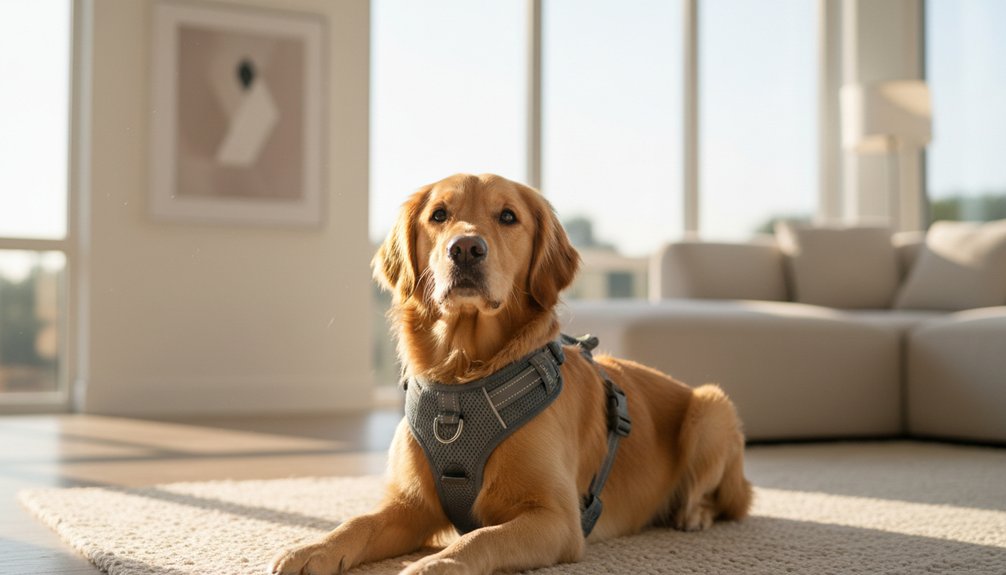
Keep hands for calm petting only, and end play instantly if teeth touch skin. For walks and outdoor energy, a properly fitted dog harness offers comfort and control, so your puppy can burn energy without redirecting it onto your hands.
Manage Biting With Leashes and Calm Time-Outs
Use a leash and short calm time-outs so your German Shepherd puppy quickly learns that teeth-on-skin ends the fun.
Keep a light leash dragging during supervised play, you can calmly escort him to a quiet spot the moment he mouths skin. A no-pull dog harness can also provide better control during supervised play, letting you guide your puppy without tugging on his neck.
Keep the leash loose, a tense leash builds stress.
When biting starts, freeze, then turn away, cross your arms, and walk off or lead him to a crate or pen for 10–20 seconds.
End the time-out, then reward calm with play.
Repeat every time, steady and predictable.
Hard bites get first.
Match Chews to Teething Pain and Jaw Needs
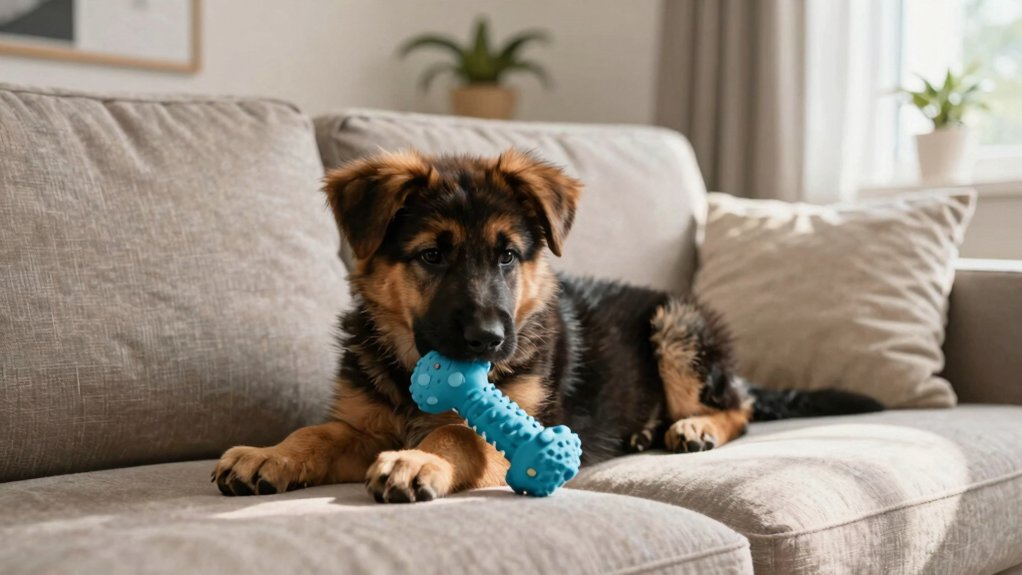
Match your German Shepherd puppy’s chews to what their mouth feels like right now, because teething pain changes fast. Since German Shepherds are intelligent and driven, first-time owners should expect consistent training to be essential from the start.
Start with very soft, puppy-safe rubber or nylon chews, they compress under thumb pressure. This soothes sore gums and lowers tooth fracture risk during the early weeks, then bumps up as adult teeth emerge around 12 weeks.
Around 3–5 months, use medium-firm puppy chews, longer and thicker so back teeth do the work.
Add ridged, textured toys for sensory feedback.
And when pain spikes, chill or freeze puppy teething rings.
Keep rotating options, serve safe sizes, supervise closely.
Socialize Early to Reduce Fear-Driven Nipping
Start socialization when your German Shepherd puppy is about 3–12 weeks old, right in that sensitive learning window, because early safe experiences shape what “normal” feels like.
Then use gentle, controlled human encounters—think friendly neighbors, men and women, different hats or walkers—so your pup learns people are safe and not scary.
Watch for that first fear period around 8–10 weeks, and if you see stiff body language or wide eyes, slow down the exposure and return to what feels comfortable.
Start Socialization During Peak Window
Have you noticed how fast your German Shepherd puppy learns what’s “safe”? That’s your cue to start socialization between 3 and 14 weeks, before fears fully kick in around 8 weeks.
You’ll want to gently expose your pup to new places, sounds, surfaces, and people-free, dog-free routines—think parks, sidewalks, elevators, and laundry noises.
And do dog–dog meetups with friendly, well-socialized pups during that same window, 2–3 short sessions per week.
Positive, reward-based exposure helps prevent avoidance and fear, so nipping stays play, not defense.
Use Gentle Encounters With Humans
Gently introduce your German Shepherd puppy to lots of calm, friendly humans early, and you’ll cut down fear-driven nipping later.
Aim for 100 people before three months, then 100 more in the next month.
When you meet someone, keep it smooth and slow, use quiet voices, and let your puppy approach.
Hand-feed with soft, non-threatening movements, so hands mean rewards, not restraint.
Practice gentle touch daily, petting and handling paws, ears, tail, and muzzle with treats.
Groom slowly.
Avoid looming, grabbing, or sudden reaching.
If mouthy biting starts, pause attention, redirect to a chew toy.
Teach soft mouth over weeks.
Build Calm Handling Tolerance With Gentle Practice
Build calm handling tolerance by practicing short, predictable “exam-style” sessions.
Keep them 5–10 minutes, twice a week, in a quiet, comfy home spot.
Start low-invasiveness.
Place your hand near paws, mouth, ears, and body, then touch for 2–3 seconds.
Reward fast, then repeat.
After a few reps, gently increase to 10–15 seconds only if your puppy stays relaxed.
Add positive reinforcement: pair every calm touch with high-value treats, like “happy visits” in clinic-like places.
Practice paws, nails, ears, muzzle, chest, back, belly, and tail.
Go gradually, adjust to stress signals, and pause if they stiffen or pull away.
Reduce German Shepherd Mouthing With Exercise and Tasks
Once your puppy can stay calm for quick handling touches, you’ll get more progress by lowering their overall “mouthy” energy.
Start with structured exercise.
Aim for about 5 minutes per month of age, up to twice daily, then add more frequent short breaks through the day to prevent over-tired biting.
Do training 20–30 minutes after intense play, when they’re calmer and can practice bite-control.
Before cue work, run or fetch first, then cool down with sit and down.
Give puzzle toys, scent games, and safe chew items to redirect mouth habits.
Share tug, 30–60 second rounds, with take-and-drop breaks.
Stop Accidental Reinforcement: Consistent Responses Only
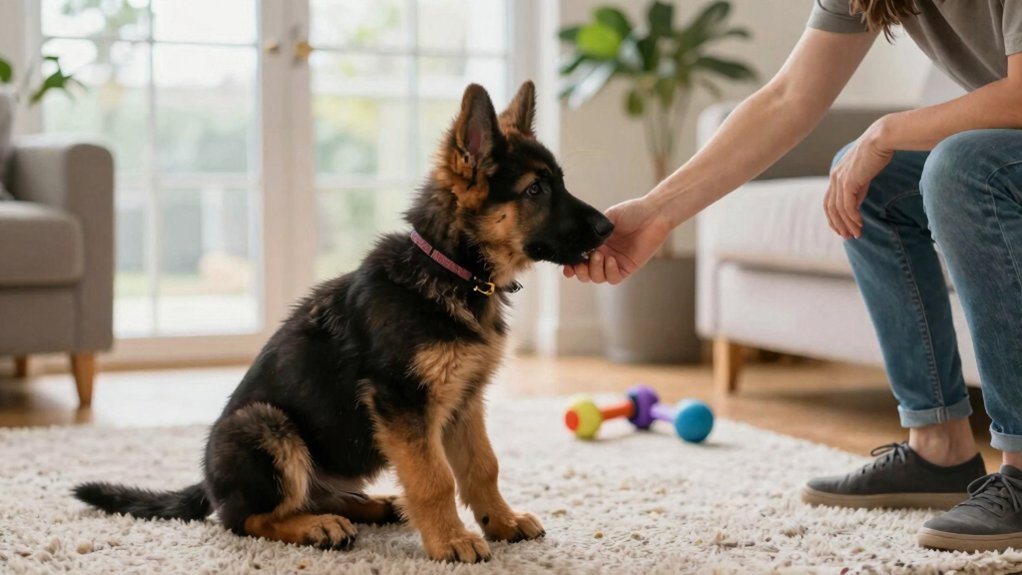
After your puppy nips, you need to stop any accidental rewards fast, like attention, talking, petting, or tug within a second.
Use the same cue every time (for example, a calm “ouch”), then pause all interaction and toys for 10–30 seconds so teeth on skin clearly end the fun.
And when he’s calm again—no mouthing—go back only after he’s settled, so your re-contact rewards gentle behavior instead of repeat nipping.
Prevent Reinforcing Mouth Play
Every time your German Shepherd puppy bites or nips your skin, you should stop the fun instantly—no exceptions.
Stand still, tuck hands away, or turn back for 10–60 seconds, then pause behind a baby gate.
This consistent withdrawal teaches that teeth on skin ends interaction, not laughter.
If you yell, chase, or wave hands, you boost arousal, and mouthing turns into a tug game.
So keep a calm, neutral body and quiet voice.
When mouthing starts, immediately offer a tug toy or chew.
Praise calm chewing.
All family members follow the same rule.
Use Same Cue Every Time
A clear cue makes puppy biting easier to fix. Pick one short word, like “ouch” or “no bite”, and use it every single time. Avoid switching phrases, because each new word becomes a new cue, and that slows learning.
When biting starts, deliver the cue immediately, not 2–3 seconds later. Say it in a calm, neutral voice, not a high-pitched shout.
Then follow the same non-reinforcing response pattern each time. Make every household member use the same word and timing. Post the cue list, so visitors match too.
Pause Interaction After Contact
When your German Shepherd puppy’s teeth touch your skin, pause the interaction instantly, every time. Stop play and attention right then, no excited talk, no petting, not even “oops!”
Stand up, cross your arms, and turn away. Wait a few seconds with your gaze averted, so your puppy learns that mouthing ends access to you.
For a quick reset, step behind a baby gate, or into another room for 10–20 seconds.
If nipping continues, use a boring crate or pen for 2–5 minutes.
Everyone must respond the same.
Protect Kids: Puppy Bite Boundaries and Safe Distance
Protect your kids by treating puppy play like a safety job, not a free-for-all. You supervise every second.
Don’t leave kids alone with the puppy, not even “just for a minute,” and a sleeping adult doesn’t count.
Keep a safe distance.
Teach kids to stay out of reach unless an adult stands right there, ready to step in.
Set rules: no hugging, no climbing, no pulling ears, no grabbing toys.
And kids must never approach while the puppy eats, guards food, plays with valued toys, sleeps, or seems tired.
Give the puppy a retreat space away from kids.
When to Seek Help for Persistent German Biting
If your German Shepherd puppy keeps biting past the normal “teething stage,” you shouldn’t just grin and bear it, you should step in and get expert eyes on the problem.
Seek help if adult teeth cause painful bites with broken skin or bleeding, or if bouts keep returning after you train.
If structured training doesn’t improve mouthing within a few weeks, contact a qualified behaviorist or veterinarian.
Watch for frequent, unpredictable targeting of hands, feet, or faces.
Also act fast when bites escalate, or when you see tense body, deep growling, hard staring, freezing, snapping, or head shaking.
Sudden changes, and any guarding or puncture wounds need urgent medical care.
2-Week German Shepherd Bite-Control Training Plan
Now you’re starting the 2-week German Shepherd bite-control training plan, and you’ll see the biggest gains when you stay consistent and calm on purpose.
In Week 1, run two 10–15 minute bite-control blocks daily, plus micro-interventions.
In Week 1, run two 10–15 minute bite-control blocks daily, then use quick micro-interventions to keep progress steady.
Use a crate or exercise pen 3–5 times for short rest, to stop overstimulation.
Enforce calm before freedom: open the door only after 3–5 seconds of quiet stillness.
Stop all roughhousing and chasing at home.
Define soft-mouth, any skin dent ends play for 20–30 seconds.
Freeze, remove attention, fold hands 10–20 seconds.
Log triggers for 7 days.
Rotate chews 3–4 times daily.
Add 2–3 scent/puzzle games.
Frequently Asked Questions
Should I Punish My German Shepherd Puppy for Biting, or Use Rewards Only?
Yes—use rewards, not punishment. When your puppy nips, you calmly interrupt and remove attention, then immediately reward gentle play. You’ll build trust, reduce stress, and teach what to do instead—fast, safely, and kindly.
What Age Should Bite Inhibition Improve in German Shepherd Puppies?
Bite inhibition should improve noticeably between 8–16 weeks, with most German Shepherd puppies showing major reduction in hard mouthing by 5–6 months. You’ll still see gradual gains up to about 18–20 weeks.
Can Teething Alone Cause Increased Nipping, and How Can I Tell?
Yes, teething can increase mouthing, but it won’t explain targeted nips at skin. You’ll see slow gnawing on toys, drooling, swollen gums, or blood spots. If nips spike during play and chase, it’s social arousal.
Will My Puppy Bite More After Naps, Overstimulation, or Excitement?
Yes—after naps, after overstimulation, and during excitement, you’ll often see more biting. Overtiredness and high arousal reduce self-control; your puppy mouths more when they’re cranky or overamped.
Is It Normal for My Puppy to Mouth My Face or Hands During Play?
Yes—puppies often mouth hands during play, but mouthing your face or head isn’t appropriate. You should end the game immediately, say “ouch,” redirect to a chew or tug, and reward gentle, low-pressure mouthing.