Your German Shepherd barks so much because it’s often one clear need showing up fast, like a “watchdog” alert, a greeting, or a boundary guard. High, friendly barks can mean excitement, low rumbling can mean warning. Whining is usually a request, but it can also signal stress or pain. Howling often points to loneliness or separation, especially if it starts 15–30 minutes after you leave. Track triggers daily, then teach “quiet” with quick rewards, and you’ll get more clarity.
Swift Summary
- German Shepherds often have a genetics-driven “watchdog” drive, leading to frequent alarm barking.
- Barking, whining, and howling differ by tone and emotion, with high excitement, low warning, and howling often signaling loneliness or alerts.
- Fear, stress, boredom, or pain can increase vocalizations, especially with pacing, panting, cowering, or repetitive monotone barking.
- Daily routines and triggers like greetings, anticipation before walks, doorbells, fences, and separation timing can reliably cue barking/howling.
- Sudden changes or pain-associated whining can indicate medical issues, so contact a vet or qualified behavior professional.
Why German Shepherds Bark So Much
German Shepherds bark often, and it usually starts with their background and brain.
You’ll notice a built-in “watchdog” drive, plus genetics that lean toward frequent alarms.
That’s why do german shepherds bark so much, and does german shepherd bark a lot—often a mid-range baseline.
Early puppies already whine, grunting at 2–4 weeks, barking by about 4 months.
Then your high-energy dog may bark from boredom, poor exercise, or low mental work. Dogs that are skilled at backing out of standard harnesses may need an escape-proof harness built for clever dogs.
Then your high-energy dog may bark from boredom, poor exercise, or low mental work—so add structured play and enrichment daily.
If you’re wondering why is my german shepherd so whiny, start with training and daily, structured play.
For how to stop a german shepherd from barking, reward quiet.
If german shepherd won’t stop barking, manage triggers and keep sessions 10–20 minutes.
German Shepherds are also naturally protective and may alert frequently to changes around the home (protective instincts).
What German Shepherd Vocalizing Usually Means
Why does your German Shepherd make all those sounds—barks, whines, and howls?
Usually, you’re reading their emotional state and needs.
High, tonal barks often mean friendly excitement, like “come closer.”
Low, rumbling barks often mean warning or fear, like “back off.”
Whining often signals a clear request, like going outside, hunger, or play, but it can also mean stress or pain. Pain from ear infections is a common reason a dog whines, especially when it is paired with head shaking or scratching at the ears.
Howling commonly points to loneliness, separation, or long-distance contact, and it can be triggered by sirens or other dogs.
If vocal patterns change significantly, it’s a good idea to talk to a veterinarian or a qualified trainer or behaviorist.
Always pair sounds with body language—relaxed and wagging feels joyful, crouched with raised hackles feels scared.
How Greetings and Anticipation Trigger Barking
When you greet your German Shepherd, you’re basically handing them a “hello” cue, and that excitement can turn into repetitive barking fast—often short, sharp barks with a high, excited pitch as they move toward the door. greeting barking can look relaxed and enthusiastic at first, but it can still escalate quickly into demand behavior if the dog learns barking makes the interaction start immediately. But anticipation works like a countdown, the barking ramps up in the minutes before a fun event, like 5–10 minutes before a walk, when keys jingle, a leash appears, or you head to the door. If you learn that pattern, you can redirect the energy with a calm cue and a short pause before the good thing, so the alert vocalizing stays fun, not out of control. Mixed-breed German Shepherds can inherit vocal tendencies from their other parent breed, so inherited vocal tendencies may make greeting and anticipation barking more intense.
Excited Greetings Trigger Repetitive Barking
Because your dog loves you and feels the moment coming, excited greetings can quickly turn into repetitive barking, whining, or even howling.
In these visits, you’ll often notice loose body posture, wagging, forward movement, and a friendly, soft face.
Your German Shepherd may release energy after separation, and strong attachment can make self-control drop fast.
Then the barking loop gets reinforced when you respond with attention, touching, or excited talk.
To help, lower greeting intensity, reduce crowding at entry, and teach a calm alternative like “sit” or a chew in place.
Manage access during arrivals, too.
Anticipation Builds Alert Vocalizations
Anticipation can turn your German Shepherd’s excitement into alert vocalizations, especially right before a predictable event like you grabbing the leash or you turning into the park parking lot.
You’ll hear medium-to-high, repetitive barks, sometimes with whining, short howls, and restless pacing.
Your dog’s body tenses, ears forward, tail raised, eyes scanning the trigger as it nears.
Then greetings and routine cues blend—opening a treat cupboard, hearing a doorbell on TV, even neighbor car doors.
To help, create a pause: ask for “sit,” mark calm, and reward within 2 seconds, before the barking starts.
Territorial Barking: Guarding Your Space
When your dog barks to guard space, it often shows “boundary marking,” plus a warning that someone’s close to the fence line, gate, or door.
You’ll usually notice it ramp up fast as strangers approach, and doorbell or delivery sounds can trigger the same protective alarm within seconds, especially in alert breeds like German Shepherds.
The goal is simple: spot the pattern early, manage access to the boundary, and train a calmer response before the barking turns into charging. Because German Shepherds are generally responsive to training, short, consistent obedience sessions can teach them a calmer alternative to alarm barking.

【2-in-1 Advanced Design】Our dog training collar with remote can work independently even without a remote control. It's not just a command receiver, it's a smart anti barking device for dogs that automatically responds to your dog's voice. You don't have to choose between a dog shock collar or a dog bark collar, we have both.

Safe, Effective, Easy Setup: The dog bark collar has 4 working modes; 5 adjustable sensitivity levels. Just press the M button at any time to enjoy quiet time. Please refer to the user manual before use for optimal performance and safety

FINALLY, A BARK COLLAR BUILT FOR BIG DOGS — ALSO FITS MEDIUM & SMALL BREEDS: Tired of collars that are too small for your big dog? This bark collar for large dogs is designed for breeds like Labrador, Golden Retriever, German Shepherd, Husky, Doberman, Rottweiler, and Great Dane. The adjustable 10–25" strap also works as a bark collar for medium dogs and a bark collar for small dogs when sized correctly. Just measure your dog’s neck first—if it’s under 10", this collar may not fit. Finally, one dog bark collar that’s made to fit real dogs, not just a size chart
Boundary Marking And Warnings
Territorial barking in your German Shepherd often starts as boundary marking and a clear warning, so you’ll want to learn what it really means.
It’s a vocal “territorial advertisement,” and it helps guard the space your dog patrols, like your home, yard, and car.
You’ll notice deeper, louder, harsher barks at fence lines, windows, and driveway edges.
Your dog may stand stiff, lift the head, ears forward, gaze fixed.
Each bark can come with forward pouncing or lunging.
Hackles rise, tail steadies, and the pattern intensifies as threat nears.
You’ll also see scent marking, like urination on vertical surfaces, to “update” territory.
Triggers From Strangers Approaching
Stranger-triggered territorial barking is your German Shepherd’s way of saying, “You’re getting too close to my people or my space.” You’ll usually notice it start the moment an unfamiliar person nears your home, yard, or even the car—especially at the front door, gate, driveway, or the usual path you walk.
And when that stranger moves straight toward you, stares, or leans over, your dog may bark lower, harsher, and longer.
But this isn’t “bad.” It’s a warning, to alert you and deter intruders, often with stiff posture, high tail, forward ears, and exposed teeth.
Doorbells Delivery Noises Reactivity
Doorbells, knocks, and delivery sounds can set off your German Shepherd’s “guard mode” fast—so you’ll want to plan for it before it escalates. These noises act like boundary cues, your dog hears them, then expects a person entering.
Territorial barking often blends protective intent with barrier frustration at doors, windows, and gates. It can also stay strong through learning: the intruder leaves, and your barking works, that “negative reinforcement” loop keeps it going.
You can also reduce stress by blocking line of sight, using gates, and teaching “place” on a mat. Train it in quiet first, then practice with real doorbell rings.
Fear and Stress Barking in Daily Life
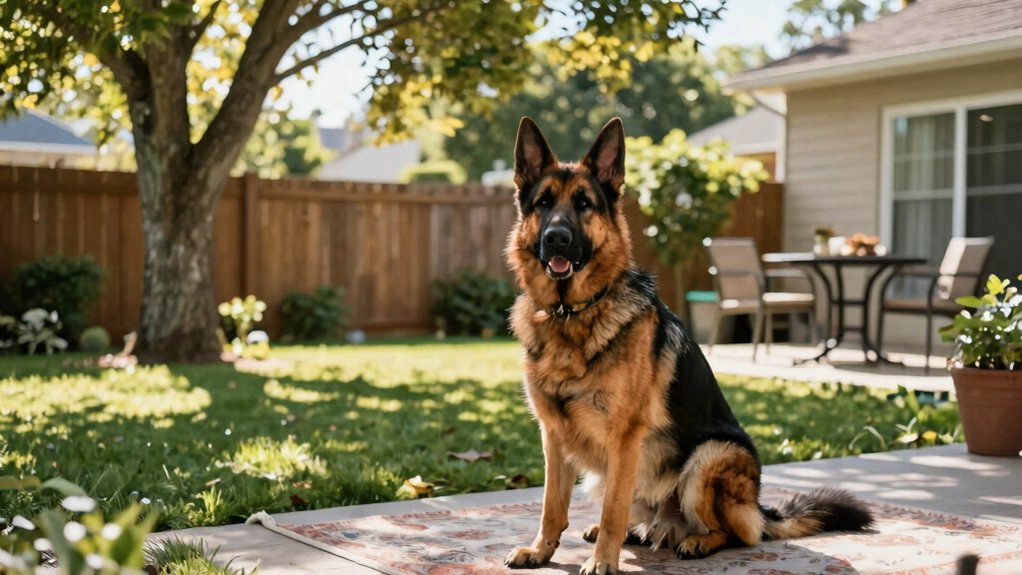
When your dog barks in fear or stress during everyday life, it usually isn’t “bad manners”—it’s a nervous body trying to protect you and them.
You’ll hear high-pitched, fast, shrill barks that say “stay away.”
And it often comes with pacing, panting, lip licking, yawning, cowering, a tucked tail, or flattened ears.
Common triggers include unfamiliar people, other dogs, novel objects, loud noises, and how close the threat feels.
You may also notice stress at passers-by, delivery activity, traffic, or neighbor sounds.
Watch context, because fear barking can shift into growling if escape seems impossible.
Recognizing these early signs can help you prevent fear-based aggression from developing, and identifying triggers and seeking professional help are key steps in managing it.

#1 VET-RECOMMENDED DOG ANXIETY VEST – Help your dog feel calmer. Trusted by veterinarians, trainers and millions of pet parents, ThunderShirt is the original dog calming vest used to reduce anxiety without medication.

【EFFECTIVELY ALLEVIATE ANXIETY & KEEP YOUR PET COMPOSED】 - This dog anxiety jacket is equipped with two Velcros on the body. It wraps from both sides towards the center, exerting a gentle and constant pressure, much like a mother's embrace around a baby. This gives the dog a sense of security and thus diminishes its stress response to the unpredictable external environment. It is suitable for all breeds of dogs and cats

Harbyel Dog Anxiety Jacket for Stress Relief: Dog calming vest applies gentle pressure to reduce fear and anxiety. Perfect thunder shirt for dogs during fireworks, storms, travel, or separation.
How Boredom Causes Repetitive Monotone Barking
If your dog barks the same way, over and over, with a repetitive, even pitch, boredom is often the culprit.
You’ll often hear continuous monotone barking, with little change in volume or length.
It may start with no clear trigger, because your German Shepherd needs more to do.
Long isolation, low social contact, and under-exercise fuel it.
Long isolation, low social contact, and under-exercise can drive endless barking—your German Shepherd needs more engagement and outlets daily.
So does outdoor confinement with few changes, plus an irregular daily routine.
High energy and strong guarding can keep the sound going.
Add mental work, 20 minutes twice daily.
Also rotate toys, add puzzle feeders, and calmly check the day’s schedule.
Providing physical and mental activities can help your German Shepherd use its energy and stay engaged, which reduces the boredom that drives this barking.


【Size】: L9.44" * W9.44"* H1.14" suitable for cats, puppies and small dogs.

Four Challenges & Levels 1-3: Multiple games with a flip game and a linear track sliding game, all requiring dogs to learn steps and find treats. This puzzle is designed to be more fun and difficult, with more unique ways to play. It can enhance your dog's IQ and train their sense of smell
Why German Shepherds Howl More Than Other Dogs
You’ve already seen how boredom can turn into the same flat bark again and again, but there’s another built-in reason German Shepherds sound so vocal.
First, they’re bred to work. Herding and guarding need long-distance signals, and their wolf ancestry helps them use drawn-out howls to communicate across fields.
You’ll also notice pack communication. They “talk” with familiar humans and other dogs, often mimicking a howl to stay connected.
Next, they guard. Territorial instincts and high vigilance make them broadcast “someone’s here” with sustained howls, sometimes mixed with barking.
Since they’re naturally talkative, be ready for more howling than in quieter breeds. Both German Shepherds and Belgian Malinois are highly intelligent, work-oriented breeds, but the Malinois generally has higher energy levels.
Howling Triggers: Alerts, Noise, and Separation

Howling doesn’t mean “your German Shepherd is being dramatic”—it usually points to a trigger.
First, watch for alert, alarm howling. If your dog stiffens, stares at doors or windows, and orients toward a threat zone, they may be warning you about unfamiliar people, animals, or yard activity. This territorial alarm can sound like a long-distance “we’re here” signal, and it often stops once the stimulus passes. If barking or growling escalates into stiffening, snapping, or lunging at you, the cause may be fear, pain, or stress, and sudden aggression toward owners should be evaluated by a veterinarian or qualified trainer.
Next, noise triggers matter. Sirens, music, alarms, beeps, horns, even vibrating furniture can start and end with the sound.
Finally, if howling begins within 15–30 minutes of you leaving, and continues, separation anxiety may be at work.
Whining vs Barking: Needs and Emotions
Whining and barking can sound similar at first, but they usually point to different needs and different feelings.
Whining tends to be higher, softer, and more continuous.
You often hear it early during separation, and it commonly signals fear, anxiety, or even pain or discomfort.
Barking is abrupt, louder, and more repeatable.
It peaks soon after you leave when separation anxiety ramps up, and it often reflects arousal, frustration, or anger.
Watch context and body language.
Whines with lowered posture and a tucked tail ask for help.
Sharp alert barks with forward weight and fixed staring warn about something outside.
Both can signal distress. If the vocalizing is tied to being left alone, gradual desensitization training can help your German Shepherd learn that your departures are safe and temporary.
Excited Whining During Walks, Play, and Meals
Once your dog clocks that a walk, play session, or meal is coming, excited whining often shows up as a burst of “I can’t wait!” energy.
You’ll hear high-pitched whining, see rapid tail wagging, pacing, and “dancing,” especially near doors, leashes, car entrances, and feeding areas.
Often, it’s anticipation plus arousal, with a little frustration when access is delayed.
For door whining, ask all four paws on the floor, wait for brief silence, then clip the leash.
On walks, use structured quiet time, then short breaks every 5–10 minutes. For dogs that tend to lunge or pull during excitement, a no-pull dog harness can provide better control.
During play, wait for calm before starting games.
Anxiety Whining During Storms and Vet Visits

Storms and vet visits can flip a noise-sensitive dog into full panic mode, and that’s when you might hear anxious whining start.
Storms or vet visits can trigger panic in noise-sensitive dogs, and that’s when anxious whining may start.
In one study of 781 dogs, about 49% showed phobic behavior in storms.
You may notice whining plus panting, pacing, trembling, drooling, or even indoor accidents, plus hiding, digging, or chewing.
Thunder can also cut play and activity by roughly 48%.
Whining can begin as mild sound fear in young dogs, often around age two.
Prior scary noise events raise risk.
With storms or clinics, create a safe den, use calm voice, and reduce exposure.
How You Might Be Rewarding Barking by Accident
If you’ve ever noticed your dog barks, and then—almost like magic—gets what they want, you’re not imagining it.
You may be rewarding demand barking by accident.
When food, toys, leashes, or the door appears right after barking, your dog learns “bark equals access.”
Even “quiet” and your attention count as a reward.
And if you sometimes ignore barking, then sometimes respond, the behavior stays persistent.
You also reinforce barking if mealtime treats, fetch, leash clipping, or a quick toy throw happens after noise.
Finally, if passersby leave after barking, your dog may think barking controls the world.

Shock Collar & Bark Collar 2 in 1– AIKEEP collar combo offers 3 modes: Shock collar mode(8 beep, 16 vibration, 99 shock), bark collar mode(5 sensitivity levels), and Combined mode. Shock collar helps correct unwanted behaviors, like barking, jumping, while bark collar mode automatically detects barking and responds accordingly.

Precision Sonic Training & Custom Modes Humanely stop unwanted barking with 5 intelligent training modes and 7 adjustable sensitivity levels, tailored to your dog’s breed, size and behavior. One quick "M" button press for instant, no complex settings.

2-in-1 Advance Design - Train your dog hands-free! This upgraded e collar combines dog training collar with remote and anti bark collars in one set. Switch between remote mode for command-based training and automatic mode for barking control. The AI chip precisely distinguishes barking from ambient noise, ensuring only your dog’s bark triggers correction
Medical Issues That Increase Barking and Whining
When your German Shepherd suddenly starts barking, howling, or whining more than usual, don’t assume it’s “just personality.” Pain and medical problems can crank up vocal stress fast, especially when the noise comes at odd times, shows up without a clear trigger, or ramps up over hours or days.
Acute pain matters. Watch for panting, pacing, lip licking, or a tender spot after stings, injury, or abdominal discomfort.
Chronic orthopedic issues like hip or elbow dysplasia can cause joint pain, especially when rising, lying down, or climbing stairs.
Sensory loss, like hearing loss, or brain and neurological disease can trigger confusing vocalization.
If it starts abruptly, call your vet.
A Step-By-Step Plan to Reduce German Shepherd Vocalization

Start by identifying your German Shepherd’s vocal triggers every day, using a simple log or ABC chart (Antecedent-Behavior-Consequence, meaning what happens right before, what they do, and what follows).
Then reward quiet with training: practice “quiet” for 1–2 minutes at a calm time, interrupt barking, and give a high-value treat within 1 second of silence, repeating until they can hold quiet for 30 seconds.
Finally, manage exercise and enrichment so boredom and frustration don’t pile up, aim for a short training session + a walk or play break daily before you ask for calm.

MANUAL AUDIBLE CLICKER: Produces an audible click when manually pressed. Contains no electronics, batteries, remote-control functions, or Electronic Stimulation features.

Can be used to train the dog basic obedience, small trick, and correct the bad behavior; Scientific method of training your pet safely and easily.

ONE MANUAL AUDIBLE CLICK SOUND: Produces one audible click when manually pressed. This clicker does NOT provide multiple selectable sounds, electronic volume controls, batteries, remote functions, or Electronic Stimulation.
Identify Vocal Triggers Daily
Every day, you’ll get closer to quiet by tracking what *sets off* your German Shepherd’s barking, howling, and whining.
Use a daily barking log, and write the time, duration, and location, indoors, yard, street, or car.
Note nearby stimuli, people, dogs, vehicles, and noises.
Tag each episode by cause: alert, territorial, attention, greeting, fear, frustration, or boredom.
Then map patterns.
List visual triggers, neighbors, bikes, wildlife, other dogs.
List sounds, doorbells, delivery trucks, lawn tools, loud bangs.
Note household changes and social moments, greetings, leash pickup, owner return.
Each week, review, pick one top trigger, and adjust management before the next peak.
Reward Quiet With Training
First, teach a clear “quiet” cue and back it up with a reward that comes right on time.
When barking starts, say “quiet” once, calmly.
Then give a tiny food reward the instant the sound stops.
Start with 1–2 second pauses, then raise the bar to longer quiet.
Use door knocks or passer-by sightings so you get repeat chances to pair quiet with treats.
Choose high-value rewards like cheese or premium meat.
Keep sessions short, and do several mini-sessions daily.
Next, use quick checks every ~20 minutes.
Praise or treat only quiet moments.
Reward early calm after triggers, then build longer silence.
Manage Exercise And Enrichment
When your German Shepherd has the right outlets, barking usually drops because they’re not stuck with pent-up energy.
Aim for 1.5–2 hours daily active movement, brisk walks, running, fetch, and off‑lead play. Split it into three parts.
Morning brisk exercise, midday off‑lead or structured games, evening low‑intensity in quieter spots.
If your dog is a puppy, use about 5 minutes per month of age, twice daily.
Next, add 20–30 minutes mental work, like puzzle toys, nose searches, and short trick training.
Feed boredom with puzzle feeders.
You’ll channel energy, reduce stress, and support calmer days.
Frequently Asked Questions
Is My German Shepherd’s Barking Genetic or Learned Behavior?
You’re seeing both—genetics set your German Shepherd’s baseline alertness, but you shape the pattern through learned reinforcement, routine, and stimulation. If triggers repeat, they become habits. Get training and enrichment to help you manage barking.
How Can I Tell Boredom Barking From Territorial Barking?
You can tell boredom from territorial barking by context and posture: boredom happens in quiet, repetitive, evenly pitched bursts when you’re away; territorial starts at doors/windows with stiff, forward-leaning focus, escalates toward the barrier, and stops when the intruder leaves.
Do Anti-Bark Collars Help, or Can They Worsen Anxiety?
Anti-bark collars might temporarily stop barking while you wear them, but they often don’t fix the cause and can worsen anxiety, fear, and stress—especially shock or aversive models. Choose humane training and behavior support instead.
Can Separation Anxiety Cause Nonstop Whining and Howling Together?
Yes—separation anxiety can cause nonstop whining and howling together; it can feel like an alarm bell in your home. When you leave, your dog panics, vocalizing fear continuously until you return.
When Should I Seek a Vet or Certified Behaviorist?
You should seek a vet right away for sudden, escalating, or pain-associated vocalising, breathing issues, GI symptoms, lethargy, or voice change. If medical causes rule out, consult a certified behaviorist for persistent anxiety, separation distress, or fear-driven barking.