If you need a versatile, steady partner for endurance work, the German Shepherd is likely your best fit. If you thrive on high‑energy, fast‑paced tasks and can supply two hours of daily training, the Belgian Malinois suits you. Both breeds demand consistent interaction, but the Shepherd tolerates occasional lapses better than the Malinois, which needs constant structure. Consider your lifestyle, space, and experience, and you’ll see which dog aligns with your goals for lasting success.
Swift Summary
- Malinois demand experienced handlers and constant structure; German Shepherds are more forgiving and suitable for first‑time working‑breed owners.
- Malinois are lean, fast, and agile, needing 2+ hours high‑intensity exercise daily; Shepherds are bulkier, thriving on 45‑75 minutes moderate activity.
- For families, Shepherds adapt to indoor life after play; Malinois require large, securely fenced yards and constant mental challenges.
- German Shepherds live 9‑13 years with higher hip/elbow dysplasia risk; Malinois average 12‑14 years and fewer inherited health issues.
- Professional units often choose Malinois for longer, healthier service careers, while Shepherds remain popular in traditional police and rescue roles.
German Shepherd vs Belgian Malinois: Quick Decision Guide
If you’re weighing a German Shepherd against a Belgian Malinois, begin by aligning each breed’s typical energy, drive, and training demands with your lifestyle and experience level. Because working dogs often join their handlers on trips and outings, a set of dog travel bags can keep food, water, and training gear organized.
Assess whether you can sustain 1–2 hours of moderate work for a GSD or the minimum 2 hours of high‑intensity tasks a Malinois expects.
The German Shepherd versus Belgian Malinois difference hinges on temperament: a German Shepherd offers calmer emotional regulation, while Belgian Malinois and German Shepherd share loyalty but diverge in drive ceiling.
If you’re a first‑time large‑breed handler, the GSD may fit; seasoned sport‑oriented users often prefer the Malinois.
Remember that working line German Shepherd vs Belgian Malinois, Dutch Shepherd vs German Shepherd vs Belgian Malinois, and size variations (Belgian Malinois vs German Shepherd size) also affect suitability.
Consider that Malinois generally benefit from a longer lifespan and lower hip dysplasia rates compared to German Shepherds.
German Shepherd vs Belgian Malinois: Origin and Traditional Work Roles
You’ve already matched each breed’s energy and drive to your routine, so now let’s explore where the German Shepherd and Belgian Malinois originated and what work they were originally bred to perform.
The German Shepherd was formalized in 1899 by Captain Max von Stephanitz from centuries‑old German herding dogs that guarded large sheep flocks across central Europe. Its early goals emphasized utility, strong nerves, and versatile farm tasks, later expanding into police and guard duties after World I. They can reach speeds of 30 mph, making them exceptionally swift for a dog of their size.
The Belgian Malinois emerged from late‑19th‑century Mechelen, selected from short‑coated Flanders shepherds for agile, close‑control herding of smaller flocks. Belgian breeders prized endurance, quick responsiveness, and a relentless work drive, which later propelled the breed into European police and military service, making them ideal service partners everywhere.
German Shepherd vs Belgian Malinois: Size, Weight, and Coat Characteristics
While both breeds stand 22–26 inches tall at the withers, the German Shepherd carries more bulk—males generally weigh 65–90 lb and females 50–70 lb—whereas the Belgian Malinois is leaner, with males ranging from 55–80 lb and females 40–60 lb.
You’ll notice sexes stand 24–26 inches (males) or 22–24 inches (females), so height alone won’t set them apart.
The Shepherd’s frame is longer than tall—a 10‑to‑9 ratio—and its muscular build adds mass.
The Malinois stays lean, favoring speed and agility over bulk.
The Shepherd sports a medium‑length double coat with a harsh outer layer, softer undercoat, and longer neck ruff and leg “trousers.”
The Malinois has a short, straight, hard‑textured double coat lying close to the body, providing weather resistance with grooming needs.
Seasonal shedding requires regular brushing for any service‑focused household. Owners should also choose a comfortable dog collar that sits well over a thick coat so the neck ruff does not cause chafing.
The Malinois outlives the German Shepherd by about eight months, according to recent lifespan studies.
German Shepherd vs Belgian Malinois: Temperament, Drive, and Family Compatibility
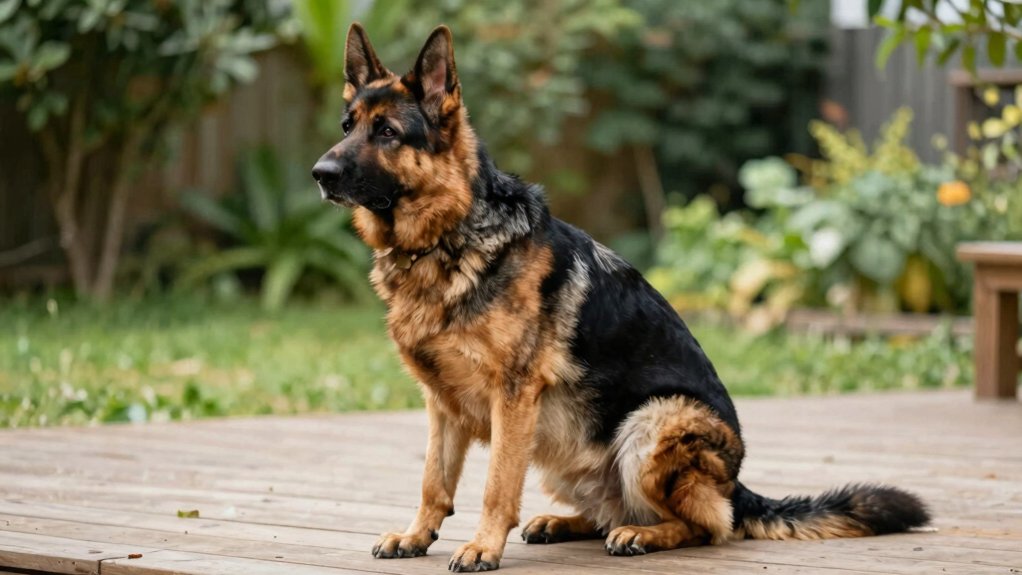
Now that you’ve seen how their size and coat set them apart, the next factor to weigh is temperament and drive. You’ll notice German Shepherds maintain a confident, steady demeanor with moderate reactivity; they relax more readily in a busy home and forgive minor handling lapses.
Belgian Malinois exhibit an intense, high‑alert baseline, needing constant structure; without clear rules they become frustrated, mouthy, or reactive. Both breeds guard instinctively, yet Shepherds distribute loyalty across family members, while Malinois often form a single‑handler “velcro” bond.
Their work drive differs: Shepherds balance task enthusiasm with off‑duty calm, whereas Malinois demand relentless physical and mental engagement. Choose the breed whose drive and emotional regulation align with your service‑oriented lifestyle and will support your community involvement goals daily. German Shepherds also need daily exercise and consistent training to stay balanced, so prospective owners should weigh their time commitment alongside temperament.
German Shepherd vs Belgian Malinois: Training Demands and Required Handler Experience
You’ll notice the Belgian Malinois needs tighter, higher‑intensity sessions, while the German Shepherd tolerates a slightly more relaxed schedule.
This difference means a novice handler can usually manage a German Shepherd with consistent, moderate training, but a Malinois demands an experienced owner who can deliver precise, daily structure. Because German Shepherds combine strong problem-solving ability with trainability, they often adapt well to mentally challenging tasks alongside obedience work.
Recognizing these demands early helps you match your skill level to the breed’s workload and avoid frustration.
Training Intensity Comparison
Because the Belgian Malinois’s work‑drive hits a higher ceiling than almost any other breed, its daily training demands are markedly more intense than those of the German Shepherd, which, while still energetic, tends toward a calmer drive.
You’ll need to provide two or more hours of vigorous exercise plus structured mental tasks for a Malinois, whereas a Shepherd usually thrives on 45–75 minutes of activity and 20–45 minutes of focused cognition each day.
Both breeds require lifelong daily training, but Malinois puppies benefit from firm, short sessions that reinforce impulse control during the boundary‑testing adolescent phase; Shepherd puppies respond best to 10–15‑minute bouts that build obedience without fatigue.
Adult Malinois thrive on high‑arousal sports, while German Shepherds favor steady, moderate‑intensity tasks that cement service reliability consistently.
Handler Skill Requirements
While the German Shepherd can thrive in many committed households, the Belgian Malinois needs a handler with proven experience and the willingness to invest intensive daily work. You must possess at least five years of handling high‑drive dogs or a comparable military, law‑enforcement, or sport background before adopting a Malinois.
Expect to deliver two to three hours of structured exercise, mental challenges, and precise training each day. Your leadership must be confident, consistent, and fair; the breed quickly learns both good and bad behaviors.
In contrast, a German Shepherd tolerates occasional handling lapses and fits active families that can provide regular obedience classes and daily walks without extreme time demands.
Choose the breed that matches your skill level, service commitment, and your noble mission today.
German Shepherd vs Belgian Malinois: Daily Exercise and Mental Stimulation Needs
You’ll notice that Belgian Malinois generally need two to three hours of vigorous activity daily, while German Shepherds thrive with about one to two hours. Keep in mind that a German Shepherd’s exercise requirements by age should be adjusted as the dog moves from puppyhood to adulthood and into its senior years.
Because of this difference, the Malinois benefits from frequent high‑intensity workouts such as running, agility, and bike‑pulling.
The Shepherd does well with a mix of walks, fetch, and moderate endurance tasks.
Both breeds also require structured mental enrichment—30–60 minutes of problem‑solving games for the Malinois and 15–30 minutes of focused obedience or scent work for the Shepherd—to maintain balance and prevent behavioral issues.
Exercise Frequency and Intensity
If you’re deciding whether a German Shepherd or a Belgian Malinois fits your lifestyle, the daily exercise commitment is the first metric to compare.
German Shepherds need 1–2 hours of activity daily—walks, off‑lead runs, fetch, agility, hiking, or swimming—split into two sessions.
Belgian Malinois require at least 2 hours, often 90 minutes of high‑intensity aerobic work plus 30–60 minutes of additional activity, thriving on intervals.
Both follow a 5‑minute‑per‑month‑of‑age rule for puppies, done twice daily to protect growth plates.
Adolescents benefit from 30–60 minutes of structured walking once or twice a day; adults should aim for 60–120 minutes of physical effort.
Pair this with 15–30 minutes of task‑oriented mental work for Shepherds, and 30–60 minutes for Malinois.
Schedule two to three focused sessions daily, inserting rests to preserve joint health and stamina.
Mental Enrichment Strategies
Since both breeds thrive on purposeful work, you’ll need to schedule daily mental enrichment that matches their drive and physical output. Allocate 15–30 minutes of structured training for a German Shepherd and multiple 5–15‑minute obedience drills for a Belgian Malinois.
Incorporate scent work: hide treats, track family members, or run “find the toy” games at least twice weekly, extending frequency for the Malinois. Use puzzle feeders, Kongs, or DIY muffin‑tin challenges each meal, increasing difficulty as mastery occurs. Rotate interactive toys to prevent habituation.
Add advanced tasks such as agility or search‑and‑rescue drills when time permits. Consistent, varied sessions provide the cognitive fatigue each breed needs to remain balanced, focused, and ready to serve.
You’ll notice improved obedience, confidence, and mission‑focused reliability in daily.
German Shepherd vs Belgian Malinois: Ideal Living Situations and Home Environment
While German Shepherds thrive in spacious suburban or country homes with secure, fenced yards, Belgian Malinois generally require even larger, tightly fenced areas to accommodate their higher intensity and need for extensive movement.
You’ll find a German Shepherd fits a country or suburban home where a secure yard lets it expend two‑plus hours of exercise daily, yet it settles comfortably indoors after structured play and mental challenges.
A Belgian Malinois, by contrast, demands a larger fenced lot and a calm, predictable household that can provide at least two hours of focused outdoor work each day.
Both breeds need human interaction; alone periods often cause anxiety.
If your family includes children, a German Shepherd usually adapts more readily, while a Malinois thrives with older kids and handlers.
Before bringing either breed home, ask the breeder for health clearances and a documented pedigree, since a well-bred puppy is more likely to have the stable temperament these demanding living situations require.
German Shepherd vs Belgian Malinois: Common Health Issues and Expected Lifespan
When you compare their lifespans, German Shepherds usually live 9–13 years while Belgian Malinois often reach 12–14 years, giving the Malinois a modest longevity edge.
You’ll notice that both breeds can develop orthopedic issues, but German Shepherds exhibit higher rates of hip and elbow dysplasia, whereas the Malinois’s lighter build generally results in fewer joint problems. Because German Shepherds are prone to hip dysplasia, owners often rely on X-ray screening to diagnose the condition early, when treatments such as weight management and physical therapy can help slow its progression.
Additionally, German Shepherds are predisposed to gastric dilatation‑volvulus, degenerative myelopathy, and exocrine pancreatic insufficiency, while Belgian Malinois primarily face seizure disorders.
Lifespan Ranges Compared
Although registry estimates place German Shepherds at 12–14 years and Belgian Malinois at 14–16 years, real‑world data shows a much tighter gap. In UK scientific records, the median lifespan is 11.3 years for German Shepherds and 12.0 years for Belgian Malinois—a difference of roughly eight to twenty‑four months, not multiple years.
You’ll notice that Belgian Malinois generally benefit from fewer inherited disorders, so many individuals reach the upper end of the 10–14 year range. German Shepherds, by contrast, carry higher rates of epilepsy, degenerative myelopathy, pituitary dwarfism, and gastric dilatation‑volvulus, which can truncate life expectancy.
Orthopedic Concerns Overview
How do orthopedic challenges shape the service lifespan of German Shepherds and Belgian Malinois? You’ll find that hip dysplasia afflicts roughly 19‑20% of German Shepherds versus a lower, but still notable, rate in Belgian Malinois.
Both breeds show joint laxity from birth; limping or bunny‑hopping often appears between six and twelve months in Shepherds and during adolescence in Malinois. Elbow dysplasia follows a similar pattern, affecting about 18% of Shepherds and fewer Malinois, producing stiff elbows, outward rotation, and forelimb lameness as early as five months.
Progressive cartilage loss and osteophyte formation drive chronic pain, reducing agility, jump performance, and rapid deceleration. Early radiographic screening lets you intervene before full workload deployment, preserving functional longevity and keeping your working companion in service longer, effectively.
Breed‑Specific Health Risks
Beyond joint pain, German Shepherds and Belgian Malinois confront distinct systemic health challenges that dictate how long they can serve. You’ll find German Shepherds typically live 9–13 years, often hampered by degenerative myelopathy, epilepsy, gastric dilatation‑volvulus, exocrine pancreatic insufficiency, and pituitary dwarfism.
These conditions can cause hind‑limb paralysis, life‑threatening bloat, chronic malabsorption, and hormonal imbalance, shortening their operational span. Belgian Malinois usually reach 12–14 years, with fewer breed‑specific disorders; occasional idiopathic epilepsy and occasional ocular issues appear, but cancer, cardiac, and endocrine problems remain less common.
Their lean build and careful breeding contribute to longer, healthier careers. When choosing, weigh each breed’s disease profile against the mission intensity you expect, ensuring you can provide vigilant veterinary oversight. Regular check‑ups and early intervention will preserve their service.
German Shepherd vs Belgian Malinois: Why Professionals Often Choose the Malinois
While many handlers still associate the German Shepherd with classic police work, professionals increasingly select the Belgian Malinois because its lean, athletic build translates into superior speed, agility, and endurance on the field.
You’ll see elite units—US Special Operations, Secret Service, and most municipal K9 teams—favor Malinois for rapid acceleration, tight turns, and sprint speeds near 30 mph. Its lightweight, square‑shouldered frame reduces joint strain, extending career length and lowering hip or spine issues.
The breed’s intense work drive, 195 PSI bite, and focused attention produce precise, controlled apprehensions. High intelligence enables rapid mastery of detection, tracking, and protection tasks, making the Malinois a dependable partner in high‑pressure missions.
Today, police forces use Malinois in 90 % of units for explosives and searches, as stamina sustains operations. German Shepherds are generally responsive to training, and their strong intelligence and drive make them a practical choice for handlers who are newer to working breeds.
German Shepherd vs Belgian Malinois: Which Breed Is Right for Your Lifestyle?
If you’re trying to match a dog’s energy, training needs, and living‑space requirements to your daily routine, the differences between German Shepherds and Belgian Malinois become critical.
German Shepherds need about two hours of combined physical exercise and mental tasks, which fits active families, service volunteers, or professionals who can schedule daily walks, obedience work, and interactive play.
Belgian Malinois require roughly two hours of vigorous activity plus ongoing task‑oriented training, so they excel in homes with experienced handlers who engage in advanced sports, protection drills, or intensive work programs.
If your living space is an apartment or lacks a fenced yard, a German Shepherd adapts better with outings, while a Malinois generally needs a secure yard or access to areas to stay balanced.
German Shepherd vs Belgian Malinois: Final Checklist to Choose the Right Breed
Since choosing between a German Shepherd and a Belgian Malinois hinges on several concrete factors, we’ve distilled the decision into a concise, four‑part checklist.
1⃣ Structural: Pick the German Shepherd if you require a larger, heavier dog for endurance. Pick the Belgian Malinois for a lighter athlete suited to intense tactical work.
2⃣ Work drive: Choose the Belgian Malinois for extremely intensive daily operational or sport tasks demanding high energy. Choose the German Shepherd for a high yet slightly less extreme workload.
3⃣ Temperament & training: If you’re a first‑time handler, the German Shepherd’s nature eases learning. If you’re experienced, the Belgian Malinois’ focus and need for leadership reward skill.
4⃣ Health: German Shepherds often have joint issues. Malinois typically enjoy longer, healthier lives.
Frequently Asked Questions
How Much Does It Cost to Own a German Shepherd Vs a Malinois?
You’ll spend roughly $3,300‑$6,400 the first year for a German Shepherd and $3,200‑$7,100 for a Malinois; annual upkeep averages $1,500‑$2,000 versus $2,200‑$3,200. Food, vet, insurance, and gear add $800‑$1,800, $400‑$900, $500‑$1,000, $150‑$300 for the Shepherd.
Are There Breed‑Specific Insurance or Liability Considerations for Each Dog?
You’ll find insurers often label German Shepherds and Belgian Malinois as high‑risk, so you must check policy exclusions, anticipate higher premiums, possibly add riders, and maintain thorough training records to mitigate liability for your practice.
Can Either Breed Be Trained for Competitive Agility or Obedience Sports?
Like a well‑tuned instrument, you can train both German Shepherds and Belgian Malinois for competitive agility and obedience; you’ll find each excels uniquely, and with empathetic guidance, they serve reliably in sport for handlers too.
What Are the Travel and Airline Requirements for Transporting These Breeds?
You’ve got to obtain a veterinary health certificate, current rabies vaccination, and an airline‑approved hard‑sided crate; because adult German Shepherds and Belgian Malinois exceed cabin limits, airlines require cargo or checked‑pet transport with proper documentation.
How Do German Shepherds and Malinois Differ in Compatibility With Other Household Pets?
You’ll find German Shepherds generally adapt well to cats and other dogs when you socialize them early, needing supervised introductions; Belgian Malinois often retain a high prey drive, making small‑pet compatibility difficult despite structured training.