Between 9–12 weeks, keep core vaccines on track, usually every 2–4 weeks (often aiming at 9–12, then again near 14) to beat maternal antibody “blockers.” Book rabies when your vet says you’re within 12–16 weeks, since many laws require it by 4 months. Plan about 18–20 hours of sleep, with wake windows of 45–90 minutes. Potty right after naps, plus every 60–90 minutes. Teach sit and name recall in 3–5 minute sessions, and stop nipping fast by redirecting to a chew. If you keep going, you’ll learn more tips.
Swift Summary
- Continue core vaccines on schedule every 2–4 weeks to beat maternal antibody interference, typically aiming for doses around 9–12, then 14+ weeks.
- Plan rabies and required paperwork by booking rabies once about 12–16 weeks old, aligning microchip timing for certification records.
- Use risk-based non-core vaccines (e.g., Bordetella, Lyme, leptospirosis) based on exposure factors like boarding, daycare, ticks, and travel.
- Expect 15–20 hours/day sleep at 9–12 weeks with awake windows ~45–90 minutes, plus potty right after naps.
- Start early training with short 3–5 minute sessions: crate routine and name recall/sit, and manage nipping via rapid redirection to toys.
German Shepherd Puppy Vaccine Schedule (9–12 Weeks)
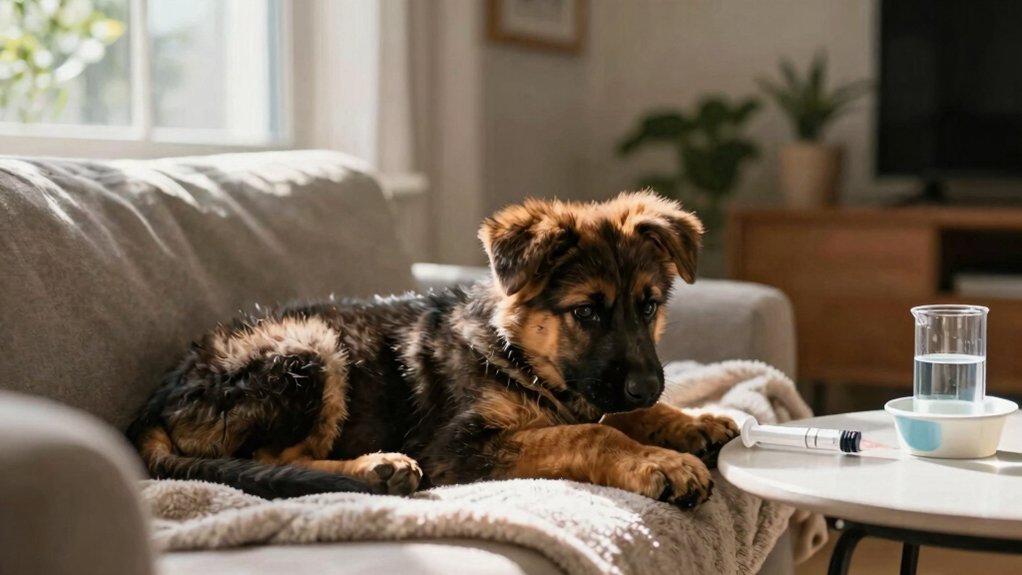
Let’s map out the German Shepherd puppy vaccine schedule for your 9–12 week window, because this is where many pups start to build stronger protection. You’ll treat your 3 month old german shepherd puppy like a moving target, thanks to maternal antibodies, and you’ll keep visits on time, every 2–4 weeks, to beat that interference. While most pups develop normally, a few German Shepherds may be affected by rare conditions like neurological disorders or dwarfism, so mention any unusual growth or coordination problems to your vet at each visit. For a 9 week old german shepherd puppy, you usually continue core shots now, then repeat at 11 weeks, then again by 14 weeks. For a 10 week old german shepherd puppy, you’ll often use the next dose at 12 weeks. For german shepherd after 3 months, plan boosters through at least 16 weeks. In general, core distemper/adenovirus/parvovirus vaccination requires at least 3 combination vaccine doses between 6 and 16 weeks, given 2–4 weeks apart.
When to Book Core Shots and Rabies Timing
When you’re planning your German Shepherd puppy’s next vet visit, start by booking core shots first, because timing them right helps your pup actually benefit from the vaccine. You’ll keep the core series on schedule every 2–4 weeks, often hitting doses around 9–12 weeks, then continuing until at least 16 weeks. Maternal antibodies can block vaccines early, but by 12–14 weeks they fade, so your puppy responds better. Microchip timing matters Vaccination records used for rabies certification must reflect that the rabies vaccine was given after the microchip was implanted, so confirm the microchip is documented before your rabies visit. For rabies, book the first dose once your pup is 12–16 weeks old, since laws often require it by 4 months. This keeps you both caring and compliant. Coat color, including a rare shade like the Isabella German Shepherd color, has no bearing on how a puppy responds to these vaccines, so the same schedule applies to every pup.
Non-Core Vaccines: Choose What Fits Your Puppy
Non-core vaccines can sound optional, but they’re not “no big deal”—they’re “choose based on risk.” Since your German Shepherd’s lifestyle changes what they’re likely to catch, you and your vet should match vaccines to where you live, where you go, and what they’ll be exposed to, like boarding, daycare, ticks, or travel. When in doubt, vaccinate—especially if vaccine status is unknown or overdue—because benefits in most cases outweigh risks. Non-core options include Bordetella, canine influenza, Lyme, leptospirosis, and rattlesnake toxoid. For Bordetella, pick intranasal from 4 weeks for group settings, then do 2 doses subcutaneously 2–4 weeks apart if needed. For Lyme, start a 2-dose series 2–4 weeks apart, then boost yearly where ticks are common. This individualized plan supports long, healthier lives. German Shepherds can also be prone to flea allergies, so discussing year-round parasite prevention with your vet is worthwhile when deciding which exposures your puppy faces.
How Much Sleep Do German Shepherd Puppies Need?
For 9–12 week German Shepherd puppies, aim for about 18–20 hours of sleep each day, split into naps and a longer nighttime stretch.
You’ll also want to plan for short awake windows of roughly 45–90 minutes, then let them crash again for 30 minutes to 2 hours, since their nap cycle keeps them from getting overtired.
And when they wake at night, expect about 6–10 hours total sleep with a few breaks, because their body clock is still maturing. Establishing a consistent daily routine early on supports healthy development, a principle that carries through lifelong German Shepherd care from puppyhood to the senior years.
Daily Sleep Targets And Ranges
Typically, 9–12-week German Shepherd puppies sleep about 18–20 hours per day, including naps and nighttime rest, so if your pup seems to “disappear” for long stretches, that’s usually normal.
You can think of it as total rest, not nonstop sleep.
At this age, many guides list a broad band of 15–20 hours (sometimes 16–20), and a large-breed range near 16–18.
Nighttime often runs 6–8 hours, plus 8–12 more in daytime naps.
If sleep drops under 14 hours, double-check, then adjust support.
Awake Windows And Nap Cycles
At 9–12 weeks old, your German Shepherd puppy usually needs a nap after about 45–90 minutes of awake time.
Aim for 45–60 minutes at 8–10 weeks, then work toward ~90 minutes as they grow.
After that, don’t push it.
If you do, you’ll see frantic, chaotic zoomies, extra mouthiness, and poor response to cues.
Plan a repeat cycle, wake, potty, a short play or training burst (2–5 minutes), then rest.
Most puppies do best napping about every 1–1.5 hours, often 2–3 hours at a time.
Use a crate or pen, with calm lights.
Build a 9–12 Week Nap-and-Potty Routine by Age
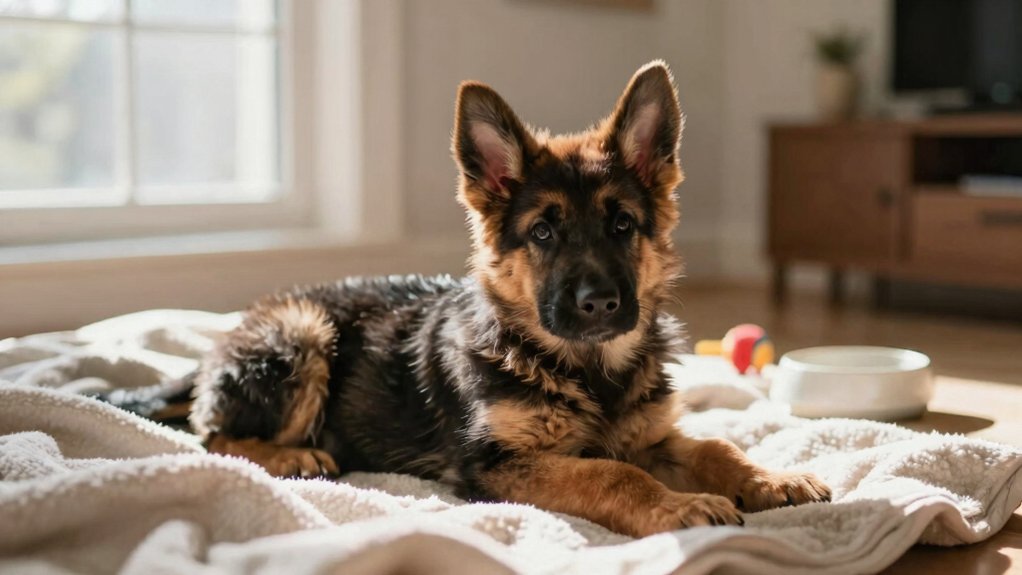
So once your German Shepherd hits the 9–12 week mark, you’ll build a simple daily rhythm that matches their sleep needs and their tiny bladder.
At 9 weeks, expect naps every 1.5–2 hours, because they’re awake only 30–45 minutes, then boom—sleep again.
Immediately after each nap, take them outside for potty.
Aim for every 1–2 hours while awake, plus a trip 15 minutes after meals or big drinks.
At 10 weeks, keep the same nap timing, but potty at least every 2 hours.
At 11–12 weeks, lengthen wake to 60–90 minutes, yet keep potty after naps, meals, play, and bedtime.
Consistent timing and a set potty spot help puppies learn faster, and crate training can make these scheduled trips easier to manage.
Use Crate Training to Prevent Accidents (Step-by-Step)
Set a simple crate schedule for your 9–12 week German Shepherd puppy, with crate time about (age in months + 1) hours, and plan potty breaks every 60–90 minutes. Choose a properly sized crate that lets your puppy stand, turn around, and lie down comfortably, since extra space can encourage accidents.
When your puppy goes in, use tiny treats and a calm routine, tossing them in so the crate feels safe and rewarding, not scary.
But don’t just leave them. Keep the door closed for short bursts first, like 10–30 seconds, then slowly build up while you stay nearby and watch for the next potty cue.
Set Crate Schedule And Routine
To help your 9–12 week old German Shepherd stay accident-free, you’ll want a crate schedule that matches their bladder and attention span.
Follow this daily rhythm, and you’ll protect sleep and house-training progress.
Morning: potty at 6–7 a.m., breakfast, then supervised play before the first nap.
First nap: 1–2 hours in the crate, then potty and a short walk.
Midday: after meals and training, crate for another 1–2 hour nap.
Late afternoon: 1–1.5 hours.
Evening: potty, calm play, final potty, then nighttime crate.
For 9–10 weeks, 30–60 minutes max; for 11–12 weeks, up to 2 hours, never back-to-back.
Track whining, accidents, stress.
Use Treats For Positive Confinement
Treats make crate training feel safe and even a little keen for your 9–12 week old German Shepherd.
Place the crate in your main living area, add comfy bedding, and add safe chew toys.
Before you use treats, toss a few high-value soft treats at the entrance and just inside.
Encourage short exploration, then shape voluntary entry: toss one small treat in.
Repeat until stepping in is fast and keenness.
Add a cue like “crate” right before each toss.
When your puppy stays calm, deliver treats through the door, close it for 1–2 seconds, then open and reward.
Gradually lengthen, and use a food puzzle to enjoy settling.
Teach Name Recall and Sit in 5-Minute Sessions
Start with a quick, calm win—because your 9–12 week German Shepherd puppy learns best in tiny lessons that don’t wipe them out. In a quiet, low-distraction room, do 3–5 minute sessions. Use a “yes” marker or click, plus high-value treats.
Start with a quick, calm win: 3–5 minute sessions in a quiet room, using a “yes” marker or click and high-value treats.
Say your puppy’s name once, then wait for instant eye contact. Mark and reward fast, like 20 marked responses per session. In about 3–5 days, aim for a head turn within one second.
Next, pair the name with your recall word, like “come,” indoors, short distance, step back, reinforce every return.
Finally, teach sit by luring nose up, bottom down, marker on contact, then reward. Once sit is reliable, you can move on to other essential commands that build obedience and provide valuable mental stimulation.
Handle Nipping and Mouthing With Redirection Every Time
When your 9–12 week German Shepherd puppy mouths or nips during play, you redirect right away—every single time. Hand them a tug toy or chew within 1 second, and if they keep biting you give a brief attention break for about 10–20 seconds, then try again with the toy right at their mouth. This “redirection” (moving biting from skin to a safe object) helps them learn what’s okay, and it stops rough play from getting attention. Pairing this with consistent boundaries teaches your puppy that human skin is not a chew toy.
Redirect To Appropriate Chews
Right now, you can reduce nipping fast by setting up chew options before your puppy even mouths you. Place approved chew toys at mouth level in every main room, and offer one right before hands or feet get close.
When mouthing starts, swap in a plush toy or chew immediately, then calmly withdraw attention once your puppy chooses the toy. Keep the same set of outlets daily so the lesson sticks.
Rotate textures and shapes. Choose safe, age-appropriate chews, like hard nylon or durable puppy teething rings.
Avoid antlers, pig ears, hooves, foam-stuffed, and anything with metal. Inspect and replace damaged toys.
Manage Nipping During Play
As soon as your 9–12 week German Shepherd puppy bites or mouths your hand or skin during play, treat it like a clear “too much” signal—then immediately interrupt the game every single time.
Give a sharp, non-scary “yip/ouch,” then make your hand still and uninteresting, no more wrestling.
Next, turn away, fold arms, or step out for 10–20 seconds, keeping calm eye contact when you return.
Repeat gently, but remove attention longer if it happens again, up to 1 minute.
Keep sessions short, choose fetch or tug with cues, and reward sniffing or licking instead of teeth-on-skin.
Start Leash Basics and Mat-Settle Practice Soon (12–16)
Start leash basics and mat-settle practice soon, because this 12–16 week window is perfect for building calm habits before excitement spikes.
Start leash basics and mat-settle practice early—this 12–16 week window builds calm habits before excitement spikes.
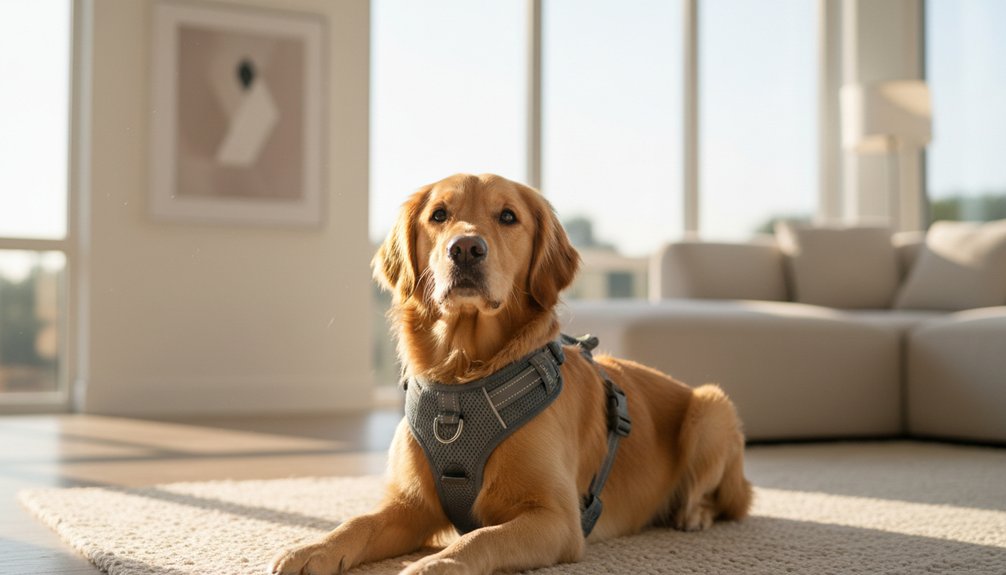
Start with brief, 3–5 minute indoor sessions. Clip on a light flat collar or harness, then add a 4–6 foot leash. A front-clip harness can help steer a puppy back toward you when the leash goes tight, which makes stop-and-go practice easier.
Let it drag only under close watch. Practice stop-and-go: walk 3–5 loose steps, stop the instant leash tension appears, wait for slack, mark, and reward by your side.
Then move to a quiet outdoor spot for 5–10 minutes on grass. Use your mat for short settles, rewarding calm check-ins.
Avoid jerks or punishment.
Plan Safe Socialization During the 12–14 Week Fear Period?
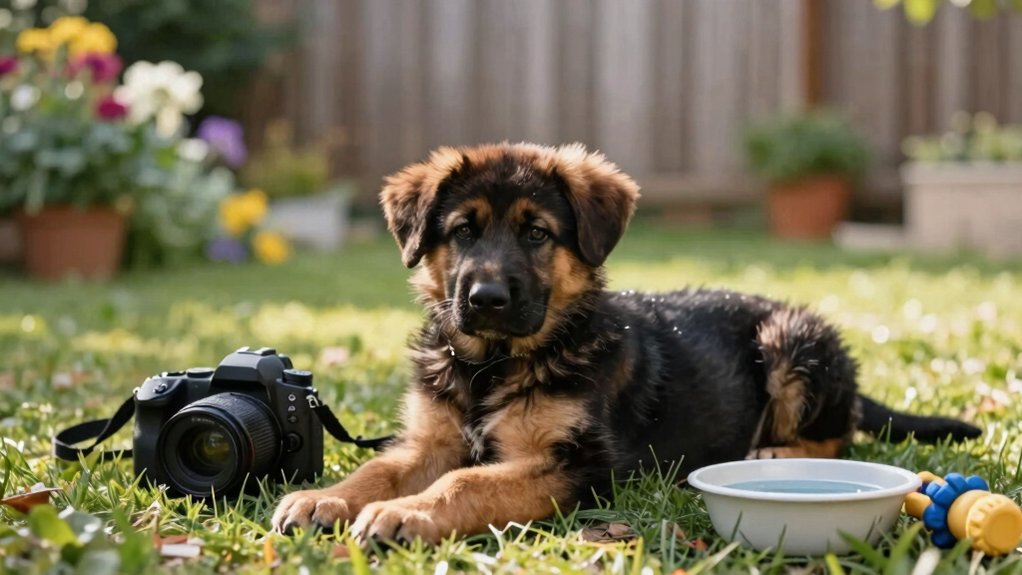
During the 12–14 week fear period, you’ll want to keep socialization going, but with extra care, so your German Shepherd puppy feels safe and stays curious.
Aim for short, frequent outings, 3–10 minutes, in quiet places.
Pair every new thing with high-value treats, play, or calm touch.
Start with predictable, low-traffic streets, then parks with distance.
Invite one or two new humans per session, varied clothes and ages.
For sounds, keep volume low, like a distant doorbell, and repeat often.
Let your pup choose approach or retreat.
Watch for cowering or freezing, then lower intensity.
Choose healthy, vaccinated, gentle dogs only.
Once your puppy is comfortable with outings, you can also add short games and puzzle toys that offer mental activities to help use up energy and prevent boredom.
Frequently Asked Questions
What Treats Are Safest for German Shepherd Puppies During Training?
Use soft, easily breakable puppy treats in tiny, nail-sized pieces; choose low-calorie, single-protein or commercial training treats, or break freeze-dried meat. Avoid chocolate, grapes/raisins, onions, garlic, xylitol, and salty, greasy, heavily seasoned foods.
When Can I Introduce Grooming Tools Like Brushes and Nail Grinders?
Start now, like planting seeds: introduce soft brushes at 8 weeks with brief calm sessions. Let nail tools in at 8–10 weeks for sniffing and touch only; begin gentle trimming/grinding around 12 weeks, gradually, with treats.
How Do I Prevent Overexcitement During Play to Avoid Nips?
Prevent overexcitement by keeping play short and predictable, watching arousal cues, and stopping instantly when mouthing escalates. Use calm body language, switch to chew toys, and pause for quick calm-down treats, so nips stop before they start.
Should I Switch to a Larger Puppy Harness at 10–12 Weeks?
Yes—switch when it no longer fits: look for two-finger space under each strap, not maxed adjustment, no chafing, and normal breathing. At 10–12 weeks puppies often outgrow fast, so remeasure chest weekly.
How Can I Tell Normal Puppy Behavior From Pain or Illness?
You can tell normal vs illness by watching change over time: healthy puppies play in bursts, sleep, and eat consistently. If you see sustained lethargy, refusal to eat, repeated vomiting/diarrhea, limping, guarding, or pain when touched, call your vet.