If your German Shepherd puppy looks “dwarfed” or oddly small, don’t just guess “Down syndrome.” Pituitary dwarfism (autosomal recessive LHX3) often shows slow growth after weaning, retained puppy coat, and delayed permanent teeth. Start with thyroid-axis tests: total T4, then free T4 and endogenous TSH, since pituitary cases show low T4 with low/not-rising TSH. Hydrocephalus and congenital hypothyroidism can mimic it, and short spine syndrome (abnormal vertebra ossification) causes a visibly short spine. Keep going for the key clues and vet timelines.
Swift Summary
- Pituitary dwarfism in German Shepherds can cause dwarf adult size, slow growth, and retained puppy coat.
- “Down syndrome” labeling is often incorrect; canine trisomy 21 can’t occur like human trisomy 21.
- Pituitary dwarfism is autosomal recessive (LHX3); carriers are healthy, so testing is essential before breeding.
- Diagnosis uses thyroid-axis testing (total T4, ±free T4, TSH) showing low T4 with low/non-rising TSH.
- Treatment includes oral levothyroxine and sometimes growth hormone, plus monitoring IGF‑1, glucose, kidneys, and dental retention.
Pituitary Dwarfism: What It Looks Like in German Shepherds
Pituitary dwarfism is one of those conditions that can sneak up on you, because your German Shepherd puppy can look totally normal at birth. But after weaning, you’ll notice slow growth, small weight gain, and a proportionate, “dwarf” adult size. Compare your pup to littermates around 3–8 weeks. You may also see a persistent puppy coat—retained soft hairs with patchy, symmetric hair loss on trunk and neck, with tufts on head and legs. In classic cases, retained puppy coat can become more obvious as the pup gets older. Skin can darken and get irritated, sometimes leading to infections. Dentition may lag, deciduous teeth can stick around, and some may show mild neurologic signs like instability. Because these pups already struggle to gain weight, keep toxic foods such as grapes, onions, and chocolate out of reach at all times.
Pituitary Dwarfism Genetics: Autosomal Recessive Explained
Now that you’ve seen how pituitary dwarfism shows up in growth and coat, let’s talk about *why* it happens genetically—because it’s all about one gene and how it gets passed in families.
Pituitary dwarfism comes from an autosomal recessive mutation in the LHX3 gene. Autosomal recessive means a dog needs two changed copies to show disease, one from each parent. Carriers—dogs with one changed and one normal copy—look healthy, but they pass the mutation on. You can’t tell by appearance alone. In carriers × carriers, you expect ~25% affected, 50% carriers, and 25% clear puppies.
genetic testing is required to prevent mating of two carriers.
How Pituitary Dwarfism Is Diagnosed and What Tests Help
You start by watching for clear growth delay in a young German Shepherd, plus signs like a puppy coat that won’t change, thin hair, and slow eruption of permanent teeth. Owners should also watch for recurrent skin infections and unexplained weight loss, since these can accompany many common German Shepherd health problems. Then you do endocrine testing, and thyroid levels matter a lot—ask your vet to measure T4 and thyroid-stimulating hormone (TSH), because pituitary dwarf dogs often run low on both, pointing to hormone deficiency rather than plain malnutrition or parasites. Because juvenile-onset panhypopituitarism (pituitary dwarfism) involves incomplete development of the anterior pituitary that disrupts normal hormone output (pituitary dwarfism), you’ll be on the right track for pituitary dwarfism and can move to the next round of pituitary tests.

A COMPLETE CANINE SUPPLEMENT - A multivitamin (Vitamins A, B, C, D, E, K & other minerals) PLUS Essential Fatty-Acids for Skin & Coat Support, Glucosamine for Hip & Joint Support AND Probiotics to promote the absorbtion of nutrients for Digestion and Gut Health.

Healthy Breeds Omega HP is a high potency, veterinarian-recommended, comprehensive blend of essential fatty acids for your dog that are necessary for optimal health and must be obtained through their diet, as they are not produced in the body

Treat your German Shepherd to a nutrient-rich supplement they deserve. Formulation meets the nutritional needs of German Shepherds, supporting joint health, muscle recovery, and overall well-being.
Clinical Signs And Growth Delay
Often, pituitary dwarfism shows up as a slow, steady growth problem that you can spot before it becomes obvious. You’ll notice marked growth delay, and your dog stays small and well-proportioned versus littermates.
After the first weeks, growth slows, weight gain drops, and puberty never brings the expected adult height or weight, even with good food. You may also see puppy-like features stick around, with delayed epiphyte closure lasting up to 4 years.
And the coat can look “woolly,” with retained puppy hair, then gradual, symmetric hair loss on trunk and neck, dark skin, scaling, and repeat skin infections. You’ll also watch delayed teeth and possible neck instability.
Endocrine Testing: Thyroid Levels
To diagnose pituitary dwarfism in German Shepherds, you start by checking thyroid hormones, because the pituitary gland controls them.
Next, run a thyroid panel: total T4 first, since it’s a common screening test with ~90% sensitivity.
If T4 is low-normal, add free T4 (fT4) and measure endogenous TSH.
In pituitary causes, you usually see low T4 plus low or not-rising TSH, not high compensating TSH.
And if needed, confirm thyroid axis response with TSH stimulation, then follow with GH/IGF‑1 and full pituitary tests for a complete picture.
Treatment Options for Pituitary Dwarfism and Thyroid Support
You’ll start thyroid support by giving oral levothyroxine, a synthetic thyroid hormone, often around 20–22 µg/kg every 12 hours, then adjust based on clinical signs and blood work like total T4, free T4, and canine TSH.
But don’t stop there—monitoring matters, so you’ll recheck levels regularly and watch for steady energy, a better hair coat, and normal weight as metabolism shifts over weeks.
And while you consider growth hormone options, you’ll also give supportive care for skin issues and any complications, because timely hormone treatment can improve survival and quality of life, not just numbers. Because German Shepherds are often compared with other breeds for their bite strength, it helps to remember that PSI figures are estimates rather than precise measurements.

It is a significant dietary factor in preventing fatty-liver syndrome in diabetic dogs It can donate methyl groups needed to synthesize other compounds It is necessary for...
Thyroid Hormone Replacement Therapy
When your German Shepherd has pituitary dwarfism, thyroid hormone replacement therapy usually becomes a lifelong plan, because the condition often causes secondary hypothyroidism (low thyroid hormone made from a problem in the brain’s pituitary area).
You’ll typically use oral levothyroxine, a synthetic T4 hormone. Start by giving the dose on an empty stomach, once or twice daily.
Common starts run about 20–22 µg/kg every 12 hours, or 0.02 mg/kg twice daily by guidelines, often using lean body weight if overweight.
Then you titrate slowly and recheck thyroid levels regularly.
You should see coat and energy improve in 4–8 weeks.
Monitor Growth And Metabolic Health
As your German Shepherd starts pituitary dwarfism treatment, you’ll get the best results by monitoring growth and metabolism step by step, not just guessing how he feels.
Use porcine growth hormone at 0.1–0.3 U/kg, under the skin, three times weekly for 4–6 weeks.
Then, track IGF-1 (growth signal) and sometimes GH levels, so you don’t overdose.
Check blood glucose often, since treatment can trigger diabetes.
Weigh him and score body condition, every week, to spot healthy gain vs obesity.
Also do periodic urinalysis and biochemistry.
Adjust dose frequency—every 3 weeks, then 6—based on labs.
Supportive Care For Complications
Supportive care matters because pituitary dwarfism isn’t only about height, it’s also about keeping the body’s systems working smoothly while you treat the hormone gaps.
Start thyroid support with oral levothyroxine, about 22 mcg/kg every 12–24 hours, usually for life. Check serum T4 often, and adjust to prevent too much thyroid hormone.
Then, consider porcine growth hormone, 0.1–0.3 U/kg subcutaneously, three times weekly for 4–6 weeks, if you can obtain it.
Or, use progestagens like medroxyprogesterone 2.5–5 mg/kg every 3 weeks, but only after spay, due to risks like mammary issues and pyometra.
Long-Term Care for Pituitary Dwarfism: Kidneys, Teeth, Hearing
If you’re caring for a dog with pituitary dwarfism, think “long game,” because kidney issues and dental problems often show up and build slowly over time.
Track kidneys: ask for baseline and serial plasma creatinine, blood urea nitrogen, and electrolytes during hormone therapy.
Do urinalysis often, check urine specific gravity, protein, and glucose for early damage.
Also, watch hearing and comfort, since hormone shifts can cause vague signs.
For teeth, expect delayed eruption or missing permanent teeth, plus retained baby teeth and crowding.
Schedule regular oral exams, remove retained deciduous teeth when needed, and plan cleanings every 3–6 months. Because dogs with pituitary dwarfism are smaller and may have altered energy needs, portions should be planned with calorie guidance tailored to age, size, and activity.

Urinary Tract Infection Support: Help clear out harmful impurities and maintain a clean system. This powerful formula protects the urinary tract for dogs while soothing active burning discomfort.

Herbal and mushroom whole food supplement designed to help support your dog’s kidneys. All natural, with NO synthetic ingredients.

Kidney Supplement for Dogs: Canine Renal Support provides support for the normal function of dogs' kidneys while also supporting essential systems related to renal support
Down Syndrome” in Dogs: Why It Isn’t a Real Diagnosis
When you see a dog with a “Down syndrome” label on social media or from a well-meaning owner, pause and look at the facts first.
Down syndrome describes a human genetic condition, caused by extra human chromosome 21, called trisomy 21. Dogs have 78 chromosomes, 39 pairs, and no chromosome that matches human 21, so this exact biology can’t happen.
Down syndrome is a human condition from extra chromosome 21 (trisomy 21); dogs can’t share this exact genetic biology.
Also, chromosome numbering doesn’t transfer between species.
No peer-reviewed cases confirm canine trisomy 21.
If a dog seems different, you’re likely seeing another congenital issue. Similarly, a German Shepherd’s unusual behavior is often blamed on breed stereotypes, but canine behavior is shaped by genetics, socialization, and environment more than breed alone.
Offer kind, accurate veterinary care, not a wrong label.
Which Conditions Get Miscalled “Down Syndrome” in German Shepherds
You might see a German Shepherd online labeled “Down syndrome,” but most of the time that label is really covering something else entirely—usually a real genetic or birth defect that affects growth and brain function.
Pituitary dwarfism, caused by an LHX3 gene deletion, shrinks growth and delays hormone maturity.
Congenital hypothyroidism also slows growth and can dull the mind.
Hydrocephalus, with extra fluid in the brain, changes skull shape and behavior.
And a portosystemic shunt, a liver blood-vessel defect, can cause stunted growth plus seizures.
If your dog looks “similar,” ask your vet for specific tests.
Unlike these birth defects, degenerative myelopathy is an adult-onset condition in which the spinal cord gradually deteriorates, causing progressive weakness in the hind legs.
Congenital Hypothyroidism vs Pituitary Dwarfism: Key Differences
Right in the puppy months, congenital hypothyroidism and pituitary dwarfism can look similar at a glance, but they start from different hormone problems.
In puppy months, hypothyroidism and pituitary dwarfism can look alike, but each reflects a different underlying hormone failure.
You’ll help most by watching the pattern.
Hypothyroidism stems from poor thyroid hormone (T4) from the thyroid itself, causing disproportionate dwarfism, short limbs, broad trunk, widened skull, and delayed bone and tooth timing.
You may also see lethargy, weight gain, slow heart rate, and cool body.
Pituitary dwarfism comes from inherited pituitary underperformance, so growth hormone and several other hormones drop.
It causes proportionate small size at 2–3 months, retained puppy coat, and later extra gland weakness.
Tracking your puppy’s weight against an age-based growth chart and performing a body condition assessment can help you spot early warning signs of either condition.
Hydrocephalus and Endocrine Disorders That Mimic Down Syndrome Traits
You might notice Down syndrome–like traits in a German Shepherd, but hydrocephalus and endocrine disorders can cause similar “look and learn” problems in a completely different way.
Hydrocephalus builds up cerebrospinal fluid, raising pressure in the brain, which can lead to dullness, learning trouble, and a dome-shaped skull, often showing up within the first weeks.
And congenital hypothyroidism or pituitary dwarfism can slow hormone-driven growth and brain development, so you may see disproportional dwarfism, delayed eye/ear opening, and late dentition as early as 2–4 months—especially if growth stalls by the 6-week mark. Because these hormonal problems can also trigger patchy hair loss, a puppy showing both stunted growth and bald spots should be evaluated by a veterinarian promptly.
Hydrocephalus Brain Development
Hydrocephalus can sound scary, but understanding it helps you spot problems early, and that timing really matters.
Hydrocephalus is CSF buildup, caused by blocked flow or poor absorption.
In dogs, congenital cases start from in‑utero drainage maldevelopment.
Acquired cases follow infection, tumors, bleeding, or inflammation.
As pressure rises inside brain spaces, it compresses tissue, first with limited compensation, then with progressive cortical atrophy.
In congenital internal hydrocephalus, signs often appear at 8–12 weeks, or within 6 months, right during rapid brain growth.
Watch for enlarged dome skull, persistent fontanelle, seizures, blindness, dullness, and house-training difficulty.
MRI can reveal widespread network disruption.
Congenital Hypothyroidism Mimics
When you’re watching an infant who’s delayed growth, low muscle tone, and a puffy, “coarse” look, it can help to remember that congenital hypothyroidism can wear a Down syndrome–like disguise.
Myxedematous facial features, flat nasal bridge, macroglossia (large tongue), thick dry mottled skin, and abdominal distension can mislead you.
And severe fetal iodine deficiency can add growth failure, intellectual disability, and spasticity.
Because newborn features overlap with chromosomal conditions, ask for prompt thyroid testing and chromosomal analysis.
You’ll help prevent delay in care, especially within the first weeks.
Endocrine Growth Delay
Endocrine growth delay can look surprisingly familiar, because low hormone signaling can shrink growth and change the face in ways that people sometimes mistake for a chromosomal condition.
In dogs, you’ll see proportionate small stature, slow growth, and late permanent teeth.
Growth plates may stay open up to 4 years.
Often, the pituitary gland makes too little growth hormone.
You might also find low TSH, gonadotropins, or prolactin, which can delay maturity, cause infertility, and dull skin and coat.
And if chronic, you can see weaker immune responses, extra illness risk, and behavior shifts.
Ask your vet about LHX3-linked causes.
Short Spine Syndrome in German Shepherds: Signs You Can Spot
If you’re wondering whether your German Shepherd might’ve Short Spine Syndrome, start by looking at the big picture—then zoom in on what your dog can (and can’t) do comfortably. Remember that a large frame alone isn’t a warning sign, since giant German Shepherds can naturally grow taller and heavier than standard-sized dogs of the breed.
You’ll often notice a shortened body length, a hunchback posture, and a sloping back instead of a straight topline.
The neck may seem “missing,” with the head stuck near the shoulders.
When you call them, they can’t rotate the head alone, they turn their whole body.
Watch movement too.
Stride gets short, jumping and climbing feel hard, and they rest more.
Check for a curled, kinked tail, barrel chest, and reduced rib area.
Short Spine Syndrome Causes and How Severe Cases Are Managed
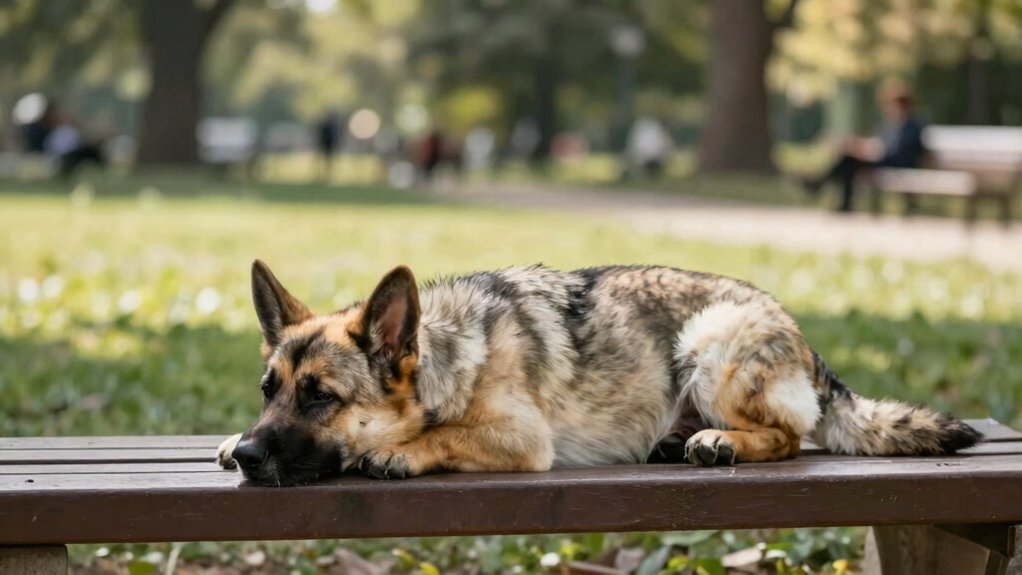
Short spine syndrome in German Shepherds starts in the womb.
You should know it’s a congenital, genetic-and-development issue, where vertebrae don’t ossify normally, meaning they stay soft cartilage too long.
This can lead to compression and fusion, so the spine shortens.
Research points to DLL3 protein mutations, but many genes are likely involved, so it’s polygenic.
It’s recessive, so both parents may carry silent changes.
In severe cases, you manage pain early, monitor spinal curvature, and adjust movement supports.
Watch posture, because altered biomechanics strain joints. Owners should also watch for signs of hip dysplasia, a common joint disorder in German Shepherds that can worsen with abnormal movement.
If mobility drops, you prevent pressure sores and plan hygiene help.
When to See a Vet: Screening Timelines for Rare Congenital Issues
When you notice something off in a German Shepherd puppy’s growth, body shape, or development, you don’t wait around—you book a vet visit right away and start a screening plan.
In the first weeks, if you see a very short spine, odd torso-to-head proportions, or early neurologic signs, ask for exam and imaging referral fast.
If lethargy, poor feeding, or failure to thrive shows up, push for tests for endocrine or metabolic issues, like congenital hypothyroidism or portosystemic shunt.
From puppy to juvenile age, when growth lags by months and the coat stays soft, schedule endocrine screening, often IGF‑1 and hormone panels.
For predisposed lines, plan pre-breeding checks.
Healthy Breeds Puppy Multi-Vitamin is a daily supplement that compliments a puppy’s diet to help provide all the nutrients they need!

A COMPLETE CANINE SUPPLEMENT - A multivitamin (Vitamins A, B, C, D, E, K & other minerals) PLUS Essential Fatty-Acids for Skin & Coat Support, Glucosamine for Hip & Joint Support AND Probiotics to promote the absorbtion of nutrients for Digestion and Gut Health.

BONE MUSCLE BUILD: For balanced puppy growth and structural development of bones, muscles, cartilage, and soft tissue using digestible nutrients for steady frame and mobility foundation in puppies and growing dogs for growth phase mobility stages
Frequently Asked Questions

Polyurethane Foam: The EHEYCIGA orthopedic dog bed features memory foam and egg crate foam to provide even support and pressure relief. It offers a good balance of softness and support, making it particularly suitable for elderly dogs to alleviate joint pressure.

🐶COMFORT AS PRIORITY: Large Dog bed with C-shape chaise design creates a cozy and inviting space that promotes comfort and security, offering your pet a variety of cozy positions to snuggle. The fence-like design makes the dogs feel more secure lying in it. The 4-sided 3.5" side bolster of dog pillow adds extra support to your pet's neck and head on for optimum lounging comfort.

All SIZE SUPPLIED: EHEYCIGA dog beds for medium, large and extra large dogs have many sizes which can fit all kinds of scenes including using in dog kennels and crates, and placing directly on the floor to bring you convenience to choose the best suitable dog bed for large dogs.
How Early Can Pituitary Dwarfism Be Suspected in German Shepherd Puppies?
You can suspect pituitary dwarfism as early as 9 weeks, especially if a puppy shows slower growth than littermates. Most often you’ll notice it between 2–5 months, when height/weight milestones lag and the coat stays “puppy-like.”
Can Pituitary Dwarfism Carriers Appear Completely Normal on Physical Exams?
Yes—you’ll see that carriers can look completely normal on routine physical exams; they won’t show dwarfism signs. Since only genetic testing confirms heterozygosity, you should rely on DNA results to guide responsible breeding decisions.
What Kennel Tests Confirm “short Spine Syndrome” Without Confusing It With Other Deformities?
Use full-spine lateral and VD radiographs to count vertebrae, assess compression/fusion, and note abbreviated rib cage; then refer equivocal cases for CT/MRI. Add a focused neuro exam to rule out other causes of compression.
Are There Any DNA Tests Available for Pituitary Dwarfism in German Shepherds?
Yes—several labs offer PD-LHX3 DNA tests for German Shepherd pituitary dwarfism. You can sample with EDTA blood or cheek swabs, send to clinics like Laboklin/CAGT/Genomia, and receive clear/carrier/affected results in about 2–4 weeks.
What Daily Accommodations Help a Dog With Short Spine Syndrome Stay Comfortable?
You’ll keep your dog comfortable daily by using non-slip ramps, low reachable furniture, a supportive orthopedic bed, elevated food/water bowls, short frequent walks, and avoiding jumping or stairs; monitor pain signs and call your vet fast.