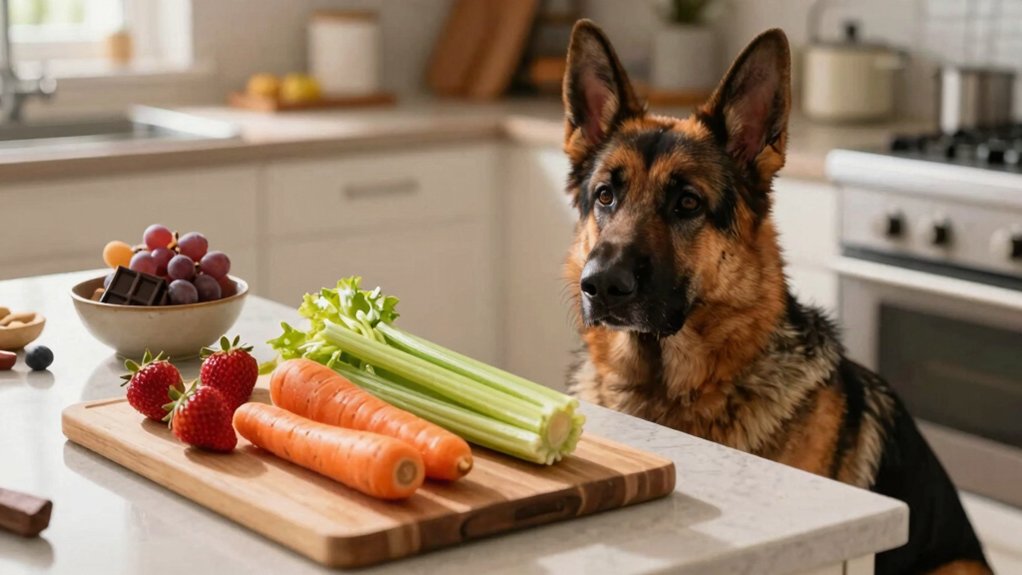
You can safely give your German Shepherd small, well-prepped fruit and veggies. Try 1–2 tablespoons of sliced apple (core and seeds off), small berry pieces, or seedless watermelon, as a midday topper. For veggies, use cut cucumber, celery, lettuce, bell pepper, cooked carrots, or steamed pumpkin/squash. But never feed grapes/raisins, cherries, onions/garlic, chocolate, xylitol, alcohol, coffee, bones, salty scraps, or fatty table food. Always remove pits and rinds, watch for vomiting/diarrhea, and call the vet right away if you suspect toxins—there’s more you can learn next.
Swift Summary
- Feed only safe fruits/veggies in small “toppers” portions: 1–2 tablespoons fruit, and cut everything into bite-size pieces.
- Avoid grape and raisin products completely, as they can cause sudden acute kidney failure within 6–24 hours.
- Skip allium plants (onion, garlic, leeks, chives) in any form due to hemolytic anemia risk from even small exposures.
- Never give chocolate, xylitol, alcohol, or coffee, and seek urgent help if accidental ingestion occurs.
- Remove seeds, pits, cores, and thick rinds to prevent choking and GI upset; stop and call a vet if vomiting/diarrhea lasts.
Safe Fruits for German Shepherds (Quick List)
Can german shepherds eat apples? Yes, sliced, core and seeds out.
Can german shepherds eat strawberries, blueberries? Yes, small pieces.
Can german shepherds eat watermelon? Yes, with rind and seeds removed.
Offer 1–2 tablespoons. German Shepherds shed heavily year-round, so regular brushing helps control loose fur and dander around the home.
Never give pits.
Avoid things german shepherds can t eat—grapes, raisins, cherries, avocado.
Safe Veggies That Won’t Upset Your German Shepherd
Safe veggies can be a fun, low-calorie way to add crunch to your German Shepherd’s day—just keep it simple and small. Choose plain, bite-sized greens, like cucumber and celery, served raw and cut small. Serve only small portions and keep the add-ons as occasional extras alongside a complete, commercially made dog food. Add green beans for fiber, but keep portions moderate to avoid gas. Bell peppers and lettuce also work well, sweet and light. For roots, offer cooked carrots, or steamed pumpkin and squash for gentle support. Peas are fine too, raw or cooked, again plain. Serve without oil, salt, butter, or seasonings, and you’ll help prevent tummy trouble. A healthy diet supports a glossy coat, and regular brushing with an undercoat rake keeps that thick double coat looking its best.
Portion Rules: How Much Fruit/Veg to Give
And yes, treat sizes matter. For a typical adult German Shepherd, that 10% often means just a few bites per day. Because a German Shepherd’s daily calorie needs depend on its age, size, and activity level, the 10% limit should be calculated from that individual dog’s total rather than a fixed number.
Use veggies as the bigger share, and reserve higher-sugar fruit for smaller portions. Spread treats across the day, not all at once.
If you add fruit or veg, cut back other snacks to stay at 10%.
Remove Seeds, Pits, Cores, and Rinds
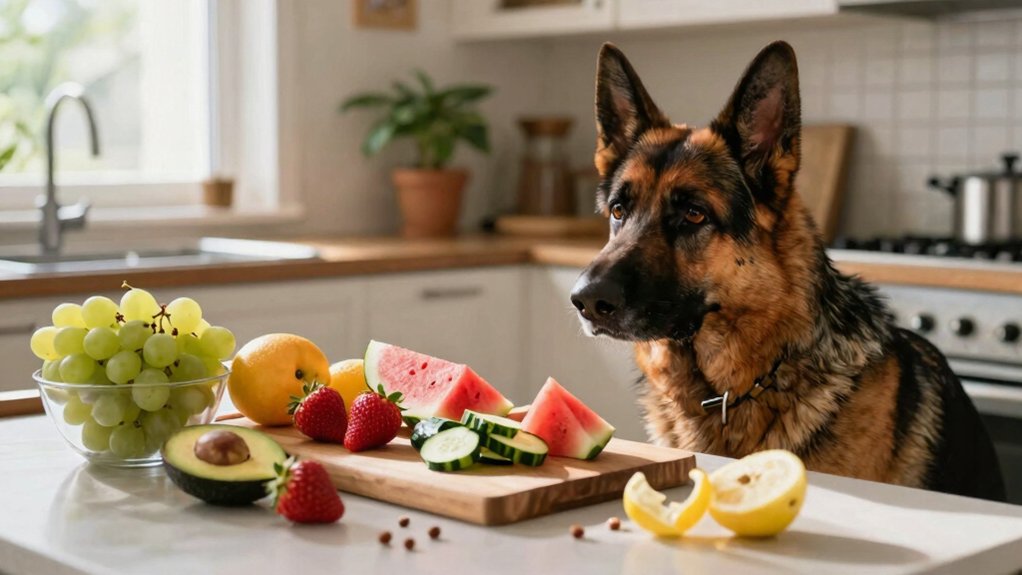
Before you hand your German Shepherd any fruit or veggie, you’ve gotta remove the risky parts—seeds, pits, cores, and thick rinds.
Seeds and pits can release cyanide compounds, especially if they’re crushed, which can cause serious issues in hours.
Hard pits also cause choking, and thick stems, peels, skins, and rinds don’t digest well, leading to upset or intestinal blockage.
Cut apples into small, seedless bites, remove the core too.
Take out pear pits and seeds.
For watermelon, skip the rind and remove the seeds, or choose seedless.
Serve only soft, flesh portions.
Fruits to Never Feed: Grapes and Raisins
Keep grapes away from your German Shepherd, because even a few can trigger sudden acute kidney failure, and that can happen within about 6–24 hours. Grape toxicity is separate from eye problems, which in German Shepherds often involve redness, cloudiness, or changes in vision.
Raisins are just as dangerous, and they can set off toxic kidney reactions with no “safe” amount you can count on, so don’t guess.
And whatever you do, include no grape products at all: no fresh grapes, no seedless grapes, no currants, no sultanas, no raisins, and no mixed dried fruit.
Grapes Cause Sudden Kidney Failure
Grapes and raisins can cause sudden kidney failure in dogs, and you should treat any exposure like an emergency.
Grapes are highly toxic, linked to acute kidney failure and even death.
In case reports, some dogs worsened fast, within 6–12 hours after eating.
You’ll often see vomiting, diarrhea, belly pain, low energy, and dehydration first.
Then kidney damage progresses in 24–72 hours, sometimes to little or no urination.
Even 4–5 grapes in a small dog have triggered failure, and no safe amount exists.
If your German Shepherd ate grapes, call your vet immediately.
Raisins Trigger Toxic Reactions
Raisins are one of those “small treat, huge problem” foods for dogs—because even a little can trigger acute kidney injury and renal failure.
And you should treat any exposure as an emergency.
More than one raisin per 4.5 kg (10 lb) may be enough to risk damage.
There isn’t a safe dose.
Vomiting and diarrhea often start within 6–12 hours, sometimes sooner.
Next, your dog may seem sleepy, refuse food, drool a lot, and drink more.
Within 24–72 hours, urine can drop or stop.
Call your vet or poison center right away.
Include No Grape Products
When it comes to fruit snacks, don’t give your German Shepherd anything grape-related—this includes fresh grapes and seedless grapes, but also skins, juice, wine, grape extract, and even dried treats like raisins, currants, sultanas, or Zante currants.
All grape products are unsafe because they can trigger unpredictable, potentially fatal acute kidney failure. Even a few grapes can do it.
You might see vomiting and diarrhea within 12–24 hours. Then appetite drops, your dog gets very tired, drinks more, and pees less.
For safety, keep grapes and grape-derived foods at zero exposure, always.
Fruits to Avoid: Cherries and Cherry Pits
Even though you might love tossing your German Shepherd a cherry “treat,” you should skip cherries and especially cherry pits, because they can be dangerous.
Cherry pits, stems, leaves, and most plant parts contain cyanide compounds.
These can turn into hydrogen cyanide in your dog’s gut, causing poisoning, or they can block the digestive tract.
Whole cherries with pits add both risks.
If your dog chews multiple pits, cyanide poisoning becomes more likely.
And pits can crack teeth, too.
Serve other fruits instead, and keep cherries out of reach. Since German Shepherds can develop food allergies, introduce any new fruit slowly and watch for itching, hives, or digestive upset.
If ingestion happens, call your vet right away.
Skip Allium Plants: Onion, Garlic, Leeks, Chives
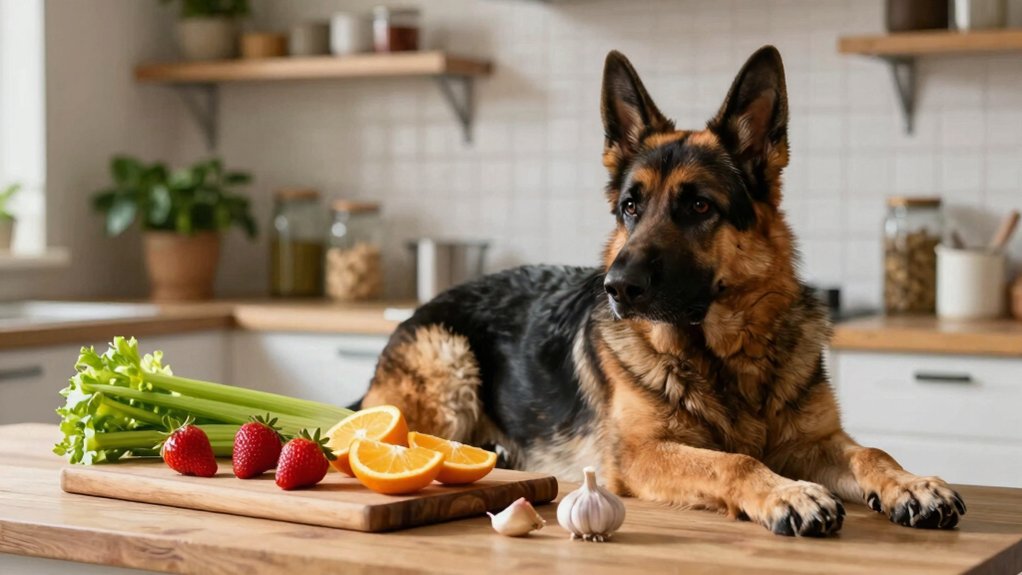
Skip all Allium plants (onion, garlic, leeks, and chives) because they can seriously harm your German Shepherd.
Allium includes shallots too, and every part counts: flesh, leaves, stems, bulbs, juice, and even powders.
Allium includes shallots too—every part counts: flesh, leaves, stems, bulbs, juice, and even powders.
You should never share them, in any form, not raw, cooked, dried, processed, or spoiled.
These foods create oxidative damage to red blood cells, which can lead to hemolytic anemia, meaning your dog’s blood can’t carry oxygen well, and it may become life-threatening.
Watch for mouth irritation, drooling, vomiting, then weakness within about one day, or even days later.
Keep leftovers and garden plants off-limits. When you travel, a portable dog playpen can keep your German Shepherd away from food scraps and plants at each new location.
No Onion or Garlic: Any Form, Any Amount
Keep onion and garlic completely out of your German Shepherd’s food, because there’s no reliable “safe” amount. Onion and garlic damage red blood cells through oxidative injury, meaning the cells get worn out faster than the body can replace them. That can cause hemolytic anemia, and it may lead to red or brown urine.
Toxic effects have shown up around 15–30 g/kg for onion, and about 5 g/kg for garlic, but small repeat exposures also add up over time.
You must avoid all forms, raw, cooked, dried, powdered, or mixed—onion powder and garlic powder hide easily in sauces. If you suspect exposure, call your vet fast. Make sure your German Shepherd wears a dog ID tag with your current phone number, so anyone who finds your dog can reach you quickly if it gets into onion or garlic.
Avoid Rhubarb and Wild Mushrooms
Avoid rhubarb and wild mushrooms for your German Shepherd, because both can be dangerously toxic.
Rhubarb—especially the leaves—contains oxalic acid, which can bind calcium and form crystals that build up in kidneys, so even a small amount can cause vomiting, weakness, and possible kidney failure within hours to 1–2 days.
And with wild mushrooms, you can’t reliably tell what’s safe, so treat any intake as an emergency and call your vet or poison control right away. German Shepherds shed heavily during seasonal coat blowing, but a sudden change in shedding or coat quality can also signal poor health, so any unusual symptoms after eating rhubarb or mushrooms should never be ignored.
Rhubarb Risks To Dogs
Rhubarb can be dangerous for dogs, and it’s mostly the leaves that cause the biggest trouble.
The leaves contain lots of oxalic acid, a natural chemical that binds calcium, then forms sharp crystals.
Those crystals can build up in kidneys, and that can lead to kidney damage or even failure.
You should keep your German Shepherd away from every part of rhubarb.
If your dog licks or eats any leaves, call your vet or a pet poison hotline right away.
Watch for drooling, vomiting, diarrhea, tremors, or bloody urine.
Timing matters—get help fast.
Wild Mushrooms Toxicity Warning
Before you relax outdoors, remember this: wild mushrooms can be a serious danger for your German Shepherd, even when they look “normal.”
Some mushrooms make dogs feel mildly sick, but others can shut down organs, and a few cases end in death.
Most wild mushrooms aren’t toxic, but you can’t reliably tell in the field.
Treat any unknown mushroom as potentially toxic.
Signs may start fast, in 15–30 minutes, or delayed up to 24 hours.
Watch for drooling, vomiting, diarrhea, tummy pain, or sleepiness.
Some types cause seizures, tremors, or coma.
Others can trigger liver failure within 1–2 days.
If your dog eats any wild mushroom, get vet help immediately.
Avoid Tomatoes’ Green Parts and Plant Leaves
Because tomato plants make natural chemical defenses, you should keep your German Shepherd away from all the green parts—leaves, stems, vines, flowers, and unripe green tomatoes. These parts contain higher glycoalkaloid toxins, like tomatine and solanine. Ripe red tomato flesh is usually safer in small amounts, but you’ll reduce risk by avoiding plant material completely. Puppies are especially vulnerable during their first four weeks of development, when their bodies are still maturing, so keep young pups away from tomato plants entirely.
And don’t assume “just a nibble” is harmless, since enough leaves can upset the stomach and even affect the nervous system. If your dog eats green tomato parts, call your vet or a pet poison service right away, and watch for vomiting, drooling, weakness.
Treat Timing: Add Fruit/Veg as Toppers
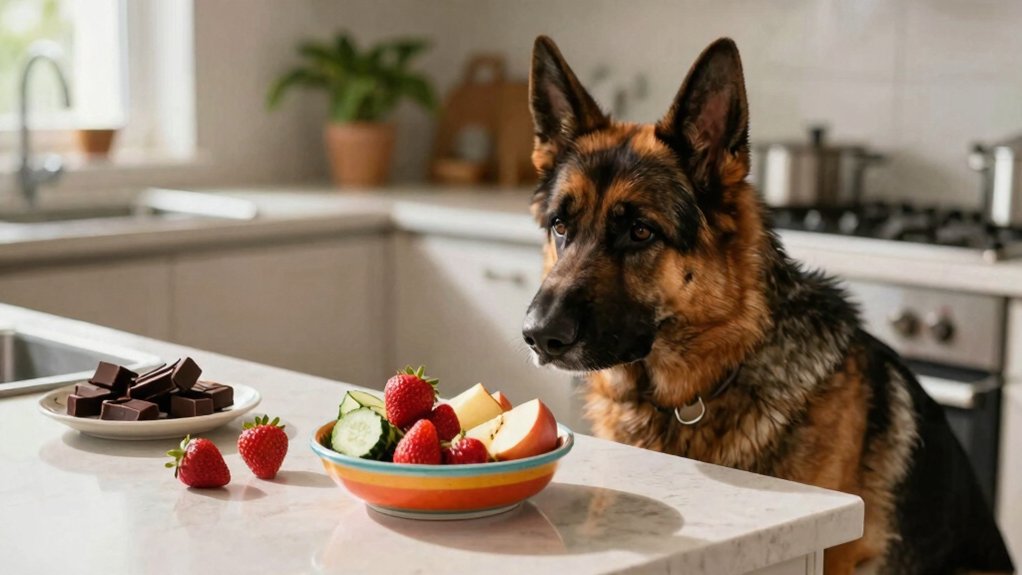
Often, you’ll get the best results by adding fruit or veggie toppers as a *midday boost*, not as a last-minute swap right before or after a full meal.
Feed your German Shepherd main meals 8–12 hours apart, then plan topper treats in the gap. Before setting topper amounts, review the commonly considered formulas compared in the Royal Canin, Purina Pro Plan, and Eukanuba guide, since the main meal provides your dog’s core nutrition.
After a full meal, your dog’s training focus drops, so rewards feel less exciting.
Keep topper amounts within 5–10% of daily calories, the 90–10 rule.
Use tiny fruit/veg pieces, reward within 1–2 seconds, and mark the behavior first.
If you add toppers, cut kibble slightly, about 0.25 cup or less.
Raw vs Cooked: Best Prep for Digestion
Raw vs cooked can feel like a big nutrition debate, but for digestion, the practical takeaway is simple: don’t assume raw always sits “better” in your German Shepherd’s gut.
Cooking animal protein can sometimes lower bioavailability, yet dogs can adapt and digest cooked diets efficiently.
For vegetables and fruits, raw usually digests poorly, so vitamins and minerals absorb less well.
Cook until soft, or steam lightly, then puree, grate, or finely grind to break down plant cell walls.
Heat also gelatinizes starch, helping enzymes work, and reduces fiber-related upset.
Choose balanced, complete cooked meals, and skip pathogen risks from raw meat.
Spot Trouble Fast: Choking or GI Upset
If your German Shepherd grabs fruit, veggies, or treats with seeds or pits, remove them fast and cut food into small pieces, because choking can happen in seconds and vomiting can start just as quickly.
Watch closely for the first signs—pawing at the mouth, repeated gagging, drooling, or that “tripod” stance—then act, because trouble that doesn’t improve within minutes can turn into a real emergency.
And if they throw up or get diarrhea soon after eating something new, especially with gas, mucus, or belly pain, stop the food, keep them hydrated, and call your vet if symptoms last past 24 hours or get worse.
Remove Seeds And Pits
Before you share any fruit with your German Shepherd, take a quick second to remove every seed and pit—because these hard pieces can turn into real trouble fast.
Seeds and pits can release cyanide, and avocado pits contain persin, both can cause serious illness.
Worse, hard pits can block the throat, even if the fruit looks harmless.
To protect your dog, always discard pits from cherries, peaches, plums, apricots, nectarines, mangoes, and avocados.
Then watch closely for choking signs right after chewing, like gagging or pawing, and for GI signs like vomiting or constipation.
Prevention beats emergency.
Cut Into Small Pieces
To keep playtime safe, cut every fruit or veggie you share into small, bite-sized pieces—because big chunks and whole items can block the airway or the gut faster than you think.
Aim for pieces small enough to chew easily, especially for “gulpers” who swallow fast.
Hard produce like carrots, apples, and pineapple should be chopped into tiny segments.
And if a treat fragments into large swallowable bits, you’re raising choking risk.
Use small portions too, around 5% of daily calories, and offer softer, smaller bites, not one big serving.
Smaller pieces mean less throat blockage and less GI stress.
Watch For Vomiting Diarrhea
Keep a close eye on your German Shepherd after meals and treats, especially when you introduce something new.
Watch the vomiting pattern.
If your dog vomits suddenly soon after eating a new food, treat, or non-food item, that can mean irritation or even blockage.
If vomiting won’t stop, or keeps happening, dehydration and electrolyte imbalance become serious fast.
Also check for lethargy, no appetite, or a swollen belly.
Vomit with blood, coffee-ground bits, or a fecal smell is an emergency.
Diarrhea often shows obstruction too, especially with vomiting.
Stop and call your vet if it lasts over 24 hours.
Call the Vet Fast After Suspected Toxin
If you suspect your German Shepherd got into something toxic, call your vet or the nearest emergency animal hospital right now—even if your dog seems fine.
Rapid vet contact is your core first-aid step.
Don’t wait for symptoms.
Some poisons act fast in minutes, others later in days, but early help can prevent organ damage.
Call animal poison control too, they’re open 24/7.
When you call, share the exact substance, brand, ingredients, amount, and your dog’s weight.
Report the time of exposure, and any signs like drooling, tremors, or seizures.
Move your dog away, and bring packaging safely.
Chocolate, Xylitol, Alcohol, and Coffee: Never
Chocolate, xylitol, alcohol, and coffee are four “never-treats” for German Shepherds, and you should treat them like an emergency waiting to happen.
If your dog gets into any, act fast and call your vet.
Chocolate, even dark, raises heart stress.
You may see vomiting, thirst, restlessness, panting, tremors, then seizures.
Signs often start 2–12 hours after eating.
Xylitol is worse.
It triggers a quick insulin surge, causing severe low blood sugar in 30–60 minutes.
Watch for weakness, wobbliness, disorientation, tremors, seizures, and collapse.
Alcohol and coffee also drive dangerous effects on the brain, blood sugar, heart, and liver.
Skip Bones, Salty Scraps, and Fatty Table Food
Bones, salty scraps, and fatty table food can seriously mess up your German Shepherd’s health, so don’t “just give a little.”
Cooked bones splinter and can block or cut their mouth and gut, and raw bones can carry bacteria like Salmonella that trigger painful diarrhea and vomiting.
And salty foods? They push toxic sodium levels, especially if water is limited, causing vomiting, diarrhea, tremors, even seizures.
Skip processed meats, chips, soy sauce, and salty broth.
But fatty leftovers are just as risky. Greasy meat, skin, gravy, and fried foods can trigger pancreatitis—abdominal pain, vomiting, and lethargy—often needing emergency care.
Store trash securely, and share only dog-safe treats.
Frequently Asked Questions
Can German Shepherds Eat Fruit Daily, or Should It Be Occasional?
Daily fruit? Think “sweet, but not a staple.” You should keep fruit occasional: treats shouldn’t top 10% calories. Feed small portions, watch sugar and tummy upset. Avoid toxic fruits entirely, and prioritize balanced complete dog food.
Are Frozen Fruits and Veggies Safe, or Do They Cause Stomach Upset?
Yes—frozen fruits and veggies are usually safe for you to serve your German Shepherd. Keep portions small, choose plain options, and thaw or steam for easier digestion. Overfeeding can cause vomiting, diarrhea, gas, or bloating.
What Fruit or Veggie Is Best for Training Treats Without Extra Calories?
Choose blueberries or green beans for training—low-calorie, fiber-rich, and easy to portion. Cut cucumbers into tiny slices; you reward often, you keep energy low, and your dog stays excited without extra calories.
How Long After Eating Can I See Signs of Intolerance or Allergies?
You can see intolerance signs within hours: vomiting or loose stools start quickly and often improve within 24–48 hours after removing the trigger. Allergies show up minutes to hours, or may recur days to weeks after repeated exposure.
If My Dog Eats Grapes or Chocolate by Accident, What’s the First Step?
If your dog eats grapes or chocolate by accident, call your veterinarian or a poison helpline immediately. Tell them the type, amount, weight, and time ingested. Don’t wait for symptoms or induce vomiting without instructions.