You can figure out how much to feed your German Shepherd by starting with calories, then converting to cups using your food label’s kcal per cup. For puppies, aim for 400–550 kcal/day at 8–12 weeks, split into 4 meals (4x), then switch to 3 meals at 12+ weeks. Adults often do well on 2 meals 8–12 hours apart. Use RER = 70×(kg^0.75), then multiply by activity (about 1.4–2×). Adjust after 10–14 days, target BCS 4–5/9, and keep treats to ~10% total. Keep going to nail the exact plan.
Swift Summary
- Use body weight to estimate RER, then multiply by an activity factor to reach MER (daily calories).
- Feed puppies 4 times/day at 8–10 weeks, 3 times/day at 12+ weeks, then move to 2 meals for adults.
- Convert calories to kibble using the food label’s kcal-per-cup, since cup volume and density vary by brand.
- Target healthy body condition (BCS 4–5/9) and adjust portions about 10% after 10–14 days.
- Reduce bloat risk by avoiding one large meal and spacing meals 8–12 hours apart for adults.
German Shepherd Feeding Chart by Age and Weight
Before you measure anything, you’ll want a simple game plan for how much to feed your German Shepherd as they grow—because age and weight change their calorie needs fast. Use this german shepherd feeding guide by matching age, weight, and meals, so you serve your pup confidently. Around the time your pup nears adulthood, plan to switch from puppy food to an adult or senior formula, and make the change gradually over several days to avoid digestive upset.
For adult German Shepherds, daily calorie needs commonly fall in the range of 1,160 to 1,810 calories per day. At 8–12 weeks, plan 400–550 kcal/day for an 11–17 lb pup, plus 4 meals.
How often to feed german shepherd puppy? Feed 4 times at 8–10 weeks, then 3 times at 12 weeks.
For 3–6 months, expect 1100–1800 kcal/day and 3 meals.
How much german shepherd eat per day? Adult 50–90 lb usually gets 3–5 cups, twice.
Is it ok to feed german shepherd once a day? Not usually.

BREED HEALTH DOG FOOD: Royal Canin Breed Health Nutrition German Shepherd Puppy Dog Food Dry Formula for purebred German Shepherds 8 weeks to 15 months old
BREED HEALTH DOG FOOD: Royal Canin Breed Health Nutrition German Shepherd Puppy Dog Food Dry Formula for purebred German Shepherds 8 weeks to 15 months old

LARGE BREED PUPPY FOOD: Royal Canin Large Breed Dry Puppy Food for puppies 2 to 15 months with an expected adult weight of 56 to 100 lbs
Use a Calorie Calculator to Estimate Daily Needs
First, use a calorie calculator to estimate your German Shepherd’s RER (Resting Energy Requirement), which is the daily energy a resting, healthy dog typically needs. Enter your dog’s weight in kilograms, then the calculator uses a formula like \(RER=70imes BW_{kg}^{0.75}\), and it will also apply a life-stage or activity factor to turn RER into MER (Maintenance Energy Requirement). Because adult maintenance nutrient needs change with age, your life-stage/activity multiplier should reflect your dog’s specific adult phase rather than assuming a single adult value for all ages. Next, pick a multiplier that matches real exercise—about 1.4× RER for low activity, around 2× for light work, and up to 3× or more for moderate-to-heavy work—then adjust portions after 10–14 days based on body condition and weight change. German Shepherds need regular physical and mental stimulation to stay healthy, and dogs with more daily exercise will generally require a higher multiplier than those with sedentary routines.
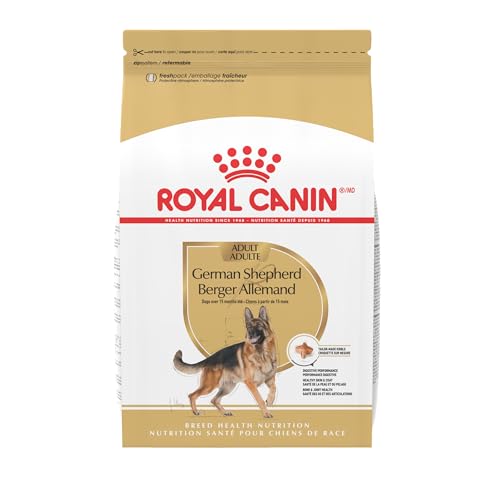
BREED HEALTH DOG FOOD: Royal Canin Breed Health Nutrition German Shepherd Adult Dog Food Dry Formula for purebred German Shepherds 15 months and older

BREED HEALTH DOG FOOD: Royal Canin Breed Health Nutrition German Shepherd Adult Dog Food Dry Formula for purebred German Shepherds 15 months and older

NATURAL APPETITE STIMULANT FOR PICKY EATERS – The irresistible all-natural salmon flavor turns any bowl of dry kibble into a meal your dog eagerly finishes. Simply drizzle this high calorie liquid food topper over meals to end mealtime battles and support healthy weight gain in dogs of all breeds and sizes.
Estimate RER With Weight
To estimate your German Shepherd’s RER (Resting Energy Requirement—the energy a healthy dog uses at rest in a comfy, non-stressful temperature), start with body weight. Measure it on a scale, then convert pounds to kilograms: kg = lb ÷ 2.2. Next, plug kg into the standard exponential formula: RER = 70 × (kg^0.75), which many vet references use. Use a calculator, raise the weight to 0.75, then multiply by 70. For example, 30 kg gives about 897 kcal/day at rest. This RER is your baseline before any daily adjustments.
One important note is that RER is a baseline, not the final number you’ll feed, since activity level and life stage factors come next.
Apply Activity Calorie Multiplier
Once you’ve estimated your German Shepherd’s RER (resting energy requirement, or the calories your dog burns at rest), you can estimate daily needs by multiplying RER by an activity factor.
And that activity factor acts like a dial, it adjusts for life stage, exercise, and even health.
For many neutered adults, use about 1.6× RER at normal activity.
Intact adults often need 1.8× RER.
If your dog is very inactive or obesity-prone, go lower, about 1.2–1.4× RER.
Puppies may need 2–3× RER, while working dogs can need 2.0–5.0× RER.
Then feed, observe, adjust.
Match Puppy Cups to Calories at 8 Weeks and 4 Months
Start by matching calories to the kibble density, because cups aren’t a fixed number. Compare German Shepherd formulas from brands like Royal Canin, Purina Pro Plan, and Eukanuba before measuring portions, since each product’s calorie content per cup can differ.
At 8 weeks, most charts land around 526–1100 kcal/day, which often translates to about 1–2 cups total split into 4 meals (roughly 0.4–0.6 cups per meal).
Then at 4 months, aim for about 1121–1343 kcal/day, and use the cup ranges like 1.5–2 cups for typical guidance or 2.5–4.5 cups depending on weight and whether you feed 3 meals.
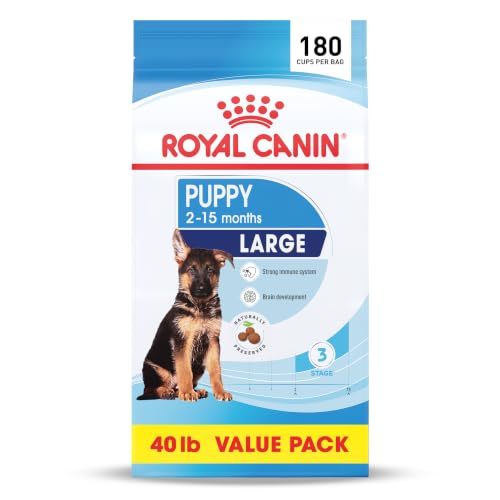
LARGE BREED PUPPY FOOD: Royal Canin Large Breed Dry Puppy Food for puppies 2 to 15 months with an expected adult weight of 56 to 100 lbs
LARGE BREED PUPPY FOOD: Royal Canin Large Breed Dry Puppy Food for puppies 2 to 15 months with an expected adult weight of 56 to 100 lbs
LARGE BREED PUPPY FOOD: Royal Canin Large Breed Dry Puppy Food for puppies 2 to 15 months with an expected adult weight of 56 to 100 lbs
Calorie Estimates At 8 Weeks
When your German Shepherd puppy is around 8 weeks old, you can think in calories first, then translate to cups after.
At this age, many charts place daily needs roughly 400–1,100 kcal, depending on body weight.
For example, 7.5–14 lb pups often target 526–817 kcal/day****.
If your pup is 11–20 lb at 8–10 weeks, look for about 600–900 kcal/day.
A weight-based chart for 15–25 lb pups at 8–12 weeks suggests 800–1,100 kcal/day, split into 3–4 meals.
Use calories now, because growth multipliers run high.
Cup Ranges At 4 Months
A good rule of thumb is that at 4 months, most German Shepherd puppies eat about 2.5–3.5 cups per day of large-breed puppy kibble, often landing anywhere from 2 to 4 cups depending on weight and growth speed.
You’ll see charts that suggest ~3–4 cups/day for some puppies, while more conservative, 20–35 lb guides start closer to ~1.75–2.25 cups/day.
But remember, kibble calories per cup vary, usually around 350–400 kcal/cup.
Meal Frequency And Portions
At 8 weeks, you’ll usually feed your German Shepherd puppy smaller, more frequent meals, because their stomach is still small and their energy needs run high. Aim for 4–5 feedings, then total about 1–3 cups of large-breed puppy food daily, roughly 600–900 kcal.
Use the label’s “kcal per cup” to match calories. For many 8–10 week puppies (5–9 kg), split 1.5–2.5 cups into 4 meals, about 0.5–0.6 cup each.
Set Adult German Shepherd Feeding Portions by Activity Level
Setting your adult German Shepherd’s daily food portions by activity level keeps weight and energy in a good, healthy balance. Maintaining a lean body condition supports healthy aging and can ease strain on joints in a breed prone to conditions like hip dysplasia.
First, pick an activity band: low, moderate, or high/working.
For low activity, common charts land near 1,300–1,600 kcal/day for 50–60 lb dogs.
For moderate activity, aim around 1,600–1,900 kcal/day for 50–60 lb dogs.
For high activity, you often move to 1,900–2,400+ kcal/day.
Next, convert calories to cups from your food label, then split into two meals.
Start with the chart.
Adjust gradually, over days, not hours.

Taste of the Wild High Prairie with ROASTED BISON and VENISON dry dog food; REAL MEAT is the #1 ingredient; high-protein (32%) to help support bones, joints and LEAN, STRONG MUSCLES

100% Complete and Balanced: Every bowl of this dry dog food serves 100% complete and balanced nutrition for your adult dog

Protein-Packed Nutrition: IAMS Proactive Health High Protein With Chicken & Beef Dry Dog Food is crafted with 80% of protein from animal sources, approximated and derived from unprocessed state of ingredients, to support strong muscles and overall vitality
Adjust for Body Condition Score Instead of Guessing
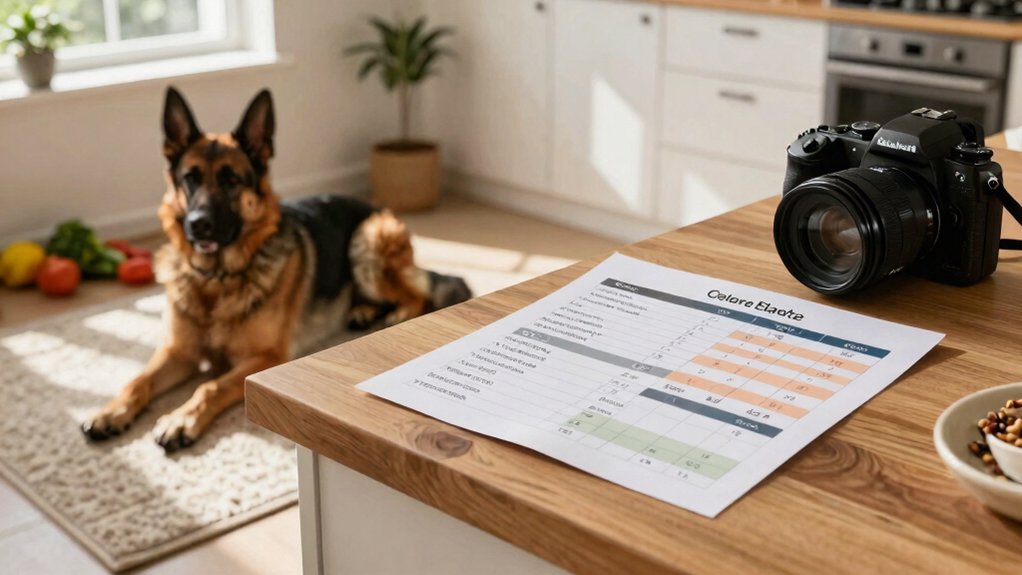
Instead of eyeballing your adult German Shepherd’s portion size, use a Body Condition Score (BCS) so you can feed with real numbers.
Instead of eyeballing your adult German Shepherd’s portions, use a Body Condition Score (BCS) to feed with accurate, consistent numbers.
BCS is a simple visual and touch check of fat cover over ribs, spine, and waist.
Aim for 4–5 out of 9, or 2.5–3 out of 5, which vet guidelines call ideal.
If your dog’s ribs are hard to feel, lower calories.
If ribs are easy and spine shows, increase them.
A shift of about 1 BCS point is roughly a 10% body-weight change.
Adjust daily calories ~10%, then recheck in 4 weeks.
Pair this check with a German Shepherd weight guide that lists healthy weights by age and gender to confirm your dog’s target.
Plan Meals and Feeding Frequency for Healthy Digestion
Once you’ve nailed the daily calorie target, you can protect your German Shepherd’s digestion by planning the meal schedule, not just the amount.
Split the total ration into multiple smaller meals. Aim for at least three meals daily for large or giant dogs, often four for puppies.
Adult German Shepherds commonly do great with two measured meals, spaced about 8–12 hours apart, and evenly divided portions.
This helps prevent stomach distension.
Because German Shepherds face higher GDV, bloat risk, avoid one big meal.
Feed slower, pace water intake, and skip hard exercise right after eating.
Because a 6-month-old German Shepherd is going through adolescent growth, its calorie needs can change, so review the feeding plan as your dog matures.
Calculate Treats and Total Food so You Don’t Overfeed
Treats can quietly add up, so do the math before you start rewarding. Aim for treats at or under 10% of daily calories, or even 5% if your German Shepherd tends to gain weight.
For a 1,500 kcal/day diet, that’s about 150 kcal (10%) or 75 kcal (5%). Now count everything: kibble, training treats, dental chews, and table scraps.
Example: 4 cups at 364 kcal/cup equals 1,456 kcal, before treats. If treats add 200 kcal, reduce meal calories by 200.
Measure portions, split treats small, choose low-calorie options like peas or green beans. Compare everyday rewards with dedicated training treats, since their size and calorie content can vary widely.

Puppy-sized: 475+ uniform pieces per 4 oz bag. Sized for puppy mouths. Used for general puppy training as well as potty training.

Chew and Heal's low-calorie jerky contains healthy fruits, veggies, and chia seeds, making it the perfect snack to help with weight management.

Special treats for special dogs: Low Protein, Low Phosphorus, Low Sodium
Frequently Asked Questions
How Do I Switch Diets Without Upsetting My German Shepherd’s Stomach?
Switch diets like a surgeon—slowly. Mix 25% new with 75% old for days 1–2, then 50/50 days 3–4, 75/25 days 5–6, and finish by day 7–10. Watch stool and appetite; slow if symptoms appear.
Can I Feed by Weight Alone, or Does Activity Always Matter?
You can’t reliably feed by weight alone; activity always matters. Start with weight-based maintenance, then adjust calories up or down based on daily exercise, body condition, and waistline. Ask your vet if you’re unsure or results stall.
What’s the Safest Way to Reduce Calories for Weight Loss?
To reduce calories safely, you should cut intake by 20–30% under veterinary guidance, aiming for 0.5–2% body-weight loss weekly. Track every treat, weigh every two weeks, and adjust food if progress stalls or slows.
How Much Water Should My Dog Drink With Dry Versus Wet Food?
With dry food, aim for about 60–80 mL/kg/day total water; with wet food, totals often drop to ~24–40 mL/kg/day because food adds moisture. In normal temps, check thirst and pee—call your vet if it’s extreme.
When Should I Contact a Vet About Underweight or Overweight?
Contact your vet if your dog’s BCS falls below ideal (under 4/9 or 1–3/9, or overweight 7–9/9), or if weight loss/gain is sudden or comes with vomiting, diarrhea, lethargy, refusing food, or breathing trouble.