You’ll usually switch your German Shepherd from large-breed puppy to adult food at about 12–18 months, when they hit roughly 80–90% of expected adult weight and have a healthy BCS (body condition score) around 4–5/9. Check ribs and waist too—BCS 4–5 means not skinny, not chubby. Do a 7–14 day mix, like 75% old/25% new, then 50/50, then 25% old/75% new. Then switch to senior food around 7–8 years using the same gradual plan, and keep an eye on stools so you’ll know what to do next.
Swift Summary
- Switch large-breed German Shepherds to adult food around 12–18 months, often near 80–90% of estimated adult weight.
- Use body condition, aiming for roughly BCS 4–5/9, and avoid switching if the pup is still too lean or rapidly growing.
- Transition based on weight targets (males ~70–90 lb, females ~50–70 lb) and typical 80% benchmarks (e.g., 80 lb → ~64 lb).
- Follow a 7–14 day gradual swap (75/25 to 50/50 to 25/75 to 100%); lengthen if stools loosen easily.
- Plan senior food at 7–8 years old with a gradual mix (about 75% adult / 25% senior for 7 days), and call a vet for persistent diarrhea.
When to Switch German Shepherd Puppy to Adult Food
But when can you feed a german shepherd adult food?
Aim for that window, because large-breed pups grow slower, and you protect bones and muscles with the right nutrients.
You’ll often keep puppy formula until 15–18 months for many German Shepherds, especially if growth runs long.
For others, you may start at 12 months.
A smooth transition also supports digestion during the growth phase typical for German Shepherds. large-breed
Do the switch gradually over 7–14 days, mixing 90% puppy with 10% adult, then reversing daily. Comparing puppy, adult, and senior formulas based on their nutritional needs can help you choose the right food at each stage.
Ask your vet if stools stay loose.
Use German Shepherd Weight and Body Condition Rules
Use weight and Body Condition Score (BCS, how lean or fat your dog looks and feels) to guide the switch.
Aim to feed growth-focused food until you reach about 90–100% of your estimated adult weight** *and* your BCS is 4–5/9 (or 2.5–4/5), not when your dog just hits an stage. Compare your dog’s weight against typical German Shepherd ranges** by age and gender to see whether growth is on track.
But if your German Shepherd stays lean, you can progress to adult sooner and keep portions steady, while extra-heavy days mean you should adjust for activity levels and avoid any signs of overweight (BCS 6–7/9) or obesity (BCS 8–9/9).
Hands-on checks like rib, back, tail base, tummy, and waist feel help confirm the BCS before you change formulas, especially during growth spurts ( “ribs should be feelable” ).
Target Adult Weight Threshold
Choosing the right adult-food switch point starts with your German Shepherd’s target adult weight, because that number tells you where growth should slow down.
For males, plan around 70–90 lb, and for females, 50–70 lb.
Then use the simple 80% rule: switch toward adult food when your puppy reaches about 80% of that target.
For a male targeting 80 lb, that’s ~64 lb.
For a 90 lb male, ~72 lb.
For a 60–70 lb female, think ~48–56 lb.
Most pups hit this window at 9–12 months, with steadier weights by 2–3 years.
Maintain Lean Body Condition
Most of the time, you’ll get the best results by judging your German Shepherd’s body condition (how lean or chunky they are) instead of obsessing over the number on the scale—especially during the puppy-to-adult change.
Aim for a Body Condition Score (BCS) of about 4–5 on the 9-point WSAVA scale, lean but well-muscled.
If ribs feel like the back of your hand, that’s a good sign.
Look from above for an hourglass waist, from the side for an abdominal tuck.
More soft fat over the lumbar spine means “back off.”
Keeping them lean also lowers hip-dysplasia risk.
For males, ~65–90 lb; females, ~50–70.
Transition Based On Activity Levels
If you want an easy way to time the switch, go by your German Shepherd’s activity level and what their body condition looks like, not just their birthday.
Most switch between 12–18 months, after they hit about 80–90% of expected adult weight.
If your pup stays lean and active, but growth slows around 12–15 months, you can move to adult food.
Keep puppy food closer to 18 months if skeletal growth still looks obvious or weight rises fast, even with daily exercise.
Aim for BCS 4–5/9.
If BCS is ≥6, switch earlier; if ≤3, stay longer.
Adjust portions ±10% first.
German Shepherd Adult Weight Benchmarks (80% Rule)
Use the 80% rule to estimate when you can switch foods: once your pup hits about 80% of her adult weight range, you’re usually in the 6–12 month window.
Start by estimating adult size, like 65–90 lb for males (29–41 kg) and 50–70 lb for females (23–32 kg), then calculate 80%—so roughly 52–72 lb for males, 40–56 lb for females.
Then check a body condition score, a simple “fit vs chubby” body rating, because age alone can mislead. If your pup suddenly refuses meals after a food switch, a change in appetite can signal illness or stomach problems, so consult your veterinarian before assuming the new food is the cause.
Use 80% Adult Weight
When your German Shepherd hits about 80% of their expected adult weight, growth usually shifts from “getting bigger fast” to “filling out,” and that’s a useful benchmark to watch.
You’ll often see this around 7–10 months, with 8 months as a common point, though charts vary.
That’s your cue to slow down, but not to rush.
Many vets still recommend holding large-breed puppy food until at least 12 months, because growth plates may still be open.
Then switch 12–18 months, and fine-tune portions using body condition, like feeling ribs easily.
Estimate Adult Size Range
A good way to estimate your German Shepherd’s adult size is to track where they land in the typical weight range for their sex.
Use sex benchmarks first: males usually run 65–90 lb, females 50–70 lb, with full maturity around 18–36 months.
Now estimate using growth milestones. At 6 months, many pups weigh about 62% of their projected adult weight, and at 8 months they’re around 80%.
If your male hits roughly 52–72 lb at 8 months, expect an adult nearer the mid-to-upper range.
If your female is 40–56 lb then, aim mid-range planning, and adjust feeding calmly.
Check Body Condition Score
Body condition score, or BCS (a simple 1–9 “how lean is your dog” rating), helps you decide whether your German Shepherd is truly ready for adult food—not just a number on the scale.
Aim for BCS 4–5/9.
You should feel ribs easily, like the back of your hand, with no hard pressing.
Look from above for an hourglass waist behind the ribs.
In side view, you’ll see a tuck up behind the ribcage.
If your dog feels soft over the lower back, BCS may be above 5/9—delay the switch, even at 80% weight.
A Safe 7–14 Day German Shepherd Food Transition Plan
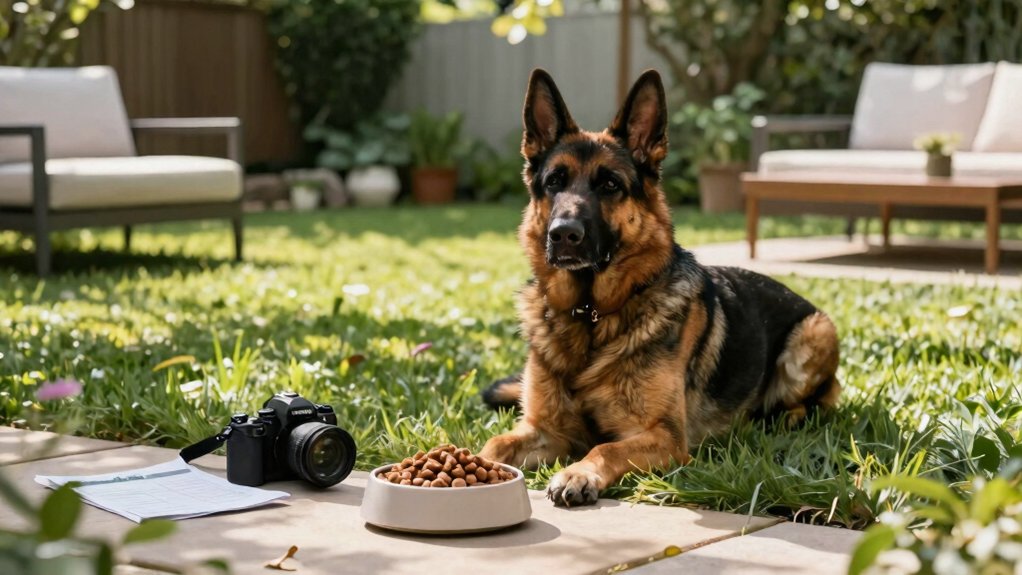
If you’re switching your German Shepherd from puppy food to adult food, take it slow, because their stomachs are picky.
For most dogs, use 7–14 days, mixing old and new food.
Day 1–2: 75% old, 25% new.
Day 1–2: Start with 75% old food and 25% new to help your German Shepherd adjust gently.
Day 3–4: 50/50.
Day 5–6: 25% old, 75% new.
Day 7: 100% new.
But if your dog has loose stool, gas, or any history of gut trouble, stretch it to 10–14 days.
Start 90% old, 10% new, and move up every 2–3 days.
Keep an eye on stools.
Once the switch is complete, adjust the portion size to match your dog’s daily calorie needs, which depend on age, size, and activity level.
How to Change Meals and Portions to Adult Food
Once you’ve started the 7–14 day switch, you’ll also need to change how you serve meals—not just which food you serve. Aim for 2 meals a day once your German Shepherd reaches the near-adult stage, and keep that schedule for adults. Split the adult daily calories across breakfast and dinner. Watch your dog’s coat during the transition, since excessive hair loss can sometimes signal a medical problem that needs veterinary attention.
For healthy 50–90 lb adults, target about 1,150–1,800 kcal per day, often around 3–5 cups total, depending on your kibble’s calories. Measure the exact amount from the label, then adjust for work or low activity.
In senior years, keep 2 meals, but cut calories by 10–30% by reducing portions.
Watch Stool and Appetite: What Counts as “Normal
As you switch to adult food, watch the stool first, because it tells you how well the gut is handling the change.
You’re looking for chocolate-brown, formed, easy-to-pick-up stool with little mucus, and during a smooth shift you may see small, short-lived softening that fixes itself within 1–3 days.
And don’t ignore appetite—most adult dogs go once to three times daily, so if you notice repeated loose stool or a big appetite drop lasting more than 12–24 hours, call your vet. Keep in mind that German Shepherds shed heavily year-round and go through seasonal coat blowing, so a temporary increase in loose fur during the switch doesn’t signal a digestive problem on its own.
Track Stool Consistency Changes
Check your German Shepherd’s poop every day during the switch, because stool tells you a lot about how their gut handles the new food. Normal stool stays chocolate brown, moist, compact, and log-shaped, firm but not hard.
You want it segmented like a caterpillar, not greasy or overly shiny. It usually lands around a mid texture score (about Type 3 on a 1–7 chart). Mild softness for less than 24 hours can be typical.
But if it stays watery, blood shows, mucus appears, or it looks like pudding for over a day, call your vet. Any constipation clues too.
Monitor Appetite During Transition
Monitor your German Shepherd’s appetite closely during the switch, especially for the first 5–7 days. Use baseline meals as your reference.
Puppies under six months usually eat three to four times daily, while 6–12 months often shifts to two to three meals.
During a gradual mix, it’s normal if they eat a little slower or show less excitement.
You’ll often see selective nibbling at first, then better acceptance as the new formula rises over 5–7 days.
Watch for mild gassiness, too.
If they skip one meal, or eat less, appetite should return in 12–24 hours.
But if refusal lasts over 12–24 hours, call your vet.
If Growth Is Slow: Adjust Timing With Vet Guidance
If your German Shepherd pup seems to grow slowly—staying more than 10–15% under the breed growth chart for weight or height—you shouldn’t guess the switch timing alone.
You should book a vet exam.
They’ll check for systemic disease, intestinal parasites, malabsorption (can’t absorb nutrients), and skeletal issues. Skeletal problems such as hip dysplasia are among the common health concerns in German Shepherds, so your vet may examine joint development closely.
They’ll use breed growth charts and body-condition scoring to decide between puppy and adult formula.
Usually you switch near 80% of adult size, but slow growers may hit it at 14–18 months.
Keep large-breed puppy food longer, and avoid early adult diets.
Growth that’s flat before 6–9 months needs help, fast.
Switch German Shepherd to Senior Food Around 7–8
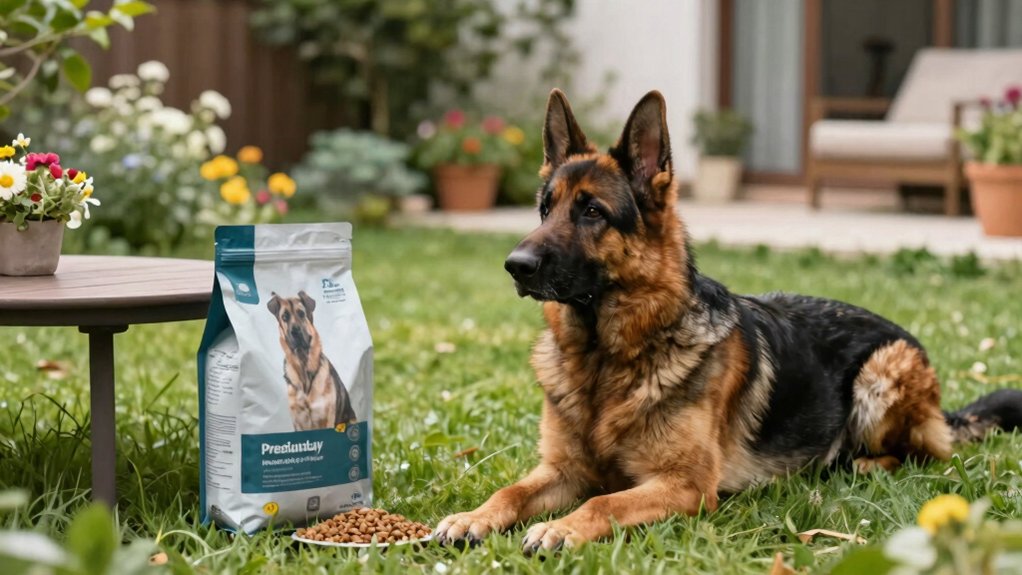
When your German Shepherd hits about 7 to 8 years old, you can usually start the switch to senior food—think of it as a gradual step, not an overnight change. Since the breed’s typical lifespan generally falls between 9 and 13 years, this timing gives aging dogs nutritional support before common age-related health concerns become more noticeable.
Many guides label this “senior 7+,” and you’ll often see it match real life.
You may notice less endurance, stiffness in the rear, and more resting.
Start by mixing about 75% adult with 25% senior for 7 days, then move to 50/50, then 25/75.
Around this age, you’ll often feed roughly 2¾–3½ cups daily, but adjust to energy and weight.
Senior Food Benefits for Joints, Heart, and Digestion
You’ll usually see big payoffs when you switch to senior food for your German Shepherd’s aging body, especially for joints, the heart, and digestion.
For joints, you’ll get daily support from glucosamine and omega-3s, often with chondroitin too, plus green-lipped mussel, all working together in the bowl.
Senior formulas also help you manage weight with lower calorie density, so you reduce joint stress while omega-3s (EPA/DHA) calm inflammation.
Senior formulas use lower-calorie ingredients to manage weight, easing joint stress while EPA/DHA omega-3s calm inflammation.
For the heart, you’ll often see reduced sodium, plus taurine, arginine, and L-carnitine.
And for digestion, added fiber, prebiotics, and probiotics support smoother stools and better nutrient use.
German Shepherds are also prone to degenerative myelopathy, a progressive disease of the spinal cord, so keeping your dog at a healthy weight with joint and overall nutritional support can help them stay mobile as they age.
Confirm Your Plan With Your Vet at Each Stage
Before you change anything in your German Shepherd’s diet, confirm the plan with your vet at each stage.
Pick the right timing, usually between 12–18 months, up to 24 months for large-breed growth.
Your vet should guide you once your dog reaches about 80% of adult size.
They’ll check body condition, fat cover, and growth curves, using serial weight checks.
If your puppy gains too fast, they may adjust portions or delay the switch. Rapid growth and excess weight can increase the risk of hip dysplasia in German Shepherds, so controlled feeding matters during this period.
They also help you choose large-breed formulas with controlled calcium, phosphorus, and calories.
Then monitor stool, energy, and weight during a gradual phase-in.
Frequently Asked Questions
Can I Use Adult Food Only Temporarily During Teething or Growth Spurts?
No—you shouldn’t use adult food, even “just temporarily.” During teething or growth spurts, you’d starve your pup’s fast-building body of key calories and nutrients. Stick with puppy food, soften kibble, and offer safe chews.
Should I Switch Foods if My Puppy Is Spayed or Neutered Early?
Yes—don’t switch just because you spayed or neutered early. Keep large-breed puppy food for growth, then cut portions and monitor body condition; ask your vet if you should use a slightly lower-calorie neutered-puppy diet.
What if My German Shepherd Grows Fast but Body Condition Stays Lean?
You’ve got a fast-growing, lean GSD? Trust that leanness with a steady growth curve usually means you’re feeding right—stick with the large-breed puppy diet and portions. Don’t switch early; monitor ribs, weight, and vet guidance.
Is Chicken-Free or Grain-Free Adult Food Better for Allergies During Transition?
Chicken-free usually beats grain-free for allergies during shift if chicken triggers symptoms. Avoid the specific suspected protein first. Choose a single novel or hydrolyzed protein adult food, then transition gradually over ~2 weeks.
How Do I Adjust Adult Food Portions for High-Activity or Working German Shepherds?
Increase adult portions 20–30% for high-activity, and 50–100% for working dogs. Start with your feeding chart, target calories 1.85–2.3k+ daily, then adjust by weekly weight changes and body condition.