Measure your German Shepherd first: nose-to-tail, shoulder-to-floor (withers), and shoulder width. Then pick a crate by interior length, height, and your dog’s weight together. Add 2–4 in to the crate length, and set the bed 4–6 in longer, snug. Use a divider for puppies so they sleep close to a den area, and keep space for standing, turning, and stretching. For outdoor runs, aim for at least 1.5× nose-to-tail length in a trot lane. Size the dog house interior 1.25–1.5× nose-to-tail, and use a raised, insulated door to cut heat loss—then you’ll get even more tips.
Swift Summary
- Measure your German Shepherd’s nose-to-tail and floor-to-withers to choose crate interior length and height, adding comfort allowances.
- Use the crate divider to create a den for training and anxiety control, ensuring the puppy can stand, turn, and lie stretched.
- For outdoor runs, plan a long trotting lane (about 1.5× body length) plus a rest pod with non-slip, well-drained footing.
- Size the dog house interior using ~1.25–1.5× nose-to-tail length, ~1–1.25× shoulder width, and standing height plus 2–4 inches.
- Fit winter doors with insulated double flaps and a raised threshold to reduce drafts; add moisture barrier, insulation, and fleece bedding.
How to Measure Your German Shepherd for Housing Fit
Before you buy or build a German Shepherd crate, kennel, or dog house, you’ll want to measure first—because “close enough” usually ends up too tight.
Start with standing height from floor to the top of head or ear tips, then add 2–5 inches for comfort. This supports a den-like space that helps your German Shepherd feel secure.
Next, measure body length from nose to the base of the tail.
Measure body length from your German Shepherd’s nose to the base of their tail for proper crate, kennel, or dog house sizing.
For width, record shoulder height, shoulder width, chest girth (widest ribs), and neck girth.
For diy german shepherd dog house plans, use nose-to-tail plus 12–18 inches, and scale interior width about 1.5× shoulder width.
Aim for the best crate for german shepherd fit, then plan best type of dog bed for german shepherd space, plus easy steps for german shepherd to get on bed. Dog crates are designed for different purposes, including home use and travel, so match the size to your dog’s primary need.
Crate Size: Use Length, Height, and Weight Together
Once you’ve got your measurements, size the crate using length, height, and weight together, not just one number. Start with interior length: measure nose to tail base, then add 2–4 inches, sometimes up to 6 for German Shepherd charts. Correct crate sizing supports pet safety and comfort during travel. If your dog’s body length is near 42 inches, pick a 42–48 inch crate so they can stand, turn, and lie stretched. For 44 inches or more, or fully extended sleep, choose 48+ inches. Next check height: use head height standing or sitting, plus 3–4 inches. Finally, match weight to the chart’s XL/XXL range. Avoid height or length shortfalls. Plastic dog crates designed for home use and secure transportation come in a range of sizes, so check the manufacturer’s chart before buying.
Use Dividers for a Puppy Crate That Grows
A puppy crate should fit your dog now, and still work as they grow, so you’ll want to use a crate divider. Use the divider to turn your adult-size crate into a cozy den, so your German Shepherd doesn’t toilet on one end and sleep on the other. This smaller space helps house-training, and it can ease anxiety and reduce destructive chewing. For dogs that are already learning crate boundaries, positive reinforcement training can help them settle comfortably in the smaller space. Place the divider so your puppy can stand, turn fully, and lie stretched out.
Fit it snugly across the crate width. Many adjustable dog crates include dividers designed to grow with your puppy. For 8–16 weeks, aim for 30–36 inches inside.
Move it back about 1 inch every two weeks, and check gaps.
Kennels and Runs: Plan Outdoor Space for Exercise
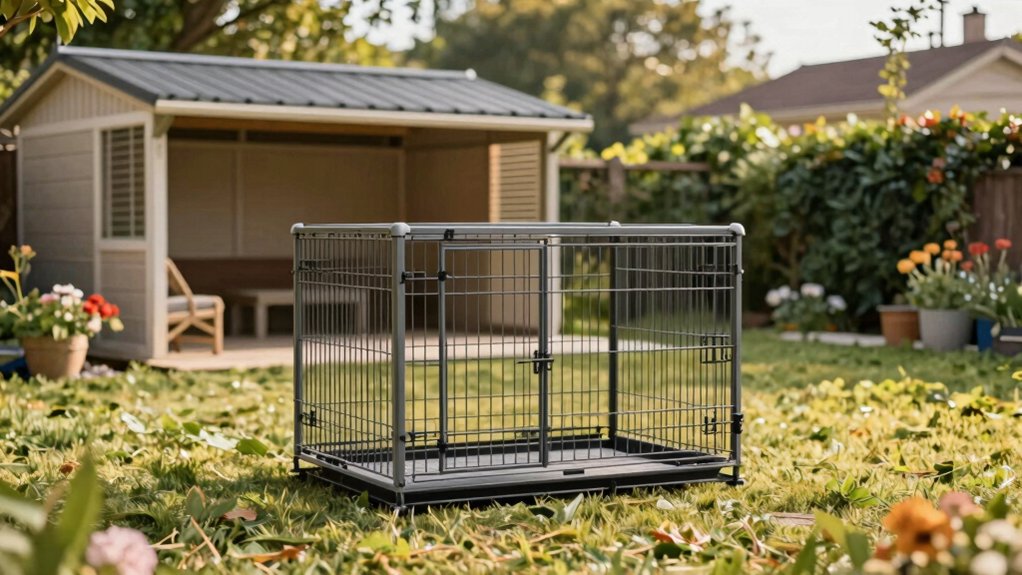
Measure your run length so your German Shepherd gets a real stride, aiming for about 6 x 10 ft minimum (and up to 8 x 12 ft or more if they’ll be out for hours).
Choose a rest “pod” area inside the kennel or run, using a non-slip, well-drained surface so they can chill between bursts of 90–120 minutes of daily activity.
But don’t forget smart barriers and weather shelter—use at least a 6 ft secure fence (8 ft if they jump), add solid lower sections to cut fence-line arousal, and include shade or a roof so they stay safe when it’s hot or rainy. Much like indoor dog gates that restrict access to areas of the home, these solid barriers should be firmly anchored so they cannot be pushed over or squeezed under.
Measure Run Length For Movement
When you plan your German Shepherd’s outdoor run, start by thinking about movement, not just square footage. You want a long, unbroken lane for trotting, since dogs often travel straight.
Measure your dog’s nose-to-tail length, then plan run length at least 1.5 times that distance, or use body-length math: 4 to 6 times shoulder-to-body length for meaningful exercise.
For a lively GSD, aim about 6 meters (roughly 20 ft) minimum.
If you’re budgeting, set a practical floor plan like 4 ft wide by 20 ft long, beyond the shelter. You’re serving play that fits.
Choose Pod Size For Rest
Choosing the right resting pod size keeps your German Shepherd comfortable, and it also supports better behavior when they’re outdoors. For an adult, go bigger than the legal bare minimum.
A basic pod is about 1.5 m × 1.3 m (≈2.0 m²), good for short stays.
For routine rest, choose the welfare upgrade, 1.8 m × 1.5 m (≈2.7 m²), around 21–29 sq ft, so they can stretch out.
Keep pod height at least 100 cm, with a matching doorway, so they can sit upright and stand easily.
Build rest space as a calmer “yes” zone.
Plan Barriers And Weather Shelter
Once your German Shepherd has a comfy rest pod, you can level up their outdoor time by planning secure barriers and a weather shelter for their kennel run.
First, fence for safety. Aim about 6 ft high welded wire, with 2 in mesh, and keep gaps under 4 in. Set posts in concrete, use strong latches, and smooth panel edges.
Then, add a weather cover. Choose a UV‑resistant waterproof canopy with a sloped or peaked roof to shed rain.
For side protection, use all‑weather panels.
Place the run in a well‑drained, quieter spot, watching sun and wind at different times.
Dog House Sizing: Pick the Right Interior and Door
Pick a dog house interior that’s big enough for standing, turning, and lying down, but not so oversized it loses heat fast—aim for interior length about 1.25–1.5× your dog’s nose-to-tail length, width about 1–1.25× shoulder width, and height about standing height plus 2–4 inches.
For the door, keep the opening shorter to trap warmth, use a door height around 70–80% of shoulder height, and set the door width about 2–4 inches wider than the widest point of the shoulders.
Measure your dog’s nose-to-rump length and shoulder-to-ground height first, then match the interior and door ratios so your German Shepherd can get in easily without drafts. Once the interior is sized correctly, bedding matters too, since crate-fitting beds add cushioning for comfort without taking up valuable floor space.
Interior Footprint And Height
For German Shepherds, the inside size matters as much as the roof. Aim for a roomy floor first, since your dog needs a true “stretch and turn” space.
Use the chart as a starting point, like extra-large around 120×80×90 cm, or roughly 107×71×76 cm for many XL builds.
For height, target clear headroom, about 1.1–1.3× your dog’s shoulder height.
Many large houses land near 29–34 in inside height. Measure shoulder height, then pick a model with that internal height.
You’ll know you nailed it when your dog stands comfortably.
Door Opening For Warmth
After you’ve set the right inside height, you can tune warmth by sizing the door opening smartly. Aim for about three-fourths of your German Shepherd’s shoulder-to-ground measurement.
This smaller opening lets your dog duck in, and it cuts heat loss.
If your dog house fits up to 95 lb, you’ll often see a door around 13.25 in wide by 19.5 in high.
Oversized doors waste warmth through exposed air.
Use a rectangular opening for easy fit.
Add a modest raised threshold to block floor drafts.
Then install an insulated, double-flap door or cover.
It can boost overnight warmth by 5–8°F.
Set Up for Comfort: Stand, Turn, Lie, Stay Warm
Once you’ve sized your German Shepherd’s crate, you’ll want to set it up so your dog can stand tall, turn fully, and lie stretched out—comfortably, every day.
Measure nose-to-tail and floor-to-withers, then add 4–6 inches for movement.
Use about a 30-inch interior height so your Shepherd can stand upright without head contact.
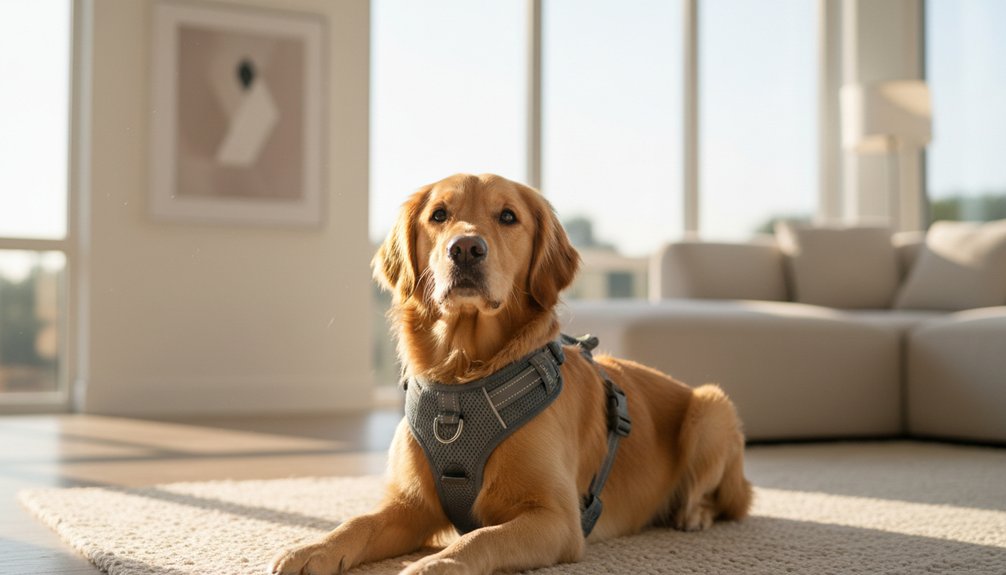
Pick a bed 4–6 inches longer than the standing body length, snug to prevent sliding.
Add fleece or memory-foam cushioning, and start warmer setups with a moisture barrier plus insulation.
For winter, cover three sides on wire crates.
In cold snaps, use a warming pad, but watch for overheating.
Because wire dog crates offer ventilation and visibility along with adjustable space, you can adapt the interior as your German Shepherd grows and keep airflow steady year-round.
Frequently Asked Questions
What if My German Shepherd’s Measurements Fall Between Two Crate Sizes?
Like choosing the next stepping-stone, pick the larger crate when you fall between sizes. Measure nose-to-tail and standing height, then add a little room. Undersizing stresses your dog; modest oversizing helps comfort and training.
Should I Use a Crate Cover for Airflow and Comfort?
Yes—you should use a breathable crate cover to boost comfort and privacy. Keep airflow safe by leaving at least one side uncovered and never block kennel vents. Monitor your German Shepherd for heat or stress, then adjust coverage.
How Much Bedding and Airflow Is Best Inside a Kennel or Dog House?
About 3–4 inches of breathable loft works best, and you should keep bedding snug. Provide steady airflow with 10–12 exchanges/hour; use vent gaps (roof 0.5–1 inch) and screened inlets/outlets to prevent overheating, dampness, and odors.
Can a German Shepherd Overheat in a Dog House or Outdoor Kennel?
Yes, you can cause overheating a German Shepherd in a dog house or outdoor kennel—especially in 75–80°F and up with humidity and poor ventilation. Stuffy, dim, sunbaked enclosures trap heat. Minimize exposure and ensure airflow.
How Often Should I Reassess Sizing as My Puppy Grows?
You should reassess sizing every 2–4 weeks during your puppy’s fastest growth (first 6–8 months). After that, check every 1–2 months through about 18 months, and adjust sooner if height or weight jumps.