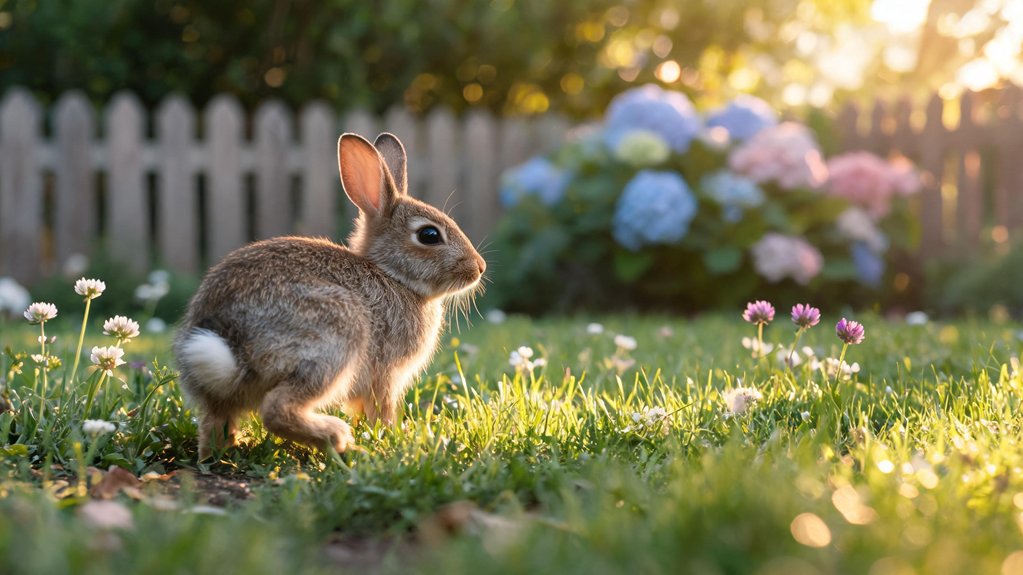
You see rabbits best as motion-and-low-light detectors, not tiny cameras. They spot movement first, and they work great in dawn and dusk. Their eyes sit high on the sides, so you get huge peripheral coverage—almost a full circle. But up front near the nose, there’s a small blind cone, and close depth is fuzzy (about the first 10 inches). Color is limited, and glare can wash things out. Want practical tips for jumps and safe handling?
Swift Summary
- Rabbits see best in dawn and dusk, detecting motion and low light more effectively than fine detail.
- Their wide, side-set eyes give near-360° panoramic coverage, with limited overlap and a small forward blind spot.
- Binocular depth overlap is narrow near the nose, so rabbits may miss close objects straight ahead.
- Vision is sharper for distant shapes; close focus blurs quickly within about 10 inches.
- Color vision is limited and crepuscular, relying mostly on green and violet-blue cues; glare can wash out images.
What Rabbit Vision Looks Like in Daily Life?
In daily life, you’ll notice that your rabbit’s eyesight works more like a “motion-and-low-light detector” than a camera that shows every tiny detail. So when you ask how do rabbits see, think “movement first.”
How is rabbits eyesight? It’s built for dawn and dusk, when their eyes handle half-light best. A reflective layer helps them use dim scenes, so they navigate better than you at night, but they still can’t see clearly in total darkness. They detect approaching predators quickly and effectively from almost any direction, helping them stay alert to danger around them.
They track movement well at how far rabbit can see—often beyond what you expect—yet still miss tiny, still details near the nose.
How Rabbit Eye Placement Creates a Huge Field?
With your rabbit’s eyes set high on the sides of the skull, you’re basically looking at a built-in “almost panoramic” viewing system.
This is how rabbit eye placement creates a huge field?
Each eye has laterally placed parts of rabbit eye, positioned so the visual axes spread widely.
Instead of pointing straight forward, your rabbit’s eyes diverge by about 150–175 degrees, so you get less overlap in front, but more peripheral coverage.
Each eye can cover over 180 degrees, and together they approach 360 degrees—so how can rabbits see behind themselves?
They have nearly 360-degree panoramic vision by watching with those wide side and rear angles, plus slight head tilts.
Where Are Rabbit Vision Blind Spots (and Why)?
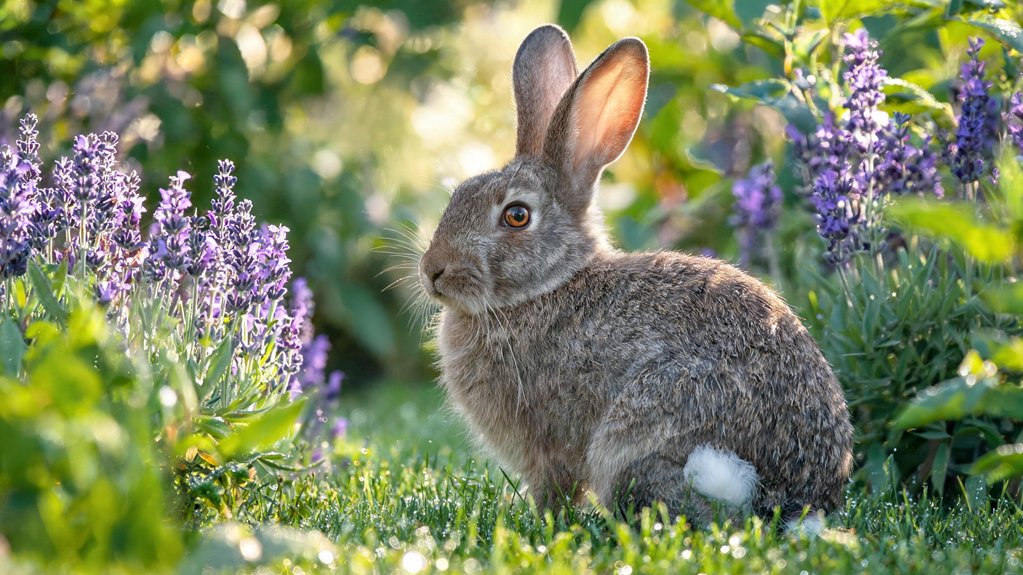
You’ve probably noticed your rabbit looks past things that are right at their nose, because there’s a tiny “blind spot” directly in front of the face where vision doesn’t reach.
Their eyes mostly overlap for depth (binocular overlap) only in a narrow band, roughly 10–30° across, so straight-ahead close objects can get missed unless you move them sideways or wait for a head turn. Because rabbits have a nearly 360° field of view thanks to their eye placement, they rely heavily on scanning the environment rather than focusing on one straight-ahead spot.
When you offer food, aim from the side, and watch the nose—those nose twitches and whiskers help them find what their front vision can’t.
Central Front Nose Blind Spot
That little “nose area” where a rabbit can’t see well is one of the weirdest parts of rabbit eyesight.
When you ask, how does a rabbit see, remember the central blind spot sits right in front of its muzzle, down under the chin.
Think of it like a narrow cone, about 10 degrees wide.
If you place food directly there, your rabbit may fumble and sniff, then feel around with whiskers.
But if you nudge the treat slightly to the side, it pops into view.
How can rabbits see? By using side and overhead vision, plus smell.
Narrow Binocular Depth Overlap
Rabbits don’t just “see”—they scan. Their eyes sit high and to the sides, so you get wide coverage but a narrow overlap.
Only about 10–35° in front gives binocular depth, meaning limited 3D distance.
So you’ll wonder how do rabbits see humans? They spot you best with motion and shape first, then judge distance less precisely at close range.
Can rabbits go blind? Yes, but this blind-spot feel often comes from design, not disease.
If you move slowly near their face, they read depth using movement parallax.
How Sharp Is Rabbit Vision Near vs Far?
How sharp is rabbit vision when things are close versus far?
When you look after your rabbit, remember this key difference: rabbits see farther more clearly. Their eyesight tends to be long-sighted, meaning distant shapes and movement pop out better than nearby ones.
You’ll notice clearer detection from about 3 feet up to hundreds of feet, and under ideal conditions even farther.
Up close, focus gets fuzzy fast, within roughly 10 inches.
Up close, rabbit vision blurs quickly—within about 10 inches—so details near the nose are harder to focus on.
Their near vision also has a small blind spot right in front of the nose and under the chin.
For safety, guide them using sound, scent, and gentle movement.
Do Rabbits See Color Like Humans?

You might think rabbits see the world in the same bright reds and greens you do, but they don’t.
Instead, you can think of their color vision as limited, more like human red‑green color blindness.
Rabbits are dichromatic, meaning they use two main “color channels,” not three.
Their eyes rely on S-cones for violet‑blue light, and M-cones for green light.
Because they lack long‑wavelength (red‑sensitive) cones, red objects don’t stand out as true red.
You’ll notice reds may look dark, grayish, or similar to dark greens.
How Light Levels Change Rabbit Day vs Night Vision?
Twilight has a lot more in common with rabbit vision than bright midday does.
As light drops at dawn and dusk, your rabbit’s eyes switch on their “night mode.”
Rabbits are crepuscular, so they see best in half-light, not harsh sun.
Their retinas have more rods than cones.
Rods (light sensors) work in dim light, so surroundings look brighter than they’d to you, but fine detail turns grainy.
Large pupils pull in more light, yet they don’t shrink much in time.
At deep night, they rely on rods only, and pitch-black scenes still block vision.
Why Rabbits Get Dazzled by Bright or Sudden Light?
Bright, sudden light can dazzle your rabbit fast, and it’s not just “discomfort” to them—it’s a real vision problem.
Rabbits have very light-sensitive retinas tuned for dawn and dusk.
In bright glare, their rod cells (for dim light) get overwhelmed, so the image turns washed out and grainy.
Their pupils also can’t shrink much, so too much light hits the eye.
And if the light changes quickly, their eyes adjust slowly, so you may see them blink, freeze, or look away.
If you use a camera flash or bright lamp, dim it first.
Albino rabbits need even more care.
How Poor Depth Perception Affects Grabs and Jumps?
Because your rabbit has a narrow “binocular overlap” (where both eyes see the same spot), they only judge depth well in a small forward zone, not right at the nose.
That’s why close grabs can miss a treat, or a jump can overshoot or undershoot when the distance feels off, since the tiny blind area in front makes nearby targets harder to place.
But you’ll see it improve when you guide them with movement cues—use a gentle head-bob or keep the target still, because rabbits also use motion-based checks to fine-tune distance before they commit.
Narrow Binocular Depth Range
Even though you’ll see rabbits scan the world wide and fast, their depth perception has a narrow “sweet spot” in front of their face.
With eyes placed far to the sides, you only get a small binocular overlap where both eyes judge the same spot.
That makes reaching and jumping less exact.
So, when you offer treats, lower them to just in front of their nose, and move slowly.
For jumps, let them choose their own takeoff and landing.
They’ll rely more on motion cues, size, and head positioning than true stereo depth.
And that keeps them safer.
Near Obstacle Misjudged Distance
Rabbits can spot movement far out, but when objects get close—like a treat at nose level or a step right in front of them—their depth perception gets less reliable.
Their eyes sit on the sides, so the near view is small, and details blur.
And that means you’ll often see misjudged grabs or jump starts, especially straight-on.
But you can help.
Offer treats a little higher or farther back, and guide jumps with a clear ramp.
Keep gaps and low ledges from directly under their nose.
Use calm touch, plus scent cues, to show safe paths.
Head Movement For Distance Checks
And when your rabbit goes for a grab or lines up a jump, that “how close is it?” question matters more than you might think. Rabbits can’t judge depth in front of their nose, so you’ll see head bobs, and side-to-side checks, to use parallax—objects shift more in your view when they’re near.
As you watch, remember: small up-down bobs help before takeoff, especially near ledges.
For grabbing, guide slowly, and let them sniff and use whiskers.
They often turn their head sideways, then inch closer, so the target lands in their sharper vision.
How to Handle Rabbits Safely: and When to See a Vet?
When you handle your rabbit safely, you’re protecting their fragile spine and helping them stay calmer, which makes checkups and trips to the vet way less stressful. Approach quietly, let them sniff, then support their body close to your chest.
Use one hand under the chest, behind front legs, and one under the rump, keeping all four feet held against you.
Never lift by ears.
For unhandled rabbits, gently grasp loose scruff while supporting the rump.
For stress reduction, use a “football” carry, or a towel wrap.
Let a vet see them soon if droppings change, appetite drops, breathing shifts, or you notice eye/nose discharge, hunched posture, or head tilt.
Frequently Asked Questions
How Do Rabbits See Humans up Close?
You’ll look to your rabbit as a big, moving shape, not sharp facial detail. Up close, it struggles to focus, so it relies on your outline, motion, scent, and sound to recognize you, sometimes with a small nose blind spot.
How Far Can a Rabbit See From Where It Sits?
From where they sit, you can expect a rabbit’s clear vision up to about 1–2 miles in open light. If something moves, they often notice it from even farther—around 2 km—though fine detail is limited.
Can Rabbits See Behind Themselves, and Where’s the Real Blind Spot?
Yes—you can see most behind them. Rabbits’ eyes sit high and wide, giving near-360° rear vision. The real blind spot sits directly in front of the nose and under the chin (about a 10° cone).
Can Rabbits Go Blind, and What Eye Signs Mean Trouble?
Yes, rabbits can go blind, often from ulcers, cataracts, glaucoma, infections, or untreated pain. Watch for weepy or red eyes, cloudiness, squinting, discharge, bulging, or sudden behavior changes—call a rabbit-savvy vet fast.
What Do Rabbits See Best In—Bright Light, Dim Light, or Both?
Your rabbit sees best in dim “half-light” at dawn and dusk, not bright sun. For example, during evening feeding, it tracks movement well. In full brightness or total darkness, vision gets much less clear.