You can trace today’s German Shepherd icon back to Max von Stephanitz’s “sheepdog” vision, then Horand von Grafrath (SZ1) as the breed’s starting blueprint. In 1899, the SV (Verein für Deutsche Schäferhunde) set one working-first standard, choosing utility over show, with records, tests, and even “42 teeth.” As farming declined, you’ll see the dogs shift toward policing. In WWI they served as messengers, sentries, and medics—up to 1,274 at the front by May 1915—and today’s legacy is shaped by modern health screening and line breeding, so keep going to get the bigger picture.
Swift Summary
- Max von Stephanitz promoted breeding from working ability, shaping the German Shepherd around a loyal “sheepdog” helper.
- In 1899, SV standardized records and the written standard, anchored by Horand von Grafrath (SZ1) as the breed’s foundation.
- Early selection emphasized utility traits like stamina, strong nerves, obedience, and flock control in large open-field sheep management.
- As farming declined, breeding shifted toward police demands: tracking, control, and protection testing frameworks.
- World War I expanded deployment, with tens of thousands of service dogs, including German Shepherds used as messengers, sentries, and detectors.
Max Von Stephanitz and Horand Von Grafrath’s Breakthrough
In 1899, Max von Stephanitz didn’t just admire herding dogs—he aimed to build one purpose-bred German Shepherd type, step by step, from working ability.
You can ask, what were german shepherds originally bred for? In practice, you see it: control large flocks, drive sheep, guard perimeters, and outthink danger.
Dissatisfied with uneven regional dogs, von Stephanitz chose utility, not show style, as how german shepherd was made.
At a dog show, he bought Hektor Linksrhein, then renamed him Horand von Grafrath.
At a dog show, von Stephanitz bought Hektor Linksrhein, renaming him Horand von Grafrath to shape the breed’s future.
Horand entered the Zuchtbuch as SZ1, and when did german shepherds become a breed?
With that first registration. Over the following century, breeders gradually changed the appearance and structure of the German Shepherd, while its working roles also evolved.
How the SV Created a Unified German Shepherd Standard
With the SV leading the way, you can see how a unified German Shepherd standard stopped the breed from drifting into local “styles” and started pushing one clear working type. Founded 22 April 1899 in Stuttgart, the Verein für Deutsche Schäferhunde ran centralized governance, kept records, and oversaw breeding. You benefit because the SV adopted a detailed written standard on 20 September 1899 in Frankfurt, then updated it in 1901, 1909, 1930, and 1961. Zuchtbuch für deutsche Schäferhunde also anchored breeding decisions to a single registry starting with Horand von Grafrath. You also see enforcement through Sieger titles and the Körung survey, plus strict rules on character, health, and 42 teeth. Over time, global adoption brought consistent form and function. Over time, the shared standard still allowed breeders to emphasize different traits, with working-line German Shepherds prioritizing drive and function over show-ring presentation.
Working Traits Early Breeders Prioritized in German Shepherds
Because early German Shepherd breeders treated success like a practical job, they prioritized utility and intelligence from day one. You chose dogs for working ability first, not looks. Their veterinary-science background helped breeders apply knowledge of biology, anatomy, and movement to select dogs that could perform reliably. You built “shepherd breeding” as “working dog breeding,” so every litter added calm minds, strong nerves, and reliable behavior. You also prized herding control, with instincts to manage huge flocks, up to about 1,000 sheep, like a living fence. You kept clear flock boundaries, stopped strays, and protected stock during breaks. And you selected sound structure, endurance, sharp senses, and trainability, so the dog served others every day. Modern owners still value comfort on the trail, so many choose step-in dog harnesses that fit quickly and suit everyday walks.

Size Instruction: This large dog harness fits chest girth: 27-37 in, neck girth: 19-25 in. Perfect for German Shepherds, Labradors for hiking, walking, or daily outdoor adventures. Breed suggestions are for reference; please measure your dog's chest, neck, and weight for the best fit.

Size Instruction: This large dog harness fits chest girth: 27-37 in, neck girth: 19-25 in. Perfect for German Shepherds, Labradors for hiking, walking, or daily outdoor adventures. Breed suggestions are for reference; please measure your dog's chest, neck, and weight for the best fit.

No Pull, 2 Clips - With 2 sturdy metal hook loops for leash attachment. Use the front clip to create gentle redirection force, to reduce tugging during walks and training. While back clip is great for casual walks, jogging for well-behaved dogs
Why Farming Decline Pushed German Shepherds Toward Policing
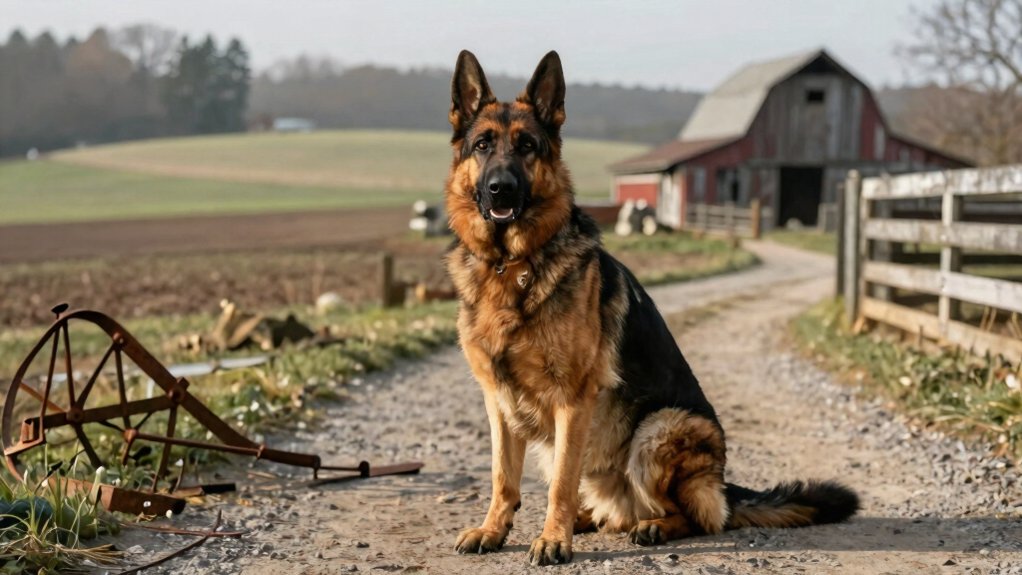
As farming and large free‑ranging sheep flocks shrank with industrialization, you saw less need for one farm shepherd dog per flock, and that changed everything.
But when Max von Stephanitz and police clubs pushed breeding for police tasks like scent tracking (finding hidden people or objects by smell) and obedience, the German Shepherd still had a clear job to do.
You can picture the shift like this: as demand for guarding flocks fell, demand for help in public security rose, and the breed had to adapt fast—so it did. Those same strong working instincts still shape the breed today, and when they are not channeled through proper socialization and training, even a well-bred German Shepherd can develop problem aggression.
Declining Large-Flock Farming Demand
When the big, open sheep farms in Germany started to fade, German Shepherds had to find a new job fast. You could feel it in the fields. Industrialization shrank grazing land, so large sheep flocks declined. With fewer flocks, you needed fewer sheepdogs, and the old herding work lost demand quickly. Many shepherds moved to crops or city jobs.
Meanwhile cities grew, and law enforcement needed sturdy, smart help for tracking, guarding, and patrol. You’d see breeders and working groups adapt, using herding-line traits for public service. So your dog’s work shifted, step by step.
Breeding For Police Work
Farming didn’t just shrink the work German Shepherds were used to—it pushed the breed toward a new paycheck, and police work became that job.
As you chase purpose, Max von Stephanitz and the SV in 1899 kept the motto “Shepherd breeding is working dog breeding.”
Early herding focus shifted to obedience and protectiveness.
You saw Horand von Grafrath set the standard for strength, intelligence, and versatility.
SV rules demanded dogs pass Schutzhund or herding tests, proving “working ability.”
Around 1901, police-style trials measured tracking, calm control, and protection.
Successful lines got bred.
You trained trust, nerves, and a steady drive to serve.
German Shepherd Dogs in WWI: Messengers, Sentries, Medics
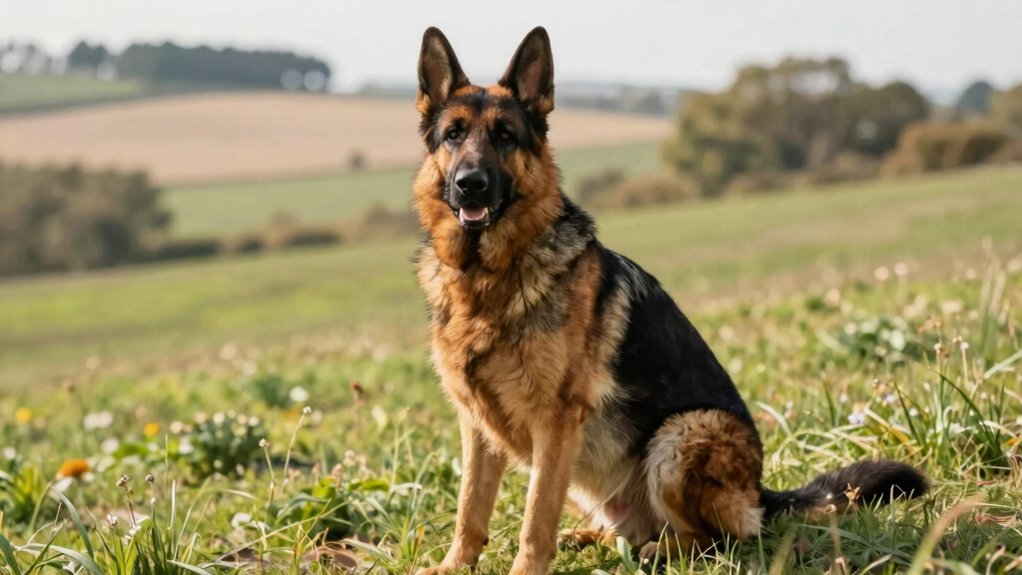
German Shepherds didn’t just “serve” in World War I—they helped keep armies connected, alert, and alive.
You can picture about 50,000 military dogs at work, with roughly 30,000 in German forces, and 1,274 German Shepherds sent to the front by May 1915.
In messengers, you trust them to carry letters, lay telephone cables, and haul 25–30 pounds of ammo and rations through trench danger, using a “liaison” double-journey route.
As sentries, you rely on their keen hearing and scent to spot threats beyond human reach, guarding depots.
Medics also counted on them to find wounded fast, even when you couldn’t reach. Modern German Shepherds still face health concerns, so owners should watch for signs of hip dysplasia, such as limping, stiffness, or reluctance to climb stairs.
How Postwar Exports Turned German Shepherds Global Icons
After the trenches and frontline work, German Shepherds needed a new job—winning hearts across borders. You see how postwar recovery rebuilt German breeding, then exports restarted. Early demand lagged, because anti‑German sentiment in the UK and US cooled imports. But West Germany’s rebound in the early 1950s, aided by show winners like Rolf vom Osnabrücker Land in 1951, changed that.
From the early 1950s into the 1960s, fresh imports surged into American kennels, then dominated show circuits and AKC registrations. Later, import waves slowed, yet popularity stayed high, and clubs and registries kept the “global icon” status growing. Today, the breed’s intelligence and loyalty still attract families and high exercise needs make it a more demanding choice for older adults.
The Breed’s Shift From Herding Roots to Modern Service Roles
You start with a dog built for farm work, managing sheep and guarding flock boundaries like a living fence, so the groundwork was all about focus and stamina. Then, as big pastoral flocks faded in Germany, you pivot toward police service, where Max von Stephanitz pushed the breed into patrol and tracking, and you see those skills turn into arrests, crowd control, and sentry duty. By the 1900s and mid‑century, you keep riding that momentum into military roles, using German Shepherd dogs for guarding and detection, and you end up with a versatile service partner that can handle new jobs as fast as you train them. Their highly responsive to training nature, driven by strong intelligence and work drive, is a big reason they could adapt so quickly to each new role.

Easy Adjustment - for Ultimate Comfort.Slip into and out of our dog harness effortlessly with the help of 2 quick-release buckles. Experience Unmatched Mobility with 4 Fully Adjustable Meatl Rings, two on the shoulders and two on the chest, which ensure a snug fit that enables unrestricted movement.

【Large Dog Molle Vest】: Neck Girth: 21-28 inch, Chest Girth: 24-39 inch, Belly Length: 24-39 inch, Back Length: 13.5 inch. Ideal for Large Breeds such as German Shepherds, Belgian Malinois, Golden Retrievers, Huskie, Labrador, Akita. A professional working dog vest for service, police, or military dogs, but also suitable for outdoor companion dogs. Please refer to our size chart, make sure match up your dog's measurement, Do not choose the size base on dog's weight or guess

【Large Dog Molle Vest】: Neck Girth: 21-28 inch, Chest Girth: 24-39 inch, Belly Length: 24-39 inch, Back Length: 13.5 inch. Ideal for Large Breeds such as German Shepherds, Belgian Malinois, Golden Retrievers, Huskie, Labrador, Akita. A professional working dog vest for service, police, or military dogs, but also suitable for outdoor companion dogs. Please refer to our size chart, make sure match up your dog's measurement, Do not choose the size base on dog's weight or guess
From Farm Flock Management
Even though German Shepherds are famous now for police, guide, and rescue work, they started in a very practical place: helping farmers manage flock life. You can picture open fields, large unfenced sheep flocks, and your dog acting like a living fence.
You relied on steady boundary herding, perimeter patrolling, and flock containment, plus moving stock between pastures. When night came, you needed guarding of mixed livestock, deterring predators, and keeping everyone calm.
Max von Stephanitz then standardized the breed in 1899, selecting stamina, strong nerves, and obedience, so you could train for useful service later.
Transition To Police Service
As farming needs faded and cities grew louder, German Shepherds made a smooth leap from herding to policing—still using that same steady brain and body control, just in a new kind of job.
Max von Stephanitz pushed “utility,” so you trained for real work, not show.
In early trials like Schutzhund—tracking, obedience, and protection—you built skills police needed.
You rely on their strong sense of smell, stamina, and durability for patrol and detection.
By early 1900s, Germany deployed them in hundreds of stations, then opened Greenheide’s training school in 1920.
In the early US, cities like New York added K9s by 1907.
Expansion Into Military Duty
World War I gave German Shepherds their first big break as war dogs, and it built directly on the same “work first” mindset you saw in policing.
In 1914, the German Army began formal deployments, with about 6,000 trained service dogs early on, many German Shepherds. By May 1915, 1,678 were sent to the front, including 1,274 Shepherds.
You’ll see why they mattered: you train obedience, courage, and utility, then use sharp senses to detect, to carry messages, to lay phone cables, and to find wounded soldiers.
About 28,000 total war dogs were requisitioned, and thousands died serving others.
Afterward, other nations copied the model.
Working and Show Lines: What Changed
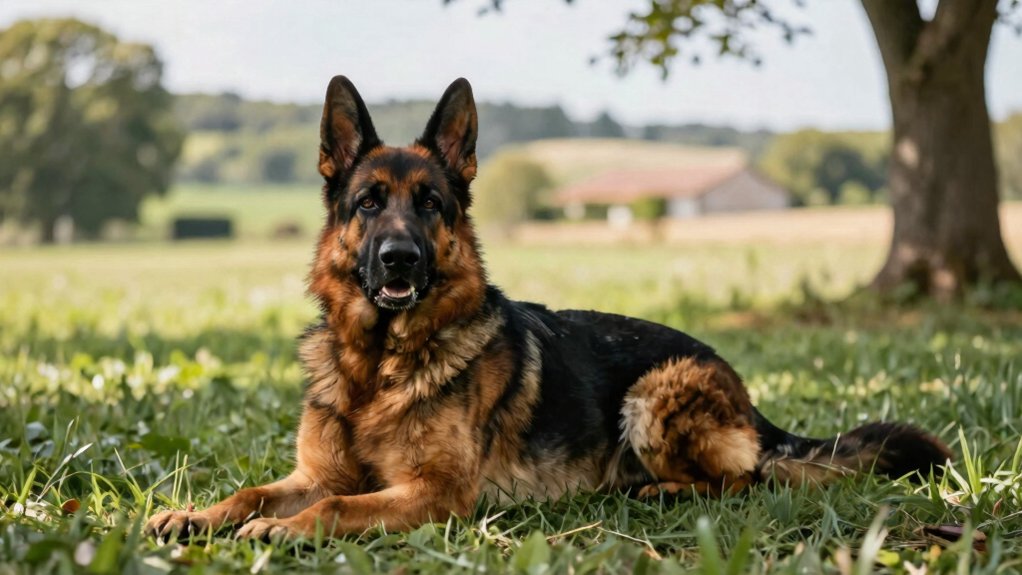
After World War II, German Shepherd breeding started to split into two very different missions, and you can still see the results today.
After World War II, German Shepherd breeding split into two missions—working ability versus show conformation—and that legacy still shapes lines today.
You’ll notice working lines stay performance-first. Breeders select for herding, guarding, police tasks, and sport results, not just ring looks.
They reward straight, slightly sloped backs for endurance and agility, plus strong, steady nerve. You’ll also see show lines chase conformation, meaning body shape and movement “type.”
They favor dramatic gait, sloped toplines, and longer bodies. Working dogs often need structured training and outlets.
Show dogs tend to be calmer, more sociable home companions. Owners choosing between the two lines should weigh factors such as drive, temperament, and lifestyle suitability before deciding which type of German Shepherd fits their home.

【Large Dog Molle Vest】: Neck Girth: 21-28 inch, Chest Girth: 24-39 inch, Belly Length: 24-39 inch, Back Length: 13.5 inch. Ideal for Large Breeds such as German Shepherds, Belgian Malinois, Golden Retrievers, Huskie, Labrador, Akita. A professional working dog vest for service, police, or military dogs, but also suitable for hunting and outdoor companion dogs. Please refer to our size chart, make sure match up your dog's measurement, Do not choose the size base on dog's weight or guess

MILITARY-GRADE DURABILITY & CONSTRUCTION - Heavy duty tactical vest made from 1050D nylon with reinforced stitching for maximum durability and wearability in all field conditions, featuring two metal shoulder buckles that withstand strong pulling force and two POM belly buckles for easy on-and-off, making this harness suitable for training, hunting, working, and everyday activities with powerful breeds like German Shepherds and Belgian Malinois.

Built for Working Dogs & Strong Pullers — Heavy-duty reinforced nylon with bar-tack stitching at every stress point. Weight rated by size: Medium up to 66 lbs, Large up to 99 lbs, XL up to 143 lbs. Designed for German Shepherds, Belgian Malinois, Labs, and high-drive large breeds used in training, patrol, hiking, and public access service work.
Health Concerns That Reshaped German Shepherd Breeding Today
You can see how health issues reshaped German Shepherd breeding, starting with dysplasia screening. Hip and elbow dysplasia (joint problems that cause pain) pushed breeders to use tools like OFA and PennHIP, and they often target “better hip scores” before mating. Then DNA testing for degenerative myelopathy (DM, a spinal nerve disease from an SOD1 gene mutation) changed the game, because you can spot carriers, plan smart pairings, and keep the working–show balance from falling apart. Because DM causes gradual hind-limb weakness that often appears in middle-aged or older dogs, early diagnosis allows owners to begin supportive care sooner.
Dysplasia Screening Programs Expanded
As breeders and owners got more serious about German Shepherd health, hip and elbow dysplasia screening quickly moved from “nice idea” to “required step.”
And once you understand why, it’s easier to see how today’s breeding rules took shape. You’ll see it start in Sweden in the 1950s, with a 1–4 hip scale, then shift to letters A–E.
In 1965, the BVA/KC program and later OFA scoring pushed common standards.
You can help by using OFA radiographs, and SV’s A‑Stamp, sedated X‑rays after 12 months.
These rules cut dysplasia rates by the 1980s, too.
Degenerative Myelopathy Testing Advances
Cheek swabs make testing easy.
Labs use reliable PCR genotyping, now widely available through OFA.
Working-Show Breeding Balance Debate
Because modern breeding choices changed what German Shepherds look like, the working–show balance debate isn’t just about style—it’s about how much strain that style can put on the body.
If you care about serving others, prioritize structure that lasts. Working-line dogs often keep straighter backs and moderate hind angulation, which supports endurance and efficient movement.
But some show lines intensify rear angulation, creating a sloping topline. When backs slope too much, weight shifts forward, hind-limb motion changes, and joint stress rises.
You’ll see more hip and elbow dysplasia, arthritis, and even spinal strain like degenerative lumbosacral stenosis. Choose balanced “square” frames.
Support show reforms and judge training.
What the SV’s 2 Million Registrations Reveal About Scale
Two million SV studbook entries aren’t just a big number, they’re a loud signal about scale you can measure.
Two million SV studbook entries signal measurable scale—each record a traceable continuation of breeding history.
As a service-minded breeder or owner, you can track this continuity: Horand’s first entry in 1899 becomes a multi-decade paper trail.
About 10,000 entries still come in each year, and early on it likely ran near 20,000 pups annually.
That steady rhythm means sustained participation, not a short trend.
And when SV-DOxS stores pedigrees for over 2 million dogs, you see the real workload behind “line traceability,” across countries and kennel systems.
Breeders and owners who follow practical ownership advice at every life stage can keep their German Shepherds healthy from puppyhood through the senior years.
How Movies and Law Enforcement Cemented the German Shepherd Image
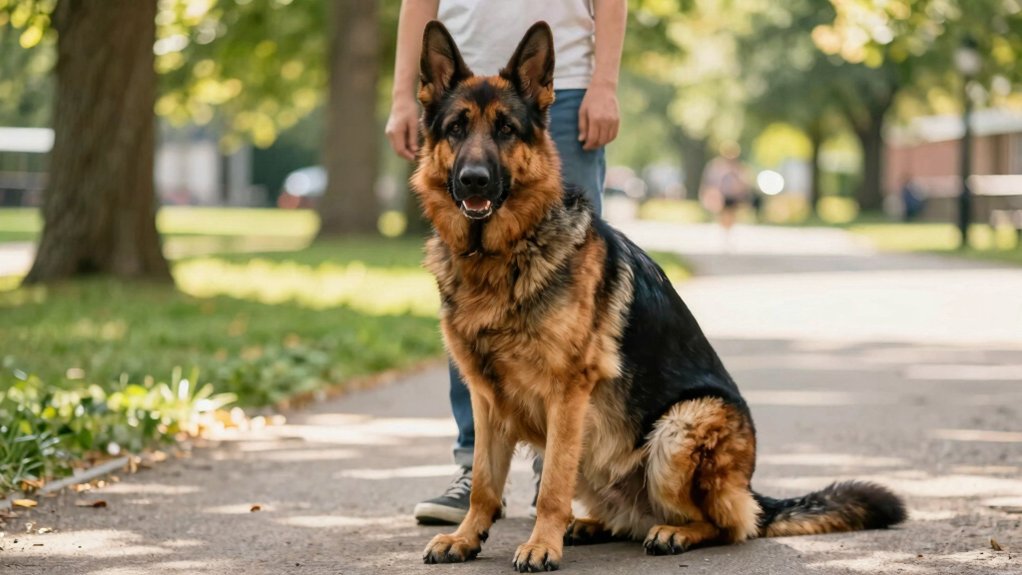
If you’ve been tracking how SV registrations show real long-term participation, you can see the same pattern in popular culture—movies and police work helped lock the German Shepherd into a single, unforgettable public role.
Rin Tin Tin, rescued from a WWI battlefield, became a box-office sensation, starring in about two dozen silent films.
Strongheart followed, appearing in early hits like “The Silent Call,” “Brawn of the North,” and “White Fang,” and fans credits these stars with boosting ownership in North America and Europe.
Meanwhile, police adoption spread the “Police Dog” identity.
Soon you saw a loyal, brave helper everywhere.
Frequently Asked Questions
What Exact Traits Did Horand Von Grafrath Pass Down to Early German Shepherds?
You should know Horand von Grafrath passed down a medium, wolf-like physique; pricked ears and sable Thuringian coat type; clean sinewy endurance; lively sound temperament; high intelligence and keen senses; strong herding instincts; and loyal protective drive.
How Did SV Testing Evaluate Nerves and Temperament, Not Just Appearance or Size?
SV testing evaluates nerves and temperament by running mandatory character tests and Wesensbeurteilung that expose you to varied stimuli. You score unflappability, social friendliness, noise and movement security, stress recovery, and steadiness throughout standardized protocols.
When Did the Breed First Become Common as a Police Dog in Germany?
Around 1910, German Shepherds became common police dogs: about 450 stations used trained dogs, and they formed the majority—an unstoppable surge that helped you serve your community with reliable patrol, tracking, and protection.
Why Did Early Shepherd Dogs Struggle Once Large-Flock Farming Declined Further?
Early shepherd dogs struggled because industry and fencing shrank flocks and replaced roaming herding with pen work. You needed close, scheduled tasks, not long patrol independence. Their instincts for wide tending and guarding often clashed with crowded, fixed farm routines.
What SV Health or Certification Rules Most Influenced Today’s Breeding Practices?
SV health rules that most shaped today’s breeding are mandatory HD/ED X‑ray screening with central expert grading, breeding only approved A–C hips and 0–1 elbows, and ZW-guided mating limits that remove high-risk lines.