Rabbit fur loss and bald patches can be normal molt, but you shouldn’t guess. First check the skin: clean, dry shedding in clumps often means seasonal molt, while itching, broken hairs, or lots of extra fur from barbering or stress needs a closer look. Redness, flakes, thick crusts, bad smell, wet dark mats, open sores, or maggots are urgent. Also treat as an emergency if your rabbit stops eating or pooping for 12 hours—then act fast and see a rabbit-savvy vet.
Swift Summary
- Normal molting can cause clumps of shedding and small temporary bald spots with mostly intact, non-red skin.
- Sudden warning signs include wet/dark matted patches, foul smell, maggots, open wounds, or not eating/pooping for 12 hours.
- Bald patches with itching, licking, scratching, or broken short hairs suggest pain, overgrooming, barbering, or fur-plucking.
- Symmetrical thinning or long-lasting firm bald areas can indicate hormones, stress, diet issues, or scarring that prevents regrowth.
- Parasites and skin diseases like mites or ringworm cause crusting/flaking/“walking dandruff,” needing rabbit-savvy vet diagnosis and safe hygiene care.
Rabbit Fur Loss: What It Usually Means
When you see bald spots or fur loss, it’s tempting to panic—but often, it’s your rabbit just doing normal coat changes. You may notice a bald rabbit with patchy tufts, especially on the head, neck, back, and rump. During seasonal molting, fur sheds in clumps, skin stays mostly intact, and new regrowth can look darker. Some rabbits also shed again several times a year. And if you have an intact female, pregnancy or false pregnancy can cause rabbit without hair on the belly, chest, or chin, from nesting. Also watch social barbering, or rabbit overgrooming, which usually leaves broken hairs, not raw skin. If fur loss starts, a vet check is recommended because alopecia is often treatable.
Rabbit Fur Loss: Emergency Warning Signs
It’s not just “normal shedding” if you notice any emergency signs along with bald patches.
If you see a rabbit without fur plus wet, dark, matted spots, a strong foul smell, or maggots, act now.
Check for open wounds, bleeding skin, or painful, swollen areas.
Also treat this as one of the biggest reasons for rapid hair loss if your rabbit stops eating, or stops pooping, especially for 12 hours—get help immediately from a rabbit-savvy exotics vet.
Flystrike is also known as myiasis, and it can become life-threatening very quickly.
Why is my rabbit over grooming?
If itching, scratching, or dandruff appears, don’t wait.
Rabbit Fur Loss: Signs of Bald Patches to Note
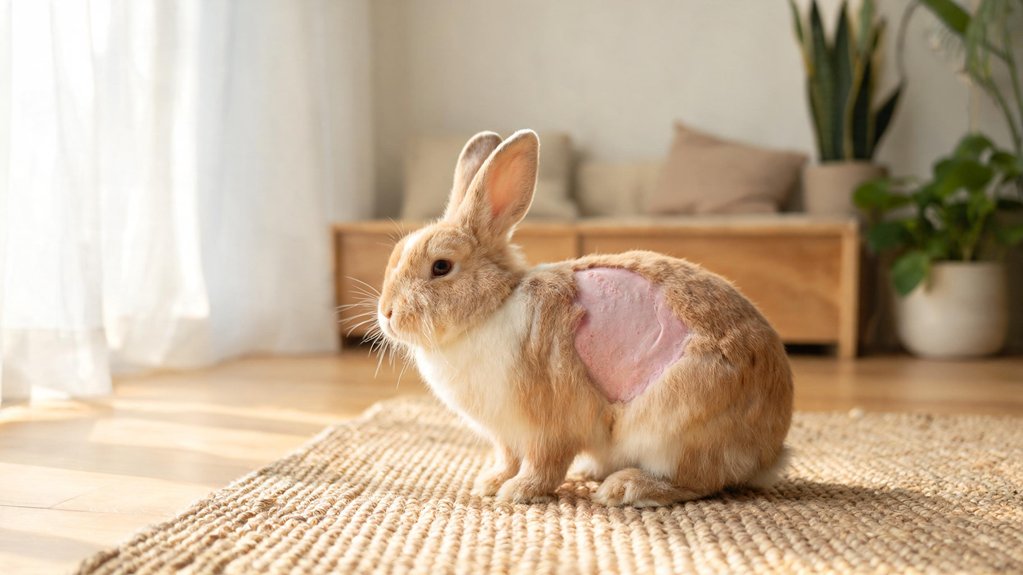
Spotting bald patches can feel alarming, but you can learn a lot from how they look and how your rabbit acts.
Spotting bald patches can feel alarming, but observing their appearance and behavior can guide you toward possible causes.
You should look for patchy thinning, not just total naked skin.
Watch for circular or spreading areas with sharp edges.
One of the most common causes is alopecia from fur-plucking or barbering, so also look for patterns that suggest the hair is being pulled out rather than falling out naturally.
Check exposed skin for dryness, flakes, dandruff, redness, or crusting.
Notice where it happens: back and shoulders with flaking can fit mites, round spots can fit ringworm.
Bald near the rear, dewlap, or skin folds can come from moisture or urine scald.
Also note behavior: licking, scratching, or fur-pulling, plus extra shed fur in bedding.
If they stop eating or pooping 12 hours, call an exotics vet.
Common Fur-Loss Patterns and What They Suggest
Fur loss in rabbits often follows patterns, and those patterns can point you toward the most likely cause.
In a normal molt, you may see a head-to-tail shedding line, or wave-like bands across the back or face.
You might also notice a sudden “coat blow,” big clumps coming off, with clean, non-red skin.
During heavy seasonal molt, loose tufts can create small, temporary bald spots.
But if you see symmetrical, non-molt patches, or gradual thinning across the trunk, think hormones, stress, or diet issues.
If your rabbit seems unwell, contact a rabbit-savvy exotics vet urgently.
Parasites Causing Patchy Bald Spots (Quick Checks)
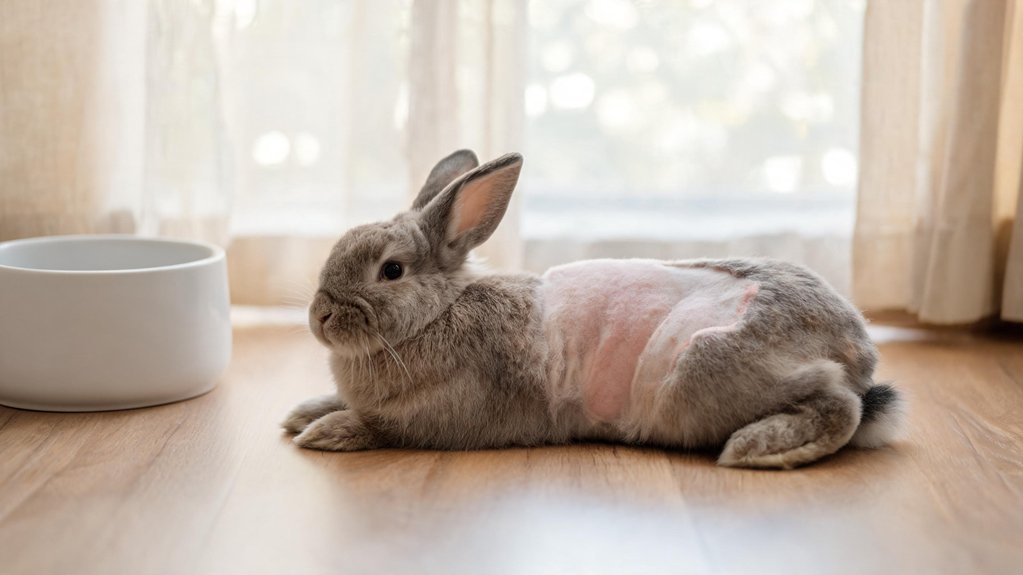
Patchy bald spots can happen for lots of reasons, and some of the most common ones start with tiny external parasites.
Patchy bald spots can have many causes—often starting with tiny external parasites—so check closely before assuming it’s just normal shedding.
Start with a full-coat look, then gently feel for rough, thickened, scaly skin, not just normal shedding.
Check shoulders, back, and neck first, then hindquarters.
Use a magnifying glass if you can.
Are there moving specks, crusts, or flaky “dandruff”?
Flea comb through scaly areas onto dark paper.
If you see “walking dandruff,” think fur mites (Cheyletiella).
If itching is intense with thick crusts on face, ears, legs, or genitals, mange mites may be burrowing.
If your rabbit stops eating or pooping for 12 hours, treat it as an emergency—see a rabbit-savvy exotics vet.
Ringworm Clues in Rabbit Fur and Skin
When you notice bald areas on your rabbit’s head, face, or ears, ringworm (a fungal skin infection) should be on your list—because it often shows up as round or irregular spots of hair loss with crusty, flaky skin.
You’ll usually see scaly, white bran-like flakes, raised or reddened edges, and dry yellowish crusts.
And sometimes the “ring” isn’t clear, it’s more patchy with scabs.
But watch spread too: it often moves from the head to eyelids, muzzle, then paws, nails, and legs.
Mild itch may be absent, too.
Get a rabbit-savvy exotics vet; don’t guess treatments.
Bacterial Skin Infections: Crusts, Redness, Irritation
You might see localized crusts and redness where your rabbit’s skin stayed wet or got irritated from pressure or a scratch. Don’t guess—get a rabbit-savvy exotics vet, because they may need testing to confirm the bacteria and choose targeted antibiotic therapy (wrong antibiotics won’t help).
And if your rabbit stops eating or pooping for 12 hours, treat it like an emergency and go in right away.
Localized Crusting And Redness
Localized crusting and redness from a bacterial skin infection can show up as a “rough” area where fur falls out, skin turns red and sore, and you may notice dry, flaky crusts that sometimes smell bad.
It often starts after skin damage, like damp bedding, urine scald, or sore paws.
You might see circular raised red patches with white, bran-like crusts, or brown crusts around genitals or nose.
Keep your rabbit warm, dry, and clean, and gently remove only loose debris.
Contact a rabbit-savvy exotics vet promptly.
A rabbit not eating or pooping for 12 hours is an emergency.
Antibiotic Testing And Vet Care
Before your rabbit ever gets antibiotics, your best move is to ask a rabbit-savvy exotics vet about culture and sensitivity testing—it helps the vet choose the right medicine instead of guessing. The vet may take samples from the crusted skin, abscess wall tissue, or nasal/ocular discharge.
Then they run aerobic and anaerobic cultures, since some germs need different conditions. Next, the vet uses results to pick a safer antibiotic, often for weeks when Pasteurella or moist dermatitis is involved.
For bald patches, you also want skin scrapings, tape impressions, and cytology.
And call right away if your rabbit stops eating or poops for 12 hours.
Moist Dermatitis From Urine, Diarrhea, or Clagging
Moist dermatitis from urine, diarrhea, or “clagging” (matted, wet fur around the rear end) can sneak up fast, because wet skin stays in contact with irritating fluids for too long.
And when fur stays damp, urine scald and chemical burn-like inflammation start, causing hair loss and raw, sore skin.
You’ll often see it on the perineal area, hindquarters, ventral belly, or base of the tail, with redness, ulcers, odor, and crusting.
Check for diarrhea and poor grooming, too—age, pain, or obesity reduce cleaning.
Keep bedding dry, clean hutch often, and see a rabbit-savvy exotics vet urgently.
Any 12 hours no eating or pooping is emergency.
Wounds and Scars: Why Regrowth Can Stall
When your rabbit gets a deep bite wound, abscess, or incision, scar tissue can replace normal skin and leave less room and support for hair follicles to grow new fur.
Even after the surface heals, chronic inflammation can keep follicles from working, so the bald patch may stay sparse or not fill back in.
If you see scaling, crusts, redness, or your rabbit acts off, contact a rabbit-savvy exotics vet, because fast wound care helps limit scarring and can also catch infections that stall regrowth.
Scar Tissue Impairs Follicles
Scar tissue can be a big reason your rabbit’s bald patch doesn’t fill back in.
When a wound heals with scarring, your skin forms thick fibrous “fibrotic” collagen.
That layer covers the area, and it usually destroys the normal follicle structures.
Follicles are the tiny skin units that grow hair, and they also rely on stem cells, glands, and good blood flow.
In scarred skin, those parts often don’t return, so the follicle cycle can’t restart.
So, don’t just wait.
Ask a rabbit-savvy exotics vet about scar-related hair loss, especially if you see firm skin or long-lasting bald spots.
Chronic Inflammation Limits Regrowth
Chronic inflammation can keep your rabbit’s hair from coming back, even after the original wound looks “healed.”
Right after injury, the body sends in immune cells to clean up the area.
But if that inflammation stays, pro-inflammatory signals like TNF-α and IL-6 keep stressing hair follicle cells.
Those signals can impair stem cells, shrink follicles, and stop new growth.
You also may see long-lasting M1-like macrophages, releasing nitric oxide and ROS, which add irritation.
The skin microenvironment gets tougher, with stiff scar-like matrix that disrupts normal hair cycling.
For care, see a rabbit-savvy exotics vet.
Stress Fur Pulling and “Barbering” From Companions
Even if your rabbit’s bald spots look “random,” stress fur pulling and “barbering” between companions usually follow a pattern.
You may notice thinning on flanks, sides, or the back, where one rabbit plucks the other.
Often, dominance, frustration, or conflict drives it.
You’ll see clumps of fur, bites, lunges, or nonstop mounting.
Submissive rabbits can get overgroomed, especially in bonded pairs with unequal footing.
Triggers include a new rabbit, a tense group, noisy surroundings, or overcrowding.
Also check boredom, poor hygiene, rough handling, and insufficient space.
If your rabbit stops eating or pooping for 12 hours, treat it as an emergency.
Pain, Arthritis, and Overgrooming Bald Spots
If you notice your rabbit licking or chewing one specific spot again and again, pain might be driving the behavior. Pain from arthritis, dental issues, or internal illness can make them focus grooming on the sore area, leaving localized bald patches.
You’ll often see broken, short hairs, uneven fur, and red skin, crusts, or even open sores.
And if grooming takes over their day, they may skip eating, resting, or play.
Check posture, movement, and touch reactions near hips, spine, or jaw. If arthritis is suspected, a vet may discuss rabbit arthritis supplements that may help ease stiffness, pain, and reduced mobility.
Contact a rabbit-savvy exotics vet.
If your rabbit isn’t eating or pooping for 12 hours, treat it as an emergency.
Hormonal and Reproductive Causes of Rabbit Fur Loss
Hormones and reproductive changes can absolutely play a role in bald rabbit patches, especially in intact (not spayed or not neutered) rabbits.
If your doe is pregnant or has pseudopregnancy, she may pull chest, belly, sides, chin, or dewlap fur to “nest,” and patches can appear for about 15–18 days.
And hormone shifts in pregnancy, false pregnancy, and lactation can loosen hair so it sheds easier.
But ovarian cysts or uterine disease can also cause longer, even patchy or symmetrical loss.
For intact males, testicular problems can disrupt hormones too.
If you see this, book a rabbit-savvy exotics vet.
Nutrition Gaps That Slow Coat Regrowth
Nutrition can slow your rabbit’s coat regrowth more than you might think, so start by looking hard at what’s going into the food bowl. Keep grass hay as about 80% of daily intake, because fiber supports gut health and helps hair follicles work.
If you rely on pellets, treats, and too little hay, fur can look dull and regrowth lags.
Next, check protein and essential fatty acids. Too little can thin fur.
Also add leafy greens like romaine, cilantro, parsley, and dandelion leaves for vitamin A.
Missing B vitamins can happen when cecotropes (soft night droppings) aren’t eaten—so adjust diet and watch for improvement over 3 weeks.
Rabbits with stiff joints may also groom less, so supplements that support mobility and joint comfort can be worth considering, though they do not replace a balanced diet.
If your rabbit stops eating or pooping for 12 hours, treat it as an emergency.
Ask a rabbit-savvy exotics vet.
Damp Bedding, Hygiene Issues, and Contact Irritants
Damp bedding and dirty housing can be a bigger cause of bald patches than most people realize, because wet fur stays pressed against the skin and irritates it day after day.
Keep litter boxes big, scoop daily, and fully swap bedding often—at least 1–2 times weekly.
Wet urine can “scald” skin, causing redness, matted fur, odor, and hair loss around the hindquarters.
Check for drips under water bottles, and clean leaks right away.
Also, avoid harsh cleaners or scented, rough bedding that leaves residues.
If your rabbit stops eating or pooping for 12 hours, treat it as an emergency—contact a rabbit-savvy exotics vet.
How a Vet Diagnoses Rabbit Bald Patches
At your rabbit’s vet visit, you’ll start with a whole-body exam and a close coat check, because pattern matters, from patchy thinning to complete bald spots.
Then the vet uses skin scrapings and skin cytology (a quick smear) to look for mites or lice, plus bacteria or yeast that can move in after irritation—expect a close look under a microscope.
If that doesn’t explain it, they’ll screen for parasites and fungal issues with tests like tape or hair samples, and a fungal culture or Wood’s lamp check, so you don’t just guess—plus if your rabbit isn’t eating or pooping for 12 hours, treat it as an emergency.
Physical Exam And Coat Check
When you bring your rabbit in for bald patches, your vet will start with a careful “coat check” and full physical exam, because hair loss is rarely just a skin-only problem.
First, you’ll share history, when it started, any over-grooming, itching, diet, and who else lives with your rabbit. Your vet asks about spay or neuter status and nesting, since hormones or pregnancy can drive fur pulling.
Then they map bald spots, check whether hairs break or shed, and note regrowth over weeks.
They look for redness, crusts, and bad odor.
They also palpate skin for lumps, and assess eyes, ears, and feet.
If your rabbit won’t eat or poop for 12 hours, it’s an emergency.
Skin Scrapings And Cytology
Next, your vet may do skin scrapings and cytology to “read” what’s on your rabbit’s skin, not just what you can see.
You might feel nervous, but it’s straightforward.
Your vet will scrape about one square inch, sometimes using mineral oil, then place the sample on a slide and stain it for microscope viewing.
They may take many sites, like ears, feet, neck, trunk, and hindquarters, because mites can hide.
Superficial scrapings find surface bugs, deeper ones can reach follicle issues.
Cytology uses smears or tape impressions from moist or crusty spots to spot inflammation, bacteria, or yeast.
If your rabbit stops eating, treat it as urgent.
Fungal Tests And Parasite Screen
After skin scrapings and cytology show what’s *happening* on the surface, your exotics vet usually checks *what’s causing it* with a fungal test and a parasite screen.
For fungus, they may culture plucked hairs or scales on DTM, a selective medium, at about 30°C with proper humidity, and they keep the culture for up to 14 days before calling it negative.
They may also mount hairs in potassium hydroxide or oil to look for fungal structures.
No fluorescence on a Wood’s lamp doesn’t rule it out.
Then they screen for mites, fleas, ticks, and ear mites, linked to patchy hair loss.
Treatments for Rabbit Fur Loss by Likely Cause
Treating rabbit fur loss starts with figuring out the most likely cause, because the “right” fix for mites is very different from the “right” fix for ringworm or a bacterial skin problem.
If you suspect ectoparasites, a rabbit-savvy exotics vet may use rabbit-safe macrocyclic lactones like selamectin or ivermectin, then repeat 2–3 times to catch new life stages, and clean the cage after each dose.
If it’s ringworm, expect systemic antifungals, plus topical therapy, isolation, and extra cleaning to lower spores.
If skin is moist, scabby, or oozing, your vet may choose rabbit-safe antibiotics and gentle cleansing.
If your rabbit stops eating or pooping for 12 hours, treat it as an emergency.
Safe At-Home Care While You Wait for the Vet
While you wait for your rabbit-savvy exotics vet, you can do a few safe things at home to protect the skin, keep comfort high, and spot red flags fast.
Check bald patches daily.
Check bald patches daily, watching for spread, color changes, crusting, or scaling to catch issues early.
Watch for spread, color change, crusting, or scaling.
Note dandruff, thick flakes, or debris near shoulders, back, tail base, and behind ears.
Take weekly photos.
Keep the room quiet and low-stress.
Provide soft clean bedding, changed at least weekly, and vacuum loose fur.
Gently brush during shedding, or use a damp hand to remove loose fur, no pulling.
Offer unlimited hay, fresh water, greens, and keep an appetite/stool log.
If your rabbit stops eating or pooping for 12 hours, call right away.
Avoid flea drops, sprays, medicated shampoos, and essential oils.
Prevention Steps for a Healthy, Even Coat
You can do a lot to prevent bald patches and keep your rabbit’s coat looking even, starting with the basics you control every day.
Feed 80–85% quality grass hay, add 10% leafy greens, and 5–10% measured pellets. Skip sudden diet changes.
Keep clean, dry housing, swap soiled bedding fast, and aim for steady temperature, with good airflow. Brush to remove loose fur, twice weekly for short-haired, daily during heavy molts.
Offer extra hay during molting for gut flow and fewer hairballs.
Check skin daily for redness, dandruff, or thinning. Prevent mites with vet-guided treatments, and schedule a skin check every six months.
If your rabbit stops eating or pooping for 12 hours, treat it as an emergency.
Frequently Asked Questions
Why Is My Rabbit Pulling Fur Even Though Its Skin Looks Mostly Normal?
Your rabbit pulls fur because stress, hormones, boredom, or pain can trigger hair-chewing while skin stays mostly smooth. Check diet hay/roughage, add enrichment, and rule out reproductive and dental or joint pain with a rabbit-savvy exotics vet ASAP.
Can Overgrooming Be Caused by Pain or Arthritis?
Yes—overgrooming can absolutely be caused by pain or arthritis. When joints hurt, you’ll notice licking or barbering in specific spots. Get your rabbit checked by a rabbit-savvy exotics vet to find the pain source fast.
How Do I Tell Clagging From a Skin Infection or Parasites?
You tell clagging from parasites or infection by checking for wet, clumped fur in damp spots versus sharp bald patches with flakes, crusts, itch, moving specks, black dirt, redness, or smelly, weepy skin. See a rabbit-savvy exotics vet.
What Should I Look for on Ears and Head With Ear Mite Problems?
Check your rabbit’s ears and head for thick brown/red crusts, wet discharge, raw inflamed tissue, scabs or “dandruff” on the pinna, scratching or head shaking, head tilt or drooping ears. Don’t wait—see a rabbit-savvy exotics vet ASAP.
When Should I Stop Home Care and See a Rabbit-Savvy Exotics Vet?
Any sudden bald patch counts as abnormal: stop home care and see a rabbit-savvy exotics vet right away. Rabbits can get very sick fast. Go urgently if your rabbit stops eating or pooping for 12 hours.