You can see why Rin Tin Tin became the German Shepherd superstar. A WWI rescue near Flirey in Sept. 1918, saved an emaciated mother and five pups, and Lee Duncan named them Rin Tin Tin and Nanette. Then Hollywood turned that calm “problem-solver” vibe into profit, with about 22 silent features plus 7 talkies, and Warner Bros. hits earning roughly $352,000–$400,000. Today real K‑9 teams like Kaiser, Axle, and Trakr prove the same skills, in riskier real life—so keep going.
Swift Summary
- Rin Tin Tin became a German Shepherd Hollywood icon after a WWI battlefield rescue near Flirey, France, in Sept. 1918.
- He starred in roughly 22 silent films and 7 talkies in about eight years, delivering major Warner Bros. financial hits.
- Lee Duncan brought Rin Tin Tin and Nanette from France to the U.S., where training and showcase attention led to Warner Bros. signing.
- Rin Tin Tin’s fame boosted public fascination with the breed through heroic “savior” screen roles and wider mythmaking.
- The name “Rin Tin Tin” drew from French good-luck wartime lore, and his legacy continued through TV and later K-9 police stories.
Why Rin Tin Tin Became a German Shepherd Icon
Because Rin Tin Tin hit Hollywood at the perfect moment, you can see why people quickly treated him like a German Shepherd icon. You watch his silent-film stardom, where he starred in about 22 silent features, plus 7 talkies in roughly eight years. He was rescued by American soldier Lee Duncan from a World War I battlefield, which helped launch his extraordinary path to fame. And you notice his heroic screen persona, built on clear problem-solving in every story. But his impact wasn’t just acting; his movies helped Warner Bros. avoid bankruptcy, earning about $352,000–$400,000 for big hits. When you look at what celebrities have german shepherds, remember Rin Tin Tin made the breed feel brave, smart, and trainable. That image of intelligence and working ability owes much to Max von Stephanitz, who developed the breed from sheep-herding dogs in Germany.
How Rin Tin Tin’s WWI Rescue Became Legend
When you hear about Rin Tin Tin’s Flirey rescue in Sept. 1918, you’re really hearing how one grim battlefield moment turns into a wartime legend, survival and luck mixed together like a lucky charm. Lee Duncan finds a bombed kennel, then saves the newborn pups, and after weaning he keeps two (Rin Tin Tin and Nanette) before transporting them to the U.S. with help and good connections. After the rescue, the male was named Rin Tin Tin and the female was named Nanette after small French yarn dolls used as good luck charms. From there, you can see how the story gets shaped for Hollywood, because an animal’s “just barely made it” journey from war rubble to the spotlight feels like destiny. Today, anyone considering a German Shepherd can take a lesson from this legacy by reviewing a puppy’s pedigree and health history before bringing it home, since a sound background matters as much as a famous name.
Flirey Rescue Sparks Wartime Legend
In September 1918, near the French village of Flirey, you can almost feel the war throb in the ground as the Battle of Saint-Mihiel pushed German forces back in the Meuse Valley.
And when you move through the ruins, you understand why this rescue spread so fast.
On 15 September 1918, you find a bombed kennel near camp, flattened by artillery and air raids.
Most dogs are gone.
But you save an emaciated mother and five newborn pups.
You carry them to the U.S. unit camp.
Later, you name the male Rin Tin Tin, and the female Nanette, like lucky French charms (German shepherd puppies).
Their survival becomes a legend.
Lee Duncan Transports To Hollywood
After you picture that muddy Flirey kennel, it’s easier to follow how Rin Tin Tin’s story turns into Hollywood headlines.
After WWI, Corporal Lee Duncan, a California native, brings Rin Tin Tin and Nanette from France home, and you can feel the care in that step.
He trains them with obedience, socializing, and sharp hand-signal response, so they can work fast, and still stay calm.
Next, in 1922, a showcase at the Ambassador Hotel gets industry eyes on them.
Then Duncan scouts Poverty Row studios, and lands early roles—leading Warner Bros. to sign them around 1923.
What “Rin Tin Tin” Means and Why It Stuck
Rin Tin Tin didn’t start as a dog’s name at all—it began as a bit of French wartime “good-luck” lore.
You first meet it in 1913, when Francisque Poulbot created porcelain yarn dolls, Nénette and Rintintin, for soldiers.
They promised protection, backed by a slogan, “Avec nous rien à craindre.”
But you don’t just “buy” luck, you receive it, as a gift.
Civilians traded simple wool charms during bombing raids.
Then, in 1918, Lee Duncan named rescued pups Rin Tin Tin and Nanette for that same shield.
The name stuck because it sounded rhythmic, and it meant hope. Shepherd lines have long produced striking variations, as seen in the rare wolf-like appearance of the Blue Bay Shepherd.
Rin Tin Tin’s Hollywood and Warner Bros Success
On the big-screen side, Rin Tin Tin became a Warner Bros money machine in the 1920s, and you can almost feel how quickly the studio built its future around him.
In 1923, Warner Bros signed Lee Duncan and Rin Tin Tin, starting a dependable wave of canine-led features.
His breakout came with Where the North Begins, which helped save Warner Bros from bankruptcy.
And in tough times, the studio leaned on fresh Rin Tin Tin releases for steady profits.
You’ll see why insiders called him “the mortgage lifter.”
His contract paid about $1,000 per week—more than many human actors—across 22 to 27 films.
Much like the German Shepherds later valued in police and K9 work, Rin Tin Tin demonstrated the breed’s intelligence and trainability that made it a natural fit for demanding roles.
How Fame Reshaped German Shepherd Popularity
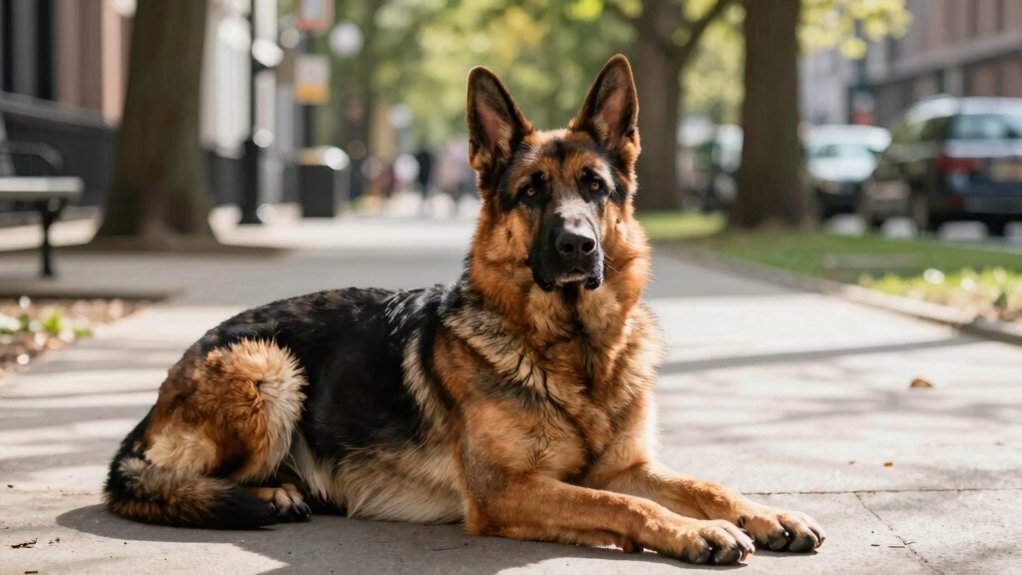
As German Shepherds hit Hollywood screens, you could feel their popularity change almost week by week—because people often copy what they see and cheer for.
Between World War I and World War II, film stars like Rin Tin Tin and Strongheart boosted breed visibility and demand.
You see it in the AKC numbers, climbing from 2,135 registrations in 1920 to 21,596 in 1926, making the breed top-ranked, even ahead of Boston Terrier around 1025.
Hollywood hype and returning soldiers also framed German Shepherds as loving family helpers.
But fame outpaced good breeding, causing defects and a late-1920s dip.
Beyond their screen fame, German Shepherds have earned lasting respect for their working ability and intelligence, traits that make them one of the world’s most popular dog breeds.
From Movie Legend to Real Policing Work
Step into the real-world impact behind the movie magic, because German Shepherds didn’t just look tough on screen—they trained for it. Their high intelligence and strong drive make them generally responsive to training, which is why they excel in demanding work.
Rin Tin Tin’s rescue in 1918, then K-9 training under Leo Wanner, led him into police work before Hollywood.
Rin Tin Tin’s 1918 rescue and K-9 training under Leo Wanner propelled him into police work before Hollywood.
Later, his legacy lived on through descendants and media.
Now you see the same strengths in real units: detection of drugs and explosives, tracking missing people, and recovering evidence with article-search and air-scenting (finding scent in the air).
Dogs like NYPD’s Apollo even support urban search and rescue.
When safety matters, you learn their teamwork saves lives.
How Myths Increased K-9 Adoption
Because myths make everything feel possible, stories about German Shepherds as near-mythic war heroes and “German police dogs” helped drive K‑9 adoption fast. You heard returning U.S. soldiers describe battlefield success, and the breed seemed built for protection and loyalty.
Early 1900s promoters like Captain Max von Stephanitz linked obedience and courage to real working skill, then added a heroic aura.
Later, films made Rin Tin Tin and Strongheart feel like saviors, and “boy and his dog” plots made the dream family-ready.
In the UK, registrations jumped from 54 in 1919 to over 8,000 by 1926. Those same romanticized images also fostered aggression myths, which later shaped debates over bite statistics and breed restrictions.
Before you adopt, verify health and training.
Rin Tin Tin Jr and the TV Legacy
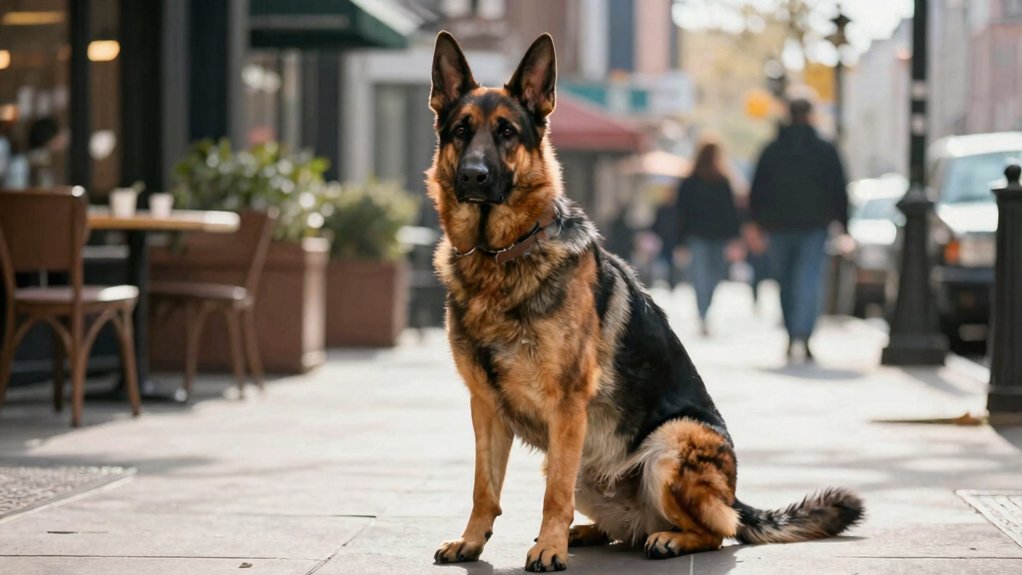
You can trace how Rin Tin Tin Jr kept the screen magic alive after Rin Tin Tin, starring in films and serials through the 1930s and into the early 1940s, so the name stayed fresh in people’s minds.
Then, those familiar heroic stories and even radio voice work helped set the stage for TV, where *The Adventures of Rin Tin Tin* ran from October 1954 to May 1959 and treated “Rin Tin Tin” like a true frontier legend.
When you watch the TV adventures with Rusty and the cavalry at Fort Apache, you’ll see how the show clearly links back to Rin Tin Tin Jr as the bridge from early movies to broadcast fame. German Shepherds have also become well known for their real-world work, and many are trained as service dogs that perform specific tasks for people with disabilities.
Starred After Rin Tin Tin
After Rin Tin Tin died in 1932, his name didn’t fade—it just kept moving, first through Rin Tin Tin Jr., and then through TV.
You see Rin Tin Tin Jr. born in September 1931, trained by Lee Duncan, and listed as a canine actor in 1930s films and serials.
You can picture him on radio too, sometimes filling the voice role in broadcast dramas, while touring and making personal appearances to keep the brand alive.
Later, ABC’s The Adventures of Rin Tin Tin ran from Oct 15, 1954, to May 1959, about 164 episodes.
Featured In TV Adventure Stories
How did Rin Tin Tin Jr keep living on after the first famous Rin Tin Tin era? You watched “Rin Tin Tin” on ABC, from Oct. 15, 1954, to May 8, 1959, in 30-minute episodes. In each one, you followed orphaned Rusty and Rin as they helped Fort Apache troops, around Mesa Grande. You saw undercover missions, rescues, and tracking that solved frontier problems with courage and loyalty.
The show ran about 164–166 episodes, about 5 seasons. After cancellation, ABC reran them on Saturdays, then CBS aired reruns on Saturday mornings. You learned how service and law-and-order heroism could reach everyone.
Kaiser: German Shepherd Bravery With PC Swain
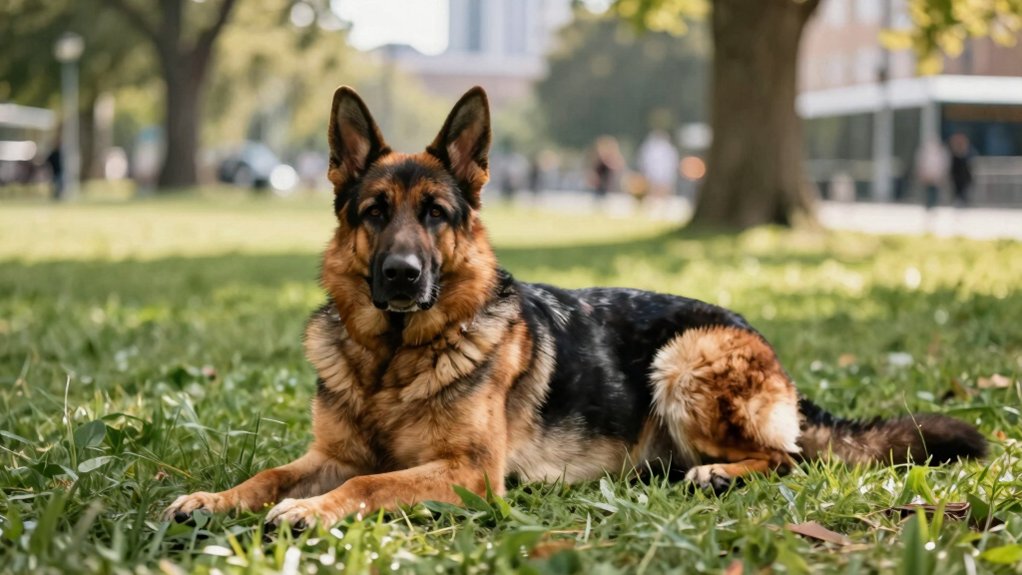
Kaiser and PC Martin Swain built their reputation the hard way, and it shows every time they get called out. You see it in their steady bond, starting when Kaiser was just eight weeks old, and living at home with Swain.
That teamwork matters on patrol. Now, Kaiser’s general purpose training means he can help in routine calls, suspect detention, and many tasks.
In a 13 Thurrock chase, he tracked into a deep water ditch, even went under briefly, and still helped arrest the suspect.
And in a Billericay burglary, at about 3:44am, he searched dense bushes and helped secure Lackenby. Consistent training and a close handler bond help keep a working German Shepherd focused, because understanding what triggers sudden aggression is key to preventing it.
Axle and the Derbyshire Police National Award
But take a breath here, because it wasn’t just the ceremony—Axle’s courage in July 2018, including the long contact that let armed officers step in, helped turn danger into arrests, and that’s the kind of devotion you should remember. Working German Shepherds like Axle must stay physically fit for demanding duties, since hip dysplasia, a common inherited joint condition in the breed, can affect mobility and performance.
National Award Ceremony Details
On Friday 8 November 2019, PDSA presented the Police Dog Axle National Award at Derbyshire Police Headquarters in Ripley****, and it made the day feel both formal and deeply personal.
You’d see police dog unit members there, with Police Constable Dean Allen standing close to Axle.
PDSA Area Veterinary Manager Robert Haselgrove led the handover, speaking the citation: “For suffering stab wounds while attending an incident with Derbyshire Police”.
PDSA recorded the official award date as 3 September 2019.
And you’d notice PDSA worked with Derbyshire leadership, sharing Axle’s recovery story for the public.
Derbyshire Police Bravery Recognition
In Derbyshire, PD Axle’s courage didn’t just happen in the moment, it got officially recognized at national level, and that matters when you’re learning what service animals endure.
On 4 July 2018, in Riddings, you see Axle help Derbyshire officers face an armed suspect with a hammer and knife.
Axle took three stab wounds, including two to the neck, and needed emergency, life-saving vet care and surgery.
Later, the PDSA Commendation added his name, “PD Axel,” to the Roll of Honour, dated 3 September 2019, for outstanding devotion and bravery while attending the incident.
That’s service.
Axle’s Service Impact Highlights
After 4 July 2018, Axle’s bravery didn’t fade once the danger passed—it got officially recognized on a national stage.
You see that on 8 November at Derbyshire Police Headquarters in Ripley, when the PDSA national commendation was presented by Robert Haselgrove.
This award celebrates outstanding service animals, like Axle’s crucial help locating and cornering a knife-armed suspect.
He’d been stabbed three times, then had two life-saving surgeries, and returned to duty days later.
Soon, you’d spot him assisting in five arrests.
Even in Parliament, “Axle’s law” echoed his impact.
Trakr’s German Shepherd Search and Law Work
Trakr the German Shepherd earned his reputation in Canada, where you could find him working as a police K9 in Halifax, Nova Scotia—sniffing and searching for people when every second mattered.
Trained for search-and-rescue, he used scent, a dog’s powerful “smell map,” to find humans even in rubble.
After retiring from regular duty by May 2001, you’d still see his value.
When 9/11 hit, handler James Symington drove him 15 hours from Nova Scotia to New York.
On Sept 12, he searched near-continuously for about 48 hours, guiding rescuers to Genelle Guzman-McMillan.
Apollo and 9/11: A German Shepherd K-9 Icon
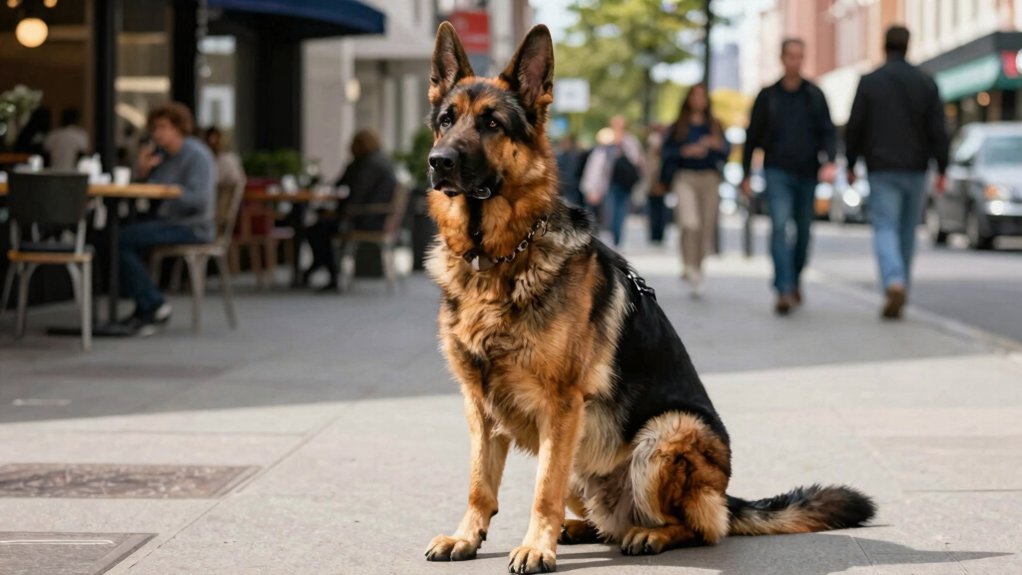
Meet Apollo, a German Shepherd who became a New York City K-9 icon the moment the world needed search-and-rescue most.
After training in the NYPD K-9 unit, he graduated around 1994, then partnered with Officer Peter Davis in Urban Search and Rescue—finding injured people in rubble.
On 9/11, you’d call him first on scene.
About 15 minutes after the South Tower collapse, he arrived, started searching right away, and worked 12-to-18-hour shifts for weeks.
He survived a fall through debris, then flames—thanks to earlier soaking.
Later, he earned ACE in 2001 and the PDSA Dickin Medal in 2002.
Kylo’s Final Shift: Risks on German Shepherd Duty
On September 24, 2026, Kylo took his last scheduled shift, and the risks hit fast.
You see him deployed in Southeast Portland, tracking a wanted homicide suspect in a tight motel area during a joint operation.
Close walls mean close gunfire, and chaos brings 20–30 shots.
Gunfire causes about 26.4% of K-9 deaths.
Kylo, 8 years old, faced higher injury odds because each added year raises risk about 60%.
German Shepherds also show higher injury rates, 7.9 times.
When you serve, plan for quick exits, clear lanes, and steady tracking support.
Modern Awards for German Shepherd K-9 Heroes
After Kylo’s last shift showed how fast danger can stack up, it’s fitting to look at how today’s K‑9 heroes get recognized when they do the job anyway.
In the UK, the Thin Blue Paw Foundation runs annual awards. You’ll see categories like Outstanding Bravery and Crimefighting Duo Award, which honors the handler–dog team’s consistent results.
German Shepherd Boss of Kent Police won that Duo Award after multiple operations, and German Shepherd PD Frankie of Surrey Police earned Outstanding Bravery for safely detaining a knife-wielding suspect.
Boss and Frankie’s award-winning bravery proved handlers and K‑9s can safely end threats through skill, teamwork, and calm.
In the U.S. and abroad, PDSA medals and the Animals in War and Peace honor courage too.
What Makes German Shepherds Excel in Police Work
You’ll notice German Shepherds shine in police work because they’re easy to train, they’ve got steady courage, and they truly want to work.
Their temperament and drive keep them focused, so you can run scent “search” drills (finding a smell trail) and tracking basics—often in short 10–15 minute sessions—then build up to longer patrol scenarios.
And when the call gets loud and stressful, you’ll see their calm under pressure, plus sharp scenting, helps them find people and contraband fast, even in crowded or messy places.
Trainable Temperament And Drive
Because German Shepherds combine high intelligence with real work drive, they tend to learn fast and stay steady under pressure. You’ll notice they’re among the most trainable breeds, so new commands often stick in under five reps.
Using positive reinforcement, you reward desired behavior, and they respond reliably in real operations. Their strong work ethic keeps them engaged, even during long patrols.
But you must give structured outlets, so energy stays controlled. Their nerve strength helps them handle noise, sirens, gunfire, and surprise moments calmly.
With courage and loyalty, you guide them safely, on duty and off.
Scent Tracking And Search Skills
Scent tracking is where German Shepherds really shine, and you can see why in police work.
Their noses work at 10,000–100,000 times human sensitivity, so they can spot trace substances under 1 gram.
That “macrosmia,” or extreme smell, improves with training.
After about two years, they can recognize two scents from the same person in 85% of cases.
You’ll use this strength for narcotics, explosives, and search-and-rescue.
Ground tracking reads footprints and disturbed vegetation.
Trailing locks onto a person’s odor, not random ground.
Air-scenting follows scent on the wind, even across city streets, forests, and disaster zones.
Courage Under High-Stress Calls
After you’ve seen what their noses can do in real time, look at what happens when the pressure spikes on patrol—German Shepherds hold their ground.
In working-line dogs, you’ll find strong nerve stability under gunfire, crowds, slippery floors, and new places.
They recover fast after startling moments, so they stay useful, not frozen.
Courage here means “brave but not reckless,” and it shows up with calm confidence in buildings, vehicles, and industrial sites.
Next, you use their drives and controlled aggression, so they confront real threats and protect you, while avoiding fear-based or territorial behavior.
High intelligence helps them follow cues, even during chaos.
Rin Tin Tin Vs Strongheart: Early Dog Stardom
Step into the silent-film era, because the race for early dog stardom is way more thrilling than it sounds.
First, Strongheart, Etzel von Oeringen, was trained as a police dog in Germany, then imported to the U.S. by Trimble and Murfin.
He debuted in The Silent Call (1921), and you could feel his appeal in both big cities and small towns, with about $1 million at the box office.
Then, Rin Tin Tin arrived, an abandoned WWI battlefield puppy, and took over in The Man from Hell’s River (1922).
You help audiences by noticing who earns roles fast—Strongheart first, then Rin Tin Tin.
Frequently Asked Questions
Where Can I See Original Rin Tin Tin Films Today?
You can watch original Rin Tin Tin films today on Tubi, The Roku Channel, Pluto TV, Plex, and Xumo Play (often via Finding Rin Tin Tin and The Return of Rin Tin Tin). In some regions, stream on Prime Video or Netflix, and buy/rent on Amazon VOD.
How Were Police K-9s Trained for Search, Patrol, and Apprehension?
You train police K-9s through obedience and socialization, scent bonding, odor discrimination, and blind, reality-based search drills. You build patrol skills with agility and building searches, then teach controlled bite-and-hold apprehension with strict out and recall commands.
Did Rin Tin Tin’s Fame Impact German Shepherd Breeding or Standards?
Yes—Rin Tin Tin’s fame reshaped breeding: Lee Duncan pursued a closed program to mirror Rin Tin Tin’s working temperament and structure, rejecting show exaggerations. You get more consistent, service-ready dogs—breeders protected that line’s standards deliberately.
What Happened to Rin Tin Tin Jr After the TV Series Ended?
Rin Tin Tin Jr didn’t continue after the TV series ended—he’d already died in December 1941. The later TV-era Rin Tin Tin dogs carried on the name through rights and marketing, not his direct life or career.
How Are German Shepherds Selected and Matched With Police Handlers?
You select police German Shepherds at 12–24 months, test drive, nerve, and sociability, then screen health and genetics. Trainers match dogs to handlers by evaluating handler skills, teamwork, obedience reliability, and real-world performance under stress.