You’re at higher risk if you have a German Shepherd, because many develop pancreatic acinar atrophy, and EPI (exocrine pancreatic insufficiency) often shows up between 1–4 years, sometimes earlier. Watch for greasy “cow-pat” yellow-gray stool, loud belly gurgling, gas, and weight loss even with ravenous appetite. You’ll confirm with fasting serum TLI and check B12/folate. Then start prescription enzymes with every meal, and expect improvement in 2–7 days, plus tighter stool by about 7. Keep going for the next steps.
Swift Summary
- German Shepherds have high EPI risk, with onset often between 6 months and 6 years, commonly around 3 years.
- EPI causes maldigestion/malabsorption from low amylase, lipase, and proteases, plus reduced pancreatic bicarbonate.
- Classic signs include yellow-gray “cow-pat” greasy diarrhea, borborygmi, weight loss with polyphagia, and oily, matted hair.
- Most EPI stems from pancreatic acinar atrophy (often autoimmune-like with genetics), with signs appearing after ~90% reserve loss.
- Diagnosis uses fasting TLI bloodwork and treatment is lifelong pancreatic enzyme replacement plus diet and vitamin monitoring.
Why German Shepherds Are at High Risk for EPI
Because EPI (exocrine pancreatic insufficiency, when the pancreas can’t make enough digestive enzymes) is so tied to German Shepherd biology, you should treat this breed as high risk from the start. Beyond pancreatic disease, this breed is also affected by rarer problems such as dwarfism and neurological disorders.
Given EPI’s strong ties to German Shepherd biology, treat this breed as high risk from the start, early on.
German shepherd pancreatic issues show up a lot, with studies estimating about 42% of EPI diagnoses and up to 60% of all cases in this breed.
Many lines also develop inherited pancreatic acinar atrophy over time, often after immune changes like lymphocytic inflammation.
You can’t always predict severity, because genetics look polygenic.
What Exocrine Pancreatic Insufficiency (EPI) Does
Exocrine pancreatic insufficiency (EPI) happens when your German Shepherd’s pancreas can’t make enough of the digestive “helpers” it normally releases into the small intestine. Without enough amylase, lipase, and proteases, your dog can’t break down proteins, fats, and starches into absorbable nutrients. EPI is caused by insufficient enzyme secretion. And when the pancreas also makes less bicarbonate, stomach acid isn’t neutralized well, so enzymes don’t work at their best. This leads to maldigestion, then malabsorption, which causes severe nutrient gaps, weight loss, weakness, and microbiome imbalance. The good news: you can often control this with lifelong enzyme replacement therapy. Because EPI is among the common health issues affecting German Shepherds, owners should learn its symptoms early so they can seek veterinary care promptly.
Spot the Classic EPI Poop and Gas Signs
When you’re checking for classic EPI clues, look for cow-pat, pudding-like, greasy stool that’s often yellow, gray, or pale, and you may even see tiny undigested bits. Then notice the gas—EPI dogs commonly have loud gurgling gut sounds (borborygmi) and belly bloating, with lots of soft, bulky stools happening more than 3 times a day. Keeping up with basic grooming needs like nail trimming and paw cleaning also gives you a regular chance to notice changes in your dog’s coat, weight, and overall condition. If you see that combo for weeks, exocrine pancreatic insufficiency call your vet and describe the color, the grease/oil look, and when the gurgling and bloating show up.
Cow-Pat Greasy Stool
Spotting EPI often starts with what you see in the yard, and cow-pat greasy stool is a big clue.
You’ll notice soft, unformed, spread-out piles, not neat logs.
The color often looks pale, yellowish, or grey.
Look closely—its surface may shine like it’s oily, because undigested fat stays in the stool.
You may also see larger, bulky amounts each time, and more trips during the day.
Sometimes the poop turns putty-like or even watery, yet still spreads flat.
And check hair near the anus—it can look matted and oily too.
Loud Gurgling Gas Bloating
So if your German Shepherd starts acting like their tummy’s “rolling,” listen—loud intestinal gurgling (also called borborygmi, basically noisy gut sounds) and excess gas often show up with EPI.
That’s because near-zero enzymes leave food to ferment.
And fermentation creates hydrogen, methane, and gas.
You’ll often notice it soon after meals, sometimes at night.
Their belly may look rounded, soft, and “bouncy” to tap—more tympanic than firm.
Expect frequent, malodorous flatulence, restlessness, pacing, and hunched cramping.
You can serve them by starting enzyme replacement and diet changes, then call your vet.
Recognize Weight Loss Despite a Hungry Appetite
If you notice sudden weight loss even though your German Shepherd seems ravenous, pay attention—polyphagia (eating more than usual) can still mean they’re not absorbing nutrients. Changes in appetite can also signal stomach problems or stress, so note any shifts in eating habits alongside weight changes.
Pair that with bloating, borborygmus (gurgling gut sounds), and greasy or loose stool, and you’ve got a strong clue for exocrine pancreatic insufficiency, not “just a picky appetite.”
Don’t wait for the next weigh-in—call your vet and ask about EPI testing, especially if the diarrhea and poor body condition have been going on for more than a couple of weeks.
Sudden Weight Loss Despite Hunger
When your German Shepherd looks hungry and yet keeps dropping weight, you should take it seriously, not shrug it off.
In EPI, the pancreas makes fewer digestive enzymes, so food passes through partly undigested.
You may see ribs, spine, and hip bones within weeks to a few months, and stools can be large, pale, and greasy.
Because your dog loses fat and muscle for energy, appetite doesn’t save the body.
Ask your vet for exams, bloodwork, and TLI testing for EPI.
Check cobalamin (vitamin B12) too.
Treatment includes enzymes with every meal, plus diet and help for bacterial overgrowth.
Polyphagia With Poor Body Condition
And yet you may notice the same pattern again and again: your German Shepherd seems hungry all the time, eats fast, and still looks thin, with ribs, hip bones, or the spine starting to show.
You’re not imagining it—this polyphagia with poor body condition signals severe maldigestion from exocrine pancreatic insufficiency (EPI).
You’ll also see muscle wasting over the lumbar spine and thighs, a dry dull coat, and low energy.
To help, score body condition weekly (1–9 scale), track calories and treats, and ask your vet for cTLI and cobalamin tests.
Feed multiple small meals, then start pancreatic enzymes with every meal.
Bloating, Greasy Stool, Borborygmus
Even though your German Shepherd acts starving and eats fast, EPI can still make them lose weight because they can’t properly digest fats, and the gut starts acting up.
Watch for greasy, yellow or gray, cow‑pat stool. It’s often bulky, loose, even watery, and smells awful.
You may also hear borborygmus, loud gurgling stomach sounds, plus flatulence and bloating.
That rumbling usually means gas and fluid moving through irritated, dilated small bowel.
If you see weight loss plus soft greasy stool, don’t assume picky eating—call your vet.
Enzyme replacement and diet can cut gas within days.
How to Tell EPI Apart From Pancreatitis and Other GI Disease
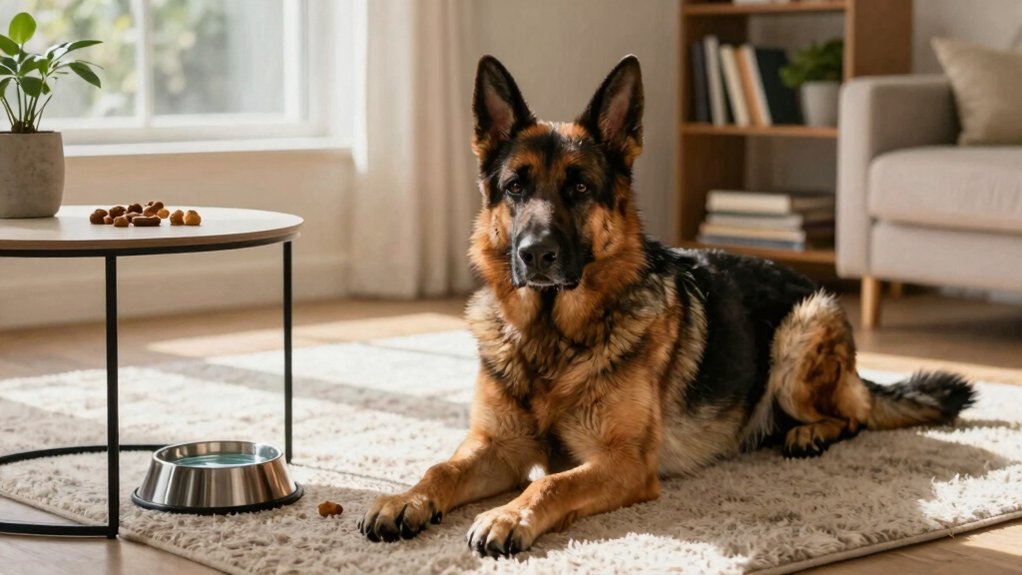
So how do you tell exocrine pancreatic insufficiency (EPI) apart from pancreatitis or other tummy problems? Start with the timeline. EPI usually builds slowly, and stays there. Because German Shepherds are prone to digestive problems, owners should track stool quality and body weight as part of lifelong care from puppyhood through the senior years.
You’ll see chronic, voluminous yellow‑to‑gray “cow‑pat” diarrhea, weight loss, and muscle wasting, even if appetite stays normal or rises. You may also notice pica and coprophagia.
Pancreatitis hits suddenly. Expect vomiting, cranial belly pain, anorexia, and strong sick signs like fever, dehydration, or shock.
Next, run the right test: cTLI confirms EPI, while cPLI plus imaging supports pancreatitis. Then rule out infections, blockages, and inflammatory bowel disease.
Understanding Pancreatic Acinar Atrophy as the Root Cause
Pancreatic acinar atrophy (PAA) drives most cases of EPI in dogs, especially German Shepherds, and it usually starts quietly long before you notice anything wrong.
You’re dealing with selective damage to enzyme-making cells in the pancreas, called acinar cells.
As these cells shrink and die, your dog’s pancreas gets replaced by fat and scar-like tissue, often with little obvious inflammation.
Only after about 90% of the functional reserve is gone do EPI signs show up.
PAA also behaves like an autoimmune, T-cell–driven disease, with genetic risk.
Because German Shepherds are also prone to degenerative myelopathy, a progressive spinal cord disease that causes hind limb weakness, owners should not assume that every change in their dog’s hind end is caused by EPI.
When EPI Symptoms Usually Start in German Shepherds
For most German Shepherds, EPI symptoms don’t usually wait until old age. You’ll most often see signs start between 6 months and 6 years, with young adults hit hardest—especially from 1 to 4 years.
Many owners notice symptoms around a median diagnosis age near 36 months, about 3 years. In fact, about every second German Shepherd shows clinical signs before age 2.
But timing can shift by cause. If pancreatic acinar atrophy drives EPI, you may see onset around 1–2 years. If chronic pancreatitis causes EPI, signs often appear later, in middle age. Owners managing early signs often choose small, low-fat training treats so that rewards don’t upset digestion.
Which Tests Confirm EPI (TLI and More)

You can confirm exocrine pancreatic insufficiency (EPI) with a fast, targeted bloodwork plan.
First, run a fasting serum trypsin-like immunoreactivity (TLI) test, since TLI (a pancreas enzyme marker) drops sharply in EPI, with values ≤ 2.5 µg/L** strongly diagnostic, and 2.5–5 µg/L** suggesting early or developing disease.
Next, check serum cobalamin (vitamin B12) and folate, because B12 often falls in EPI—so if you see low cobalamin along with low TLI, you’ve got strong evidence of true enzyme and nutrient deficiency.
TLI Testing For Enzyme Deficit
Wondering how vets confirm enzyme deficiency from exocrine pancreatic insufficiency, or EPI, in German Shepherds? They start with a TLI test.
TLI means serum trypsin-like immunoreactivity, and it reflects enzyme leakage from the pancreas into the blood.
You’ll fast your dog about 12 hours first, then your vet draws one blood sample.
The lab runs a canine-specific immunoassay, often by radioimmunoassay.
Fasting matters, so recent meals don’t push TLI up.
Very low values—often under ~2.5 µg/L, or ≤5.5 µg/L depending on the lab—confirm EPI.
Borderline results mean retesting in 1–3 months.
Cobalamin Levels For Deficiency
After you confirm the enzyme problem with a TLI test, check what’s happening with vitamin B12, because EPI often drags cobalamin levels down too.
Many dogs and cats with EPI become hypocobalaminemic, meaning low cobalamin in blood.
Start with a serum cobalamin test, plus folate.
You use folate and cobalamin to spot where the gut is failing, low folate points more to proximal disease, low cobalamin points more to distal ileum issues.
In EPI, treat when cobalamin is below 300 ng/L, or when it’s “low-normal” under ~400 ng/L.
Recheck levels during treatment.
Why Cobalamin (Vitamin B12) Testing Matters
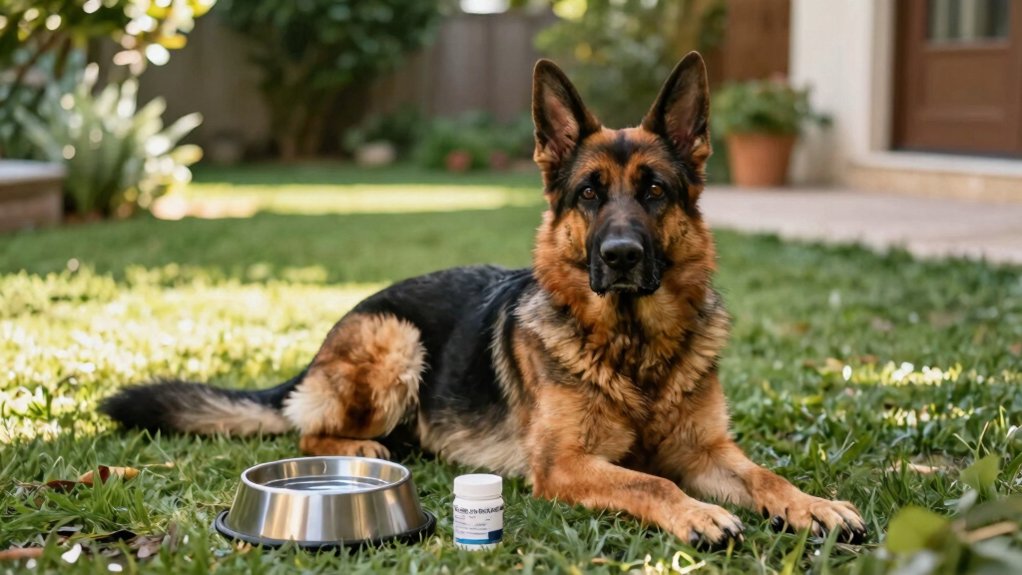
Why does cobalamin (vitamin B12) testing matter so much in German Shepherds with exocrine pancreatic insufficiency (EPI)? Because deficiency is common and serious, you need the numbers to guide care.
More than 60% of dogs with EPI run low, and about 75% show subnormal cobalamin.
The pancreas normally makes “intrinsic factor,” needed to absorb B12 in the ileum, so EPI disrupts that.
Also, small intestinal bacterial overgrowth can eat up B12 too.
When levels run low, signs like chronic wasting and poor response to treatment often follow.
Test serum cobalamin, and pair it with folate to spot malabsorption.
Owners should not confuse a German Shepherd’s German Shepherd bite strength with the body’s ability to absorb nutrients, since a powerful bite says nothing about cobalamin status.
When to Start Enzyme Replacement Therapy
When you’re seeing German Shepherds with suspected exocrine pancreatic insufficiency, your best next step is to start enzyme replacement therapy fast, because their body can’t properly digest protein, fat, and carbs.
Start right after diagnostic proof and symptoms show poor digestion.
Start immediately after diagnostic proof when signs show poor digestion—don’t delay enzyme therapy.
If cTLI is low, meaning less functioning pancreas, begin immediately.
If fecal elastase-1 ELISA confirms EPI with signs like chronic, greasy diarrhea and weight loss, start promptly.
Don’t wait for perfect certainty when stools, body condition, or muscle wasting look classic.
If diet changes fail, or young dogs stunt, move quickly.
Enzymes keep nutrition on track. Owners of crossbreeds like the Australian Shepherd German Shepherd mix, which often has high energy levels, should also monitor appetite and stool quality, since digestive signs can be easy to overlook in very active dogs.
How to Calculate an EPI Enzyme Dose by Body Weight
Getting the right EPI enzyme dose by body weight is simple once you use a consistent “per meal” calculation, because enzymes work best when you give them with food.
Measure your German Shepherd’s weight, then dose per meal: start around 1 teaspoon enzyme powder per 10kg body weight, mixed into each meal.
If your product is about 2.8g per level teaspoon, 1 tsp/10kg equals ~0.28g/kg per meal.
Many plans begin in the 0.25–0.4g/kg per meal range, then adjust by stool quality and weight.
Smaller snacks get about half the main-meal dose.
For dogs with sensitive stomachs, digestive problems, or food allergies, it also helps to review the best food choices for German Shepherds before settling on the diet you will pair with enzymes.
Managing Ongoing Vitamin Support and Injections

You’ll want to monitor cobalamin (vitamin B12) with repeat blood tests, so you can catch low levels early and keep your German Shepherd from slipping back.
After the starter phase, plan B12 injections—often every 2–4 weeks, or every 1–2 months once stable—using the dose your vet sets (commonly about 20–25 µg/kg SC per injection weekly during correction, then spaced out).
Along with lifelong selective fat‑soluble vitamin support as needed, you’ll stay consistent, because enzyme replacement alone doesn’t fix B12 malabsorption.
Monitoring Cobalamin Levels
Why gamble with your dog’s vitamin status? In EPI, low cobalamin (vitamin B12) shows up in over 60% of dogs, and up to 82.8% in one study—so you check.
Measure serum cobalamin, often with folate, especially if enzyme therapy response is poor, or signs like anemia, weak immunity, or nerve trouble persist.
Recheck about 6–7 weeks after starting support.
Then recheck about 1 month after stopping to confirm lasting change.
Use practical cutoffs: below 400 ng/L, or <350 ng/L, matters.
If serum looks “normal,” consider MMA for tissue-level deficiency.
Planning Regular B12 Injections
Planning regular B12 injections can feel a little intimidating at first, but it’s one of the most reliable ways to keep your German Shepherd from slipping back into trouble with EPI.
You’ll usually start with weekly subcutaneous doses for 6 weeks, often in a clinic so dosing is accurate and your dog is monitored.
Then you give a booster 1 month later.
Many dogs still need lifelong injections.
After that, plan monthly subcutaneous cyanocobalamin, often 250–500 µg, to prevent monthly setbacks.
If your vet uses hydroxycobalamin, they may choose about 0.25–1.25 mg, monthly or bimonthly.
Managing Long-Term Vitamin Supplementation
Once your German Shepherd is stable on treatment, managing long-term vitamin support becomes your “keep it from slipping” plan.
You’ll want routine blood checks for cobalamin (B12), folate, and key fat-soluble vitamins A, D, E, and K.
More than 60% of dogs with EPI have low B12, so test first, then recheck after you start injections or pills.
For A and E, many dogs run low, so get periodic retinol and alpha-tocopherol tests.
But don’t blanket-dose fatsoluble vitamins.
If needed, your vet may suggest E—often 400–500 IU once daily short term—adjusting by blood levels.
Choosing Helpful Diets for German Shepherd EPI
Choosing the right food is one of the biggest wins you can make for a German Shepherd with EPI (Exocrine Pancreatic Insufficiency, where the pancreas can’t make enough digestive enzymes).
Start with a highly digestible, low-residue “gastrointestinal” or “intestinal/low-residue” diet, often chosen as a first step with enzyme help.
Aim for high digestibility, calorie density, and good-quality protein like chicken, turkey, lamb, or white fish.
Keep fiber low, often under ~5% crude fiber, because it can block enzyme activity.
Use moderate fat, not ultra-low.
Adjust fat and calories based on stool quality and weight, with gradual diet switches over several days.
Keeping Diet Consistent to Stop Stool Swings
Keeping your German Shepherd’s diet consistent is one of the simplest ways to calm stool swings with EPI—so try to resist the urge to “tweak” the food every few days. Stable, highly digestible meals reduce osmotic diarrhea, because fewer undigested nutrients sit in the gut.
Feed the same formulation, nutrient profile, and schedule. Pair pancreatic enzyme doses with every meal, at the same times. Then wait.
Stool quality often improves within days, with best consistency in 2–4 weeks.
Aim for steady WSAVA fecal scores around 3–4. Sudden brand or fat changes can trigger pale, loose, high-volume stools.
Lifelong Monitoring: Tracking Response to Treatment
As you start pancreatic enzyme therapy, you’ll get the best results when you watch your dog closely and log what you see.
In the first days, track stool quality, fecal frequency, and diarrhea episodes.
For uncomplicated cases, you should see resolution in about 2–7 days, with well-formed feces by around 7 days.
Also note appetite, energy, vomiting, and activity, because relapse or side effects can sneak in.
Use symptom logs to guide dose changes, and schedule vet rechecks if things stall.
Weigh your dog at least monthly, watching body condition and muscle mass.
Test cobalamin (vitamin B12) regularly, and repeat labs when response is incomplete.
Prognosis and Common Complications From Undertreatment
With good enzyme therapy, most dogs with EPI do well long-term, but undertreatment can quickly turn your progress into a slow decline. You’ll see persistent weight loss, emaciation, and failure to regain body condition when enzymes don’t fully break down food.
If EPI starts before your German Shepherd reaches skeletal maturity, it can stunt growth and shrink adult size.
Ongoing maldigestion leads to catabolic “muscle breakdown” and polyphagia.
You may also notice watery, fatty stools, dehydration, and electrolyte problems.
Cobalamin (vitamin B12) deficiency worsens everything, and severe low B12 can cut survival.
Left untreated, dysbiosis, bacterial overgrowth, anemia, and even gastric torsion can follow.
Frequently Asked Questions
Can EPI in German Shepherds Be Inherited or Autoimmune-Related?
Yes—EPI in German Shepherds can be both inherited and autoimmune-related. You’ll find a strong genetic predisposition (polygenic risk) and immune-mediated pancreatic acinar atrophy with T-cell infiltration, so your dog’s body gradually destroys enzyme-producing cells.
What Does an Enzyme Dose Look Like, and When Should I Give It?
You’ll think of enzyme powder like keys: each meal needs a key. Start ~1 tsp per 10 kg (about 1–2 tsp per meal for many dogs), mix into moist food, feed immediately or after 15–20 minutes. Give every meal.
Why Do Some Dogs Still Have Diarrhea After Starting Enzymes?
Some dogs still get diarrhea because the enzyme dose’s too low, you don’t give it with every meal, mixing’s poor, or diet fiber/fat keeps triggering maldigestion and bacterial overgrowth. Also, cobalamin deficiency or another gut issue can delay recovery.
Are There Contagious or Infectious Causes of EPI to Consider?
No—contagious or infectious causes aren’t proven. Focus on exclusion of differentials like parasites, chronic pancreatitis insults, tumors, or toxins. You should test stool, rule out intestinal disease, then treat immune-mediated acinar atrophy with enzymes.
When Should I Contact My Vet Urgently Despite Enzyme Treatment?
Contact your vet urgently if vomiting more than three times, diarrhea lasts 1–2 days with blood, your dog won’t keep water down, shows severe pain/bloating, jaundice, collapse, pale foul stools, or worsens despite correct enzymes.