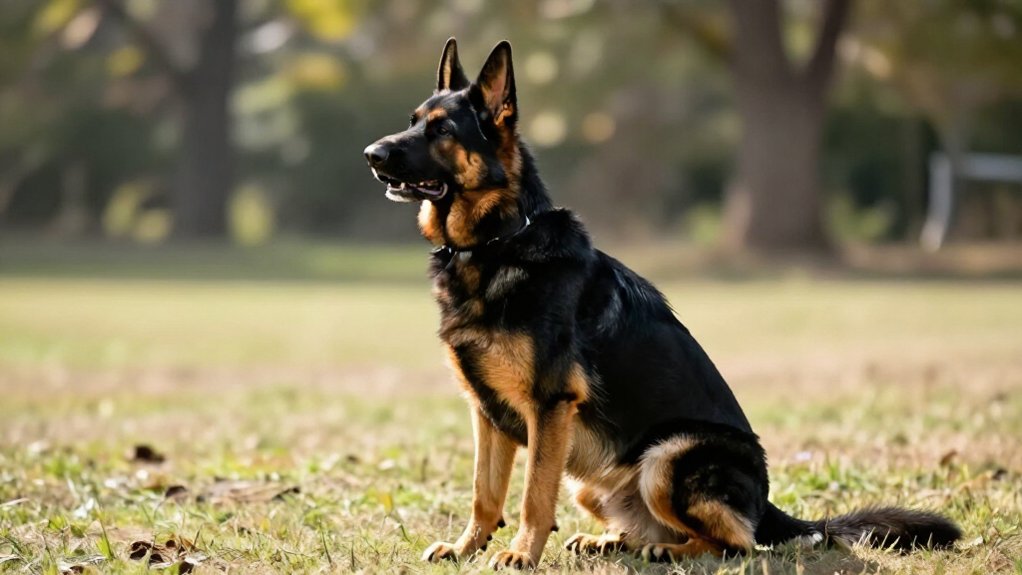
You recognize the classic black and tan German Shepherd by its striking black saddle and rich tan markings. Two pigments create this look: eumelanin makes the black, while phaeomelanin forms the warm tan. Genetics control the pattern, and puppies often start out all black before their tan points emerge over several months. Coat variations exist, but the deep, uniform look is the standard. Health issues aren’t linked to color. You’ll find out exactly what to look for when choosing one.
Swift Summary
- Black and Tan coats feature a black saddle with tan points on legs, chest, and face.
- Genetics, specifically the a^t allele at the Agouti locus, determine this classic pattern.
- Breed standards accept this color, favoring deep pigmentation and uniform mahogany tan tones.
- Puppies born black lighten over time, with tan points fully defined by 24 months.
- Maintaining the double coat requires regular brushing to manage year-round shedding and keep appearance clean.
What Defines the Classic Black and Tan GSD?
When you look at a classic Black and Tan German Shepherd, you’ll spot a striking black saddle or blanket stretching from the withers down the spine and over the ribs, creating a distinct shape across the mid-body.
You’ll also see rich tan or rust on legs, chest, face, and underside. Because this breed has a dense double coat around the neck, a well-fitted dog collar helps maintain daily comfort and control without rubbing or matting the fur.
This bicolor GSD features a black mask German Shepherd, often extending to the forehead. Unlike a black and red GSD or sable German Shepherd vs black and tan, this pattern shows clear demarcation.
You won’t find the tan and liver German Shepherd or blue and tan German Shepherd here.
When seeking a black and tan German Shepherd puppy, guarantee the mask is solid. A black faced German Shepherd stands out.
Avoid confusing it with a black and white German Shepherd or reverse mask German Shepherd.
The black and tan is iconic.
This classic pattern is primarily cosmetic in nature and does not influence the dog’s health or temperament.
How Pigments Create the Black and Tan Coat
As you examine a classic Black and Tan German Shepherd, you’ll see two main pigments at work in its coat. Eumelanin creates the deep black regions on the saddle, blanket, and nose. This pigment concentrates along hair shafts, defining sharp patterns.
Meanwhile, phaeomelanin produces the warm tan and red hues found on legs, chest, and under-tail areas. Unlike eumelanin, phaeomelanin stays within the coat, leaving facial skin dark.
Melanocytes in hair follicles manufacture these pigments during growth, transferring color into each emerging fiber. Your understanding of these processes helps you better serve dogs by recognizing healthy coat patterns and identifying potential health issues linked to pigmentation. When evaluating a puppy’s background, pedigree records can show whether black and tan coloring runs through the bloodline.
These specialized cells originate in the basal layer, where melanocyte location influences pigment production and skin architecture.
Knowing how these cells operate lets you appreciate the intricate biology behind every beautiful black and tan coat you encounter.
Which Genetics Control Black and Tan Patterns?

You’ll find that the Agouti locus acts as the primary switch for where black and tan pigments land on your Shepherd’s coat. Whenever you travel with your Shepherd, keeping a well-organized bag of dog essentials makes grooming on the go much easier.
If a dominant sable allele shows up, it will overpower the tan-point pattern you’re expecting to see.
Even if your dog carries the classic black-and-tan genes, a recessive black allele from both parents can hide that pattern entirely.
The extent of the tan markings depends on the inheritance of the dominant A allele.
Agouti Locus Genetics
If you want to understand what controls the classic black-and-tan pattern in German Shepherds, you need to look at the agouti locus and its ASIP gene.
This gene regulates pigment distribution by telling hair follicles whether to produce black eumelanin or tan phaeomelanin.
When the ASIP gene carries the a^t allele, it restricts black pigment to the body while allowing tan points on the legs, chest, and face.
The agouti locus features a specific dominance hierarchy where sable alleles sit above tan-point alleles.
This interaction relies on melanocyte migration during embryonic development to establish the distinct pigment zones.
You serve owners best by explaining that German Shepherds inherit two alleles, one from each parent, determining their final coat expression.
Dominant Sable Influence
When a dominant sable allele enters the mix, it overrides the classic black-and-tan pattern, so you’ll see sable coloration whenever that allele is present. You must understand that this dominant gene sits atop the hierarchy, masking tan-point genes entirely. Even one copy ensures your dog shows sable, not black and tan.
This dominance occurs because the Agouti gene responsible for sable acts as a dominant trait over the recessive tan-point pattern.
If you aim to breed classic black and tan, you’ll need parents without any hidden sable alleles. Two black and tan parents guarantee no sable puppies, but a sable carrier can surprise you.
Recessive Black Inheritance
Although the classic black-and-tan pattern dominates the breed’s image, a recessive black allele at the Agouti locus can conceal it entirely. You’ll find this allele, a, sits at the bottom of the dominance hierarchy, hiding the tan points when your dog inherits two copies.
This homozygous state suppresses the agouti signaling that normally creates those vibrant tan markings, leaving you with a sleek, solid black coat. As a servant to the breed, understanding this helps you predict litter outcomes accurately.
Even two tan-pointed parents can carry this hidden gene, producing black puppies unexpectedly. If you breed black to black, you ensure every pup stays solid black.
Mastering these genetic nuances lets you serve breeders and owners by setting clear expectations for coat colors.
How Puppies Change From Black to Tan
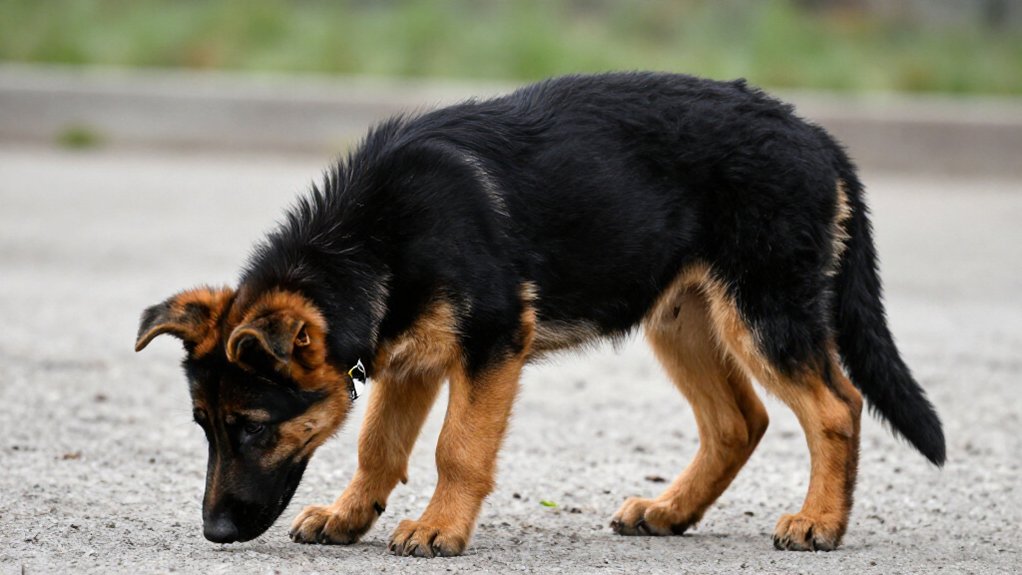
As your German Shepherd puppy grows, their coat will shift from a mostly black appearance at birth to the classic black-and-tan pattern you expect.
In the first two weeks, faint tan shading begins emerging on their face and paws as the newborn coat opens. By eight weeks, their dark baby coat starts lightening, revealing more noticeable tan areas.
Tan points on their eyebrows, cheeks, and chest become clearer during this period.
From two to six months, their legs, chest, and face broaden considerably while some black regions recede. Their coat increasingly resembles the classic pattern with sharper color separation.
Throughout adolescence to twenty-four months, their tan points often deepen to rich tones, finalizing their distinctive coloring for their future service work. The exact intensity of this coloring has also been shaped by modern breeding lines, so tan richness can differ between working and show dogs.
What Are the Variations in Black and Tan Patterns?
As your Shepherd matures, you’ll notice their coat settles into one of several distinct black-and-tan patterns. You see a classic saddle patch over the back with tan chest, belly, and legs. Saddle size varies from a narrow spine strip to wider coverage reaching toward elbows. A blanket-back variation extends black further, leaving only small tan areas on lower limbs. Some dogs show broken saddle edges allowing more tan through.
Tan pigment appears on legs, chest, underbelly, neck, and face with markings above eyes and cheeks. You’ll find tan under the tail and around rear thighs. Some exhibit paw spotting while others show minimal tan in bi-color styles.
Shades span from light cream to rich red or gold. You choose a standard lighter tone, black and cream, or deeper black and red. Breed guidelines accept various combinations, letting you find the perfect coat for your service companion. Unlike the changes a female goes through during her heat cycle, which typically recurs about twice a year, her coat pattern is set by genetics and does not shift with her reproductive hormones.
Does the Black and Tan Meet Breed Standards?
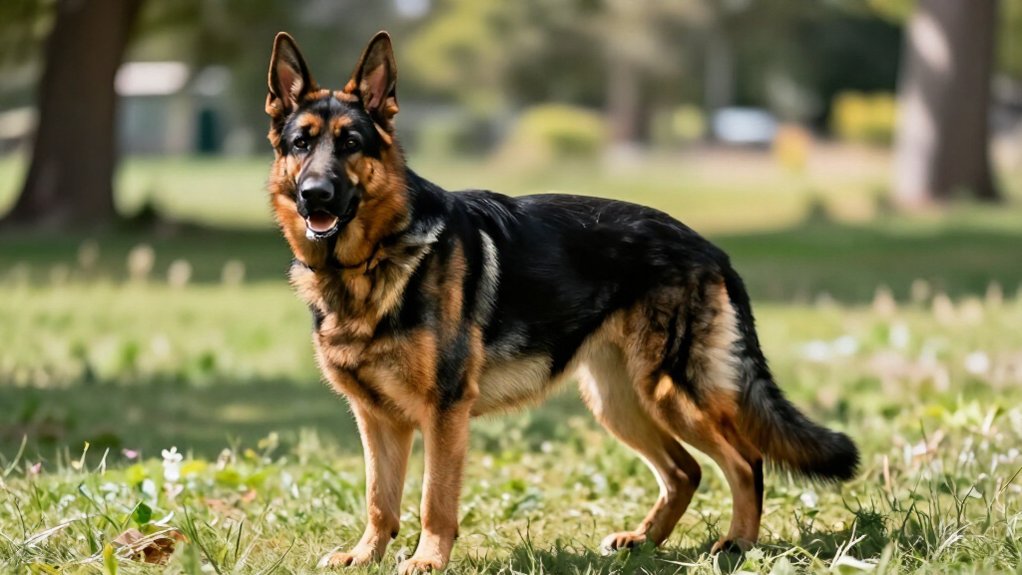
Unless you’re showing your dog, the black and tan coat meets breed standards perfectly. If you serve others in shows, the AKC fully accepts this color with no disqualification. You’ll find it listed as standard, preferred over faults like blue or white coats. The German Shepherd Dog Club of America confirms this classic look.
You must guarantee strong, rich pigmentation, as pale markings reduce conformity. Aim for a deep black saddle covering half the body, paired with uniform rich mahogany tan. Avoid washed-out colors or missing masks, which indicate insufficient pigment.
Small white chest marks are acceptable but less desirable. You’re working toward the ideal visual type that judges favor, ensuring your service dog presents the perfect, standard appearance expected in the ring. Owners who travel with their dogs often rely on protective car covers to keep seats clean from dog hair, dirt, and mess.
Why Is Black and Tan the Most Common Color?
When you look at German Shepherd populations worldwide, black and tan dominates because simple genetics, history, and human preference all align to keep it top. You see how specific genes, like the tan point allele, drive this pattern’s frequency.
Breeders often maintain two copies of these genes, ensuring litters express this classic look consistently. Historically, working lines favored this coat for its traditional appearance, cementing its role in the breed’s image.
Iconic dogs like Rin Tin Tin further popularized the color globally. Discovered by American soldier Lee Duncan in a bombed-out French kennel during World War I, Rin Tin Tin became a famous silent-film star and one of Hollywood’s earliest canine celebrities. Today, show rings and registries still favor black and tan, reinforcing its status.
When you serve others seeking a Shepherd, understanding these forces helps you explain why this coat remains the most common choice for owners everywhere.
How Does Coat Color Impact Health and Temperament?
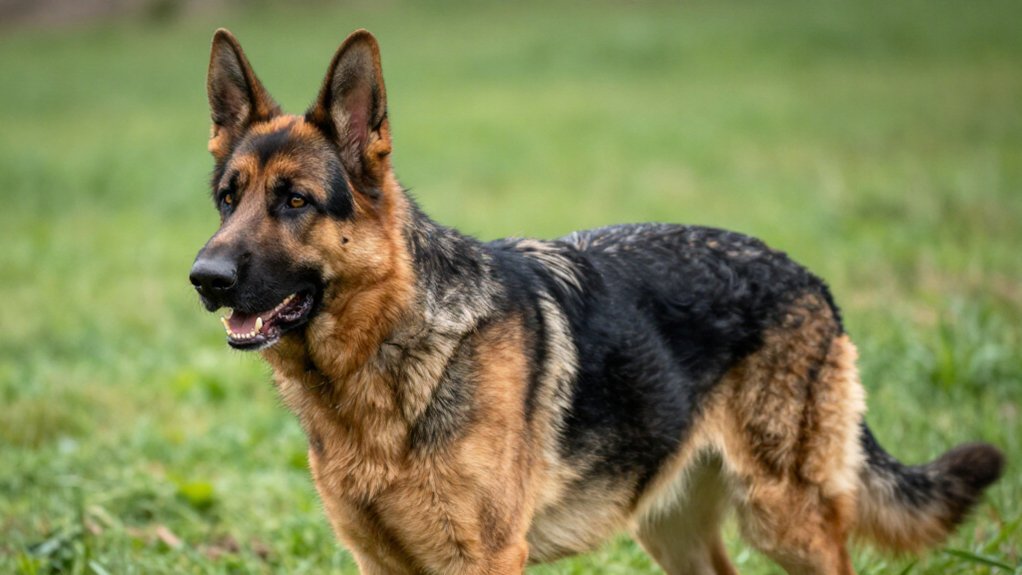
If you look closely at German Shepherd health and temperament, you’ll find that coat color like the classic black and tan pattern acts almost entirely as a cosmetic trait with no direct impact on these critical factors.
You’ll see that breed-wide concerns like hip dysplasia, degenerative myelopathy, or bloat stem from overall genetics and structure, not pigment genes.
Your black and tan Shepherd’s working ability and nerve stability depend on their lineage and early experiences, not their hue.
You won’t find data proving black and tan dogs are more reactive, aggressive, or anxious than other colors.
While double merles face risks, that pattern doesn’t exist in purebred black and tan lines.
You serve your dog best by focusing on all-encompassing health testing and responsible breeding decisions rather than worrying about shade or pattern.
For safer travel with a large dog, a dog car hammock can protect your rear seats while creating a contained travel area.
What Health Tests Matter for Black and Tan Shepherds?
When you’re evaluating a black and tan German Shepherd, you’ll want to confirm their genetic health screening for conditions like degenerative myelopathy. Degenerative myelopathy is a progressive disease of the spinal cord that often begins with hind limb weakness in affected dogs.
You should also ask for their hip and elbow dysplasia results, as these orthopedic issues are common in the breed.
Getting these clear reports helps you choose a dog built for a healthy, active life.
Genetic Health Screening
Before you bring a black and tan German Shepherd into your home, take time to understand which genetic health tests really matter. You should prioritize Degenerative Myelopathy DNA testing to identify carriers and at-risk dogs, ensuring responsible breeding decisions.
Check for MDR1 sensitivity too; this vital test prevents adverse reactions to common medications, protecting your dog’s welfare.
Utilize extensive breed-specific panels covering inherited disorders like dwarfism and von Willebrand disease. These panels offer cost-efficient broad screening for multiple conditions simultaneously.
Request ocular examinations and metabolic screenings as well to catch eye or organ issues early.
Hip And Elbow Dysplasia
To guarantee your black and tan German Shepherd’s joint health, you should prioritize orthopedic screening like OFA and PennHIP, which evaluate hip and elbow dysplasia through standardized imaging. These tests measure joint laxity, conformation, and degenerative changes to quantify risk.
You’ll need radiographs taken at or after 24 months for OFA certification, grading hips from excellent to severely dysplastic. PennHIP assesses passive laxity as early as 16 weeks using a distraction index.
Since German Shepherds average high laxity, rely on PennHIP’s objective numerical values alongside OFA. Comparative studies show OFA-normal hips often hide significant laxity detectable via PennHIP.
Use these results to make informed breeding choices and guide treatment plans. Serving others means ensuring your dogs’ lifelong mobility through rigorous, evidence-based health verification.
Are Black and Tan Shepherds Good Working Dogs?
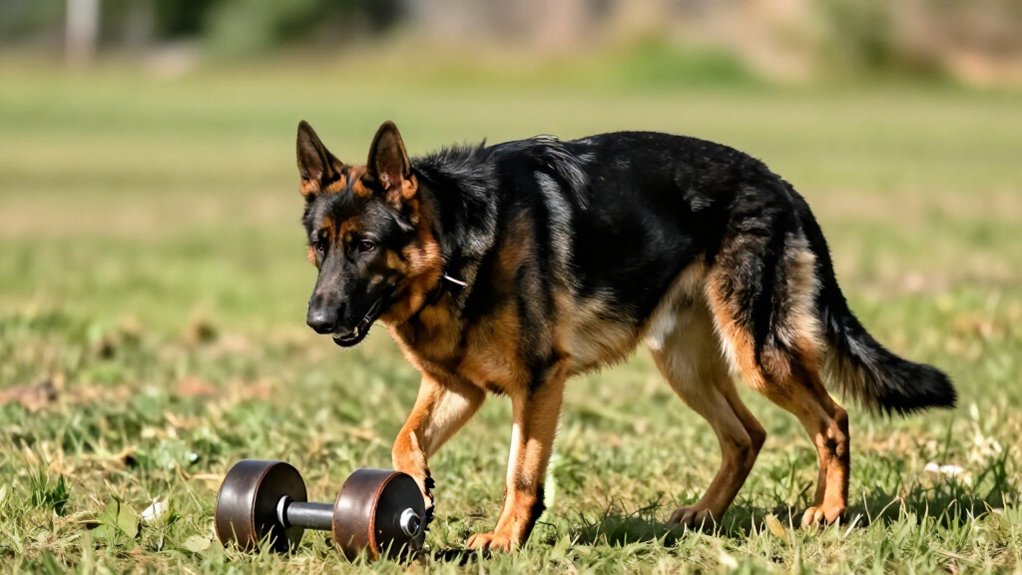
If you’re looking for a reliable partner on the job, rest assured that black and tan German Shepherds are exceptional working dogs. You’ll find these dogs excel in police, military, and rescue roles because their coat color never limits their capability.
Breed experts confirm color is purely cosmetic; instead, they evaluate temperament and drive for work suitability. You should choose dogs selected for strong nerves and high energy rather than looks. Steady nerves are built partly through early socialization, which exposes puppies to new people, sounds, and environments during their critical developmental window.
Many service organizations trust these classic-colored dogs for guiding, therapy, and detection tasks. Their natural intelligence and loyalty make them perfect when you aim to serve others.
You won’t find better teamwork than these dogs offer when you need reliability under pressure. Their proven track record in challenging environments shows they’re ready for serious duty alongside you.
How To Care For a Black and Tan Double Coat?
You keep your black and tan German Shepherd’s coat healthy by brushing regularly with the right tools.
When it’s time to clean, bathe gently using dog-specific shampoo and lukewarm water. These steps preserve their natural oils and vibrant color while keeping skin irritation at bay.
Brush Regularly
While your black and tan German Shepherd’s medium double coat sheds year-round, brushing it 2–3 times a week keeps it healthy and controls loose hair. You should use a slicker brush first, then follow with an undercoat rake to remove dead fur effectively.
During peak shedding seasons, increase your routine to daily sessions. Use deshedding tools sparingly, limiting them to once or twice weekly, to protect the topcoat.
Always brush in the direction of hair growth to minimize tugging and breakage. Work through manageable sections from shoulders to hindquarters for thorough coverage.
Afterward, smooth feathering on legs and tail with a comb. This consistent care serves your dog by keeping skin nourished and home free of excess hair, demonstrating your dedication to their well-being and comfort every single day.
Bathe Gently
Though it may feel like more work, gently bathing your black and tan German Shepherd every 6 to 12 weeks helps protect their skin and undercoat oils. Use lukewarm water, starting at the neck and working toward the tail. Make sure you soak the dense undercoat thoroughly so shampoo reaches the skin.
Choose a dog-specific shampoo formulated for double coats to avoid stripping natural oils. Dilute the product and massage it in section by section with your fingers. Pay close attention to rinsing until water runs clear and no soap remains.
Check for residue by running your flat hand over the thick fur. This complete rinse preserves protective oils essential for healthy skin. Limiting bath frequency keeps your companion comfortable and their coat vibrant.
What To Consider Before Buying a Black and Tan GSD?
Before you bring home a black and tan German Shepherd, recognize that coat color is purely cosmetic and shouldn’t drive your decision. You must prioritize sound genetics, stable temperament, and suitable living conditions over appearance.
Evaluate breed-specific health risks like hip and elbow dysplasia, which affect roughly 20–21% and 19% of German Shepherds. Confirm breeding dogs have official evaluations performed after 24 months.
Consider that this high-drive breed requires substantial daily exercise, structured obedience training, and early socialization to prevent reactivity. You’ll need secure outdoor space for vigorous activity and regular grooming for their double coat.
Remember that coat pattern doesn’t alter temperament; behavior stems from genetics and training consistency. Prepare for long-term financial responsibility, including potential health issues like bloat or degenerative myelopathy.
Confirm your lifestyle supports their mental and physical needs as a working dog.
Frequently Asked Questions
How Can I Remove Dark Spots From My Gsd’s Tan Markings?
You can scrub away surface stains like rust with color-safe shampoos. But genetic spots are tattoos your dog earned; groom them proudly instead of trying to erase their unique, sun-kissed story.
Will My Black and Tan Gsd’s Coat Fade Permanently Over Time?
Yes, your GSD’s coat will fade permanently over time. Protect them with shade and grooming to maintain their color. This guarantees they always look their best for those they serve. Keep their skin healthy too.
Do Black and Tan Shepherds Shed More Than Other Coat Colors?
No, black and tan shepherds don’t shed more than other colors. You’ll see equal hair loss across all breeds since genetics, not pigment, drives shedding volume for these dogs.
Are There Specific Dietary Needs to Maintain a Gsd’s Tan Color?
Do you feed enough tyrosine and copper? Yes, proper nutrients maintain GSD tan color. Aim for 25–30% protein and include zinc-rich foods like fish to support healthy melanin production for your loyal companion.
Can I Find Rare Black and Tan GSDS With Unique Patterns?
Yes, you can find rare black and tan GSDs with unique patterns like panda, but you’ll need to seek specialized breeders since these nonstandard markings are uncommon and often excluded from standard breeding programs.