At 5–7 weeks, you’ll shift from milk to soaked large-breed puppy kibble. Start thick gruel, then make it more solid over 4–7 days. Feed small meals every 2–3 hours while awake, 10–15 minutes max, then remove leftovers. Keep the last meal 2–3 hours before sleep. Encourage gentle “gentle mouth” play for bite control, and do 3–5 short handling sessions daily. Start outdoor time at 5 weeks, secure and brief, up to ~30 minutes safely by 6 weeks—then keep going for more tips.
Swift Summary
- Begin weaning at 5–7 weeks by thickening milk-to-mush from soupy gruel toward moist, mostly solid puppy food.
- Soak large-breed puppy kibble in warm water or milk replacer 10–15 minutes, then shorten soaking and increase kibble by 6–8 weeks.
- Feed small portions every 2–3 hours during the day, remove leftovers after 10–15 minutes, and finish meals 2–3 hours before sleep.
- Start first socialization at 5–7 weeks with 3–5 brief daily handling sessions and introduce 1–3 calm people per day.
- Teach gentle bite inhibition during litter play and avoid removing puppies from dam/litter before about 8 weeks to protect development.
What German Shepherd Weaning Looks Like (5–7 Wks)
Between 5 and 7 weeks, weaning is where the “milk first” chapter starts closing, and you begin guiding your German Shepherd puppies toward mostly solid food. For a 5 week old german shepherd, you’ll thicken the mixture, from thick gruel toward moist, mostly solid puppy food, while liquid slowly drops. Use soaked, softened large-breed puppy kibble, plus quality wet puppy food, because their bodies need steady growth, not sudden change. You’ll also see shorter nursing bouts as deciduous teeth help them chew. large-breed puppy food is important at this stage to support healthy, steady growth and help reduce orthopedic risk. Because nutritional needs shift across life stages, puppies need a growth-specific diet that differs from the formulas suited to adult or senior German Shepherds.
How Often to Feed GSD Puppies During Weaning
Space meals through waking hours, about every 2–3 hours, so they digest comfortably and keep energy steady. Many people use mid-morning, noon, mid-afternoon, early evening, and late evening. Offer small portions, let them eat 10–15 minutes, then remove leftovers. Finish the last meal 2–3 hours before sleep. Keeping meals at consistent times also supports house-training, because a regular schedule helps your puppy learn when to go outside.
Drop Milk: Start With Soaked Puppy Kibble
As your German Shepherd pups start to replace milk with solids, you’ll usually get the best results by starting with soaked puppy kibble—soft, nutrient-rich food made for growing bodies. Aim around 5–7 weeks, many are fully off dam’s milk by 6 weeks. Their teeth start working at about 3–4 weeks, so softened kibble feels right, not hard. soaked puppy kibble Soak dry kibble in warm water or puppy milk replacer for 10–15 minutes, until it’s soupy or porridge-like. Use a shallow bowl, encourage lapping, and remove leftovers after 10 minutes for hygiene. Choose complete puppy formulas, then mix in over 4–7 days. Mealtimes also offer a good chance for early socialization, since pups learn to eat calmly while people and littermates are nearby.
When to Add Slightly Dry Food Safely
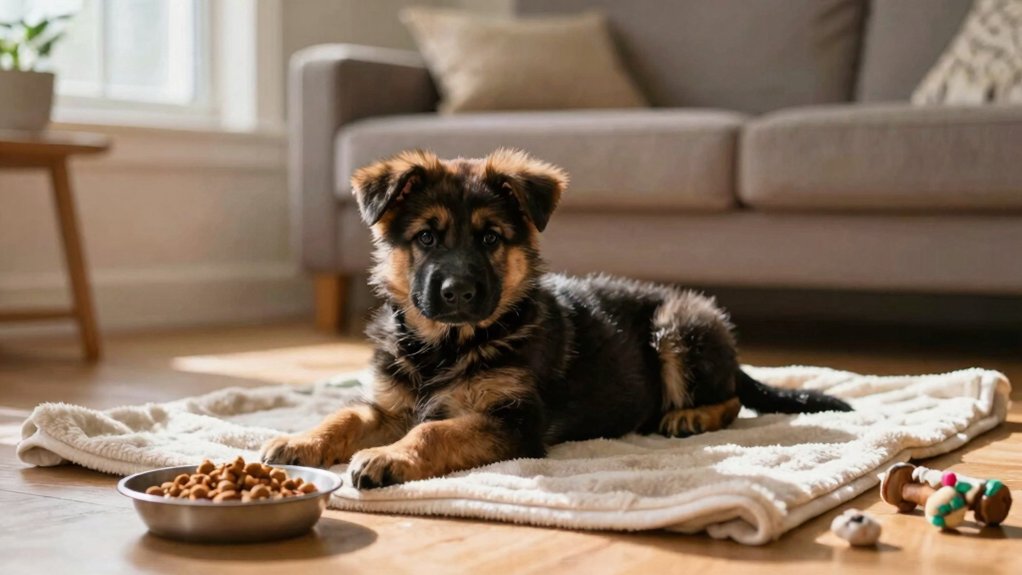
Instead, shorten soaking from 10–15 minutes to 5–10, until pieces hold shape. Start small—just a few kernels mixed into the soft meal—and watch them chew without struggling.
Then check stool quality. If it gets loose or smelly, go back to softer. By 6–8 weeks, you can slowly raise the dry portion. As you do, keep an eye on calorie needs, which depend on your puppy’s age, size, and activity level.
Weaning Hunger Cues That Mean “More Food
As you wean your German Shepherd pups, watch for early “milk-hungry” cues: frantic nursing or noisy bottle time beyond the usual window, then rapid searching for crumbs right after the meal.
When you see they empty the bowl fast, lick leftovers right away, or vocalize and pace near the feeding spot within an hour, bump the mush amount slightly can help, since they may still need more energy for growth (5–7 weeks).
But if they relax, settle to sleep without bloating, and stop pawing at the enclosure, keep the schedule steady and focus on smooth changeover timing from milk to mush. Pups that learn to settle calmly during these short separations from their littermates and handlers may also be better prepared to avoid separation anxiety later in life.
Spotting Early Milk-Hungry Cues
Between feeds, you’ll want to watch for early “milk-hungry” cues, because those little signals often mean your 5–7 week German Shepherd puppies need either a fuller meal or a small adjustment to the schedule.
At 5 weeks, aim for four tiny meals, 4–6 hours apart.
If you hear vocalizing, see restlessness, and catch strong food-seeking, you’re likely looking at milk hunger.
You may also notice low energy if a meal gets missed.
Puppies that nurse loudly, compete for the dam, or try latching again after milk slows need help.
Watch weight gain and calm sleep.
Frequent crying or poor growth means adjust, or call your vet.
Transitioning From Milk To Mush
When you spot milk-hungry cues from the last section, you’ll usually find the fix is about changing what they eat, not just how often.
Around 3–5 weeks, sharp deciduous teeth erupt, and the dam may seem reluctant to nurse. That discomfort tells you to lean more on mush (thick gruel) and less on milk.
Watch the bowl.
If they sniff, lick, trail you, or clear a shallow dish in minutes, offer slightly larger, thicker portions.
If they whine, pace, or cluster at the nipples after mush, increase volume.
Keep meals 3–4 times daily now, and aim to finish solid shift by 7–8 weeks.
Feeding Schedule For Growing Pups
Right now, you’ll set your German Shepherd puppy up for steady, healthy growth by feeding on a simple schedule, not by guessing from a full or empty bowl.
At 5–7 weeks, serve 4 small meals daily, about 07:00, 11:00, 15:00, and 19:00. Offer complete puppy food, then limit each meal to 10–15 minutes to prevent grazing.
Watch hunger cues, too. Crying or agitation between feedings can mean “more.”
Also track weight, stool, and ribs—not the bowl. But if the belly looks stretched, stools get loose, or energy drops, ease portions and check the diet richness.
Daily Human Socialization Plan for 5–7 Weeks
From day 1, start a simple daily human socialization routine when your German Shepherd puppies hit 5–7 weeks, because this is a high-sensitivity window for building trust and preventing fear.
Do 3–5 short handling sessions daily, 2–5 minutes each.
Gently stroke body, legs, paws, tail, ears, and muzzle.
Then add calm restraint, like being held or lightly hugged, but let them move away.
Pair touch with soft praise and tiny treats.
Invite 1–3 calm people daily, aiming for 10–30 different people by this stage.
Include men, women, kids, hats, glasses, uniforms.
Keep the puppies’ sleeping area clean by lining the crate with a removable protective tray that can be easily washed and replaced.
New Sounds, Surfaces, and Places: What to Add
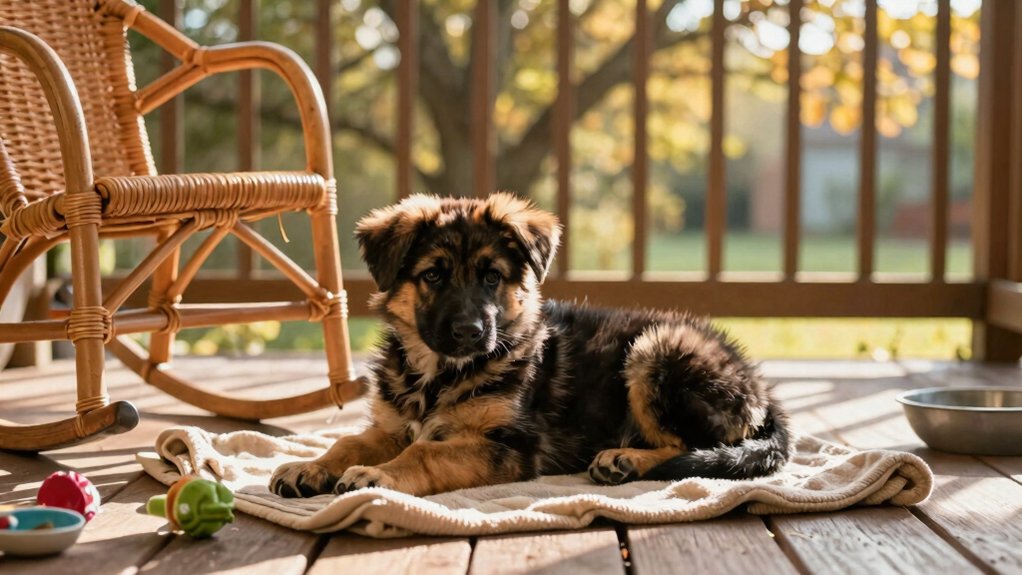
Start with sound at low volume first, because their sound window opens around 5 weeks and begins closing by about 14 weeks, so you’re building confidence fast.
Use TV, radio, dishwasher, and the washing machine quietly, then turn up a notch each day.
Add vacuum: start off nearby, then on across the room.
Next, set an exploration area with towels, rubber mats, turf, and smooth-pebble trays.
Swap room access, rearrange furniture, and do short stair steps.
Early exposure now also prepares them for later challenges like teething and growth spurts, which typically arrive around four to five months of age.
Short, Safe Play Sessions: How to Set Them Up
Start with play you can manage, because at 5–7 weeks your German Shepherd pups learn best when sessions stay short and predictable.
Aim for 5–10 minutes of good play, then break.
Do 3+ play times per week in a separate safe area, plus daily one-on-one play with you for at least 5 minutes.
Use non-slip floors like carpet or grass.
Keep it enclosed, fenced or indoors, with direct supervision.
Watch body language, loose wagging is “yes,” but hackling or barreling means “pause.”
End before they get wild, then offer naps or quiet toy play.
Brief sessions also give you a calm moment to introduce basic grooming, such as paw cleaning, which helps pups get comfortable with handling.
Keep Litter Play Teaching Bite Inhibition
To keep your German Shepherd pups learning good bite control during litter play, you want every wrestling session to teach “gentle mouth” instead of letting hard bites slip through.
Bite inhibition means jaw pressure control, so mouth contact communicates without damage.
Bite inhibition means teaching jaw pressure control, so your pup’s mouth communicates clearly without causing harm.
You’re in the 5–7 week window, when play gets more intense and jaw strength rises fast.
In litter play, your pups keep getting clear feedback.
Hard bites usually trigger a yelp and instant partner withdrawal, so the message lands.
Mother and littermates also interrupt rough play with gentle corrective bites.
You reinforce this by letting them engage, watching body-language cues, and interrupting if play turns rough.
Consistency builds soft-jaw habits.
German Shepherds are generally highly responsive to training, so their quick learning ability helps these early bite-control lessons stick.
Why Leaving Before 8 Weeks Can Backfire
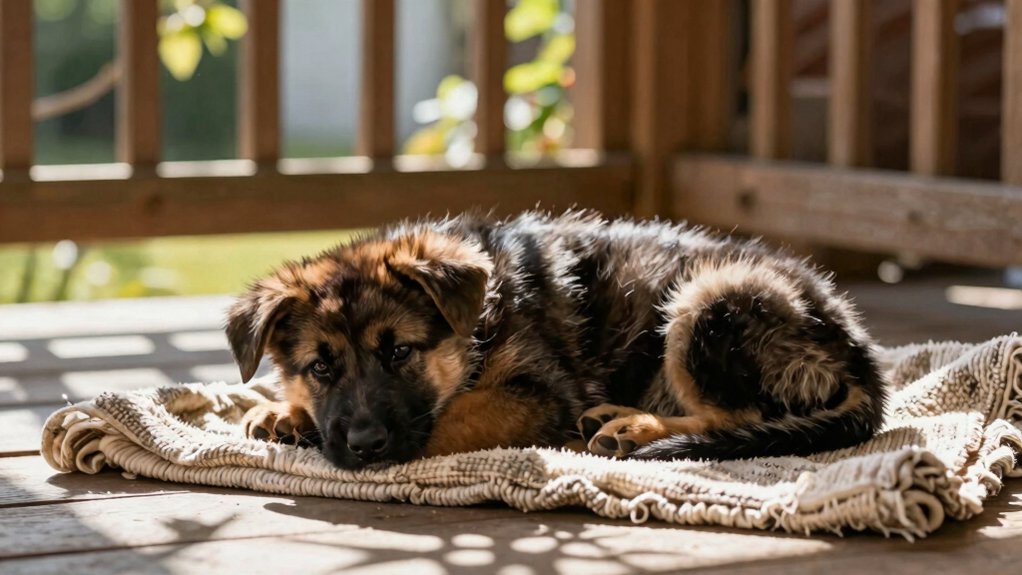
If you move a German Shepherd puppy out of the dam and litter before about 8 weeks, you can accidentally interrupt a key stretch of brain and social development, and that can backfire later.
During 3–12 weeks, the puppy social “window” is most sensitive around 6–8 weeks, so 5–7 weeks matters a lot.
When you separate too early, you miss maternal and littermate guidance, and play cues.
That can raise long-term risk for fear, anxiety, and even aggression.
You’ll also see more avoidance and exaggerated reactions to new people, places, and things, because the brain is still maturing.
Once your puppy reaches 9 to 12 weeks old, early socialization with people, sounds, and other animals should continue as a regular part of its daily care.
Outdoor Time: Start With Safe 30-Min Sessions
Once your German Shepherd puppy is safely out in the world, you can use those early social hours in a smart way.
Start at about 5 weeks.
Start at about 5 weeks, using short, secure outdoor sessions to gently begin smart socialization for your German Shepherd puppy.
Aim for 30 minutes total outdoor time per day, in a secure, escape-proof area.
Keep first sessions short, around 10 minutes, at least three times weekly, then build up gradually.
By 6 weeks, you can do multiple introductions per day, up to about 30 minutes per session.
Supervise closely.
Use varied ground, like grass and gravel, and protect from cold, heat, and rain.
Let friendly, vaccinated adults guide dog-to-dog contact only.
Avoid crowded public spots until core vaccines.
Prevent Fear Imprints With Gradual, Positive Steps
You prevent fear imprints by handling and exposing your puppy in small, calm steps.
Introduce one new thing at a time, keep sessions short (about 30 minutes from 6 weeks), use treats and gentle play so the experience feels safe, and let your puppy choose to approach or retreat.
Watch for stress signs, and stop early if they start to freeze, whine, tuck their tail, or back away—those “learning moments” should stay positive.
Gradual Handling, Never Overwhelming
During the 5–7 week window, German Shepherd puppies start sliding from curious attraction into early fear learning, so pace matters. You handle gently, for short bursts, and you stop before stress builds.
Aim for several brief sessions daily, not one long one. Early on, you’ve already built tolerance by touching the head, stroking the back, and lightly to the tail tip, never sudden grasping or force.
Now, use everyday care—quick grooming and simple health checks—to normalize touch. Introduce novelty stepwise, one mild sound or familiar area first, then add more later.
Never mix new people with loud noise.
Calm Setups, Positive Pairings
Calm setups and positive pairings should happen every day, not as a big “socialization day,” because at 5–7 weeks your German Shepherd puppy is right on the edge of learning what feels safe.
You start with a low-noise room, stable lights, and a predictable routine for feeding, play, and calm breaks.
Before new sights, you make sure your puppy is relaxed.
Then you pair “mildly concerning” things with high-value treats, soft toys, and gentle petting.
When distant traffic or kids playing appear, feed at the moment they notice.
Add 2–3 new safe locations weekly, keep distances large, watch body signals.
Short Sessions, Stop On Stress
Keep socialization short, so your German Shepherd puppy stays curious instead of overwhelmed.
Aim for 10–15 minutes total, and for very young pups keep play or training to 2–3 minutes, then repeat later.
Start sound or novel-object checks under 1 minute, too.
Then, watch your puppy like a caring guardian.
If you see droopy ears, sagging posture, scratching, yawning, or panting, you stop and reduce intensity.
If stress grows—tucked tail, pinned ears, shaking, hunched body—you end the session.
If “whale eye,” stiffness, or food refusal appears, treat it as red zone.
Stop, add distance, and return only when relaxed.
Health Checks Before Starting Puppy Classes
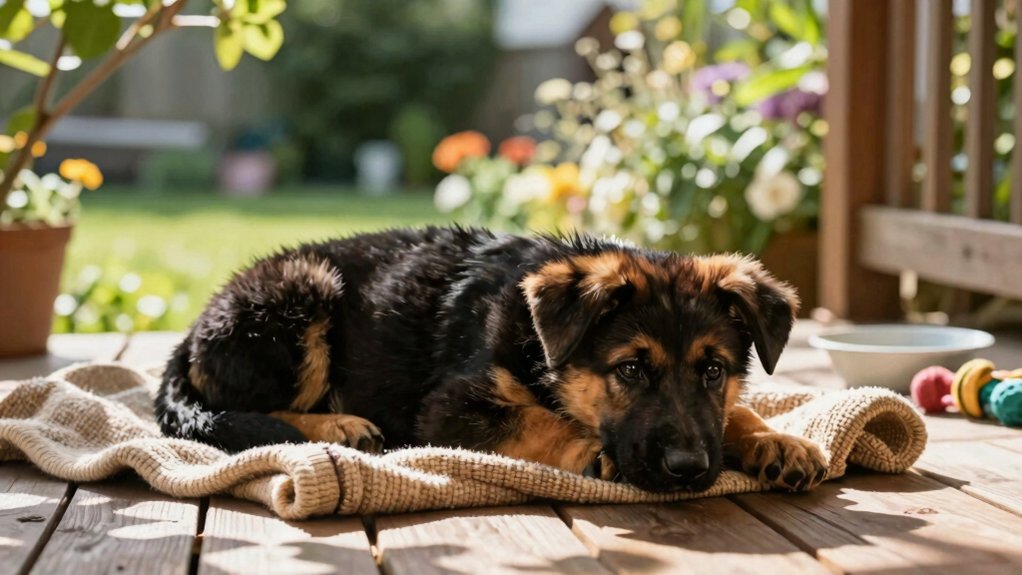
Before you head to puppy class, get a quick health check so your German Shepherd pup stays safe and so you don’t accidentally expose other dogs.
Schedule a vet exam right after you bring them home, then confirm they’re up to date on at least one DHPP/DAP (distemper–parvovirus) shot.
Wait about 7 days after the first vaccine dose, and ask about kennel cough (Bordetella) rules.
Make sure your pup has a deworming start, and bring recent fecal results.
The vet listens to heart and lungs, checks temperature, reviews meds, and clears parasites.
Then you’re ready to serve, responsibly.
Continue Socialization After the 8-Week Move
Keep up positive human encounters every week right after your puppy’s 8-week move, so new people feel safe and fun, not scary.
Aim for quick, calm meetings with different adults and kids in controlled spots—busy sidewalks, quiet shops, even school grounds—about 2–3 times weekly, and reward your puppy when they stay curious.
But watch for the 8–9 week fear shift, so if your pup hesitates at loud noises or sudden movements, slow down, increase distance, and try again later.
Maintain Positive Human Encounters
After your German Shepherd puppy’s 8-week move, you’ll want to keep social time with people going, because the “sensitive window” runs roughly from 8 to 12–14 weeks.
Aim for frequent, reward-based meetups, about 4 sessions per day, up to 30 minutes.
Pair greetings with treats, gentle play, and calm handling.
Each day, introduce at least 5 minutes of individual play with a person.
Seek diversity, men and women, different ages and appearances, even hats or uniforms.
Keep it puppy-controlled: let them approach and retreat.
Avoid looming, rough petting, grabs, or punishment.
For shy pups, start farther away, then close the distance.
Continue Controlled Exposures Weekly
Once your German Shepherd puppy’s first move into home life settles, you’ll want to keep socializing on a simple weekly rhythm.
Plan 2–3 short outings each week, keeping each session 5–10 minutes. In busy places, you introduce one or two new stimuli only, so she can explore confidently, not get overwhelmed.
Rotate surfaces—grass, concrete, tile, gravel, and stairs—and practice calm stairs at a safe pace.
Add household sounds slowly, like vacuum, fans, and doorbells. Watch body signs of stress.
Then step back, lower intensity, or add distance.
Keep handling paws, ears, mouth, and tail several times weekly.
Frequently Asked Questions
How Much Should a 5–7 Week Puppy Gain Weight Weekly During Weaning?
You’re aiming for about 1–2 lb (0.5–1 kg) per week during weaning—like steady “growing momentum.” If gain stalls or jumps far higher, you should contact a vet promptly and weigh weekly.
When Is It Okay to Start Crate Time and Naps for 5–7 Week Puppies?
You can start brief, positive crate naps at 5–7 weeks: a few minutes at first, then slowly extend if they relax. Keep sessions short and supervised; most structured crate training begins around 8 weeks.
How Can I Tell Hunger From Teething or Normal Play Biting?
Tell hunger by tense focus on bowls, food prep areas, and hands; it eases right after eating. Tell teething by chewing any texture plus swollen gums, drool, and mild bleeding. Tell play biting by loose, wiggly body language, pauses, and easy disengagement.
What Vaccine, Deworming, and Parasite Prevention Schedule Should Breeders Follow Now?
Start core vaccines at 6–8 weeks, repeat every 2–4 weeks through 16 weeks. Deworm every 2 weeks from 2–8 weeks (2,4,6,8). Begin broad-spectrum parasite prevention at 6–8 weeks; continue monthly per label.
How Do I Introduce Kids Safely Without Overwhelming or Frightening Puppies?
Introduce kids super-slow: put puppies in a quiet safe room with escape routes, have children sit calmly, let the puppy approach, keep sessions 5–10 minutes, avoid squeals/hand grabbing, use toys, and separate fast if arousal rises.