At 4–5 months, your German Shepherd’s adult teeth are pushing through, so expect puffy gums, a bit more drool, mild bad breath, and even tiny red gum spots. Chewing ramps up because it soothes gums and helps them explore. When nipping starts, redirect to a frozen Kong or safe chew, then give a quick “ouch” and stop play for 10–20 seconds if they bite skin. Keep exercise gentle, use naps (about 16–18 hours), and call your vet if bleeding or eating worsens—stick with this for more tips.
Swift Summary
- Teething peaks around 4–6 months, with swollen gums, mild drooling, and temporary bad breath as adult teeth push through.
- Adult tooth eruption can cause tiny gum spotting and shed baby teeth; repeated, prolonged bleeding, or refusal to eat needs a vet check.
- At 4–5 months, mouthy nipping is often normal exploration—redirect quickly to safe chews instead of hands/clothes.
- Use bite inhibition: a sharp “ouch” plus immediate play break and 10–20 second timeout for hard bites to teach gentle mouthing.
- Avoid high-impact exercise during growth spurts; use controlled, short sessions and let soft, self-directed play replace jumping or stairs.
What 4–5 Month Teething Looks Like in German Shepherds
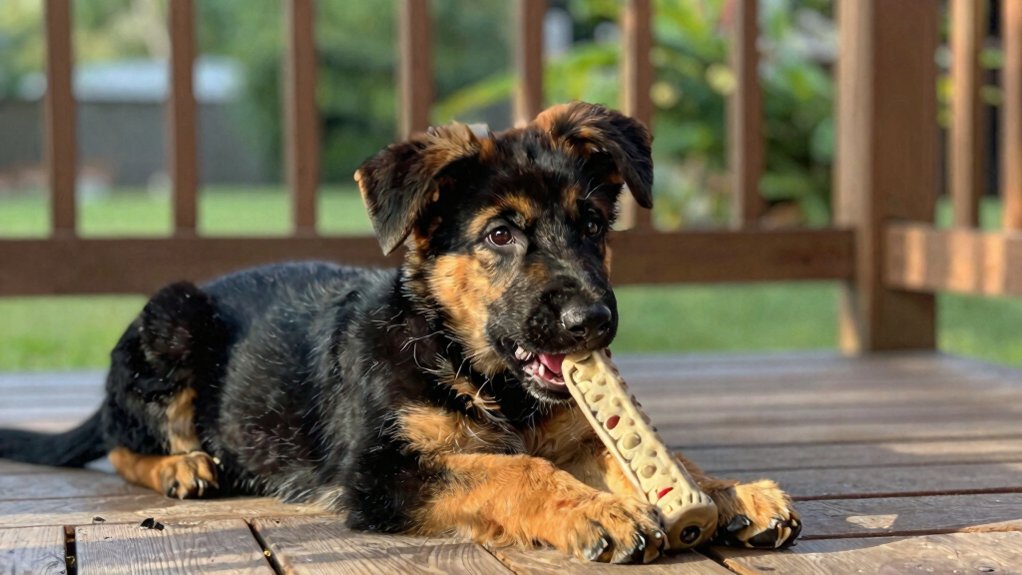
Between about 4 and 5 months, your German Shepherd puppy hits a peak teething window, and things can look a little “messy” in the mouth. You might notice a 4 month old german shepherd puppy losing front baby teeth, while larger adult teeth push through. In a 4 month german shepherd, incisors shed around 12–16 weeks, so by now baby teeth are loosening and gums may look puffy, reddened, or slightly swollen. Baby canines and then premolars erupt at 16–24 weeks, adding jaw pressure, drool, and mild “teething breath.” You may wonder, how long does german shepherd teething last, and what age do german shepherd stop teething? Usually, completion nears 6–7 months, with 42 teeth by 8. Consistent early training can help redirect chewing toward appropriate toys during this period.
Why Your German Shepherd Puppy Is Chewing Everything
They explore by mouthing, learning taste, texture, and weight.
Chewing also supports gum health, with a natural “mechanical cleaning” effect.
Plus, chewing behavior helps meet natural needs that develop as puppies explore their environment and investigate objects.
Finally, boredom hits fast.
If you under-exercise or skip puzzle toys, your pup creates their own fun by chewing furniture.
Stress matters too; chewing can soothe anxiety and release calming endorphins. Unaddressed stress can also contribute to defensive aggression in German Shepherds, so calm handling and early attention to warning signs like stiffening or growling are important.
Finally, your reactions can teach patterns.
Give safe chews, more play, and calm redirecting.
Adult Teeth Eruption, Drooling, and Lost Teeth
Between about 4–5 months, you’ll usually see adult teeth start pushing through: incisors first (3–5 months), then canines (4–6 months), plus premolars and the first molars. As that happens, you may notice extra drooling, red or puffy gums, and even mild bad breath, because saliva and gum irritation ramp up when new teeth erupt. And as the puppy’s baby teeth loosen in this same period, you can find a few lost teeth or small blood spots on toys, so do quick, gentle mouth checks to track progress and watch for teeth that won’t fall out. During this stage, most intense teething often occurs between 4 and 6 months, and sore gums can make your German Shepherd puppy chew more frequently. Offering appropriate chew toys and redirecting biting onto them is a key part of puppy manners training, which helps protect your belongings and teaches the puppy what is acceptable to bite.
Adult Teeth Coming In
As your German Shepherd puppy hits about 4 to 6 months, adult teeth start sliding in and pushing out baby teeth, so you’ll likely notice more chewing, a bit more drool, and tiny sharp teeth on floors or bedding.
Between 3 and 7 months, permanent teeth erupt, and the first ones are usually incisors. Then premolars follow around 4 to 6 months, and molars show from about 4 to 7 months.
In this busy 4–5 month window, you’ll often find gaps plus new bumps in the mouth within days.
Drooling And Gum Irritation
During the 4 to 5 month adult-teeth eruption window, mild drooling and slightly red, puffy gums can pop up in German Shepherd puppies, and it often comes from the new teeth pushing through and loosening baby teeth.
You’ll see brief drool after chewing, not nonstop all day.
Look for clear saliva, red swollen gums, and cranky, picky eating.
Offer safe teething toys, and expect small blood spots on bedding.
Temporary bad breath also happens from plaque buildup.
But if drooling suddenly gets heavy, stays constant, turns yellow/green, or comes with vomiting, lethargy, or breathing trouble, call your vet right away.
Lost Baby Teeth Timeline
Once the drooling and puffy gums calm down a bit, you’ll start noticing the baby teeth themselves, and that’s the fun (and messy) part of teething.
From 12–16 weeks, baby teeth start loosening.
Around 3 months, they loosen and fall out as adult teeth push up under the gum line.
From 3½–5 months, shedding becomes steady, you may even find teeth on the floor or tucked in bedding, so you can clean up for your puppy’s comfort.
Then 4–5 months brings peak loss: incisors first, canines next, and premolars after.
Normal Gum Bleeding vs Red Flags
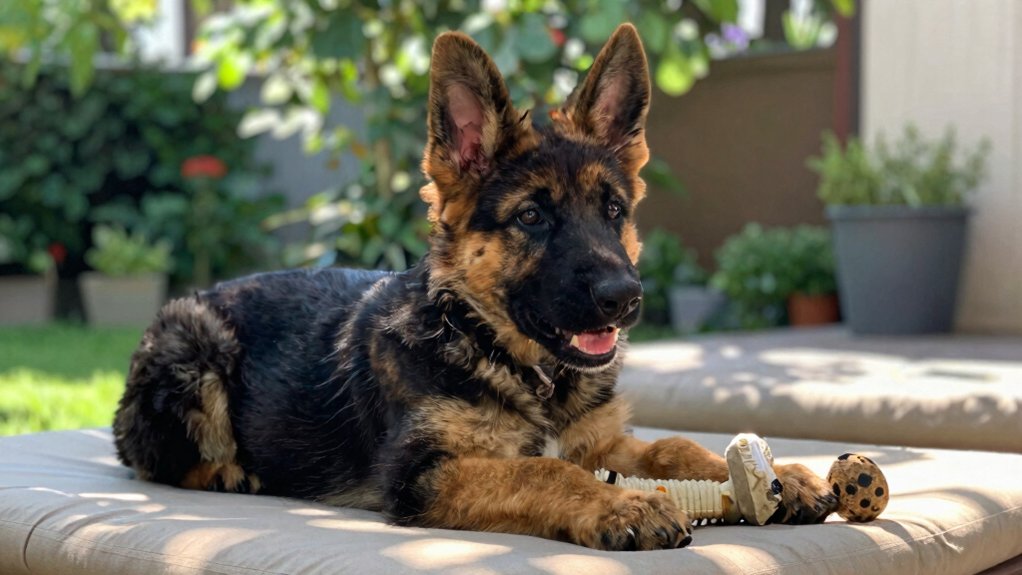
When your German Shepherd puppy bleeds a little from the gums during teething, you’ll usually see just faint, tiny red spots, often on a chew toy or bedding.
That’s normal in months 3–6, when baby teeth loosen and adult teeth erupt.
Look for small redness in one spot, then quick stopping within a few minutes once chewing stops.
But watch closely.
Get vet advice if bleeding repeats often, lasts longer than a few minutes, spreads widely, or your puppy won’t eat.
Also treat pale or white gums, lethargy, fast breathing, collapse, or foul breath as urgent red flags.
Knowing the puppy’s health background also helps, so review the breeder’s records and the puppy’s overall physical condition to better tell normal teething from a real problem.
What to Do About Nipping and Mouthy Biting
When your 4–5 month German Shepherd puppy nips, redirect its mouth fast from your hands and clothing to a tough chew like a frozen Kong or a Nylabone. If it nips too hard, use a quick social timeout—say “ouch” (a high yelp), stop all play, and turn away for about 10–20 seconds before you re-engage.
Then reward calm chewing right away, so your pup learns that soft, relaxed mouth time pays off, while biting people makes fun disappear. Staying consistent with clear boundaries helps your puppy learn that people are not chew toys.
Redirect Mouth To Chews
Start right away by keeping chew items within easy reach, because your German Shepherd puppy is teething and their mouth is basically “on.”
Place toys and food-stuffed chews in a few spots around the house, so you can redirect fast the moment teeth hit skin or clothing.
And when nipping starts, move a chew directly in front of their mouth, calmly replace your hand, then reward when they chew.
Rotate plush, rubber, rope, and edible chews to keep interest high.
Use puppy-safe, soft chews, plus frozen Kongs for cooling.
If a toy loses appeal, switch quickly to another engaging option.
Use Brief Social Timeout
If your puppy’s redirecting chews only works for a second and those teeth still find skin or clothing, use a brief social timeout right away.
You remove attention instantly, then pause all play. This is negative punishment, meaning the “good” social contact stops, so the biting drops over repeated chances.
Use it for hard bites, intense nipping, and even any mouth contact on skin, shoes, or clothes.
Say “ouch,” stop, turn away, and wait 10–20 seconds.
If it keeps happening, step over a baby gate, exit for 30 seconds, or move to a calm pen.
Keep it non-scary, then resume when calm.
Reward Calm Chewing Behavior
Reward calm chewing early, so your puppy learns that “teeth on toys” keeps the fun going.
Set out several chew options, rubber toys, safe bones, Nylabones, and stuffed frozen Kongs, and keep them in your rest spot, play spot, and crate.
When your puppy chews calmly, mark it with a quick “yes” and reward, then continue the play.
But when teeth hit skin or clothing, pause attention, say “ah-ah,” and guide the mouth to the toy right away.
For handling, offer a high-value edible chew.
Use gentle pats only when relaxed.
Practice “nose-to-palm” touch.
Choose Safe Chew Toys for 4–5 Month German Shepherds
When your German Shepherd puppy hits 4–5 months, you can make teething way safer by choosing chew toys made from puppy-appropriate materials. Pick non-toxic, food-grade natural rubber, soft textured nylon, or tightly woven cotton rope. Because German Shepherds are prized for police and K9 work, their strong jaws and intense chewing drive make durable, puppy-safe toys especially important.
Skip vinyl or unlabeled soft plastics with a strong chemical smell. Look for BPA-, phthalate-, and lead-free packaging claims.
Choose soft, slightly yielding toys. Avoid items that can’t be indented with a fingernail.
And don’t use antlers, hooves, or extremely hard “bones.”
Buy medium-large or large size, so nothing fits behind back teeth. Finally, check daily for cracks or tiny pieces.
Use Bite Inhibition Training With Quick Timeouts

After you’ve picked safe chew toys, it’s time to teach your 4–5 month German Shepherd puppy what “too hard” feels like.
Set a clear goal: softer mouthing, no skin contact.
When your pup bites hard, give one high-pitched “ouch” while skin is touched, then immediately pull your hand, stop moving.
If it keeps biting, start a quick timeout in 1–2 seconds.
Remove social contact for 10–30 seconds in a boring crate or pen.
Walk away or exit behind a gate.
End when calm shows up—no active mouthing.
Repeat, and tighten weekly by rating bite intensity.
Never punish, yell, or intimidate.
Teaching basic obedience commands such as “sit” and “leave it” also provides mental stimulation and gives your puppy an alternative behavior to use instead of mouthing.
Skip High-Impact Exercise During Growth
So during your 4–5 month German Shepherd’s growth phase, skip the high-impact stuff like jumping, forced running, stairs, and sharp turns. Those moves hit vulnerable growth plates, the soft cartilage zones where bone grows.
During your 4–5 month German Shepherd’s growth phase, avoid jumping, stairs, forced running, and sharp turns.
When you protect them, you lower the risk of pain, joint harm, and future lameness. Keep sessions short, about five minutes per month of age, up to twice daily.
That’s roughly 20–25 minutes total. Choose soft surfaces, like grass, and let your pup self-direct play.
Then rest often, and stop when you notice fatigue. For musculoskeletal care, serve your puppy gently. Long hikes and fast runs should wait until your pup is older, because safe distance and pace depend on gradual conditioning.
Reduce Biting With Naps and Arousal Control
Schedule regular naps and catch the early “I’m getting too hype” signs, like zoomies and frantic mouthing. If you notice glazed eyes, you should calmly trigger a quick crate/pen break right away. Because German Shepherds are prone to separation anxiety, short, calm crate breaks also teach your pup that being alone is safe and temporary.
Then manage excitement by keeping play shorter, adding cool-down breaks every few minutes, and finishing training about 30–60 minutes before you expect the next nap so your pup stays regulated.
When biting starts, interrupt the fun, then redirect teeth to a chew toy (not your skin or clothes) and reward calm moments like sitting, because calm keeps the bite spiral from coming back.
Schedule Regular Naps
Nail the basics with regular naps, because a tired German Shepherd puppy doesn’t “have extra energy” — they just lose self-control.
At 4 months, aim for about 16–18 hours of sleep, with roughly 3.5 hours napping in the day across several naps (often 1–3.5 hours).
Keep awake blocks short, about 75–90 minutes, then guide them to a quiet crate, pen, or bed.
After hard play, enforce an enforced nap right away.
Watch for overtired signals, and plan a nap around late afternoon, plus your pre-bed rest.
This reduces frantic biting.
Manage Excitement Levels
Instead of chasing down every biting episode, you’ll get better results by managing your 4–5 month old German Shepherd puppy’s arousal—basically how “revved up” they feel—before it spills into mouthing and nipping.
Keep play gentle and low-contact, skip wrestling and chasing, and do short sessions, then neutral pauses.
After a hard bite, end attention for 10–20 seconds, turn away, and step over a gate or leave the room briefly.
Use a calm reset in a crate or playpen.
Teach sit and wait before play resumes, reward calm with food, and keep routines steady.
Redirect To Chew Toys
When your 4–5 month German Shepherd starts mouthing your hands or nipping at your feet, you don’t want to debate or chase it—you want to redirect fast. Keep a puppy-safe chew toy within reach during play.
As soon as teeth touch skin, calmly offer the approved toy, so biting stops earning attention.
The moment your pup chews, you stay upbeat. If the biting continues, remove attention briefly, then return only when chewing.
You’ll also prevent overload with naps.
During teething, use soft rubber, durable KONGs, and chilled chews, always supervise for damage.
Track Growth Spurts and Energy Changes at 4–5 Months
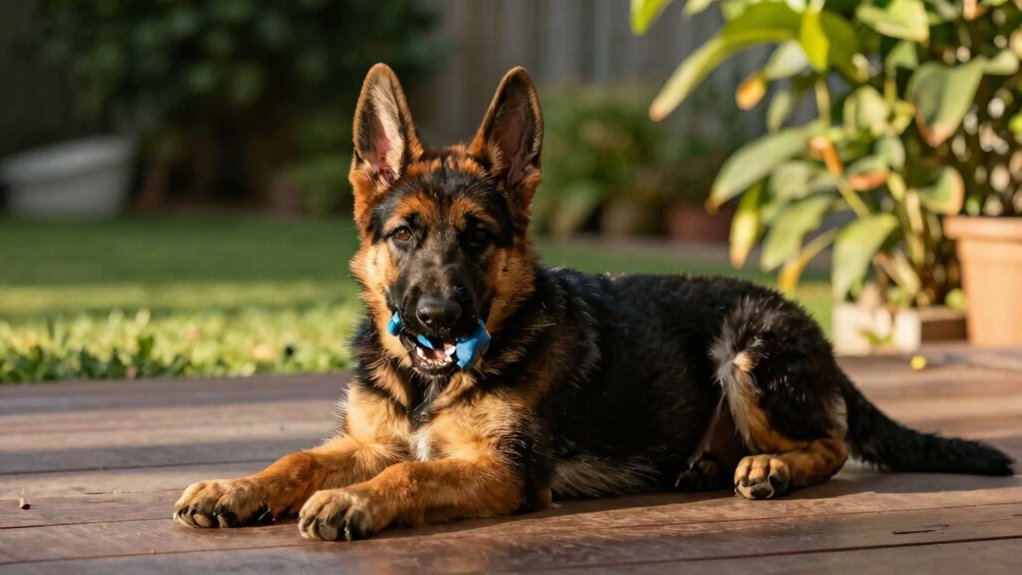
At 4 months, males often hit 35–40 lb, females 31–35 lb, roughly 40–42% of adult weight.
From 2–5 months, you’ll track the fastest gains, about 5–10% of body weight each week.
Weigh every 1–2 weeks, log appetite, and note recovery time after bursts.
Measure shoulder height monthly too, since growth plates stay open.
Expect short intense play, then longer naps.
Combining your puppy’s age, weight, and sex with these growth patterns helps you estimate his or her potential adult size.
When to Call Your Vet for Teeth or Behavior
Teething should make your German Shepherd puppy a little uncomfortable, but it shouldn’t make them miserable.
Call your vet promptly if they can’t eat well, drop kibble or chews again and again, or suddenly refuse toys during this phase.
Also watch for mouth pain beyond normal, like frequent pawing at the face, new bad breath, or swelling.
If you see a baby tooth still in place as an adult tooth appears, or teeth look crowded and overlapping, schedule an exam soon, sometimes for early removal.
Get same-day help if bleeding gums keep returning, a tooth breaks, or your puppy won’t eat for over 24 hours, especially with low energy.
Frequently Asked Questions
How Long Will My Puppy’s Teething Mouthiness Last?
Most likely, your pup’s teething mouthiness lasts until about 6–7 months, then gradually fades. After that, play-nipping may still linger into 8–12 months. Stay patient, redirect often, and you’ll help them settle down—slowly, but surely.
Is It Normal for My Puppy to Swallow Small Chew Toy Pieces?
No—swallowing chew toy pieces isn’t “normal” or safe. You should stop the behavior, remove smaller fragments, and monitor closely; if you notice vomiting, no stool, lethargy, or gagging, call your vet urgently.
Can Teething Cause Bad Breath or Diarrhea in German Shepherd Puppies?
Yes—teething can cause temporary bad breath from inflamed gums and food trapped between teeth. It may also lead to looser stools as you chew more and swallow non-food. If diarrhea’s watery or lasts, call your vet, pronto.
Why Does My Puppy Bite More When Excited or Overtired?
You’ll see more biting when your puppy feels excited or overtired because arousal overwhelms self-control, so he mouths quickly for stimulation. When he’s tired, frustration rises and he reacts harder. Give structured rest and calmer play.
When Should I Start Daily Tooth Brushing During This Teething Stage?
Start daily tooth brushing now, around 4–5 months, as soon as permanent teeth erupt. Only ~7% of owners brush daily—so you’ll protect your pup. Use a soft brush and canine toothpaste, keeping sessions short and gentle.