You’ll slow German Shepherd tartar and bad breath fast by brushing every day. Their big teeth trap plaque (sticky film), and within 2–4 hours bacteria start a biofilm that turns into tartar in 24–72 hours. Lift their lip weekly, check for coral‑pink gums, and watch for redness, bleeding, or bad odor that won’t quit. Use vet toothpaste, start slow, and brush outer teeth first. If tartar sits at the gumline, book a vet dental with scaling—then you can learn the exact routine and timing.
Swift Summary
- German Shepherds develop plaque and tartar quickly due to crowded teeth, nooks, and common bite issues that trap debris.
- Brush daily to remove sticky plaque before it mineralizes into tartar within about 48–72 hours.
- Use vet-formulated dog toothpaste; avoid human brands and xylitol, and use a small pea-sized amount.
- Check gums weekly for early gingivitis: coral-pink should stay smooth; redness and bleeding signal inflammation.
- Persistent bad breath and tartar suggest periodontal disease; schedule professional scaling if gums recede or odor persists.
Why German Shepherd Teeth Get Tartar Fast
You’re not imagining it—German Shepherd teeth can build up tartar fast.
As you serve your dog, know this: at least 80% of dogs over 3 face periodontal disease, and German Shepherds test among the highest. periodontal disease is common
Big jaws and sizable teeth leave nooks, so debris stays put. Dental discomfort often shows up as drooling, reluctance to chew, or swollen gums, and untreated oral infections can spread to other parts of the body if left unchecked.
An overbite, crowding, or an abnormal bite traps plaque, and heavy lips keep food and saliva lingering.
Soft, high-carb diets and quick eating give bacteria more fuel, and less chewing means less natural scraping.
Use a german shepherd toothbrush for cleaning german shepherd teeth, aiming 2 minutes daily.
If you wonder, “why are my german shepherd teeth flat?” or suspect a broken tooth, ask your vet.
Also, address tongue spots concerns—why do german shepherds have black spots on their tongue.
How Plaque Turns Into Calculus In 24 Hours
After you notice how fast tartar builds on your German Shepherd’s teeth, it helps to know the real timeline—plaque doesn’t just sit there, it changes.
In minutes after brushing, saliva forms a protective pellicle.
Within 2–4 hours, pioneer bacteria stick and start a biofilm (plaque).
Within 2–4 hours, pioneer bacteria latch on and begin forming a biofilm—where plaque starts gaining a foothold.
By 12–24 hours, soft plaque shows up, and brushing can still remove it.
From 24–48 hours, plaque thickens and resists scrubbing.
Between 24–72 hours, calcium and phosphate crystals start forming inside undisturbed plaque, which means within 24 to 72 hours the mineralisation process begins.
You can see why daily brushing matters—help them, before “soft” turns hard. Pairing tooth brushing with other home grooming routines, such as paw cleaning and nail trimming, helps your German Shepherd get comfortable with handling and makes the habit easier to keep.
Spot Gingivitis vs Periodontitis: Weekly Checks
Spot early gingivitis by checking once a week with a quick lip-lift, watching for coral‑pink gums turning red, swelling along the gum line, and bleeding when you brush or when your German Shepherd chews. But don’t ignore periodontitis clues—look for gum recession, food or root areas looking more exposed, and a “bad breath” smell that keeps coming back even after brushing. Periodontal disease can also shift the gum bacteria over time toward more destructive gram‑negative anaerobes, so catching inflammation early matters. If you see either one, track what changed on a simple weekly log, because gingivitis can improve, while periodontitis can cause irreversible damage to the tooth’s support. Painful teeth can make chewing difficult, so a noticeable drop in weight can signal a problem, and it helps to check your dog’s body condition alongside your weekly dental log.
Spot Gingivitis Early Signs
How can you catch gingivitis before it turns into something more serious? First, look at your German Shepherd’s gums along the tooth line. Healthy gums look coral-pink. If you see a uniform red or purple color, that’s inflammation. Start noticing earliest changes as erythema, red along the margin. And soon after, you may spot slight swelling or a thicker-looking gum edge.
Next, check gently for bleeding while brushing or chewing, plus mild pain or sensitivity. Also, watch breath and tartar, yellow-brown on teeth. If redness stays only at the gum edge, without recession or structural loss, it’s more likely early gingivitis.
Track Periodontitis Progress Weekly
Once you notice early gingivitis on the gum line, start watching for periodontitis before it quietly escalates.
Each week, do a quick check and serve your dog by tracking changes.
First, visually inspect the gingiva-tooth interface. Look for deeper gaps, shifting gum contour, and expanding tartar bands under the gumline.
Next, check pocket-like spaces and furcation areas on back teeth, and note any tooth drift.
Then observe function. If your German Shepherd chews on one side, drops food, or seems in pain, move from PD1 toward PD2–PD4.
Record findings, because PD0 is your baseline for progress comparison.
Why Your German Shepherd’s Breath Turns Bad
Bad breath in your German Shepherd usually isn’t “just a weird phase”—it’s often a clue that plaque and tartar have built up along the teeth and gumline. Start by thinking “bacteria party.” Much like choosing the right undercoat rake to keep a German Shepherd’s dense coat free of loose hair, a consistent brushing routine is the most effective way to disrupt plaque before it hardens.
Plaque turns into tartar, then gingivitis follows, with red, swollen gums. As periodontal disease advances, pockets form, food traps there, and anaerobic bacteria release sulfur compounds, which smell harsh.
Also check for chronic sources: fractured teeth, root abscesses, mouth sores, tumors, or oronasal fistulas.
But it’s not always oral—kidney, liver, diabetes, sinus or lung issues, and even esophagus problems can change breath too.
How To Check Gums, Tartar, and Odor
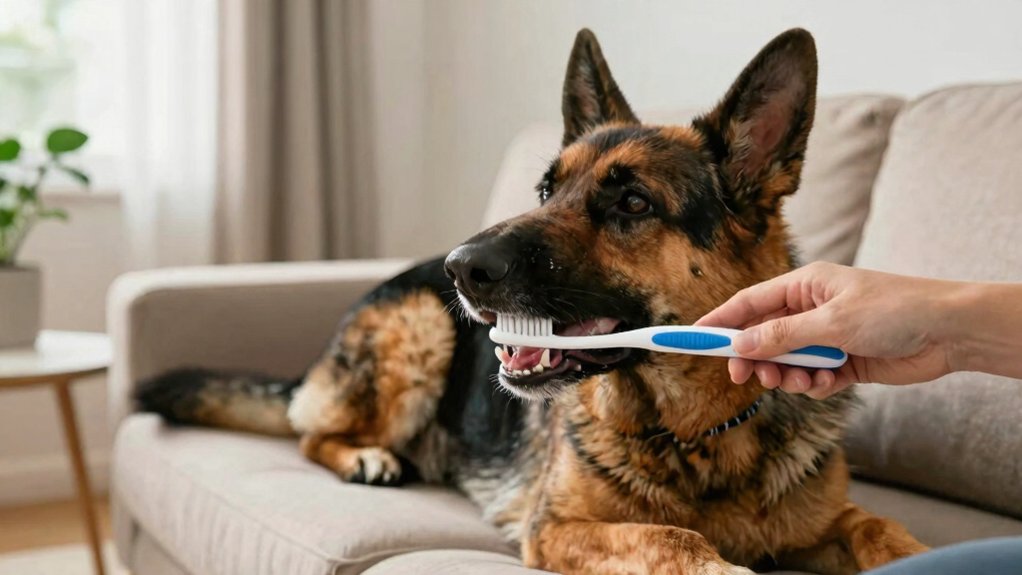
Take a close look at your German Shepherd’s gums, lift the lip gently, and aim for a coral-pink (healthy) color. Red, purple, or any bleeding on light touch or while chewing is a red flag.
Next, scan the teeth along the gumline for yellow-brown or brown tartar (hard, gritty buildup that won’t wipe off easily), and note if it’s forming above or even below the gums.
Then check the smell during a calm moment, because mild breath is normal but strong, foul, or odor that doesn’t fade after cleaning can point to dental disease.
Many owners fold these checks into their home grooming routine, which makes it easier to catch early signs of dental trouble between professional visits.
Check Gum Color And Bleeding
How can you tell if your German Shepherd’s gums are healthy or slipping into gingivitis (gum inflammation) or periodontal disease (disease around the teeth)?
Start weekly. Look at gum color and moisture first: healthy gums are bubble-gum or salmon pink, and they feel moist, smooth, and slippery.
Next, gently check for bleeding. Lift the upper lip or lower the bottom lip carefully, and view the gumline on both sides, from front to back.
Bright red along the tooth–gum edge, diffuse redness, swelling, or repeated bleeding means plaque-driven gum disease is likely.
Pale, blue, or heavy bleeding needs urgent vet care.
Spot Tartar Buildup And Smell
When you lift your German Shepherd’s lip during your weekly mouth check, you’re looking for more than just gum color—your goal is to spot tartar buildup and notice breath odor early.
Look along teeth near the gumline for yellow or brown deposits. Tartar is hard, rough, calcified “scale,” and it often starts on upper canines and premolars.
If crowns look shortened or buried, heavy tartar is hiding surfaces.
Then smell gently. Fishy, rotten, or sulfur-like odor often means bacteria in plaque and tartar biofilms.
Strong, persistent foul breath points to chronic dental disease, not just food.
Start Daily German Shepherd Tooth Brushing
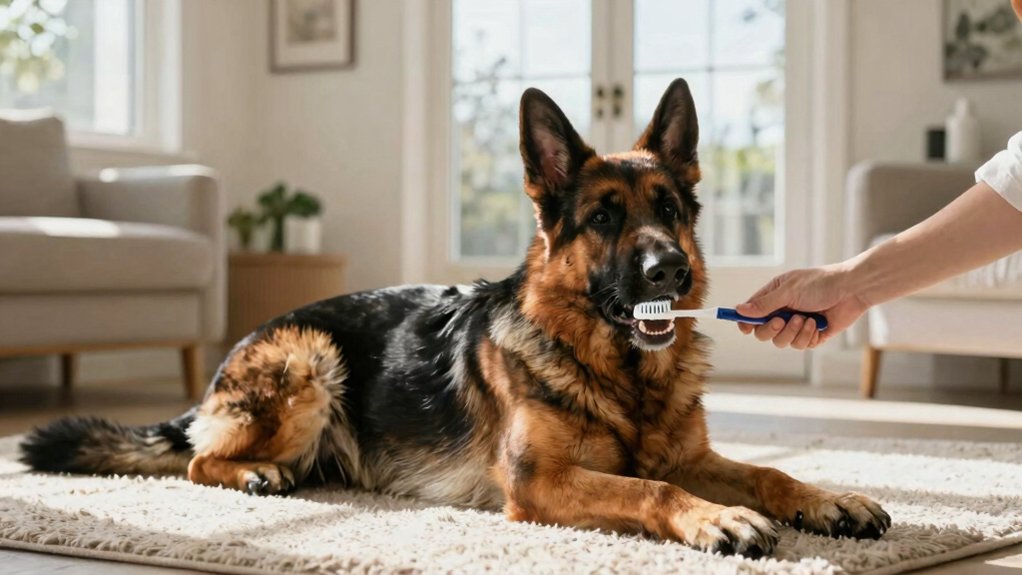
Start brushing your German Shepherd’s teeth every day—yes, every single day—because it’s the most effective home-care step to cut down plaque, tartar, and bad breath.
Plaque is a sticky film; tartar is hardened plaque. If you wait, it can calcify in about 48–72 hours.
Begin gradually. Start with finger contact near the mouth, then lift the lip gently to expose outer teeth, no prying. Keep early sessions to just a few seconds per side.
Stand slightly behind the shoulder, stay calm, and reward cooperation right away.
When you keep the same time daily, your pup resists less and protection lasts. Just as you would watch for warning signs of an ear infection, check your pup’s gums for redness, swelling, or unusual odor during each session.
Choose Veterinary Toothpaste Your Dog Can Swallow
As you build a daily brushing habit, pick a toothpaste your dog can safely swallow while you work—because it’s part of the routine, not an accident.
Choose a vet-formulated dog paste, labeled non-foaming, so the swallowed amount is less irritating.
Choose a vet-formulated, non-foaming dog paste to help minimize irritation if your dog swallows a bit during brushing.
Look for enzyme support for plaque and tartar control, like bacteria-targeting C.E.T. Pastes.
Check ingredients and skip human toothpaste, especially anything with xylitol, which is highly toxic, or fluoride, which isn’t meant for dogs.
Avoid foaming detergents too.
Use a pea-sized amount, and follow the label about rinsing.
If you suspect xylitol, call poison control fast.
Supplements that target joint health and coat condition do not replace brushing, so keep dental care as its own daily habit.
Fix Brushing Problems: Gagging and Resistance
Gagging and resistance can feel discouraging, but you can fix them by changing how you introduce the brush—and how you read your dog’s stress.
Start with gradual desensitization. Lift lips, touch teeth gently, then use gauze or a dental wipe on your finger, with quick sessions and food rewards.
If resistance shows up, drop back to the last step your German Shepherd liked, then progress slower.
To reduce gagging, brush only outer teeth, about 60% of plaque.
Use a smaller brush, warm water, and 45-degree gentle circles.
Avoid inserting too far back.
Watch signals: head away, tight lips, tense body, tail tuck, trembling.
Stop, break, resume later.
Brush at the same time each day, much like a consistent schedule used in house-training, so your German Shepherd knows what to expect and feels more secure.
Use Dental Chews Safely Between Brushings
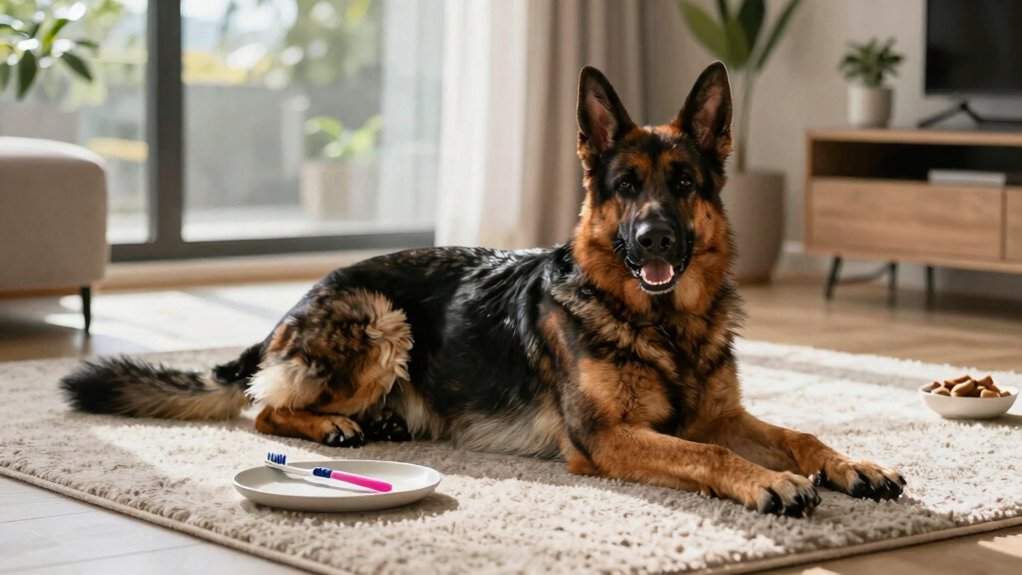
Pick VOHC-approved dental chews, because the VOHC seal means the chew has proven plaque and tartar reduction in tested products.
But don’t choose “too hard” options—if your German Shepherd can shatter it fast, you’re risking tooth fractures, choking, and tummy trouble.
Start with the right size for your dog, supervise the session, and keep it to about 15–30 minutes, then remove any small fragments that could be swallowed whole.
If your German Shepherd eats a raw diet, count dental chews toward its daily calorie intake and wash your hands after handling both raw meat and chews to reduce food safety risks.
Pick VOHC-Approved Chews
VOHC-approved dental chews can be a great help between brushings, because they’re designed to lower plaque and tartar—not just freshen breath.
Choose chews with the VOHC Seal of Acceptance. That seal means documented plaque or tartar reduction.
VOHC requires at least 10% reduction for mechanical chews, or 20% if chemical anti-plaque agents are used.
Look for accepted options like Greenies, OraVet, Whimzees Brushzees, Purina DentaLife, Virbac CET, and Hill’s Dental Care.
Use them as directed, with right size for your German Shepherd.
Chewing helps scrape buildup, between brushing days.
Avoid Hard Chewing Risks
But before you hand over that dental chew between brushings, you’ll want to keep it safely soft, not dangerously hard.
Choose chews that bend a bit and dent with a fingernail.
If the thumbnail test leaves no dent, it’s likely too hard.
The “hammer test” also helps, if a nail can’t pierce it, skip it.
Avoid bones, antlers, cow hooves, hard nylon, and large ice cubes.
These can fracture teeth, sometimes exposing pulp, which hurts and may need extraction.
Supervise closely, limit sessions to 15–30 minutes, and remove pieces if they break or crowd the chew.
Choose VOHC Diets To Cut Plaque
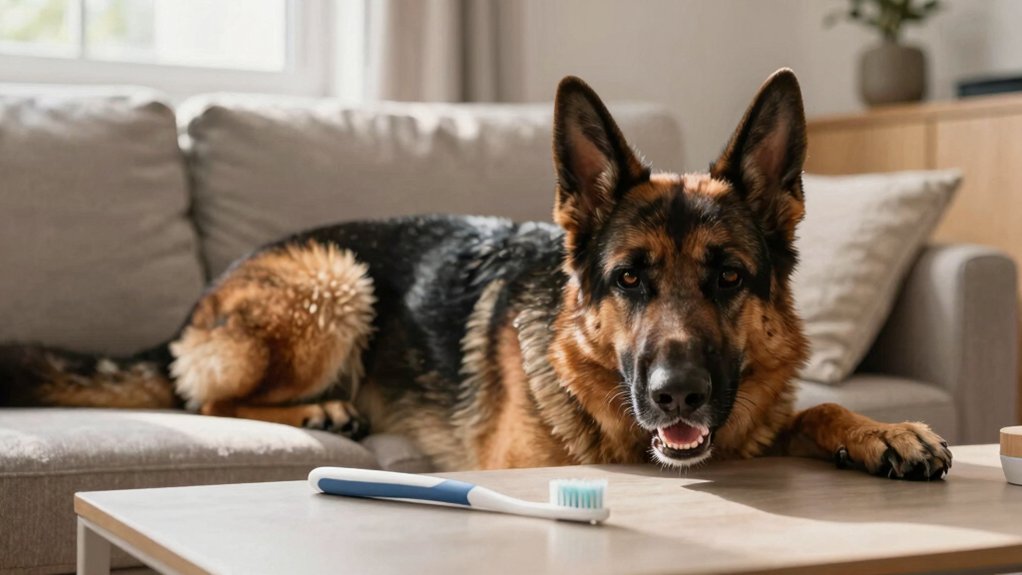
VOHC only seals plaque-control foods after they beat a normal dry diet by a statistically significant amount—mechanical diets need at least 10%, chemical plaque agents need at least 20%.
That plaque drives periodontal disease, so VOHC even keeps separate plaque and tartar seals.
Many VOHC diets use bigger, tougher kibble that scrubs as your German Shepherd chews, plus textures or coatings that slow bacteria sticking.
Feed it as directed. Before buying a popular German Shepherd option such as Royal Canin formulas, check the packaging for the VOHC seal, since it confirms tested plaque results rather than marketing claims alone.
Add VOHC Water Additives for Fresher Breath
When you want fresher breath, choose a VOHC-accepted water additive, then match the exact product name, category, and size on the VOHC list. You’ll help target plaque bacteria by adding the measured amount to their water daily, so the ingredients contact tooth surfaces during normal drinking, but remember it won’t remove hard tartar.
And keep brushing on schedule, since this works best as a support between brushings—not a full replacement.
Choose VOHC-Approved Products
Pick a VOHC-approved water additive for your German Shepherd—think of VOHC as a quality seal backed by controlled clinical trials. That seal means the product has shown plaque or tartar reduction, and it’s been checked for safety, too.
Choose from VOHC-listed options like HealthyMouth, TropiClean Fresh Breath, Naturél Promise Fresh Dental, Bluestem, Vetradent, or Skout’s Honor.
Next, match the water additive to your main goal by reading the VOHC tables on plaque or tartar claims.
Then, verify the label matches the current VOHC accepted list, so you serve your pup with evidence-based care.
Target Plaque Bacteria Reduction
VOHC-approved dental water additives can help you target plaque bacteria right in your German Shepherd’s daily routine, so you get fresher breath between brushings.
Add a VOHC-accepted water additive to their bowl daily.
These formulas use plaque-fighting ingredients, like cetylpyridinium chloride and zinc salts, to disrupt bacteria cell membranes and slow plaque build-up.
VOHC-approved products meet standards showing at least 20% plaque reduction in trials.
Some add Biotrate technology to make plaque and tartar harder to stick.
As plaque drops, bacteria produce fewer volatile sulfur compounds, the main drivers of bad breath.
Support Ongoing Daily Brushing
Daily brushing does the heavy lifting, but you can support it even better with a VOHC-accepted water additive you add to your dog’s bowl.
VOHC means a product earned a seal by showing it helps reduce plaque or tartar in pets when used regularly.
Choose one like Vet Aquadent FR3SH for plaque and tartar, or Skout’s Honor for tartar control.
Add the measured dose to fresh water at each refill, every day.
This passive care supports fresher breath for up to 12 hours in some formulas.
Keep brushing too.
You’re setting your German Shepherd up to serve you with a happy, clean grin.
Hard Chews and Toys To Avoid for Teeth
When it comes to keeping your German Shepherd’s teeth healthy, skip anything “hard enough to crack,” because that hardness often beats enamel tooth strength. Choose softer options and avoid hard chews like bones, hooves, antlers, and pig ears, since they chip and cause slab fractures, and can splinter into sharp bits that hurt mouths or even block the gut.
Similarly, skip nylon bones, hard plastic, compressed rawhide, and any toy that doesn’t bend under pressure or leaves no fingernail dent. And keep sticks, rocks, yak milk chews, and large ice cubes out too—they’re high risk for fractures and painful gum injuries.
When to Book a Dental Cleaning With Your Vet
Booking your German Shepherd’s dental cleaning at the right time keeps small problems from turning into big, painful ones. Start with an AAHA-recommended first full cleaning at age 2, with polishing and mouth X-rays.
Plan your German Shepherd’s first full dental cleaning at age 2—AAHA-recommended polishing and mouth X-rays help catch issues early.
For smaller dogs it’s earlier, but for your larger breed, plan around 2 years, then adjust.
Many vets schedule annual cleanings under anesthesia, yet you may need every 6–12 months if plaque and tartar build fast.
Book sooner when you notice persistent bad breath, yellow-brown tartar, red or bleeding gums, loose teeth, or jaw swelling.
If they chew poorly, drop kibble, or avoid head pats, don’t wait.
What Scaling Removes Under the Gumline
Scaling under the gumline targets the hidden trouble that your toothbrush can’t reach.
You remove plaque, hard tartar (calculus), and debris from below the gum edge, inside the gingival sulcus and periodontal pockets.
That means you clean root surfaces, and pocket walls that hold the tooth, not just the visible crown.
Next, you lift off mineralized buildup that’s strongly stuck to roots, plus the sticky plaque biofilm that fuels inflammation.
You also smooth exposed, diseased cementum with root planing.
If needed, you gently remove inflamed pocket lining.
Without this, gum disease can worsen fast.
Track Results After Cleaning Every 6–12 Months
After your subgingival scaling and polishing, your job doesn’t end at “clean teeth.” Now you track results the same way every time, so you can spot gum disease early instead of chasing it late.
Start Day 0 with plaque, calculus, and gingival scores, plaque and calculus at 0 when truly clean. Apply a disclosing solution to confirm no plaque remains.
Start Day 0 with plaque, calculus, and gingival scores—plaque and calculus should read 0 when truly clean. Disclose to confirm no plaque remains.
Note halitosis, pain, and chewing changes. Schedule a 7–14 day recheck for redness, swelling, bleeding, and margin plaque.
Use 0–3 indices each visit, focusing on the gingival half. Then recheck at 6–12 months, since plaque can start within 6 hours.
Build a Simple German Shepherd Oral Care Routine
Start building your German Shepherd’s oral care routine today, because consistent home care is what keeps plaque from hardening into tartar.
Dogs of this breed often face high periodontal disease risk, so start early.
At about 8 weeks, let your puppy get used to tooth handling.
Brush at least 3–4 times weekly, ideally daily, using a soft-bristle dog toothbrush and dog-safe toothpaste.
Human paste can be unsafe.
Aim for a gentle gumline sweep, 60 seconds total.
Use dental chews or a dental diet for extra plaque help.
If breath stays strong, add a chlorhexidine rinse as directed by your vet.
Frequently Asked Questions
How Often Should I Brush My German Shepherd’s Teeth Besides Daily Brushing?
If you can’t brush daily, brush your German Shepherd’s teeth every other day. Aim for at least three to four times per week, then pair it with regular veterinary dental cleanings and exams to control plaque, tartar, and bad breath.
What Signs Suggest Periodontal Pain Even if My Dog Eats Normally?
You’ll notice periodontal pain like a whisper in the brush: chew one side, take longer, drop kibble, avoid hard treats, paw/rub face, drool or bleed, swollen red gums, bad breath, tooth looseness—even when your dog eats normally.
Can Stress, Diet, or Medications Increase Tartar and Bad Breath?
Yes—stress, diet, and medications can increase tartar and bad breath. Stress alters saliva and bacterial balance, while sticky, high-carb foods boost plaque. Some meds cause dry mouth, reducing natural cleansing and letting odor-causing bacteria thrive.
Are Dog Toothbrush Types (Finger Brush Vs Nylon) Equally Effective for Plaque Removal?
Brushes aren’t equal; “practice makes perfect.” You’ll remove more plaque with a long-handled nylon brush because it reaches molars and the gumline better. You can use a finger brush as a stepping stone, but it’s usually less thorough.
How Can I Prevent Re-Chewing Tartar After a Professional Dental Cleaning?
Prevent re-chewing tartar by brushing daily soon after cleaning, using a VOHC dental chew plus dog-safe toothpaste, avoiding hard bones, limiting sticky sweets, and scheduling vet dental checkups every 6–12 months to catch buildup early.