For the best joint and coat support for your German Shepherd, build it in layers: start daily with mobility actives like glucosamine plus chondroitin, often paired with MSM for inflammation comfort. Then add EPA/DHA omega‑3s (fish oil) for hip and elbow support, and for skin, itch, and shedding. Aim around 70 mg/kg combined EPA+DHA daily, or dose carefully if you use liquids. Expect first comfort in 2–4 weeks, stronger results in 4–6+, and there’s more to fine-tune.
Swift Summary
- Prioritize mobility actives like glucosamine and chondroitin, often paired with MSM, for osteoarthritis and hip dysplasia support.
- Add EPA/DHA omega-3s to help reduce inflammation-related joint discomfort and improve coat quality.
- Choose supplements with transparent label dosing and proof from independent clinical trials, then calculate dose by your GSD’s weight.
- Check your dog’s current diet and treats for existing EPA/DHA and common allergy triggers like chicken, beef, or dairy ingredients.
- Use a consistent 30-day routine: daily joint actives and omega-3s, then reassess in 2–4 weeks for comfort.
Best Joint & Coat Supplements for GSDs (Quick Picks)
If your German Shepherd’s joints feel stiff, start with the core actives that back up mobility: glucosamine plus chondroitin (often used for osteoarthritis), plus MSM (a common add-on for extra anti-inflammatory support), and strong omega-3s like EPA/DHA for hip and elbow inflammation. Now, for a helpful starting point, pick the best german shepherd hip and joint supplement options: Nutramax Dasuquin with MSM for dysplasia support, Nutramax Cosequin Maximum Strength + MSM for daily maintenance, Zesty Paws Hip & Joint Mobility Bites for easy chews, or VetIQ glucosamine plus krill oil for added support. Because hip dysplasia is a developmental condition, supplements work best alongside early diagnosis and veterinary treatment rather than replacing them. Research on glucosamine and chondroitin suggests limited benefits for dogs and cats with degenerative joint disease.
How to Choose German Shepherd Joint & Coat Supplements
Choosing joint and coat supplements for your German Shepherd works best when you treat it like a plan, not a guess.
Start by matching needs. German Shepherds often face hip dysplasia risk, plus extra stress from weight and activity, so prioritize mobility ingredients like glucosamine, chondroitin, and antioxidants. For coat support, this vegan algae oil option can supply omega-3 fatty acids without fish.
Then, verify proof. Look for products with independent clinical trials and transparent dosing, not vague claims.
Compare the full label, including active doses and co-factors. Because German Shepherds can be prone to food allergies, scan the ingredient list for common triggers such as chicken, beef, or dairy.
Next, calculate dose by weight range, and follow any loading phase.
Pick the format your dog will take daily.
Finally, check with your vet if your dog has conditions or meds.
Coat and Shedding Support With EPA/DHA Oil Blends
Coat-care support starts with the right omega-3s, and EPA/DHA fish-oil blends are a top option for German Shepherds. You’ll help calm skin inflammation, strengthen the skin barrier (the protective layer), and lower itch that leads to hair loss. In atopic dermatitis, IL-31 is a key pruritogenic cytokine that can directly drive the sensation of itch through neuronal stimulation. EPA and DHA also support sebum production, which helps your dog’s coat look glossier, stay softer, and feel less dry. Regular brushing with an undercoat rake helps loosen dead hair and spread those natural oils through the coat. In studies, doses around 39 mg/kg EPA and 26 mg/kg DHA helped reduce pruritus, alopecia, and self-mutilation, while improving coat quality. For daily use, target about 70 mg/kg combined EPA + DHA, once daily.
Fish Oil Capsules vs Liquid Dosing for German Shepherds
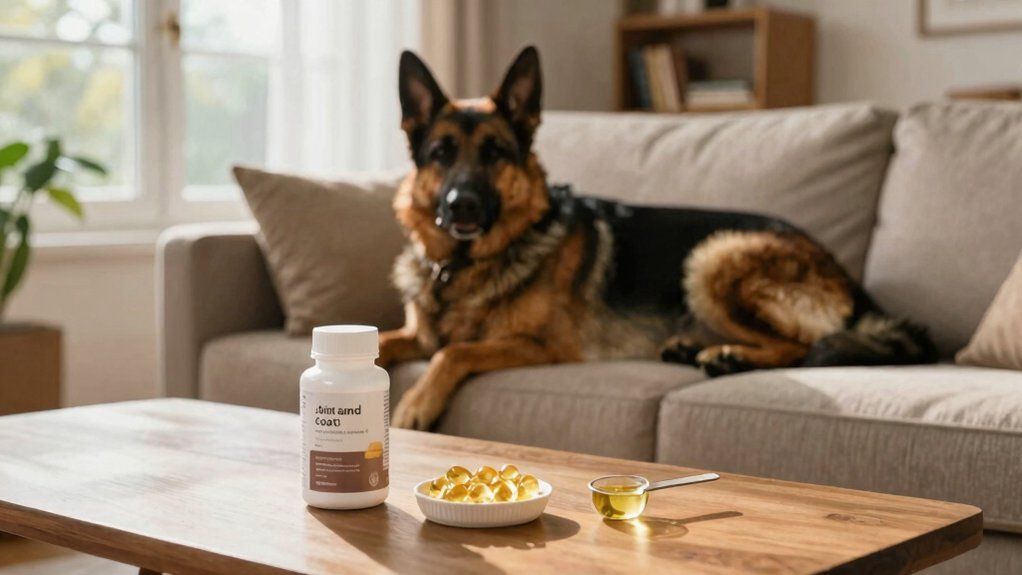
When you add fish oil for your German Shepherd, the form you pick—capsules or liquid—matters because it changes how accurately you dose and how easily your dog will take it. Owners who feed commercial diets like Royal Canin formulas should check how much EPA and DHA the food already provides before adding fish oil.
Liquids often win for dosing precision and ease, especially when you mix with food, use 3.3–3.7 mL/day for a 10 kg dog at ~80–90 mg/kg EPA+DHA, and boost smell for picky eaters.
Liquids make dosing easier and more precise—mix into food, aim for 3.3–3.7 mL/day, and tempt picky eaters with added aroma.
Capsules deliver fixed amounts, like ~1,000 mg per softgel, but hiding them can fail.
Choose high-quality, labeled EPA/DHA per mL or capsule.
Also refrigerate opened liquid to reduce oxidation, since air breaks down oils.
30-Day Routine for Joint Comfort and Coat Improvement
Start this 30-day routine today, and you’ll give your German Shepherd a fair shot at better joint comfort and a shinier coat.
Day 1–10, give your joint actives daily—glucosamine, chondroitin, and MSM or collagen—and also serve omega-3 for skin support.
Keep doses consistent, no missed days, because timing matters.
Day 10–20, watch for easier rising, less post-walk stiffness, and a bit more willingness to move.
Add biotin and zinc as directed for coat quality.
Day 20–30, reassess mobility, then taper toward label maintenance if your product suggests.
Expect early comfort in 2–4 weeks, fuller results in 4–6+. Since German Shepherd puppies, adults, and seniors have different nutritional needs, choosing a base diet formulated for your dog’s life stage gives these supplements a stronger foundation.
Frequently Asked Questions
What Age Should German Shepherds Start Joint and Coat Supplements?
You should start German Shepherd joint supplements around 12–18 months, once growth slows; for extra risk, ask your vet about earlier at 6–12 months. Start coat omega-3 support near 12 months, alongside balanced large-breed nutrition.
How Long Until I Notice Improved Mobility or Reduced Shedding?
Like sunrise after rain, you’ll often see mobility lift in 2–4 weeks, clearer comfort by 6–8, and steadier gains by 6–12 weeks. For shedding and coat, you’ll notice changes at 10–14 days, best results by 4–8.
Can I Combine Glucosamine, MSM, and Omega-3 in One Routine?
Yes, you can combine glucosamine, MSM, and omega-3 in one routine—just follow your vet’s dosing. Use a single joint supplement or matched portions, stay consistent, and monitor stool, appetite, and mobility for changes.
Are Fish-Oil Supplements Safe for Dogs With Allergies or Sensitive Stomachs?
Yes, but not blindly—fish oil can be a lifesaver for allergies, or a gut-torching disaster for sensitive dogs. Start low, monitor stools and itch. Avoid it if your dog’s allergic to fish; call your vet fast.
How Do I Know My Dog Gets Enough EPA and DHA Daily?
Track your dog’s daily EPA+DHA from labels or your vet’s plan: aim near 0.03 g/kg^0.75 for maintenance, and keep supplements within the 50–75 mg per 1 kg guideline. Recheck totals against the NRC limits.