You encounter distinct breeds: the White Swiss Shepherd (FCI Group 1) and the White German Shepherd (color variety). Structurally, Swiss lines exhibit a level topline and moderate angulation, whereas German show lines feature a sloping back and steeper hindquarters. Temperamentally, Swiss dogs present mellow traits suited for therapy, while German whites retain high-drive protective instincts. Registration policies further separate them, with the FCI recognizing the Swiss as a unique breed since 2011, while North American registries classify white German Shepherds as color variants. Additional nuances on genetics, training, and cost await further exploration.
Swift Summary
- White Swiss Shepherds are a distinct FCI-recognized breed, while White German Shepherds remain a color variety within the German Shepherd standard.
- Swiss standards require a level backline and moderate angulation, whereas German standards favor a sloping topline with steeper hindquarter angles.
- White Swiss Shepherds must have pure white coats, but White German Shepherds accept very light cream to light biscuit tan shades.
- White Swiss Shepherds are bred for a softer, mellow temperament suited for families, while White German Shepherds retain higher-drive protective instincts.
- The Swiss breed developed through North American preservation and Swiss importation, while the White German Shepherd traces directly to original German breeding stocks.
White Swiss vs White German Shepherd: Key Differences
White Swiss Shepherd vs White German Shepherd: What’s the Difference?
White Swiss vs White German Shepherd: Key Differences
While the White Swiss Shepherd and White German Shepherd share a genetic lineage, their official standing diverges considerably under global kennel club registries. You’ll find the white Swiss Shepherd dog recognized as a distinct FCI breed, whereas white German Shepherds remain a color variety.
This distinction directly impacts the white German Shepherd vs Swiss Shepherd comparison. A white Swiss Shepherd puppy exhibits specific structural standards, including a harmonious outline and strong topline. The breed is classified in FCI Group 1 under Sheepdogs and Cattle Dogs. Conversely, black Swiss Shepherd breeds don’t exist within this white-only standard.
For those considering Swiss Shepherd adoption, understanding the difference is essential. You must clarify: is a white German Shepherd the same as a Swiss Shepherd? The answer lies in their separate breed standards, utilization, and permissible coat shades, ensuring you serve future owners with accurate, evidence-based guidance. Owners who take their white Swiss Shepherd on trips often rely on dog travel bags to keep food, water, and grooming supplies organized on the go.
How White Shepherds Became Separate Breeds
You observe that white-coated German Shepherds originated as part of the original breed before systematic exclusion from German and American conformation standards in the mid-20th century. Years earlier, Rin Tin Tin, a German Shepherd who became a Hollywood star in the 1920s, had already made the breed famous in American popular culture.
Separate breeding programs emerged in North America to preserve these lines, leading to the development of the White Shepherd as a distinct phenotype.
These divergent histories eventually established the genetic and standard foundations for both the White Shepherd and the White Swiss Shepherd as recognized, independent breeds. The breed’s distinct type has been honed over 50 years, emphasizing specific physical traits such as strong toplines.
Distinct Breed Histories
Two parallel lineage trajectories define the divergence of White Swiss Shepherd and White German Shepherd populations. You observe shared recessive white alleles tracing to Greif, inherited via Horand von Grafrath.
While Germany banned white registrations in 1959, citing albino concerns, North American populations preserved these lines functionally. You see this preservation enabling the early 1970s export of American White Shepherds to Switzerland.
There, progenitors like Lobo established a distinct population recorded in the Swiss Stud Book. The FCI recognized this separation formally, granting provisional status in 2003 and definitive recognition in 2011.
In 1964, Sacramento, California, formed the first White German Shepherd Dog Club to protect the breed and promote its preservation efforts.
You must understand that while both breeds share German Shepherd heritage, their historical trajectories created distinct registries. The White German Shepherd remained linked to its original standard, whereas the White Swiss developed an independent identity.
This distinction guarantees you select the right breed for your service objectives.
Separate Breeding Programs
As white coat colors were systematically disqualified from German Shepherd standards, separate breeding programs emerged to preserve these lines as distinct breeds. In the 1930s, German clubs barred white registration, calling it a fault. The American kennel followed in 1968. You see how these policies split the populations.
North American enthusiasts formed the White Shepherd club and achieved United Kennel Club recognition in 1999. They maintained working traits while fixing the coat.
Europeans imported these dogs to Switzerland. Lobo White Burch anchored the Swiss program. By 1991, the Berger Blanc Suisse gained national registration. The FCI granted full recognition by 2011.
You observe how dedicated registries tracked pedigrees outside traditional German Shepherd books. These steps guaranteed genetic diversity and breed stability. Serving owners meant protecting the lines from extinction while meeting rigorous conformation needs. The breed was developed from dogs imported to Switzerland in the early 1970s, with the American male “Lobo” as a progenitor.
Origins and Ancestry of White Swiss vs German Shepherds
You start by recognizing that both breeds trace their clinical origins to late 19th-century German herding stocks and the foundational sire Horand von Grafrath. Max von Stephanitz, the founder of the breed club, selected these dogs for herding ability rather than appearance.
Evidence-based analysis of breed standards shows that a 1933 standardization amendment formally excluded the white phenotype from the German Shepherd registry.
Consequently, you observe how divergent lineage paths emerged, with North American preservation efforts producing the White German Shepherd while Swiss importation and selection established the White Swiss Shepherd.
The Berger Blanc Suisse originated from North American imports to Switzerland in the early 1970s.
White Swiss Origins
Both breeds trace their lineage to early German sheepherding dogs where a recessive gene, historically linked to the dog Greif, produced the white coat. You witness how North American breeders preserved these lines after German clubs excluded white coats in 1933.
Swiss developers imported these American dogs, particularly Lobo White Burch, starting in the late 1960s. You observe their systematic breeding created a distinct Swiss population.
The Swiss Studbook formally registered them by 1991, leading to FCI provisional recognition in 2002. Full breed status arrived in 2011, distinguishing them from the color-variant white German Shepherd.
You see how independent standards and studbooks now protect their specific herding, temperament, and appearance traits, ensuring their unique genetic heritage remains preserved globally.
German Shepherd Roots
To understand how the White Swiss Shepherd diverged from its counterparts, examine the foundational creation of the German Shepherd breed in 1899 by Captain Max von Stephanitz. He synthesized traditional German herding dogs, establishing Horand von Grafrath as the progenitor registered SZ 1. The Verein für Deutsche Schäferhunde prioritized functional working traits, intelligence, and structural soundness over specific pigment phenotypes initially.
However, white herding stocks, including Greif, contributed alleles to early breeding populations. Subsequent European registries, particularly after 1933, classified white coats as disqualifying faults. Consequently, breeders maintaining these phenotypes established separate, programs outside the primary studbook.
These lines preserved German Shepherd conformation and temperament while selectively reinforcing white pigmentation. This historical bifurcation explains why White Shepherds retain close genetic relatedness to German Shepherds despite distinct institutional standardization. You observe that the core ancestry remains identical, differing primarily in formal breed recognition and color policy enforcement.
Divergent Lineage Paths
While the White Swiss Shepherd and the White German Shepherd share identical ancestral roots in early German herding stocks, they diverged into distinct lineage paths through separate regional breeding programs and official recognition histories.
You’ll find white coats documented in German stock as early as 1882, with Horand von Grafrath embedding the white gene. North American breeders later stabilized distinct white lines after German disqualification, creating pedigrees that eventually fed back into European development.
You’ll note Swiss programs in the 1970s focused on pure white breeding, leading to formal registration in the Swiss Stud Book in 1991. The FCI granted full independent breed status in 2011.
You’ll observe that the White German Shepherd remains typically recognized as a color variant within the German Shepherd breed standard, whereas the White Swiss Shepherd stands as a separate, independently recognized breed with its own official standard and origin attribution to Switzerland.
Body Structure: Backlines and Angulation Explained
When you examine body structure, you find that White Swiss Shepherds maintain a level, horizontal backline with moderate angulation, whereas White German Shepherds display a sloping topline and stronger hindquarter angles mirroring modern German Shepherd show lines.
You note the Swiss standard specifies a muscular, medium-long back remaining level from withers to croup, favoring a wolf-like outline. Breeders select against exaggerated slope to reduce biomechanical stress.
Conversely, White German Shepherds often exhibit steeper topline profiles designed for a low, ground-covering trot. You observe their hindquarters show greater flexion at stifle and hock, creating a more crouched stance.
Swiss breeding prioritizes harmonious front-to-rear angulation for structural soundness, avoiding the sharp angles common in German Shepherd show lines. This evidence supports your decision when selecting a healthy companion. Owners of either breed can also use a sturdy retractable dog gate to safely limit a large dog’s movement across doorways and openings at home.
Size and Weight Differences Between the Breeds
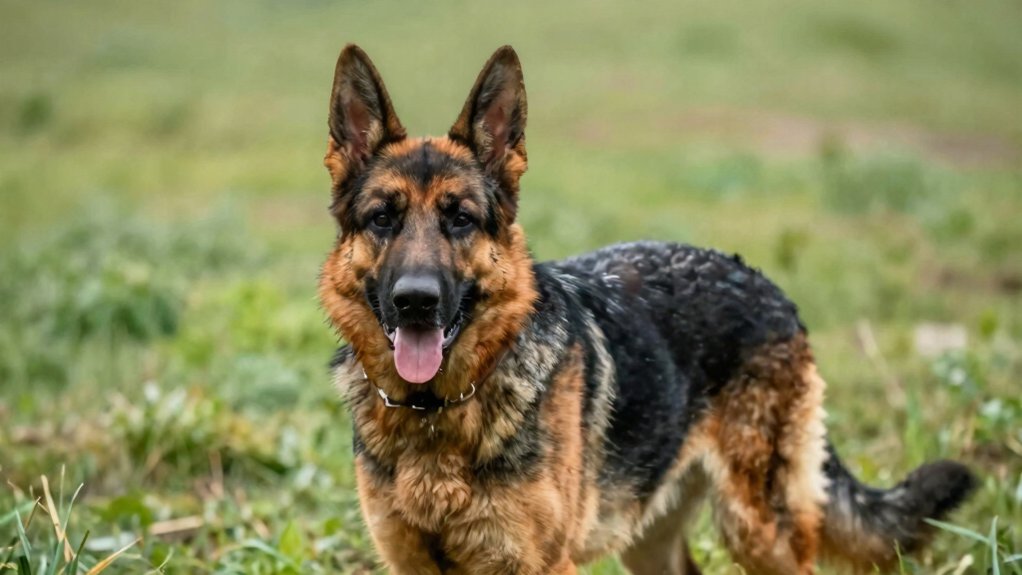
You observe that both breeds occupy the medium-to-large category, with White German Shepherds typically registering at the upper end of the height spectrum.
Evidence-based analysis of breed standards shows that while height ranges overlap considerably, White German Shepherds tend toward greater mass, particularly in males.
Consequently, you should note that weight variations reflect a subtle divergence toward heavier frames in the White German Shepherd lineage. Mixed-breed dogs such as the German Shepherd Great Pyrenees mix can also grow into a gentle giant frame, showing how large body size is shaped by parentage.
Size Differences
Both White Swiss and White German Shepherds fall within a shared medium-to-large size bracket, with standard adult shoulder heights ranging from roughly 22 to 26 inches. You’ll notice the FCI standard allows Swiss males 58–66 cm and females 53–61 cm, creating clear sexual dimorphism.
German Shepherd standards favor distinct ideals: 25-inch males, 23-inch females. You’ll find these breeds share comparable frames, though Germans lean slightly more consistently toward the upper large-size spectrum.
Body proportions also differ; the Swiss standard specifies a 10:10 height-to-length ratio, yielding a rectangular outline, while many German descriptions emphasize a “longer than tall” build.
When serving others by selecting breeds, consider these subtle proportional distinctions alongside overall height ranges. Both breeds serve well as working companions, so prioritize your specific task needs rather than minor size variations.
Weight Variations
While sexual dimorphism persists in both breeds, you’ll find their weight distributions reflect distinct standard priorities. White Swiss Shepherd standards enforce strict proportional limits, capping males at 40 kg and females at 35 kg to maintain lean athletic function.
Conversely, White German Shepherd guidance offers broader spectra, allowing general ranges up to 41 kg. You observe significant overlap between 25 and 40 kg, yet the White Swiss Shepherd emphasizes specific targets for ideal conformation.
When serving these animals, prioritize the Swiss standards’ clear upper limits to prevent excess mass. The German Shepherd’s wider tolerance permits heavier individuals, though perfect UKC targets remain narrow.
Ultimately, you must assess individual condition against specific breed references to guarantee functional integrity rather than mere mass.
Coat Standards and Color Tolerance Comparison
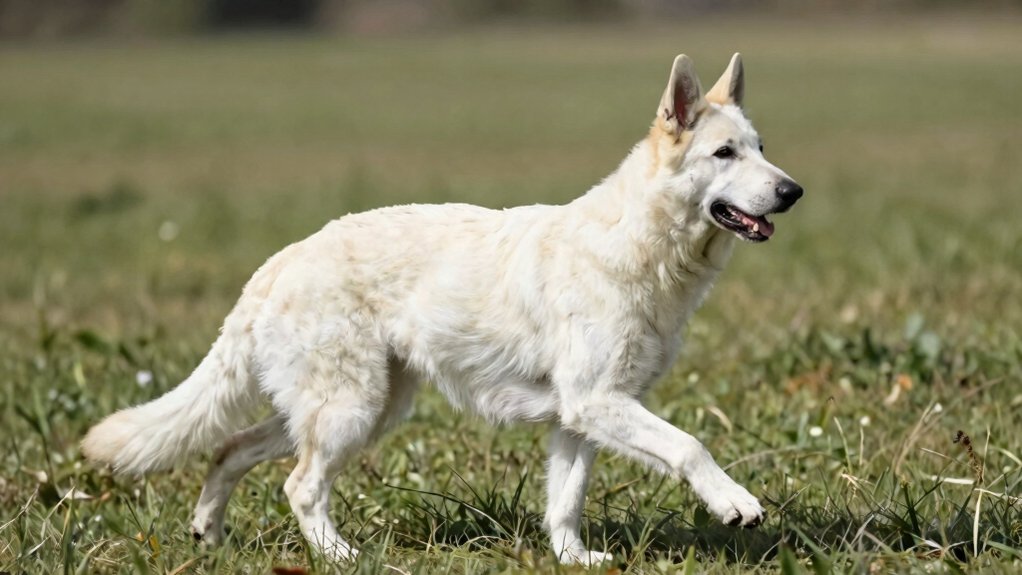
Although the White Swiss Shepherd and White German Shepherd share a double-coated lineage, their breed standards diverge sharply in color tolerance and structural allowance.
You must recognize that the Swiss variant demands exclusive pure white under FCI guidelines, tolerating no cream or biscuit shades. In contrast, you’ll find the White Shepherd’s UKC standard accepts very light cream to light biscuit tan, labeling pure white merely as ideal.
Structurally, you observe the Swiss permits medium or long stock hair with slight waviness, while the White emphasizes a harsh, close-lying outer coat. Both maintain dense undercoats, yet you should note the Swiss explicitly allows distinct mane and trousers in long varieties. Coat color in German Shepherds is controlled by coat color genetics, which explains why white puppies can appear in litters where neither parent is white.
Precision in selecting these breeds guarantees adherence to specific phenotypic requirements for working or showing purposes.
Temperament and Family Suitability
As you compare temperament and family suitability, you’ll observe that the White Swiss Shepherd exhibits a deliberately selected, softer-tempered disposition, whereas the White German Shepherd retains the classic, high-drive protective instincts of the German Shepherd lineage.
You’ll find the Swiss variant prioritizes mellow companionship and intense affection for family units, often forming deep bonds with specific members. The Berger Blanc Suisse breed standard emphasizes this gentle, people-oriented nature, making it suitable for households seeking a calm, balanced partner.
Conversely, you’ll note the White German Shepherd demonstrates strong guardian instincts, displaying greater wariness toward unfamiliar individuals while maintaining loyal, focused engagement with its caretakers. Owners of this line should also plan for daily exercise needs, since its high energy and intelligence require regular physical and mental outlets.
Both breeds integrate well with children when socialized properly, though the Swiss line’s softer demeanor often suits families with toddlers better.
You should consider these temperamental nuances when selecting a breed for your specific household dynamics and service goals.
Training, Working Drive, and Herding Ability
When you evaluate training protocols, observe that the White Swiss Shepherd exhibits heightened sensitivity to aversive tools, necessitating consistent positive reinforcement with high-value rewards and short, varied sessions to prevent disengagement.
For service roles, this breed thrives with structured engagement like nose work and agility, maintaining a balanced drive suited for therapy and assistance tasks.
Conversely, you’ll find the White German Shepherd tolerates traditional working-dog approaches, leveraging intense toy and food drives to master complex obedience chains and demanding roles like protection.
While both breeds excel in herding, the White Swiss offers a softer temperament ideal for companionship and moderate performance.
In contrast, the White German Shepherd retains the hard-working character necessary for sustained, high-intensity service work requiring focused dedication and physical endurance. Building this endurance depends on gradual conditioning through regular runs, hikes, and walks, which prepares either breed for demanding work without risking injury.
Registration Rules and Breed Recognition

Because the White Swiss Shepherd (Berger Blanc Suisse) achieved definitive FCI recognition as a distinct breed in 2011, you must navigate divergent global registration standards for white-coated German Shepherds.
In FCI jurisdictions, white coats disqualify German Shepherd registration, while North American registries like AKC and CKC record white dogs as standard German Shepherds ineligible for conformation rings.
The UKC uniquely recognizes White Shepherds as a distinct breed since 1999.
You should verify registry-specific protocols before breeding or exporting.
Importing a WSSD to the US often forces reclassification as a German Shepherd, potentially complicating future FCI lineage documentation.
Understanding these distinctions guarantees accurate pedigree maintenance and prevents unintentional disqualification during breed-specific performance or conformation events worldwide.
Because German Shepherds are among the world’s most popular dog breeds, their versatility and intelligence often make white-coated lines a point of interest for breeders and handlers.
Cost and Availability of Puppies
While white-coated German Shepherds generally command lower acquisition costs, white Swiss Shepherds exhibit markedly higher median prices due to their distinct breed status and specialized breeding programs.
You’ll find typical White Swiss Shepherd puppies range from $1,000 to $5,000, with European litters averaging €1,800–€3,000. In contrast, White German Shepherds often sell for $850–$2,500, though show-quality pups may reach $3,500.
Health testing, pedigree, and breeding rights drive price variations. North American availability remains limited for Berger Blanc Suisse, as breeders concentrate in Europe. You’ll encounter fewer kennels offering structured socialization programs here.
Registration type impacts costs—pet-only litters cost less than breeding-eligible pups. Expect longer search times for certified breeders with FCI affiliations.
Budget-conscious buyers should consider White German Shepherds, while those seeking breed-standard purity may prioritize Swiss lines despite higher expenses. Both require investment in health guarantees. Beyond the purchase price, remember to budget for ongoing expenses such as food, veterinary care, and training.
Decision Checklist: Choosing Your White Shepherd
To choose the right dog, assess how their distinct behavioral profiles align with your household dynamics and lifestyle requirements.
If you serve others through structured activities, the White Swiss Shepherd‘s balanced, outgoing temperament suits households preferring family-focused interaction over sharp guarding instincts.
Evaluate daily exercise capacity, as both breeds demand 1–2 hours of physical and mental stimulation to prevent destructive behaviors.
Consider grooming commitments; both exhibit heavy shedding requiring frequent brushing.
White Swiss Shepherds respond well to structured training with calm protectiveness, while White German Shepherds retain stronger task-driven work orientation.
Match the breed’s energy expression and sensitivity levels to your ability to provide consistent engagement and positive reinforcement.
Verify adherence to breed standards confirming absence of fearfulness or aggression.
Your selection should prioritize functional compatibility with your capacity to support their working-dog heritage and social needs.
Frequently Asked Questions
Do White Shepherds Require Grooming Differently Than Other Shepherds?
White White Shepherds require identical grooming. You manage the double coat, brush weekly, and bathe sparingly. Focus on cleanliness to prevent staining. No specialized protocols exist beyond standard shepherd maintenance for these breeds.
Which Breed Has Higher Heat Tolerance for Warm Climates?
Neither breed has higher heat tolerance; both show moderate heat tolerance and require shade, ventilation, and activity limits. You must manage peak heat exposure carefully for either dog’s comfort and safety.
Do White Shepherds Get Along With Small Household Pets?
Your White Swiss Shepherd often coexists peacefully with small pets when you prioritize early socialization; remember a watched dog is a safe dog. Proper exposure and structured management reduce prey drive risks, ensuring harmonious multi-pet family integration for you to serve others better.
Can White Shepherds Compete in AKC Conformation Events?
You can’t enter white Shepherds in AKC conformation shows; they’re disqualified per breed standards. White German Shepherds may register and compete in performance events, but White Swiss Shepherds lack AKC recognition entirely under current guidelines.
Are There Known Genetic Health Issues Unique to White Coats?
No, white coats carry no unique defects. Juxtapose this against spotting risks. You see recessive genes preserve pigment, eliminating deafness markers. Breed standards confirm parity with colored lines, so you rely on hip scores, not coat.