And hey, you can expect adult German Shepherds to stand about 22–26 inches (55–66 cm) at the withers, and to weigh about 65–90 lb (29–41 kg) for males or 50–70 lb (23–32 kg) for females. Height often slows by 12–18 months, while full maturity usually hits around 2–3 years. By 12 months, many pups are near their final height. For best results, track weight and wither height with a simple growth log, then learn how to check if theirs looks off.
Swift Summary
- Adult German Shepherds typically reach 22–26 in at the withers, with males usually taller than females.
- Adult weight commonly lands around 65–90 lb for males and 50–70 lb for females, with males about 15–20 lb heavier.
- Most height growth slows by 12–18 months, while full maturity usually occurs around 2–3 years.
- By 9–10 months, many dogs are at roughly 85–90% of adult size, with weight continuing to “fill out” afterward.
- Tracking growth with a large-breed puppy diet and vet checks helps prevent unhealthy weight gain and reduces joint stress.
How Tall Are Adult German Shepherds at the Withers?
How tall are adult German Shepherds at the withers? On average, you’ll see german shepherds size land at 22–26 inches (55–66 cm), measured at the top of the shoulder blades, called the withers. Withers measurements are typically used because they reflect the standardized height at the shoulder, rather than overall body length. Males usually reach 24–26 inches (60–65 cm), and females 22–24 inches (55–60 cm). So, if you’re planning what size kennel for german shepherd, aim for an adult height near your dog’s sex. Typically, when do german shepherds stop growing? Most stabilize by 12–18 months, with full maturity around 2–3 years. That helps you time training and gear. Since German Shepherds are known for being highly trainable and energetic, their growth timeline also influences when they can safely handle longer exercise sessions and structured obedience work.
Adult German Shepherd Weight (Males vs Females)
When you’re figuring out what to expect, adult German Shepherd weight follows a pretty clear “male vs. female” pattern—and it helps you spot problems early.
Adult males usually land at 65–90 lb (29–41 kg). Adult females typically weigh 50–70 lb (23–32 kg).
Adult males usually weigh 65–90 lb (29–41 kg), while adult females typically range from 50–70 lb (23–32 kg).
That sex difference often means a healthy male weighs 15–20 lb more than a healthy female. You’ll see standards like the FCI list males at 30–40 kg, females at 22–32 kg. Degenerative myelopathy can affect some working lines, which is one reason maintaining an appropriate weight and muscle condition matters.
Aim for condition, too. A dog is healthiest when muscle tone is strong, not when scale numbers alone look perfect. Excess weight also places added stress on the joints, which can worsen hip dysplasia in growing German Shepherds.

High protein formula, with real Chicken as the first ingredient

BREED HEALTH DOG FOOD: Royal Canin Breed Health Nutrition German Shepherd Adult Dog Food Dry Formula for purebred German Shepherds 15 months and older

BREED HEALTH DOG FOOD: Royal Canin Breed Health Nutrition German Shepherd Adult Dog Food Dry Formula for purebred German Shepherds 15 months and older
German Shepherd Growth Chart: Birth to 2 Months
Once you’ve got a handle on adult German Shepherd weight differences, the fun part is watching how those big ranges start forming at the very beginning.
At birth, expect 0.8–1.3 lb, about 3–4 in tall.
Those first 24 hours matter, because colostrum—early milk with antibodies—fuels immunity.
By 1–2 weeks, you’ll often see 1.5–4 lb, and shoulder height near 4–5 in.
Eyes open around days 10–14.
Then at 3–4 weeks, aim for 4–7 lb, 5–7 in.
Households considering this breed should also know that German Shepherds shed year-round, and that shedding spreads dander, which can be a concern for people with allergy concerns.

Healthy Breeds Puppy Multi-Vitamin is a daily supplement that compliments a puppy’s diet to help provide all the nutrients they need!

RICH IN COLOSTRUM FOR NEWBORNS: Formulated with colostrum, protein, and other nutrients, this gel is designed to give puppies and kittens a healthy start in life from their very first days.

Immune Support Formula: Bio-active immunoglobulin (IgG) colostrum paste specifically formulated to support newborn immunity in puppies and kittens
What Should a German Shepherd Weigh at 3 Months?

At 3 months old, a German Shepherd puppy typically weighs about 17–32 lb (8–14.5 kg), with males usually heavier than females.
At 3 months old, German Shepherd puppies usually weigh 17–32 lb, with males typically heavier than females.
That’s a wide, normal range, not a pass/fail goal. Weight charts show typical ranges, but body condition is a better indicator of whether a puppy is at a healthy weight.
Most charts land closer to 17–26 lb (8–12 kg), and heavier males can reach near 32 lb (14.5 kg).
Females often sit around 17–26 lb, sometimes a bit lower in lighter lines.
You weekly weigh-ins should weigh weekly on the same scale, then check body condition.
You want easily felt ribs, a clear waist, and no heavy belly.
If growth stalls, ask your vet.
German Shepherd 3-Month Height: What’s Typical?
Most charts put typical heights near 9–11 inches (23–28 cm), with females often around 8–10 inches (20–25.5 cm).
Some larger males reach 11–14 inches (28–36 cm), and a few reports even list 13–16 inches.
Remember, these are averages, not rigid rules. If your puppy lands a bit outside, don’t panic—healthy growth still matters.
You’re watching trends, not perfection. Your puppy’s growth patterns, along with its age, weight, and sex, can help you estimate its potential adult size.
German Shepherd Size at 4–6 Months (Height and Weight)
From about 4 to 6 months, you’ll usually notice your German Shepherd puppy getting noticeably taller and a bit “leggy” during teething, because their limbs grow faster than their body fills out. Each growth spurt can make this change happen quickly, so your puppy may look different from one week to the next.
At 4 months, many males stand about 11–14 in (28–35 cm) and weigh 35–40 lb (16–18 kg). Many females stand 10–12 in (26–31 cm) and weigh 31–35 lb (14–16 kg).
By 5 months, males often reach 14–16 in (35–40 cm) and 40–49 lb (18–22 kg), while females often reach 12–14 in (31–36 cm) and 35–44 lb (16–20 kg).
Track steady, healthy growth. Wide ranges are normal.
How Much Should a German Shepherd Weigh at 6 Months?
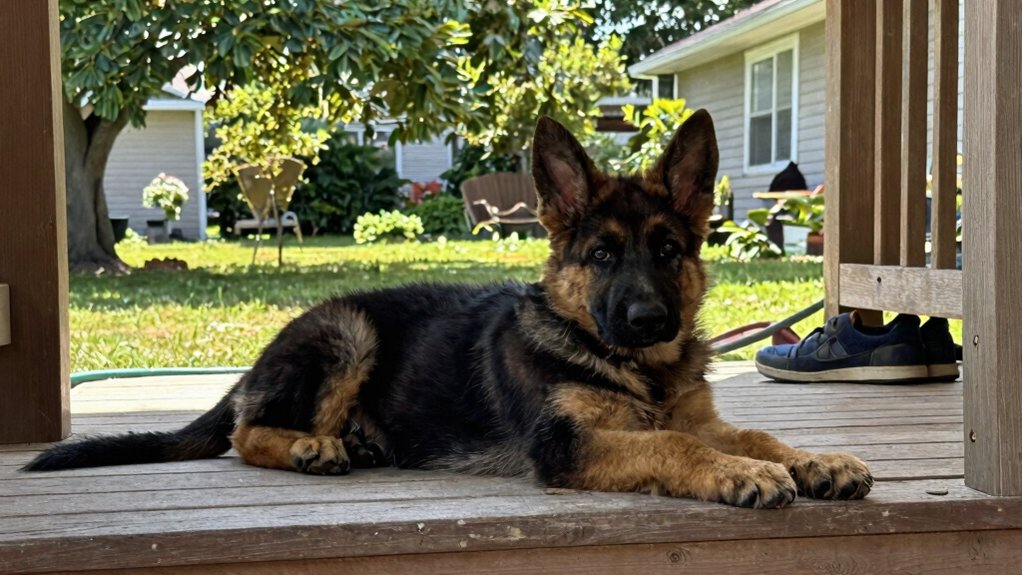
At 6 months, you can use rough weight ranges to sanity-check your German Shepherd’s progress: males usually land around 45–60 lb (20–27 kg), while females often weigh 38–50 lb (17–23 kg).
But don’t treat those numbers like strict targets, because genetics, food, and body condition can shift things a lot—some charts even show wider spreads like 38–66 lb for males and 28–52 lb for females. Diet is one factor owners often compare, and formulas from brands such as Purina Pro Plan are commonly considered for German Shepherds.
Instead, check that your pup is following a steady growth curve, and use a growth chart as guidance, not a pass/fail grade.
Typical Weight Ranges At 6 Months
By six months, your German Shepherd usually lands in the big-junior zone, not the adult finish line yet. Typical weights hover around 44–57 lb (20–26 kg), with modeled bands near 19.7–27.9 kg, or about 43–61 lb. Some charts put the “typical” point closer to 28 kg (about 61.6 lb).
In general, you’re looking at roughly 62–74% of adult weight now. That means growth continues, but more filling out than sudden expansion. Weigh your pup, then watch steady progress.
Use body-condition scoring, not exact numbers, and ask your vet if growth stalls or leaps.
Male Vs Female Weight Differences
Male and female German Shepherds don’t just look a little different at 6 months—you’ll usually see a real weight gap too.
Males weigh more then, and the gap stays in adulthood. At 6 months, male pups often hit about 65–74% of their expected adult weight, while females land around 58–65%.
That means a typical male may weigh roughly 50–55 lb, and a typical female about 40–48 lb.
Why? Males keep stronger monthly gains near 6 months, sometimes 10–15 lb per month from 3 to 6 months, not less.
Use these ranges as guides.
German Shepherd Height and Weight at 8 Months
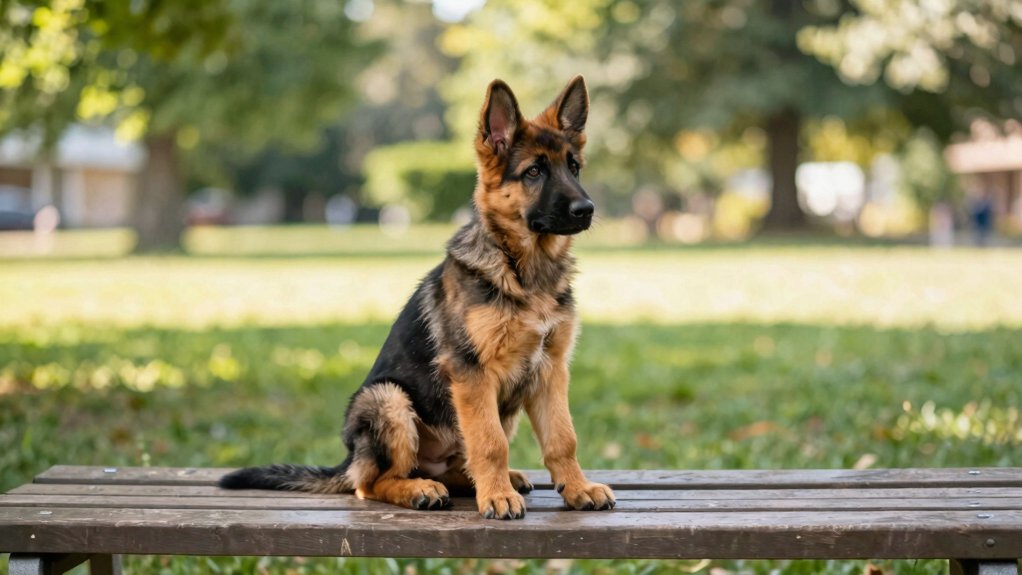
As your German Shepherd hits 8 months, you’ll usually see their size settle into a clear “almost there” stage—especially in height at the withers (the top of the shoulder) and in weight.
Most males weigh about 62–66 lb, and many females land around 53–57 lb. Some strong variation happens, so healthy pups may fall near 55–71 lb for males, or 41–58 lb for females.
For height, measure from the ground to the withers: males often reach 20–22 in, females 18–20 in.
Keep feeding steady, and track body condition monthly, too. Because nutritional needs shift across life stages, choosing an appropriate food helps support steady growth at this age.
German Shepherd Growth at 9–10 Months: Males Vs Females
Right now, your German Shepherd is in a steady stretch of growth at 9–10 months, and you’ll often notice clear differences between males and females.
At 9–10 months, German Shepherds grow steadily—males and females differ noticeably in size as development continues.
Males at 9 months commonly weigh 64–71 lb, and stand about 21–23 in at the shoulder. Females at 9 months often weigh 55–60 lb, at about 19–21 in.
By 10 months, males usually reach 66–73 lb, and females 57–62 lb.
Growth still happens, but slower—males may gain about 4 lb monthly, females about 3. About 85–90% of adult size is already there.
If your dog grows far more slowly or remains unusually small for its age, a rare condition such as canine dwarfism may be a factor worth discussing with your veterinarian.
What Are German Shepherds Like at 12 Months?
At 12 months, your male German Shepherd is often about 22–24 in tall at the shoulder and weighs roughly 71–79 lb, while your female is usually around 20–22 in and about 60–64 lb.
You’ll notice growth slows now, but your pup’s height is near adult size, and the chest and muscles start filling out through about 16–18 months.
Expect big adolescent energy, quick learning, and “testy” moments, so keep training short, fun, and focused while you protect still-growing joints with less intense jumping. Positive experiences during the socialization period in early puppyhood help your German Shepherd stay confident around new people, places, and sounds as an adult.
Typical Male Height And Weight
By 12 months, your male German Shepherd is usually close to his adult height, even though his body still has a bit of growing to do.
Expect about 24–26 inches at the withers, with only small changes from now to 18 months.
But weight keeps building.
Most males tip the scale around 70–80 pounds, or about 32–36 kg, reaching roughly 80–85% of adult weight.
You may see a range near 55–82 pounds, depending on bone size and growth speed.
Keep serving him good food and regular exercise.
He’s still maturing muscle, chest, and chest depth.
Typical Female Height And Weight
Now that your male is mostly in his adult height range, let’s talk about what you can expect from a female German Shepherd at the 12-month mark.
Many females stand about 20–22 inches tall at the withers, or 51–56 cm, close to adult height (22–24 inches, 56–61 cm).
For weight, expect roughly 42–59 lb, though some references place typical 12-month females around 60–66 lb (27–30 kg).
That usually means she’s at about 84–94% of mature weight. Keep her body condition steady with smart food portions.
Growth Milestones At 12 Months
Around the 12-month mark, your German Shepherd is usually close to adult height and hovering around about 90–95% of her or his final weight, which means you’ll often notice that “almost there” look.
At this age, expect roughly 22–24 in tall, and about 70–80 lb for many dogs.
Growth mostly shifts from height to build.
You’ll still see a slightly lanky frame, with narrower chest and shoulders, and muscle filling in slowly.
Long-bone plates still stay partly open until 18–24 months.
Meanwhile, high energy, independence, and boundary-testing can ramp up, so keep training and social work steady.
When Do German Shepherds Reach Full Adult Size?
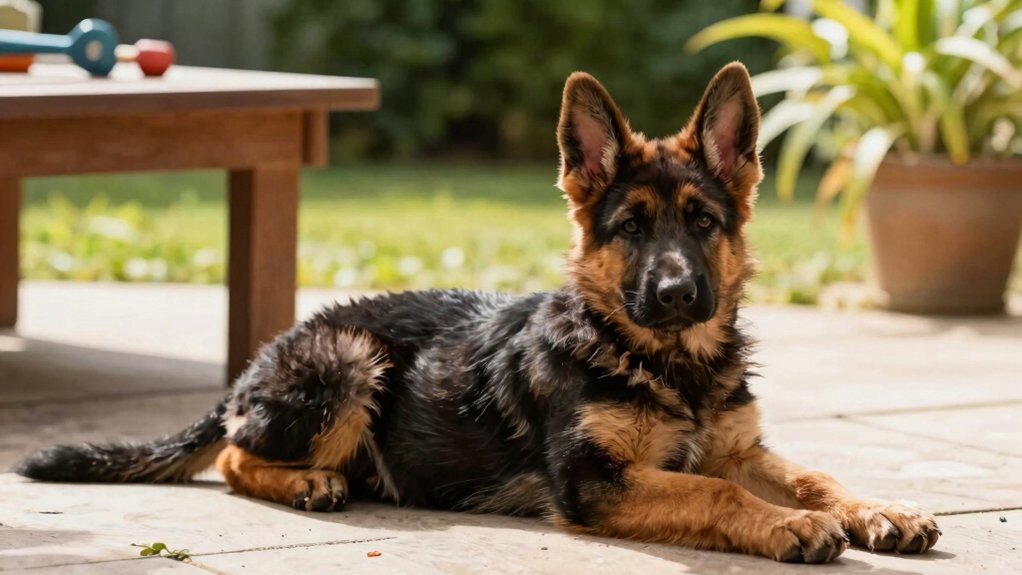
Most German Shepherds don’t fully “finish” until they’re about 2 to 3 years old, and that timeline depends on what part of growth you’re watching.
Most height growth mostly wraps up around 12–18 months.
Growth plates—tiny cartilage “growth spots” in long bones—typically close near 18 months.
After that, you’ll still see changes, but mostly in muscle, chest width, and body condition.
And while the scale may level off between 18 and 24 months, your dog may “fill out” until about 3 years.
If you’re serving your pup well, keep nutrition steady and exercise balanced.
Male vs Female Growth Differences You’ll Notice
You’ll usually notice that male German Shepherds grow faster and end up taller and heavier, while females stay a bit smaller as they mature.
For example, at 5–6 months males often weigh about 34–56 lb versus females’ 26–48 lb, and by 8–10 months you may see about 52–80 lb in males compared to 40–62 lb in females.
Even at adult size, males commonly stand around 24–26 inches and weigh 75–90 lb, while females are about 22–24 inches and 55–70 lb.
Male Growth Outpaces Females
Usually, male German Shepherds start outgrowing females earlier, and you can see it clearly once puppies hit the late puppy stage.
Around 4–6 months, males tip the scale first, often weighing more.
At 6 months, males average about 49–57 lb, while females sit nearer 44–49 lb.
From 7–8 months, the gap widens, with males commonly 57–66 lb, and females more in the mid‑40s to low‑50s.
By 9 months, males can run 57–78 lb versus 43–61 lb for females.
You’ll also notice taller, sturdier frames, with males trending higher by 7–9 months.
Females Stay Slightly Smaller
After you’ve noticed males pulling ahead earlier, the next thing you’ll see is that females stay a little smaller in both height and weight as they mature.
At full grown age, females usually stand about 22–24 inches at the shoulder, roughly 55–60 cm. Males are typically 24–26 inches.
Weight follows too: females often reach 50–70 pounds, while males commonly land 65–90 pounds.
You’ll also notice finer, lighter-boned frames on females, with a sleeker look.
In practice, that means you should plan feeding and activity by her needs, not by a male’s size.
How Should German Shepherd Proportions Compare (Length vs Height)?
When you look at a German Shepherd, aim for a shape that’s a little longer than it’s tall, so the body reads as a “rectangle,” not a square. Breed standards target about 10 parts body length to 8.5–9 parts height at the withers.
Height is measured from the highest point of the withers straight to the ground. Body length runs from the breastbone area to the rear edge of the pelvis.
You’ll get this look by balancing forequarters, back, and hindquarters. Not by forcing an overly long spine.
A steady chest and proper angulation help too.
Why Some German Shepherds Grow Faster or Slower
Growth doesn’t move at the exact same speed for every German Shepherd, even if they’re from the same litter. You’ll see differences because genetics set the ceiling and the pace.
Males usually grow taller by about 1–2 inches per month early on, while females often hit full body mass closer to 2 years.
Bloodline type matters too: show-line dogs often mature taller or bulkier, while working-line dogs tend to stay lean and compact.
Health status and the developmental environment also shift monthly growth.
Rarely, growth hormone deficiency can cause proportionate dwarfism.
If you’re helping them, track height, not just weight.
Nutrition and Exercise for Healthy Growth Ranges
To help your German Shepherd grow in a healthy, steady way, feed smart and move carefully—especially during puppyhood, when their body builds bones and muscle fast.
Choose a large-breed puppy diet with about 22–23% protein and 8.5%+ fat (dry matter), plus calcium near 0.8–1.8% DM and phosphorus 0.8–1.6% DM, with a 1:1 to 1.3–1.8:1 ratio.
Feed 3–4 smaller meals daily, and use portion control to keep a lean body.
Exercise 10–15 minutes twice daily at 8–12 weeks.
Switch to adult food around 15–18 months.
Limit treats.

Diamond Naturals Large Breed Puppy Lamb and Rice dry dog food; REAL PASTURE-RAISED LAMB is the #1 ingredient; specially formulated with carefully determined protein and mineral content to support the needs of LARGE BREED PUPPIES

Real chicken is the number 1 ingredient in this dry puppy food to help provide the protein he needs for strong, growing muscles, including a healthy heart

Veterinarians Recommend IAMS: IAMS large breed dog food recipe is made with real chicken as the #1 ingredient and contains no fillers or artificial flavors; ingredients are natural as defined by the Association of American Feed Control Officials (AAFCO)
Is My German Shepherd’s Size Off? What to Check and Measure?
But don’t guess—check your German Shepherd’s growth against charts, and compare both height and weight at key ages like 3, 6, and 12 months.
Measure height at the withers (the highest point of the shoulders) on a level floor, and weigh them on a calibrated scale, then log it so you can spot trends instead of one-day swings.
If their weight or height stays far above or below the expected range for more than a couple months, it’s time to talk to your vet and double-check body condition score (BCS 4–5 out of 9 means ribs are easy to feel with slight padding).
Check Growth Against Charts
First, pull up reputable German Shepherd growth charts for your dog’s sex, then compare your pup’s height and weight at the same ages—because “off” usually means something measurable, not a guess.
Check 8 weeks, 3 months, 6 months, and 12 months targets (for example, males 6 months are often ~20–23 in, 45–60 lb).
Next, judge growth rate. Most pups hit 80–90% adult weight by 9–10 months, and height often plateaus by 10–12 months.
Then use BCS, body condition score, to confirm under- or overweight status beyond scale numbers.
Measure Weight And Height
Start by measuring your German Shepherd’s height at the withers and body weight, because numbers don’t lie—so you can tell if your pup is truly “off” or just different.
Use a flat, firm, non-slip floor. Stand your dog square, legs straight, back level, head neutral. The withers are the highest shoulder ridge.
Mark where a level touches the wall, then measure floor to mark.
Next, weigh accurately on a calibrated clinic scale if possible.
At home, weigh yourself plus your dog, then subtract.
Track date and notes each month, especially during growth.
Small range differences can be normal.
Frequently Asked Questions
What Size German Shepherd Is Considered “small” for the Breed?
Like a pocket-sized crown, a German Shepherd counts as “small” when it’s below breed standards: males under 24 in at the withers (often under ~60–65 lb) and females under 22 in (often under ~45–50 lb).
When Do German Shepherds Start Looking Fully Grown, Visually?
You’ll usually see German Shepherds look fully grown between 18 and 24 months, when height stabilizes and their chest, shoulders, and hindquarters start filling out. Many reach a truly adult silhouette by about 2.5 years.
How Long Are German Shepherds at Full Adult Height?
At full adult height, you’ll see a German Shepherd measure about 35–40 inches (89–102 cm) from chest to rump. Like in medieval times, they carry a rectangular, longer-than-tall build—so you can serve confidently and accurately.
Do Neutering or Spaying Affect German Shepherd Growth Size?
Yes, neutering or spaying can affect German Shepherd growth size: early surgery delays growth-plate closure, often increasing adult height and limb length, but it can also alter joint alignment and raise joint-disorder risk later. Manage weight carefully after surgery.
How Can I Estimate Adult Weight From Puppy Weight Trends?
You can estimate adult weight by tracking puppy weight weekly, compare it to German Shepherd growth-chart percentages, or use (current lb ÷ age weeks) × 52. Then cross-check with vet body-condition scoring to avoid misleading numbers.