You’ll notice ten German Shepherd look‑alikes: Belgian Malinois, Dutch Shepherd, Belgian Tervuren, Belgian Groenendael, White Swiss Shepherd, East European Shepherd, Shiloh Shepherd, King Shepherd, Bohemian Shepherd, and Belgian Laekenois. Each shares the shepherd‑type build, erect ears, and double coat from a lineage. Sizes range from medium to giant; colors run from sable and black to white. Temperaments vary from workers to calm family protectors. Details follow, helping you choose the best fit for your home.
Swift Summary
- Dutch Shepherd, Belgian Tervuren, and Belgian Groenendael share the German Shepherd’s erect ears, wedge‑shaped head, and athletic build.
- White Swiss Shepherd and East European Shepherd match the Shepherd’s size and double coat, differing mainly in color and undercoat density.
- Bohemian Shepherd offers a compact, German Shepherd silhouette with a black‑tan coat, ideal for household living.
- Shiloh Shepherd and King Shepherd are giant‑sized German Shepherd look‑alikes, featuring gentle temperaments and dense double coats.
- All ten breeds possess high intelligence, alertness, and protective instincts, making them suitable for working, guard, or family roles.
Quick Decision Guide: Picking the Right German Shepherd Look‑Alike
Because you’ll often base your choice on appearance, temperament, and activity needs, this guide evaluates each German Shepherd look‑alike against those three criteria. The Dutch Shepherd retains a strong herding instinct, a trait that dates back to its origins as a farm‑yard guardian in the Netherlands.
You compare german shepherd like dogs, german shepherd like dog breed, german shepherd looking dog, small german shepherd looking dog, and german shepherd alternatives; Swiss Shepherd serves as german shepherd substitute. Before committing to any of them, owners should budget for ongoing expenses such as food, veterinary care, and grooming.
Identify what dog is similar to a german shepherd comparing dutch shepherd and belgian tervuren, dogs similar to german shepherds.
Record: what do german shepherd puppies look like, how does german shepherd puppy look like, what does blue german shepherd look like.
Verify health: what should german shepherd gums look like and what should german shepherd teeth look like.
Consider royal canin german shepherd alternative choosing alternative to german shepherd.
Belgian Malinois: High‑Drive Working Breed Similar to a German Shepherd
Originating in late‑1800s Belgium, the breed was selected for relentless endurance, rapid response, and precise obedience, traits that now power police and military deployments. You should expect extreme energy; at least two vigorous hours of running, agility, or task‑focused training daily. On trips, a dog travel bag keeps water, bowls, and leashes organized so that training sessions and exercise breaks stay on schedule.
Dutch Shepherd: Versatile Brindle Counterpart for Active Families
You’ll notice the Dutch Shepherd’s brindle coat shifts from short to rough textures, creating a striped silhouette that mirrors a German Shepherd while preserving distinct genetic markers.
Its high‑energy level demands structured physical and cognitive tasks, making the breed adaptable to varied active‑family schedules. Because energetic dogs can wander quickly during outdoor training, many owners pair them with a GPS dog collar that tracks their location in real time.
Consequently, the combination of coat versatility and stamina equips you to match the dog’s work drive with appropriate sport or utility activities.
The breed’s notable success in law enforcement and protection sports further highlights its versatility.
Brindle Coat Versatility
When you evaluate the Dutch Shepherd’s brindle coat versatility, you’ll find three genetically distinct coat varieties—short, long and rough—each forming a double coat with a woolly underlayer.
The short hair presents a hard, close‑fitting layer that covers the ruff, breeches, and tail plume while allowing the woolly undercoat to retain heat.
The long hair extends in straight, harsh strands, adding abundant tail feathering and leg breeches that enhance insulation during prolonged field work.
The rough hair consists of dense, harsh, tousled fibers that obscure the stripe pattern but deliver superior abrasion resistance for service terrain.
Grooming demands match coat type: short coats require de‑shedding times annually, long coats need weekly brushing to prevent matting, and rough coats benefit from biannual stripping plus bi‑monthly brushing.
High Energy Adaptability
If you have an active family, you’ll find the Dutch Shepherd’s high‑energy adaptability aligns perfectly with daily outdoor pursuits.
You must allocate 90 minutes to two hours of structured exercise daily, combining brisk walks, runs, and vigorous play.
A puppy needs about five minutes of controlled activity per month of age to protect joints.
Supplement physical work with mental tasks—obstacle drills, scent detection, puzzle feeders—because cognitive load reduces fatigue.
Reward‑based reinforcement channels the breed’s herding drive into obedience rather than suppression.
Implement two short training blocks, each 10‑15 minutes, interspersed with play and rest.
Secure a fenced enclosure and supervise outdoor freedom to mitigate chase instinct.
Consistent family involvement, clear rules, and varied terrain keep the Dutch Shepherd calm indoors while serving as an active, reliable aide.
Belgian Tervuren: The Long‑Coated Twin of a German Shepherd
Because the Belgian Tervuren descends from the 19‑century Belgian Sheepdog, it shares the shepherd lineage that gave rise to the German Shepherd.
You’ll notice a medium‑sized frame, 22‑26 inches tall and 40‑65 pounds, with a deep chest and square posture. The head is long, ears erect, and a black mask overlays a fawn‑russet coat; a dense, straight double coat forms a ruff around the neck, giving the appearance of a long‑coated twin to the German Shepherd. Its dense double coat sheds heavily, so protective car covers can help keep vehicle seats clean from dog hair and dirt.
Temperamentally, the Tervuren is highly intelligent, alert, and protective, excelling in herding, search‑and‑rescue, and service tasks. Its stamina and agility enable sustained work, while its vocal alertness requires early training to prevent excessive barking.
You can rely on its devotion and territorial awareness to safeguard people and property.
Belgian Groenendael: Black‑Coated German Shepherd Cousin With Elegant Hair
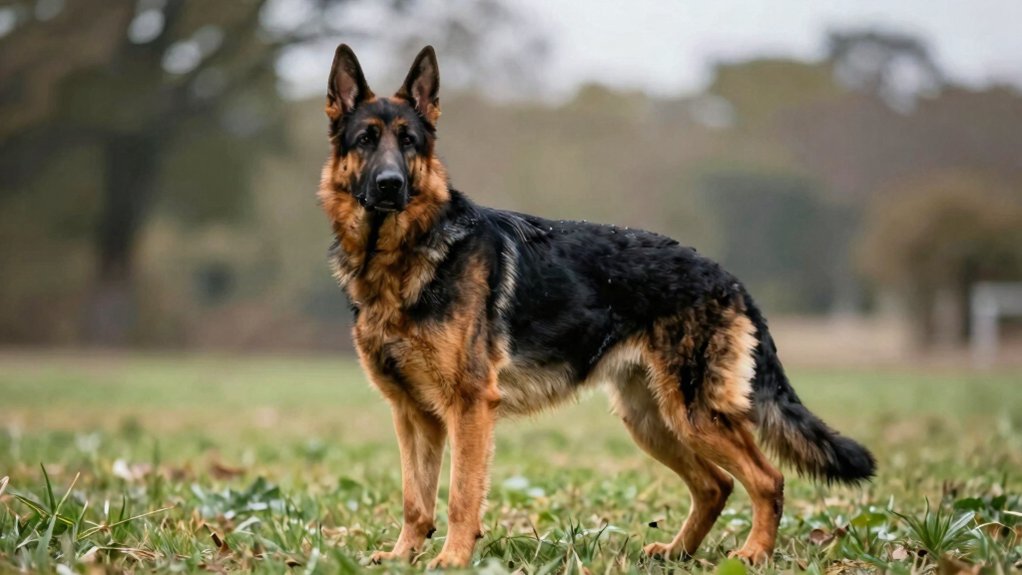
Although the Belgian Groenendael belongs to the Belgian Shepherd family, you’ll notice its solid black double coat and square, medium‑sized frame make it a distinct cousin of the German Shepherd. Like German Shepherds, Groenendaels are often bred in working lines that prioritize drive and function over the more refined appearance favored in show lines.
You recognize its origins at Château de Groenendael, where breeders selected long‑haired, black‑coated stock to create a medium‑sized, double‑coated working sheepdog.
Males stand 58–66 cm, females 56–62 cm, weighing 20–30 kg, with a square silhouette and athletic musculature.
The coat combines a medium‑harsh outer layer with a dense undercoat, short on the head and legs, feathered on the tail.
Temperamentally, you’ll find a highly intelligent, energetic, and protective dog that bonds tightly to its handler.
Structured training channels its drive into guard, search, and service tasks, while consistent socialization prevents nervousness.
You note minimal chest or paw white is permitted, and mature dogs may show muzzle frosting.
Their herding drive lets you employ them in livestock control or agility, provided you give two hours exercise and stimulation.
Bohemian Shepherd: Small‑Scale German Shepherd Look‑Alike for Home Life
While its lineage traces back to the Chodsko region of western Bohemia, the Bohemian Shepherd presents a compact, German Shepherd-like silhouette that fits comfortably into home life. You’ll notice its medium frame measures 52–55 cm in males and 49–52 cm in females, weighing 19–27 kg and 17–24 kg respectively.
The rectangular body, dense double coat, and black-tan markings replicate the German Shepherd outline while remaining lighter for indoor activity.
Temperamentally, the breed exhibits high intelligence, steady nerves, and a docile, watchful disposition, enabling rapid obedience training and reliable watchdog behavior. Because of its biddable nature, you can employ it as a service, therapy, or scent-tracking aide.
Health protocols mandate hip, elbow, and ocular screenings; lifespan averages 12–15 years, supporting long-term companionship. You’ll appreciate its adaptability in both work and home. Households that want to keep this active breed separated from certain areas often rely on hardware-mounted dog gates for a secure, permanent barrier.
White Swiss Shepherd: The All‑White German Shepherd Relative
You’ll find that the White Swiss Shepherd originated from white‑coated German Shepherd lines exported to North America before being re‑established in Switzerland and recognized as a distinct breed in 1991.
You’ll note its medium‑to‑large, rectangular build (53–66 cm at the withers, 25–40 kg) with a uniform white double coat, wedge‑shaped head, and erect triangular ears, mirroring the German Shepherd’s conformation apart from pigmentation.
You’ll also see that its temperament combines high intelligence, balanced energy, and strong social bonding, making it suitable for both working roles and family life. Its gentle, companionable disposition is comparable to that of the American Alsatian, a wolf-like breed known for its suitability as a devoted family companion.
Origins and Breed History
Since the early 20 century, white‑coated German Shepherds have been selectively bred outside Germany, creating the lineage that later became the White Swiss Shepherd Dog (Berger Blanc Suisse). You’ll find that this line descends from North American White Shepherds, which trace back to white‑coated purebred German Shepherds carrying a recessive color allele linked to the foundational dog Greif.
In 1917 the AKC recorded the strain, while Germany excluded white coloration in 1933, prompting dedicated foreign programs. Beginning in the 1970s you imported the seminal male Lobo (1966) to Switzerland, where Agatha Burch expanded the gene pool with additional imports.
Swiss cynologists then classified the population as Berger Blanc Suisse, preserving herding aptitude, stable temperament, and uniform white coat within an independent studbook to serve working communities.
Physical Traits and Coat
When you assess a White Swiss Shepherd, you’ll see a medium‑sized shepherd dog whose males stand 58–66 cm and females 53–61 cm at the withers. Its weight ranges from 30–40 kg and 25–35 kg respectively.
Its body exhibits a slightly longer than tall frame, a 12:10 length‑to‑height ratio, and a powerful, well‑muscled build with balanced proportions.
The head is wedge‑shaped, flat‑skulled, bearing erect triangular ears and almond‑shaped dark eyes. A black nose and dark eye rims contrast sharply with the pure white coat.
The double coat comprises a dense undercoat and a medium‑or long‑length outer layer that’s hard, straight, and slightly wavy. Shedding is moderate to heavy year‑round; frequent brushing is required to preserve insulation and coat integrity.
Tail reaches hock, feathered, aiding balanced, efficient movement gait.
Temperament and Family Fit
Beyond its striking white coat, the White Swiss Shepherd shows a lively yet balanced temperament that aligns best with active, structured households. You’ll find that its core disposition combines high social competence with steady vigilance, avoiding nervousness or unprovoked aggression.
The breed bonds like a “velcro” dog, seeking constant proximity to its primary handler and reacting poorly to prolonged isolation, so you must provide regular shared activities and predictable routines.
With older children, it remains patient and protective, yet it requires supervised interaction and consistent training to manage innate herding impulses.
When introduced properly, the dog greets strangers courteously, adapts to gatherings, and interacts calmly with other pets, provided you address prey drive through targeted guidance.
Your commitment guarantees the dog thrives in service.
East European Shepherd: Cold‑Weather Variant of the German Shepherd
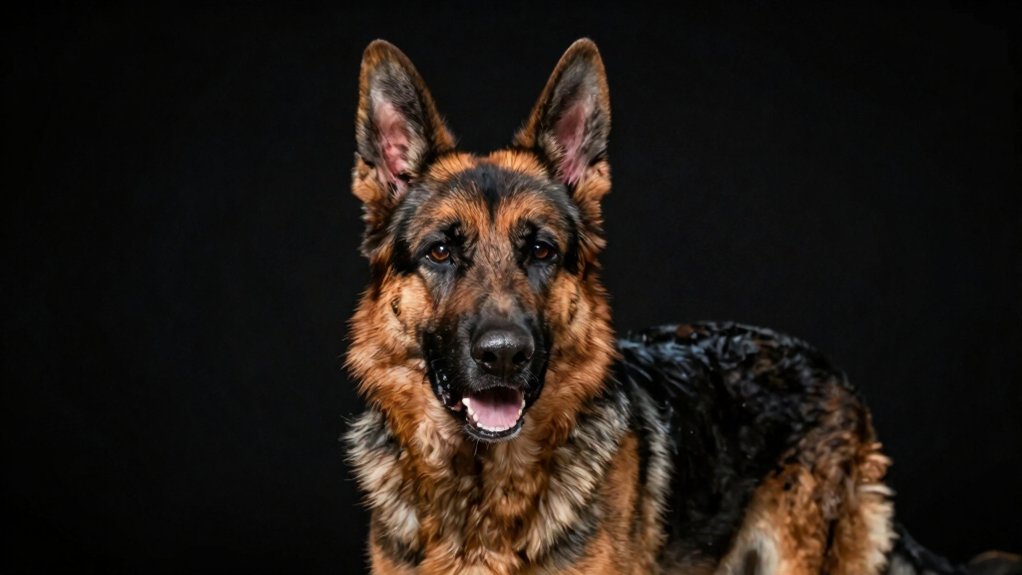
Because it was bred from German Shepherd stock imported to the Ukrainian SSR in the 1920s, the East European Shepherd (Vostochno Evropeiskaya Ovcharka) displays a denser double coat, larger, more muscular build, and markedly higher cold tolerance than its Western counterpart.
You’ll notice today that the coat consists of a thick underlayer and harsh guard hairs, providing insulation against sub-zero winds. The breed standard approved in 1955 requires a robust skeletal frame, well-developed dry musculature, and a straight topline, all of which enhance load-bearing capacity.
Selection pressure favored stable temperament, controlled defensiveness, and heightened alertness, making the dog an effective guard in harsh climates. You can expect rapid obedience learning, reliable tracking, and consistent patrol performance, attributes that serve military, border, and police units. for service. Because these large working dogs need regular access to water on long journeys, a portable dog bowl is a practical item for feeding and watering them while traveling.
Shiloh Shepherd: Gentle‑Giant German Shepherd Look‑Alike
You’ll notice that the Shiloh Shepherd stands 26–30 inches at the shoulder and can weigh up to 130 lb, making it markedly larger than typical German Shepherds.
You’ll also observe its calm, confident disposition, which translates into steady behavior rather than high-energy drive.
Because you prioritize a family-friendly companion, the breed’s low drive and gentle loyalty make it well-suited for households seeking a protective yet relaxed giant. Readers interested in a similar giant breed can also learn about the King Shepherd’s origins, size, temperament, and care needs, which set it apart from German Shepherds.
Massive Size, Calm Temperament
Although the Shiloh Shepherd stands 66–81 cm at the shoulder and can weigh 36–73 kg, its massive frame is paired with a deliberately calm disposition. You’ll notice that adult males measure 71–76 cm (28–30 in) at the withers and females 66–71 cm, while body length averages 112–124 cm, yielding a bone structure.
Typical weight spans 36–59 kg for females and 45–54 kg for males, with outliers reaching 73 kg. Muscular development is reinforced by a straighter back, providing a stable sagittal plane.
Breeders selected for low‑drive neurochemistry, resulting in steady, predictable reactions to stimuli. You’ll observe a pronounced gentle watchdog response: deep bark and upright stance deter intruders, yet the dog remains non‑aggressive and seeks calm social contact after alerting.
Energy expenditure remains moderate, permitting focused service tasks without chronic hyperactivity for guardians.
Family Friendly, Low Drive
While many shepherd‑type breeds demand high activity, the Shiloh Shepherd combines a gentle, low‑drive temperament with a strong family orientation. You’ll notice the dog forms attachment to your household, seeking proximity and displaying steady affection.
Its social, human‑focused disposition reduces aggression while preserving protective instincts, making it a guardian for children. When you introduce the breed to other pets, its low territoriality supports harmonious coexistence.
Exercise requirements remain modest: two 20‑minute walks and free play in a fenced yard satisfy its medium‑to‑low energy profile. Your routine should include at least 60 minutes daily activity, allowing mental engagement without triggering excessive arousal.
Because the breed maintains steady affection and resilience, you can train it for therapy or assistance tasks, enhancing community welfare and supporting others.
King Shepherd: Calm, Powerful German Shepherd Hybrid
Because breeders combined German Shepherd, Shiloh Shepherd, Great Pyrenees, and Alaskan Malamute genetics, the King Shepherd is classified as a giant‑sized designer hybrid that emphasizes robust structure, working ability, and a steady temperament.
You’ll notice a height of 25–31 inches and weight ranging 70–150 pounds, with males meeting a minimum of 27 inches and 110 pounds. The head is large, ears erect, eyes almond‑shaped and coat dense, double‑layered, ranging sable to black.
Temperament combines calm confidence with guardian instincts; the dog remains loyal, protective, and tolerant of children when socialized.
Intelligence and trainability enable service, therapy, and herding tasks. Regular moderate exercise sustains muscular health, while routine veterinary screening mitigates breed‑specific orthopedic risks.
You can rely on its steady presence to support community outreach and emergency response initiatives. The German Shepherd side of its heritage traces back to Max von Stephanitz, who shaped the breed from sheep-herding dogs into the versatile working dog seen today.
Frequently Asked Questions
Can German Shepherd Look‑Alikes Be Registered as Purebred German Shepherds?
By sheer coincidence, you might think look‑alikes qualify, but you can’t register them as purebred German Shepherds without verifiable AKC lineage; only mixed‑breed or Canine Partners options remain available for participation in sports and shows.
Do These Breeds Share the Same Legal Breed Restrictions as German Shepherds?
You won’t encounter identical legal restrictions for Belgian Malinois or Dutch Shepherd; they often face stricter or varied regulations, while German Shepherds generally remain unrestricted under most national breed legislation in your specific locality today.
How Do Insurance Premiums Compare for German Shepherd Look‑Alikes Versus German Shepherds?
Like a metronome, you’ll find premiums for German Shepherd look‑alikes typically match those for pure German Shepherds, differing only by a few dollars when insurers apply breed‑neutral underwriting, unless state bans prohibit breed‑rating entire policy.
Are There Specific Travel Regulations for These Shepherd‑Type Breeds?
Yes, you’ve got to follow airline‑specific breed restrictions, provide documented health certificates, guarantee microchip implantation, present rabies vaccination, and submit behavior assessments or permits where countries classify shepherd‑type dogs as controlled before travel and compliance.
Do German Shepherd Look‑Alikes Have Similar Lifespan Expectations as the Original Breed?
You’ll see that German Shepherd look‑alikes generally outlive the original, with Belgian and Dutch Shepherds averaging two to four extra years—median ages about 13.4 versus 10–11—so you should tailor health plans for each patient accordingly.