Yes, German Shepherds can be great with kids, cats, and other dogs, but you’ve got to manage it. Start training early, practice calm “sit/down/stay” 5–10 minutes daily, and never leave a toddler or infant alone with your dog. For cats, use scent swaps and brief, quiet gate or leash meetings to respect prey drive. With other dogs, do “smart” neutral introductions on a loose 6‑ft leash, then watch for whale eye, stiffening, or growling. Keep going to learn exact setup and red flags.
Swift Summary
- German Shepherds are often friendly with kids, but supervision is essential due to size, energy, and protective instincts.
- Teach calm manners early (sit/down/stay, settle mat) and practice short, positive greetings to prevent jumping and accidental knocks.
- Watch for stress signals like whale eye, freezing, or growling, and stop interactions immediately to prevent escalation.
- With cats, prey drive can trigger chasing; manage with controlled introductions, barriers, and safe cat perches to reduce risk.
- With other dogs, outcomes vary; prioritize early, structured “smart dog meetings” on neutral ground for reliable, calm socialization.
Are German Shepherds Good With Kids?
Are german shepherds friendly? Often, yes—when you train and socialize early, and you supervise closely.
Add 1 sentence: Because German Shepherds are smart and need a job, they do best with structured activities that also support calm behavior around children.
You’ll serve your kids best by starting puppy introductions at 8–12 weeks, then rehearsing calm manners daily, for 5–10 minutes.
Why are german shepherds good with kids? They’re loyal and active, but size and energy can knock over toddlers. Watch for early warning signs of fear-based aggression, such as stiffening, growling, or lip-lifting, since these often signal a trigger that needs management or training before it escalates.
Do german shepherd like kids? Most do, especially older, steady kids.
If my german shepherd is too friendly with strangers, manage greetings fast. Consistent exercise helps too.
What Makes German Shepherds Kid-Safe at Home?
You’ll get kid-safe results when your German Shepherd forms a loyal, steady protective bond, and that protective instinct only matters when you guide it with clear home boundaries. Start early, during the first months, by doing calm, positive meet-and-greets with children, using slow approaches, allowing sniffing, and rewarding gentle behavior—think treats on a flat palm. Because they’re known for intelligence, alertness, and loyalty, German Shepherds typically learn household expectations quickly. But even with training and the right temperament, you still supervise, and you set simple rules for greetings, no jumping, and calm handling so play stays gentle, not wild. Many German Shepherds can learn to swim safely, so a gradual, positive water introduction can become another fun activity to share with children, as long as an adult is always watching nearby.
Loyal Protective Family Bonding
Because German Shepherds bond deeply with their people, they often feel most “at home” when the family is close by, not when they’re stuck alone in another room. You’ll notice strong loyalty and a protective calm that centers on your household. And many will shadow children, alerting you when strangers approach. Their herding/work background builds attachment to a core group, so they work hard for cues you give familiar handlers. Their intelligence and alert instincts also help them detect and react to potential threats, especially around unfamiliar people. But you still supervise. With a dog’s size and strength, keep kids within adult view, and don’t leave them alone together—especially when excitement runs high.
Early Socialization With Children
Early socialization with children is one of the biggest keys to helping a German Shepherd feel safe, calm, and friendly at home.
Aim for the 3–14 week window, with extra focus at 6–8 weeks.
You’re building positive “early learning,” before the fear period around 8–10 weeks.
Start with one polite child in a quiet space.
Keep it high-quality, not overwhelming.
Use treats and play for 100+ positive interactions by 16 weeks.
Let your puppy choose to approach, then retreat.
Gradually add different ages, looks, and baby sounds for confidence.
Teach gentle touch too.
Supervised Calm Interaction Rules
Once your German Shepherd has had those early, positive meet-and-greet moments with kids, you’ll still want clear boundaries for everyday life at home.
You supervise every interaction, start to finish, and never leave a toddler or infant alone with your dog.
Use baby gates or closed doors, and keep sessions short, calm, like 2–5 minutes at first.
Watch body language.
If you see stiff posture, growling, lip curling, or the dog trying to move away, you stop the play right then.
Teach kids gentle petting on the neck or chest, slow touch, not faces or tails.
And never hug, chase, or bother sleeping, eating, or chewing time.
Red Flags: German Shepherd Stress With Kids
During child play, watch closely for early warning signs like head turning away, whale eye (seeing lots of white), or sudden yawns and lip-licking—those are “self-soothing” cues that your dog’s stress is starting to rise.
If the fun keeps going and you notice stiffening, freezing, a closed mouth after panting, or growling, that’s escalation from over‑stimulation, and you should end the interaction right then, before it gets worse. Keep in mind that excessive panting doesn’t always signal stress, since German Shepherds pant normally after play or in warm weather, so judge it alongside the other signs.
Keep a quick rule: if you see two escalating signs within 30–60 seconds, you separate them calmly, reset, and try again only when your German Shepherd stays loose, soft, and relaxed.
Warning Signs During Child Play
When kids play with your German Shepherd, you should watch closely, because stress shows up fast and it rarely improves by “trying harder.” If you notice avoidance or withdrawal—like your dog scooting away, hiding behind furniture, or leaving the room—you’re already seeing a red flag.
Next, scan for “whale eye” (visible whites at the side), hard staring, and a stiff, frozen body.
Watch for a tight, closed mouth, lip licking, repeated yawns, and tail tucked or low.
Listen for growling, whining, barking, or air-snaps.
If your dog cowers, pins ears back, or gets into a crate, stop play and give an adult-managed break.
Escalation From Overstimulation Cues
If your German Shepherd seems okay at first, overstimulation can still sneak in fast, especially during loud, touchy, or bouncy child play.
You’re seeing trigger stacking, when noise, sudden movement, and physical contact pile up.
Watch within seconds.
Early cues include yawning when not tired, repeated lip or nose licking, blinking, and turning away.
Then look for whale eye, pinned ears, and a tucked tail.
As it escalates, your dog may freeze, stare hard, raise hackles, and breathe fast.
Next, you might see a stiff crouch, creeping backward, or showing teeth.
Stop play now, create space, and help them decompress.
Teach Kids How to Pet a German Shepherd
Before your child ever pets a German Shepherd, ask the owner for permission, and then keep close supervision so you’re right there the whole time.
Teach your child to walk slowly from the front or a slight angle, never from behind.
Let the dog see and sniff a relaxed hand, palm flat or fingers curled low.
Pet only the shoulders, back, sides, or chest.
Keep strokes gentle, slow, and brief—about 3 seconds—then pause to check comfort.
Stop immediately if the dog backs away, stiffens, or growls.
Avoid faces, hugging, and rough grabbing.
Never pet during eating or play.
German Shepherds are intelligent, protective dogs that need experienced handling and a strong commitment from their owners, so children should approach only when the owner is confident in managing the dog.
Training Cues: Calm German Shepherds Around Kids
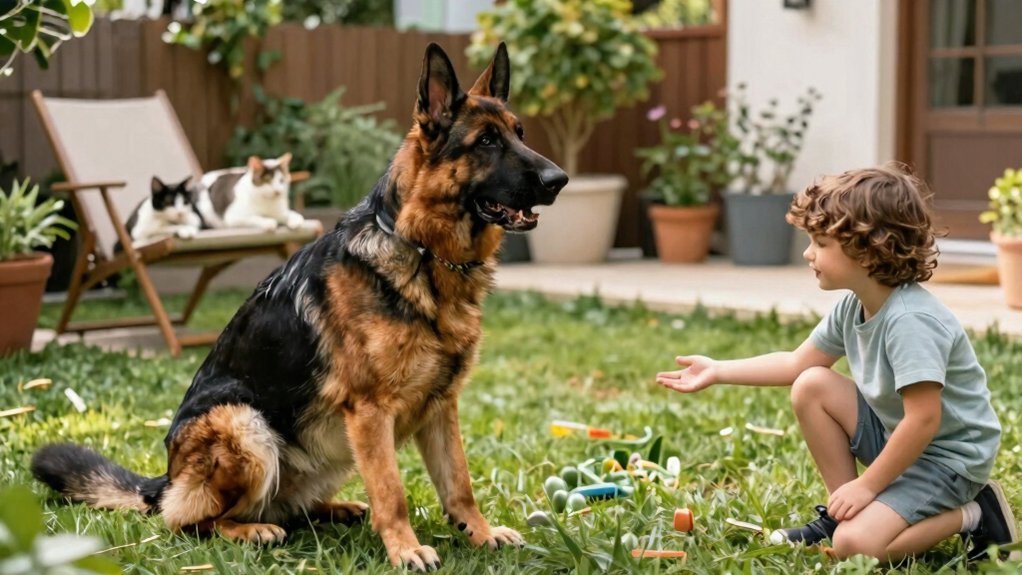
Start with a simple goal: teach your German Shepherd calm choices before kids ever get close, so your dog feels safe and knows what to do. Their intelligence and drive make German Shepherds quick learners when training is consistent.
Build solid sit, down, and stay cues first, practicing near play areas, toys, and mealtimes, to prevent jumping or blocking.
Next, use an ignore cue for dropped toys or kid items, this lowers resource guarding and accidental grabbing.
Teach reliable recall from rooms and outdoors to stop chasing.
Add a nose-to-palm hand target to redirect gently.
Finally, train a settle mat cue for relaxed lying, soft eyes, and calm chewing while kids play nearby.
Keep supervision always.
Can German Shepherds Live With Cats?
Yes, you can often get a German Shepherd and a cat to live together, but you have to respect that strong prey drive—your dog may instinctively chase fast moving targets. Because German Shepherds were bred for herding and guarding, they can show prey drive that leads to chasing small animals, so this instinct should be managed rather than ignored.
Start with controlled introductions: keep them fully separated at first, then do scent-swaps for a few days, use a baby gate or crate for short supervised meetings (5–10 minutes), and only increase time when there’s zero stalking or chasing.
With barriers, training, and clear safe spaces like tall cat perches, you lower stress for both of them and set the whole home up for calm success.
Understand Strong Prey Drive
German Shepherds *can* live with cats, but strong prey drive is the big question you have to face up front. You need to know this: their working, herding background often builds high prey drive, which means the urge to chase “small running things.”
Fast moves and sudden gestures can trigger barking, tail/heel nipping, and cat-staring. But intensity varies a lot—some dogs show mild interest, others fixate and act predatory.
Early cat socialization, calm temperament, and mature age help, while prior negative experiences and high energy raise risk. Plan obedience, use rewards, and get trainer help if needed.
Use Controlled Cat Introductions
Before you let your German Shepherd and cat meet in person, you’ll want to set them up for a calm, controlled first impression, because prey drive can switch on fast.
First, schedule a vet check for both, then keep the new pet in one room for several days.
Use gates early, and give separate food, water, litter, and beds.
Next, swap scents with cloths on cat face and dog body, rotating spaces for 3–4 days or longer.
Then do short, quiet leash meetings in a calm room, cat elevated for escape.
Repeat daily, reward calm focus, and separate immediately if chasing starts.
Manage With Barriers And Training
Once you decide to try living together, you’ll want to manage the first weeks with barriers and training, because German Shepherds can switch into “chase mode” fast.
Start with separate zones. Give your cat a dog-free room, and block access with baby gates, doors, or a crate behind a closed door when you’re away.
Use double barriers for safety.
Let cat escape, and keep hiding places.
When the dog is near, keep them leashed, then redirect calm with rewards.
Do short, frequent sit, stay, and focus sessions at the barrier for several days to one week.
Why German Shepherds Chase Cats (Herder Instinct)?
Behind that “why are they doing this?!” moment is your German Shepherd’s herding instinct, and it can be pretty automatic.
You’ll notice them stalking, rushing, or nipping at heels when cats move like “livestock.”
Add a strong prey drive, the urge to chase and capture fast things, and a darting cat triggers instant focus.
Quick hallway sprints, squeaky meows, and tail flicks can look like prey cues.
Because canine behavior is shaped by genetics, early experience, and training rather than breed alone, a chasing German Shepherd is best understood through its individual history instead of breed myths.
If your pup lacks early cat socialization and you don’t correct the chase, the behavior becomes self-rewarding.
Your job is to prevent rehearsal, not blame the dog.
Intro Plan: German Shepherd Meets Your Cat
Start by setting separate rooms with full resources, and a cat safe room the dog can’t enter. Keep these separation periods brief and pleasant, because a German Shepherd left alone for long stretches can develop separation anxiety.
Keep doors closed, so the cat won’t bolt.
Swap scents first, using two clean cloths on multiple days, then do short, quiet visual checks through a glass or screen.
During those minutes, leash the dog, keep it on “sit,” “stay,” and “leave it,” and reward calm focus.
Stop instantly at barking or lunging.
Only expand access after neutral body language stays steady for weeks.
Manage German Shepherd–Cat Homes With Barriers
Use baby gates in doorways, then keep your German Shepherd on a leash during first meetings, so you can stop lunging or jumping fast. Choose a dog gate that fits your doorway, since many models are designed to restrict access to rooms, areas, and parts of the home.
Reward calm “near the barrier” behavior with treats, and train quick redirect commands (a simple cue that tells your dog what to do instead, like “look” or “sit”) so attention stays on you, not the cat.
Start with full separation for about a week, do 1–2 supervised visual check-ins each day, and only expand shared space after repeated calm moments—trust me, this routine makes everyone feel safer.
Use Baby Gates And Leashes
In a German Shepherd–cat home, baby gates and leashes work like your calm, practical traffic signs, so you can manage access and lower stress for both pets.
Use gates to create separate zones, let your cat retreat behind a gate, and block dog entry at doorways and stairs.
Then add a leash on your German Shepherd for early cat introductions.
Keep the leash loose, so you don’t pass tension to your dog.
Do short, calm viewing through the gate, 10–15 minutes, several times daily.
For first in-room meetings, leash your dog and let your cat choose distance.
Keep this for weeks until calm stays steady.
Train Calm Redirects Toward Cats
Barriers do more than block access, they give you a safe way to teach your German Shepherd how to act around your cat. Start with initial separation using closed doors or crates, plus scent swaps, so neither feels overwhelmed.
Add brief door-crack meetings with a stop, then use solid doors or mesh screens whenever you supervise.
Practice calm body language, soft eyes, relaxed stance, and reward it.
When your dog turns away, treat fast and often.
Feed both on opposite sides.
Avoid corrections, because fear can grow.
Teach “watch,” “leave it,” and “stay,” in tiny, frequent sessions, a few minutes each, ending while everyone’s calm.
Can German Shepherds Get Along With Other Dogs?
German Shepherds can sometimes get along with other dogs, but you’ve got to think about their personality and your setup.
Many people rate them around 3/5 for “good with other dogs,” so expect selective matches, not instant friendships.
Best odds come when you start early socialization, with calm, diverse dogs, and you supervise each meeting closely.
But German Shepherds often feel protective and a bit territorial, so they may guard home spaces, people, or toys. Dogs from working line German Shepherds often show stronger guarding instincts and drive than dogs from show lines, so temperament can vary noticeably even within the same breed.
If a dog is pushy, assertiveness can turn into conflict.
Use consistent training, impulse control, and introduce slowly, step by step.
Socialize a German Shepherd With Smart Dog Meetings
To help your German Shepherd feel safe and friendly around other animals, you want “smart dog meetings,” not random run-ins.
Start in the 3–16 week window, with weekly puppy play hours in a German Shepherd club.
Keep sessions small: two unfamiliar dogs plus one calm, experienced helper.
Meet in neutral spaces like a quiet park or yard, so your dog doesn’t guard.
Go step-by-step, let each dog explore first, then allow brief play.
Watch body language: soft posture, loose wag, and soft eyes mean “go.”
Tucked tail, stiff staring, or cowering mean “pause.”
You guide the pace for everyone’s comfort.
First Leashed Greetings: Prevent German Shepherd Over-Arousal

When you plan your first leashed dog greeting, you’re really setting the tone for the whole relationship.
Start by choosing safe contexts, like neutral territory, not home turf, and skip dogs with known leash reactivity.
Pick a calm, sociable partner of similar size.
Use a non-retractable 6-foot leash and keep it loose, never tight.
Ask for a sit cue, then walk in parallel at a comfortable distance, until you find a sub-threshold gap—alert, but no frantic behavior.
Let nose sniffing last only 3–5 seconds, then cue cheerful departure.
Repeat short greeting–walk–greeting cycles.
Signs Your German Shepherd Dislikes Another Dog
If your German Shepherd dislikes another dog, you’ll usually spot it in their stress signals fast—watch for stiffening (freezing in place), a hard stare, or a tail and hackles that rise.
And if they start growling, barking in sharp bursts, or trying to avoid, you should treat it as a real “back off” message, not normal play.
But right then, redirect with a training cue like “sit” or “look,” and reward within 1–2 seconds while the other dog is still at a safe distance.
Body Language Stress Signals
Watch your German Shepherd’s body language closely around other dogs, because stress often shows up before any growling or snapping.
Check eyes first: look for “whale eye” with sclera showing, dilated dark “glassy” pupils, furrowed brows, squinting, or a hard stare.
Then scan ears and tail: ears pinned back, upright ears locked forward, tail tucked low, or high short, quick wags.
Next, watch the mouth: tight closed mouth, sudden shallow panting, drooling, or a tense lip “grimace.”
In posture, notice cowering, low hesitant steps, weight shifting back, pacing, or trembling.
Growling, Stiffening, Avoidance
Growling, stiffening, and avoidance are some of the clearest “this isn’t fun for me” signs your German Shepherd gives when another dog gets too close.
When you hear a low, prolonged growl, take it as a warning, not play.
If the growl comes with a hard stare, forward ears, and a rigid, frozen body, you should calmly add distance.
A stiff, high tail with shaking, or a sudden freeze near the other dog, raises bite risk fast.
Also watch withdrawal: head turns away, hiding behind you, arcing around, or leaving when that dog appears.
These patterns mean dislike, not normal fun.
Redirect With Training Cues
Once you spot early stress signs—lip licking, a tight stare, ears pinned back, or tail held low—start redirecting right away, before your German Shepherd “locks on” to the other dog.
Move to more space first, stay calm, and guide your pup with a “watch me” cue, using high-value treats.
If arousal rises, use “find it” by scattering food on the ground, so their nose goes to work instead of fixating.
Try “this way” or a gentle turn, then reward the moment they follow.
Practice “sit” and a mat “settle” in low-distraction spots, so you’re ready.
Impulse-Control Exercises for German Shepherds
Impulse-control training helps your German Shepherd pause, think, and make better choices—especially when excitement runs high.
Impulse-control training teaches your German Shepherd to pause and think, making better choices when excitement runs high.
Start with food and door rituals.
Ask for “sit,” lower the bowl, then raise it if your dog breaks position.
Use “yes” to mark the good moment, and “okay” to release access.
Practice at indoor doors too, opening only when your dog stays still.
Next, do “leave it” with a closed fist treat.
Reward from the other hand when your dog backs off.
Gradually move to open palm, then treats on the floor.
Finally, build sit-stay with 2–3 second waits, then add distance.
Exercise + Enrichment to Prevent Frustration
Most days, you’ll prevent frustration in your German Shepherd by pairing the right amount of exercise with real mental “work.”
For many adults, aim for about 1.5–2 hours total of high-energy activity per day, split across 2–4 walks, so your dog gets both movement and focus—not just one long outing that leaves everyone overstimulated.
For mental work, add 40–60 minutes daily of training, puzzle toys, and scent games.
Because herding breeds need at least 30 minutes vigorous effort, use structured play often.
Shorter sessions beat marathon trips.
When you can’t do much, use snuffle mats, scattered meals, and long chews.
Always keep routines steady.
Choosing the Right German Shepherd for Multi-Pet Homes
Exercise helps you keep your German Shepherd from getting frustrated, but the next step is picking a dog who can handle your whole household.
Start by matching temperament.
Choose a dog with stable, tolerant calm, low reactivity, and minimal resource guarding, meaning less “mine!” behavior.
Choose a dog with steady, tolerant calm, low reactivity, and minimal resource guarding—so “mine!” moments stay rare.
Favor relaxed body language around kids, cats, and other dogs.
Because herding instincts can turn into chasing, pick individuals with reduced herding drive.
Next, rely on professional temperament testing.
For best results, bring home a puppy raised with respectful kids and pets, or an adult with documented peaceful co-living.
If you rescue, review intake notes carefully.
Screen breeder and rescue matches.
German Shepherd Bite Risk: Reduce Impact Safely
Because German Shepherds sometimes show up in bite-incident data, you should treat bite risk like something you can manage, not something you just accept.
You reduce impact safely by supervising every child-dog interaction, especially under age 7, and never leaving kids under 5 alone with any dog.
You also stop triggers fast, no running, screaming, or direct staring.
Watch for growling or snapping, then separate, using gates, crates, or separate rooms.
And if your German Shepherd shows tension around kids, leash them around unfamiliar children and consider a properly fitted basket muzzle outdoors.
Train bite inhibition early, every day.
When to Get Help (Or Rehome) for Safety
If your German Shepherd shows aggression toward kids, cats, or other dogs, don’t wait for “maybe it’ll get better.” You can manage bite risk, but when warning signs escalate or bites happen, you need outside help—right away.
Get a qualified trainer or veterinary behaviorist when you see stiff body, tucked tail, pinned ears, or whale eye, especially before any bite.
Act fast: consult a qualified trainer or veterinary behaviorist when stiffness, tucked tail, pinned ears, or whale eye appear—before any bite.
If a bite breaks skin, or aggression targets children or visitors, separate immediately and book an urgent evaluation.
Never leave your dog and child alone, even briefly.
If hard nipping, chasing, or cornering cats continues despite redirection, you may need a specialist risk plan.
If aggression persists despite treatment, rehome, or in rare cases consider humane end-of-life options.
Frequently Asked Questions
How Much Exercise Does a German Shepherd Need for Safe Kid Interactions?
You’ll want about 60–120 minutes of moderate-to-vigorous exercise daily—yes, more is often better—plus 30–60 minutes of mental games. This keeps your German Shepherd calm with kids; boredom turns into chaos, fast.
Are German Shepherds Safe With Toddlers, or Should I Wait Until Older?
You shouldn’t rely on German Shepherds with toddlers unsupervised; they’re generally steady but large and powerful. Keep arm’s-reach supervision, teach gentle rules, and wait until your child’s older if you can’t manage constant, calm control.
What Training Mistake Most Often Causes German Shepherds to Chase Cats?
The biggest mistake is skipping structured distance training and consistent reinforcement. If you let your German Shepherd rehearse chasing during unsupervised encounters, you reward prey drive instead of teaching “leave it,” recall, and calm settling around cats.
Can a German Shepherd Be Friendly With Dogs at Dog Parks?
Yes—you can help your German Shepherd be friendly at dog parks; treat it like a “green light.” Socialize early, choose calm times, supervise closely, reward good play, and leave at first tension. With training, you’ll protect everyone.
How Do I Tell if My German Shepherd’s Temperament Suits Multi-Pet Life?
You’ll tell by observing calm body language, soft eye contact, reliable recall, and quick redirection from triggers. Watch for tolerance of handling, minimal guarding, and steady play. Confirm you can manage greetings, meals, and introductions with supervision.