You’ll usually find your rabbit sleeping in short naps, not one long stretch. Most rabbits clock about 6–8 hours total a day, sometimes up to 8–12, often peaking near dawn and dusk because they’re crepuscular. You may see light naps first—ears semi-alert, eyes partly open, quick head lifts to sound—then deeper sleep with relaxed muscles and slow breathing. Watch positions too: loaf = safe and ready, sprawl/flop = trust, full flop = deep comfort. If sleep changes a lot, keep going to learn more.
Swift Summary
- Rabbits typically sleep 6–8 hours per day, often totaling up to 8–12 hours with naps.
- Their sleep is crepuscular, split into short naps around dawn, dusk, and sometimes midnight–early morning.
- Light sleep is easily interrupted, with quick tension, head lifts, and semi-alert ears; deep sleep shows minimal reaction.
- Common positions include loafing, loaf “loaf,” sprawl/flop, side-lying, and curled-up—generally signaling safety and comfort.
- Sudden sleep increases beyond typical levels (e.g., ~12+ hours), especially with low energy, may indicate illness and needs vet review.
How Long Do Rabbits Sleep Per Day?
Most pet rabbits sleep about 6–8 hours per day, and many adult house rabbits land closer to around 8 hours overall.
Most pet rabbits sleep about 6–8 hours a day, with many adult house rabbits averaging closer to around 8 hours.
All rabbits are crepuscular, so their rest is typically broken up into many short naps rather than one long sleep.
When you ask, “how long do rabbits sleep per day,” remember it can stretch to about 8–11 hours in comfy homes, even near 10 hours for relaxed bunnies.
In one controlled lab example with adult males, researchers recorded about 11.4 hours total sleep in 24 hours.
Still, that doesn’t mean every rabbit needs that much.
Focus on your rabbit’s usual rhythm, and offer a calm routine.
You’re helping them rest safely.
Why Do Rabbits Nap Instead of Sleeping Straight?
Why don’t you catch your rabbit sleeping straight for hours?
Rabbits have crepuscular nap scheduling, so they rest in many small chunks between dawn and dusk, often stacking naps around late morning–early afternoon and again around midnight–early morning. They typically sleep between 8–12 hours a day, including a lot of these brief rests, rather than one continuous block (sleeping between 8–12 hours a day). And even while they snooze, they do vigilant micro-wake scanning—eyes partly open, ears twitching, quick look-arounds—so they can spring up fast if anything seems off.
Crepuscular Nap Scheduling
Because rabbits are crepuscular (they’re most active around dawn and dusk), you won’t usually see them sleep in one long, straight stretch like people do.
Instead, you’ll notice nap breaks that fit your home rhythm.
You might wonder where do rabbits sleep at night—often in their usual hidey spot, then in loafing pauses near midday.
Over 24 hours, you help them rest by expecting eyes-open snoozers and many short naps, a few minutes up to 30.
Aim for quiet time late morning and again after dusk, totaling about 6–8 hours spread out.
Vigilant Micro-Wake Scanning
You’ll notice it right away—your rabbit doesn’t usually “sleep” the way people do. Instead, you get many short naps, then tiny wake-ups.
During each micro-wake, your rabbit scans the room, using vision and hearing to check for trouble.
That’s why you may see relaxed dozing, sometimes with eyes partly open.
And you may wonder, why don’t rabbits blink?
It helps them keep an eye on movement while they rest.
But don’t worry.
Let them nap in safe spots, near cover.
Keep light steady, and offer a comfy resting mat.
What Is a Typical Rabbit Sleep Schedule?
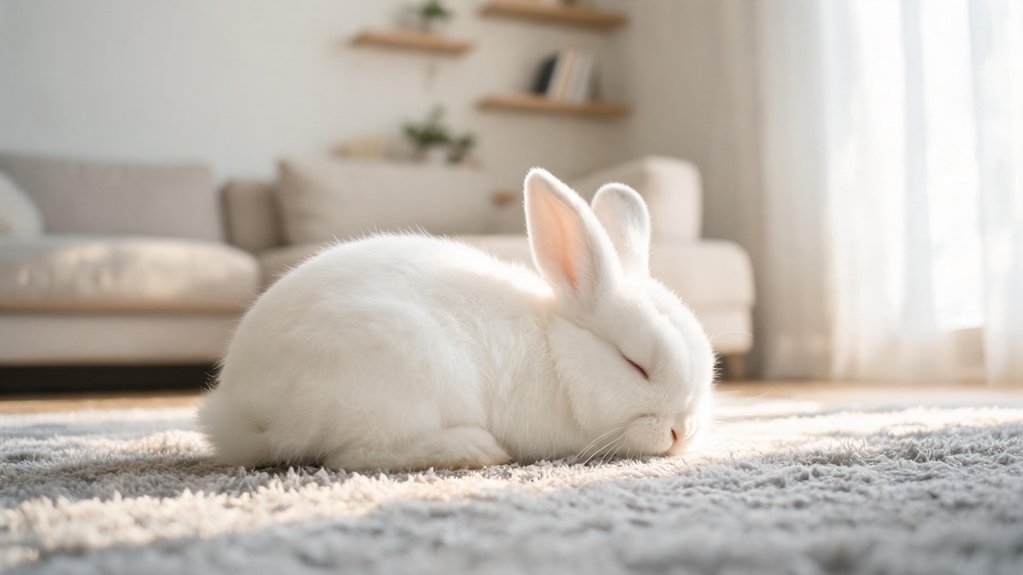
Most pet rabbits sleep in a steady rhythm throughout the day, and once you know the pattern, their napping stops feeling so random.
This is what’s a typical rabbit sleep schedule?
You’ll usually see about 8–12 hours of sleep in 24 hours, built from many naps, not one long bedtime.
Rabbits are polyphasic, meaning they sleep in multiple sessions.
They’re also crepuscular, so activity peaks near dawn and dusk.
Expect quieter rest mid-day, then another overnight block after midnight.
Still, they wake briefly to eat and check their home.
Keep nights calm, safe, and dim.
How to Tell Light Naps From Deep Sleep?
To tell a light nap from deep sleep, watch how fast your rabbit reacts to what’s going on around them.
When you wonder how do rabbits sleep, start with quick tests: in light sleep, they lift their head or tense within seconds after a sudden sound.
Wonder how rabbits sleep? Try quick tests—light sleepers tense or lift their head within seconds after a sudden sound.
Their ears stay semi-alert, ears can swivel, eyes may be partly open, and the nose twitches slow to steady.
In deep sleep, moderate noise brings little or no reaction.
Eyes fully close or look dreamy.
Nose pauses, ears rest flat, breathing slows, and muscles relax, like a floppy loaf.
What Each Rabbit Sleeping Position Means
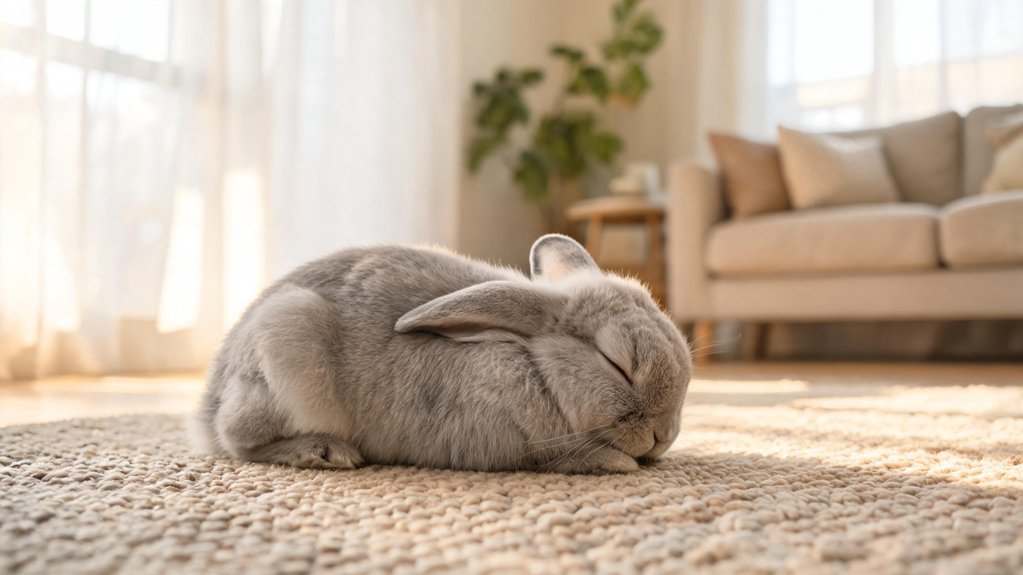
Once you’ve figured out the difference between light naps and deep sleep, the next clue is posture—how your rabbit folds up, flops down, or stretches out.
For what each rabbit sleeping position means, watch for comfort and trust. The loaf, compact and rounded, tells you it feels safe but stays mildly aware, so it can react fast.
Next, the sprawl shows stronger relaxation: legs stretch out behind or forward, helping cooling after play. Side-lying or a full flop means deep comfort and trust, even if they look “dramatic.”
Finally, a curled-up ball keeps heat in, so your rabbit seeks extra warmth.
When Sleep Changes Signal Stress or Illness?
If you notice your rabbit sleeping more than usual, don’t chalk it up to “just being lazy.” Rabbits typically nap in short bursts and total about 6–8 hours a day, so sleeping much longer—especially during your rabbit’s usual active times—can hint at illness, pain, or even stress.
If your rabbit’s sleep changes signal stress or illness?, watch their energy and interest. A sudden jump in sleep with low energy needs a vet.
Roughly 12 hours or more, especially outside recovery, can mean GI stasis, dental trouble, or arthritis.
Also watch appetite, droppings, and breathing. If sleep drops or restlessness grows, don’t wait. Immediate vet help matters.
How Environment and Bonding Affect Rabbit Sleep?
After you’ve checked whether a sleep change could point to stress or illness, you can also look at the everyday stuff that shapes how your rabbit sleeps—where they feel safe, and how relaxed they can stay.
Aim for a quiet, calm area, away from TVs and busy doors, with steady light–dark cycles.
Keep bedding warm, dry, and clean: paper-based products or dust-extracted straw.
Offer soft sleeping surfaces like fleece, towels, or deep hay, not hard floors.
And in where rabbits sleep, security matters—add hiding spots.
For bonding, keep at least one companion.
Bonded pairs often nap side by side, in contact, for extra comfort.
Quick Tips to Help Your Rabbit Sleep Better
To help your rabbit sleep better, start with the basics that match their natural rhythm—rabbits usually snooze in lots of short naps, and many sleep about 6–12 hours total in a day.
When you ask how does a rabbit sleep, you’re really looking at safety, light, and comfort.
First, watch their nap times for a few days, then build quiet around mid-day and late-night.
Next, keep the main sleeping corner darker, dim evening lights, skip constant night lights.
Give soft hay, fleece, or paper bedding, and remove soiled spots daily.
Keep temperatures comfy, avoid wire bottoms.
Follow a steady morning feeding schedule, too.
Frequently Asked Questions
How Does a Rabbit Sleep, and What Do Loaf or Flops Mean?
You’ll find rabbits sleep in short naps, often 30–60 minutes, for 6–8 hours total, sometimes more. A loaf means they feel safe and doze lightly with tucked paws. A flop means deep relaxation—often right before longer sleep.
Where Do Rabbits Sleep at Night, and Do They Choose Safe Spots?
You’d think rabbits just “sleep anywhere,” but at night you’ll find them choosing dark, quiet, enclosed spots—covered hides, boxes, or hutches’ corners. Yes, they actively pick safe spots near escape routes and away from noise and drafts.
Why Don’T Rabbits Blink Much While Resting or Napping?
You don’t see many blinks because rabbits have a third eyelid that protects and lubricates their eyes, plus strong tear distribution. Their low blinking also keeps their vision steady while they rest and stay alert for danger.
What Should Rabbits Sleep On—Bedding, Blankets, or Towels?
You should let your rabbit sleep on chew-safe, absorbent bedding like unscented paper pellets, soft hay or straw over a safe base, or dust-free aspen shavings; use blankets or towels only supervised, since they can be chewed or tangled.
Is It Okay to Leave Rabbits in the Dark Overnight?
Yes, it’s okay to leave your rabbit in the dark overnight. Even though it’s not a Victorian bedtime, you should aim for a normal light–dark cycle; avoid pitch-black outdoor isolation. Use secure housing, bedding, food, and water.