You’ll keep your rabbit happiest with a hay-first routine, because most rabbits love eating hay all day. Offer unlimited high-quality grass hay—timothy, orchard, or brome—keep it available day and night, and use hay racks or bundles. Then add fresh leafy greens daily, about 1 packed cup per 2 lb of body weight, with 3+ different greens. Keep pellets small, about 1/4 cup per 5 lb, and save fruit for tiny treats 1–2 times weekly, so you’ll avoid tummy trouble and learn more.
Swift Summary
- Rabbits love unlimited, high-quality grass hay first all day, since it supports digestion, dental wear, and gut fermentation.
- Fresh leafy greens are a favorite daily staple; aim for about 1 cup per 2 pounds body weight, split into servings.
- Offer at least three different leafy greens daily and rotate them, using kale or chard only in limited, small portions.
- Many rabbits enjoy timothy-based pellets as a supplement only, roughly 1/4 cup per 5 pounds body weight.
- Treats that rabbits love include tiny amounts of fruit or rabbit-safe foraging chews, but fruit should be rare to avoid GI upset.
What Do Rabbits Eat Most?
Most pet rabbits live their happiest, healthiest lives on a simple formula, and it starts with what they eat most every day.
Give unlimited high-quality grass hay, because it’s what’re rabbits favorite food for their gut, and it also keeps their teeth wearing down naturally. cellulose helps make this plant-based diet nutritionally valuable, since rabbits rely on fermentation to process the tough fiber.
Give unlimited high-quality grass hay to support gut health and naturally wear down your rabbit’s teeth.
Then, offer leafy greens daily, about 1 cup per 2 pounds of body weight.
You’ll see what do rabbits like to eat first—often kale, collards, dandelion greens, romaine, and parsley.
Add a small amount of timothy-based pellets, around 1/4 cup per 5 pounds, as supplementary favorite rabbit food, not the main meal. Make sure the hay you choose is fresh, sweet-smelling hay so your rabbit stays interested in eating it every day.
Save fruit for tiny treats.
Build a Rabbit Hay-First Feeding Routine
To keep your rabbit’s tummy happy, start with a hay-first routine—because hay should come before everything else, all day long. Give unlimited fresh grass hay at all times. Rabbits do best when their diet is high in fibre, which supports healthy digestion and helps prevent gut stasis. You can aim for about 80–90% of what they eat to be hay, so offer a daily amount at least equal to your rabbit’s body size in a compact bundle. Place hay in several spots, even above the litter box, so “toilet time” becomes chewing time.
Tuck hay into tubes or racks for foraging. Then feed pellets and leafy greens in small scheduled meals, while hay stays nonstop.
Reduce slowly pellets over 1–4 weeks, and introduce new greens gradually.
Pick Grass Hay Types, Skip Most Alfalfa
You’ll usually get the best results when you choose unlimited grass hay first, then let treats be just that. Pick timothy, orchard, or brome, and keep hay coming every day—morning, noon, and night, if you can—because adult rabbits need steady, high-fiber chewing to keep their gut moving. 85–90% grass hay helps ensure rabbits get the fiber they need for digestive health. Skip most alfalfa for everyday feeding, but you may use it in certain life stages like growing, pregnancy, or when your vet says so, since it’s richer than grass hay.
Choose Timothy, Orchard, Brome
Choosing the right hay makes rabbit feeding feel simple, because most adults do best when grass hay runs the show. Pick timothy hay first. It’s high in fiber, so it helps digestion and supports healthy weight. It also has less calcium than alfalfa, which can lower urinary bladder trouble.
Next, try orchard grass. It’s softer, sweet-smelling, and often easier if your rabbit has tooth sensitivity.
Then consider brome hay for variety. It’s also high-fiber, and mixing grasses encourages natural foraging and chewing.
Serve unlimited hay daily, and keep alfalfa for special cases only.
Use Alfalfa For Life Stages
As your rabbit grows, alfalfa can help at the right times, but it shouldn’t run the whole diet.
Pick grass hay like timothy as the everyday base, since it’s higher in fiber and easier on the gut.
For kits and juveniles, you can offer alfalfa hay and small alfalfa-based pellets from weaning, then phase it down around 4–5 months, finishing the shift by about 6 months.
Many nursing or pregnant rabbits benefit from limited alfalfa, too.
But for average adult rabbits, skip routine alfalfa.
Excess calcium raises stone risk, so keep it to rare small treats.
Keep Hay Unlimited Daily
Unlimited grass hay should be the base of your rabbit’s day, not a side dish. Put fresh, good-quality grass hay in front of your rabbit at all times, day and night.
Aim for about 80–85% of their intake from hay or grass. This nonstop fiber supports digestion, helps prevent gut slowdowns, and keeps teeth worn down as they chew.
Pick timothy first, then mix in orchard grass or meadow hay for variety. Offer bluegrass, brome, or ryegrass too.
But skip most alfalfa. Too much protein and calcium can cause problems.
Also, don’t feed lawn clippings. Always provide safe hay.
Feed Leafy Greens Daily With Simple Portions
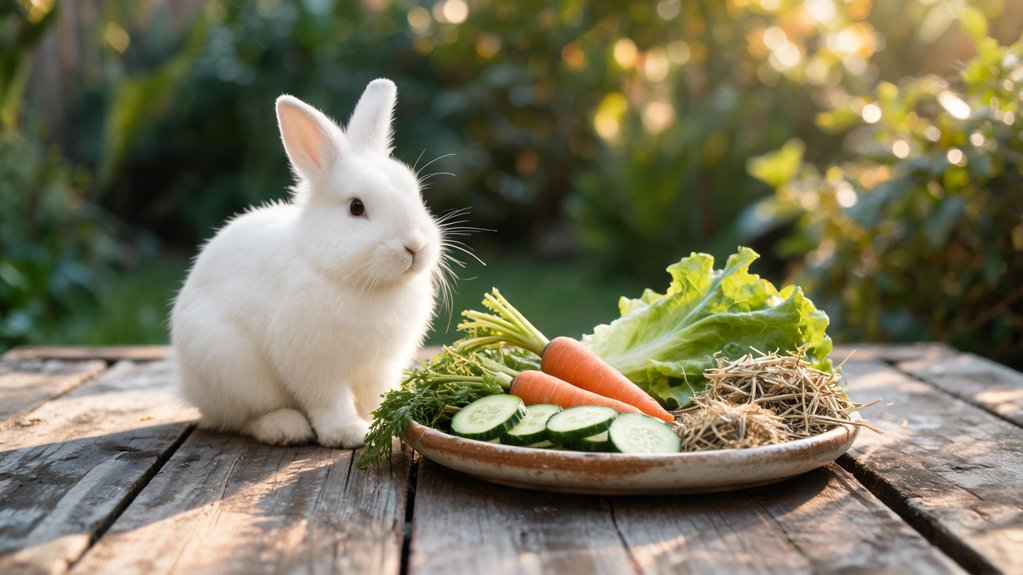
Pick leafy greens that are high in fiber, like romaine, spring greens, and watercress, and skip anything that feels questionable.
Offer a simple daily portion, about 1 cup of packed leafy greens per 2 pounds of body weight, then keep the salad fresh every day with at least 3 different greens.
Rotate dark greens carefully, so your rabbit gets variety without one type taking over too often.
Choose High-Fibre Leafy Greens
Leafy greens are the “fresh” part of a high-fiber rabbit diet, and you should feed them daily. Aim for greens that add extra fiber from plants, while still letting grass hay stay the main food.
You’ll want at least three different leafy greens each day, like romaine or spring greens, watercress, and rocket. Rotate options, too.
Choose lower-oxalic greens most days, like basil, mint, coriander, and dandelion leaves. But hold higher-oxalic greens like spinach, parsley, Swiss chard, or mustard greens to one rotation-only item per day.
Try one new green at a time, stop if stools turn soft.
Offer Daily Portion Amounts
Start each day by serving a consistent leafy-greens “salad” portion, then watch how your rabbit responds. For most adults, you’ll offer about 1 cup packed leafy greens per 2 lb body weight daily, or use a little less—about ½ cup per 2 lb—if your bunny is sensitive.
You can feed it once, or split it into two smaller meals. Many guides also suggest at least 3 leafy types in the mix for variety. Add water and unlimited hay, then adjust slowly over weeks.
Rotate Dark Greens Carefully
When you feed dark greens daily, rotate them carefully so you get variety without overloading your rabbit’s system. Aim for at least three different leafy greens in each salad, every day.
Mix low-oxalate, lower-calcium staples like romaine, green leaf, and red leaf lettuce, plus endive or escarole, bok choy, or watercress, and a little arugula.
These work often because oxalate (a naturally occurring plant compound) stays lower.
And remember, spinach, Swiss chard, and beet greens are high-oxalate choices. Limit them to occasional days, not daily.
Romaine, Arugula, and More: Best Rabbit Greens
Romaine, arugula, and other dark salad greens can become your rabbit’s daily “go-to” food, and they’re a great way to make the fresh part of the diet really shine.
Aim for daily leafy greens at least three types, so you’re giving variety for nutrition and tummy comfort.
Many people start with romaine and swap in arugula, then add butter, red leaf, bibb, or green leaf.
Use spring mixes, dark salad leaves, or dandelion greens too.
Keep iceberg out, and wash and check leaves well.
Offer about 1–2 cups mixed greens per 4 lb, alongside unlimited grass hay.
Vegetables for Rabbits: How Much Is Too Much?
You don’t want vegetables to take over your rabbit’s plate.
Hay should stay the main food, unlimited grass hay, because it provides fiber and helps keep digestion steady.
For most pet rabbits, aim for fresh leafy greens at about 10% of the day’s food by volume.
A helpful guide is a portion roughly the size of your rabbit’s head, split into two or more small servings.
Start new veggies slowly, one at a time, in tiny amounts.
And if you notice softer stools, cut back right away.
Keep carrots and sweet, starchy veg to occasional treats only.
Rotate Dark Leafy Greens to Reduce Oxalic Risk
You don’t have to ban kale or chard, but you should rotate them so oxalic acid doesn’t build up in your rabbit’s system. Try this: feed a base of low-oxalate greens like romaine or red leaf, then use kale or Swiss chard in smaller portions on different days, not every day.
Keep the salad balanced with lots of unlimited grass hay and add a few other leafy options, so your bunny gets steady fiber while keeping oxalic risk lower.
Rotate Kale And Chard
Rotating dark leafy greens helps keep your rabbit’s diet safe and comfy, because some greens carry more “oxalic risk” (oxalic acid can contribute to urinary sludge or stones if they’re offered too often).
So don’t make kale or Swiss chard everyday staples. Offer kale 2–3 times weekly, and give just one small leaf in 1–3 meals.
Offer chard 2–3 times weekly too, in small portions only.
For each day, serve at least three leafy types, and keep high-oxalate greens to just one of the three.
When you try a new green, start tiny, then wait 3 days.
Limit Oxalate Accumulation Risk
Dark leafy greens can be a big part of your rabbit’s daily menu, and that’s exciting—just keep an eye on oxalates. Oxalic acid can bind calcium, forming calcium oxalate crystals that may build up in the urinary tract, raising bladder sludge and stone risk.
Provide Balanced Fiber Options
A steady fiber routine keeps your rabbit’s tummy moving, and it starts with grass hay always available. Keep it unlimited, like constant floor support. That long-strand fiber helps food move through their gut, and it also supports dental wear.
Next, you’ll add dark leafy greens daily, aiming for a large handful, then rotate them. Don’t serve just one type every day. Mix romaine, green or red leaf, and herbs like basil, cilantro, or mint.
For extra variety, swap in kale, collards, mustard, dandelion greens, or carrot tops on different days. This balanced mix helps reduce over-reliance.
Herbs and Edible Flowers: Safe Picks and Portions
Herbs and edible flowers can make your rabbit’s leafy-green “salad” more fun, and they also add variety to the fresh-food portion.
Herbs and edible flowers bring variety and delight to your rabbit’s leafy-green salad, enriching its fresh-food routine.
Keep herbs in the mix, not as the main item.
Choose safe daily culinary herbs like basil, parsley, dill, mint, oregano, thyme, sage, rosemary, lemon balm, and fennel leaf.
Aim for salad-sized portions, mixed with other greens, about a large handful total per day, roughly 10% of that daily veggie/herb mix.
Avoid chives, garlic chives, and all alliums.
For flowers, use dandelion, calendula, nasturtium, rose, chamomile, pansies, daisies, and sunflowers.
Introduce slowly, small amounts first.
Fruit Only as Treats (Small, Occasional Amounts)
Fruit can be a fun little reward, but you should treat it as an occasional treat, not a regular part of your rabbit’s meals.
Fruit runs high in sugar, so if you overdo it, your rabbit may get diarrhea or bloating, and their gut (digestive system) can get thrown off.
Offer fruit only 1–2 times per week, and keep it tiny: about 1–2 tablespoons per 5 lbs body weight, or roughly 1–2 oz per 6 lbs.
Serve plain apple flesh, berries, or a small banana slice, with no seeds.
And always prioritize hay first.
Rabbit-Safe Garden Foraging Plants to Try
When you want to give your rabbit something new to nibble, you can start right in your own yard with rabbit-safe foraging plants.
Offer unlimited grass hay alongside daily leafy greens, then add garden treats in small, slow steps.
Offer unlimited grass hay alongside daily leafy greens, then introduce garden treats in small, slow steps for steady, safe nibbling.
Try dandelion, plantain, and sow thistle for fibre-rich munching.
For variety, grow chickweed and cleavers/goosegrass, then introduce gradually.
You can also browse bramble, raspberry, blackberry, and strawberry leaves, skipping fruit for now.
Fresh, unsprayed nettle (young leaves), burdock, and yarrow work too—only if you’re sure of ID.
If you use herbs, choose basil, parsley, dill, cilantro, mint.
Chewable Branches for Healthy Teeth and Nibbling
Adding chewable branches to your rabbit’s routine helps keep those fast-growing teeth in a healthier, more even shape. Rabbits’ teeth keep growing, so steady chewing matters, and hay stays the main food for dental health.
Next, offer untreated wood twigs for extra abrasion, not as core nutrition. Choose apple, pear, willow, hazel, maple, birch, or poplar, chemical-free, seed- or pit-free.
Wash branches, then let them dry for days to weeks before serving. Pick branch sticks made for rabbits, like applewood.
And skip stone-fruit trees like cherry, plum, peach, or apricot when fresh, plus cedar and pine.
What to Avoid When Feeding Rabbits Safely
To keep your rabbit safe, you’ll want to avoid foods and plants that can harm their digestion, teeth, or organs.
First, never share human snacks.
First, never share human snacks—some “treats” can quickly harm your rabbit’s digestion and overall health.
Skip chocolate and caffeine, cookies, crackers, bread, pasta, and dairy like milk or yogurt.
Stay away from sugary “treats,” sweetened cereals, and any items with artificial sweeteners, especially xylitol.
Next, avoid starchy, high-fat plants: potatoes and sweet potatoes, corn, and raw legumes like beans and peas.
Also, don’t feed nuts and seeds.
Finally, keep rabbits away from toxic ornamentals and houseplants, including lilies and daffodils.
Daily Rabbit Menu Checklist for Happy Bunnies
Start your rabbit’s day with a simple menu check you can stick to, every single day.
Offer unlimited high-quality grass hay, so they can graze day and night. Aim for at least a hay amount about the size of a ball equal to their body size.
Next, refresh fresh leafy greens: about 1 packed cup mixed greens per 2 lb body weight, daily.
Give 3–5 different greens, then rotate more types over the week.
Measure plain timothy-based pellets too, about 1/4 cup per 5 lb body weight.
Add water, always.
For treats, keep fruit to a few small pieces, only now and then.
Frequently Asked Questions
What Are Rabbits’ Favorite Leafy Greens to Eat First?
Rabbits often “hop” straight to dandelion greens, then romaine and mixed spring lettuces. Offer escarole, endive, carrot tops, beet greens, and cilantro as leafy favorites. Give a little variety daily, while keeping grass hay constant.
How Much Pellet Food Should I Give My Adult Rabbit Daily?
Give your adult rabbit about 1/4 cup timothy-based pellets per 5 lb body weight daily, measured and split if you want. For many rabbits, pellets should stay a small part—limit, don’t free-feed. Adjust for body condition.
Can Rabbits Eat Grass Clippings From the Lawn Safely?
No—you shouldn’t give rabbits lawn grass clippings. Clippings can ferment quickly and carry lawn chemicals, mower oil, and debris, raising bloat and illness risk. Offer fresh, untreated grass or unlimited grass hay instead.
Which Fruits Do Rabbits Like Most, and How Much Is Too Much?
You’ll find rabbits love small treats like strawberries, blueberries, apple (no seeds), and tiny banana slices. Keep fruit rare—about 1–2 tablespoons total per feeding, no more than 1–2 times weekly. Too much can cause weight and gut trouble.
What Chew Toys or Branches Help Keep Rabbit Teeth in Good Shape?
Like a dentist’s toolkit, offer rabbit-safe chew branches—apple, pear, willow, birch, or hazel—plus untreated wood or hay cubes. Rinse, inspect for pests, and avoid unsafe/toxic woods. These encourage natural grinding and keep teeth aligned.