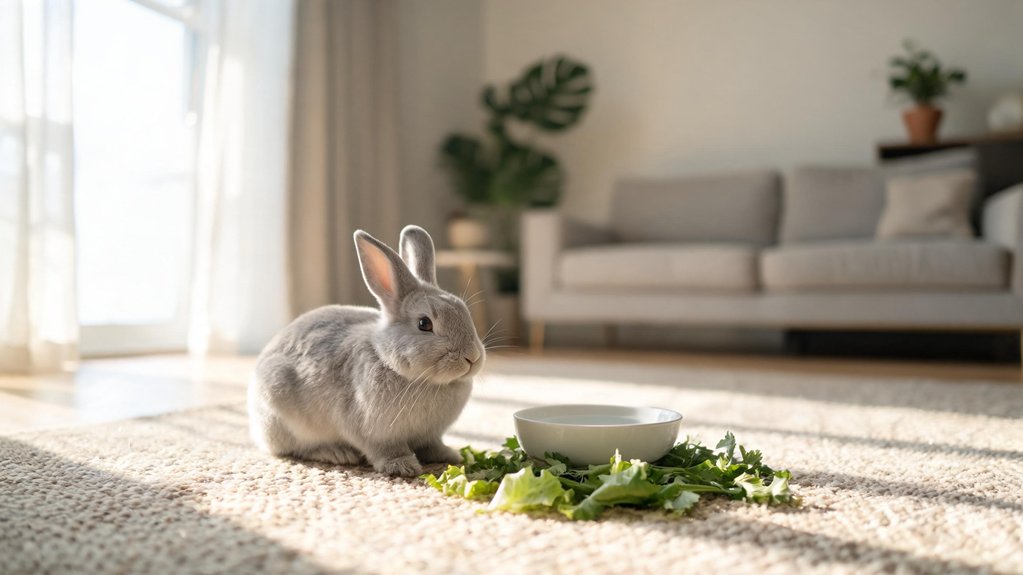
English Spot rabbits are medium, active show rabbits, usually 5–8 lb, with a slender “mandolin” body and a full-arch topline. Their short, dense flyback fur “snaps back” after you stroke. You’ll see crisp white with a butterfly nose, full eye circles, cheek spots, colored ears, a herringbone spine stripe, and side spot chains in colors like black, blue, chocolate, lilac, gray, gold, or tortoise. Feed hay daily, shift from alfalfa to grass, and give 4×2 ft resting space plus more exercise. Want the full plan, costs, and ethical sourcing tips?
Swift Summary
- English Spot rabbits are medium, athletic “mandolin” types, typically 5–8 lb, with a full-arch topline and upright posture.
- They have a mostly white coat with signature face markings: butterfly nose, eye circles, cheek spots, and colored ears.
- Body markings include a herringbone spine stripe and distinctive side spot chain, with specific pattern rules for show.
- Their short, dense flyback fur is easy to maintain; weekly brushing suffices, with daily brushing during molts.
- They’re generally docile but need daily exercise, hay-forward diet, litter training basics, and routine vet checks.
English Spot Rabbit: Quick Facts for Beginners
If you’re curious about an English Spot rabbit, here are the quick facts you’ll want from day one.
You’ll see a medium, active rabbit, usually 5–8 lb, with a slender “mandolin” body and a mostly white coat.
Look closely for the butterfly nose mark, eye circles, cheek spots, colored ears, a herringbone spine stripe, and side spots.
Look closely for the butterfly nose mark, eye circles, cheek spots, colored ears, a herringbone spine stripe, and side spots.
Common recognized colors include black, blue, chocolate, lilac, tortoise, gray, and gold.
You’ll enjoy their generally friendly, mild, docile temperament—if you give daily space, exercise, and careful handling.
Plan routine vet checks, steady hay, and grooming that stays easy with their short coat.
English Spot rabbits are typically classified as 30–32 day gestation breeders.
History of the English Spot and ARBA Recognition
The English Spot’s story starts in 19th-century England, where breeders worked to make a consistent, show-worthy “marked” pattern, not just a random set of spots. You see early print mentions by 1849, and real popularity in the 1850s and 1860s, mostly as a novelty for fur and markings, not meat. Selective breeding helped standardize the breed’s distinctive “spot” pattern. In the 1880s, breeders helped the breed bounce back, reintroducing black, blue, chocolate, and gray varieties. Then selective breeding fixed the pattern.
Origins stay uncertain, but theories link it to large European spotted rabbits, English Butterfly, or Checkered Giant types.
Size, Weight, and “Mandolin” Body Type

Next to the English Spot’s famous “marked” face, you’ll notice its build right away. You’re looking at a medium rabbit, typically maturing around 5–8 lb, and ARBA sets a maximum show weight of 8 lb (3.63 kg).
That range helps you plan space, too. Now focus on the “mandolin” body type.
“Full-arch” means the topline arches up, and the body stays well up off the table. Long, slender front legs lift the chest, and you’ll even see daylight under the belly.
It’s lean and athletic, made for running, not heavy sitting.
Coat Type: Flyback Fur and Grooming Basics
With an English Spot, you’ll usually love how simple the coat feels to care for, because it’s a short, dense flyback coat that lies flat and snaps back quickly after you stroke it.
“Flyback” just means the fur doesn’t stay ruffled in one direction—it springs back.
It’s a smooth double coat, with an undercoat and outer guard hairs.
Weekly brushing helps you remove loose fur, and it keeps skin and coat in good shape.
During seasonal molting, brush once weekly or biweekly with a slicker brush, outdoors if possible.
Avoid full shaving.
Skip water baths; spot-clean instead.
Also check nails, ears, and teeth often.
English Spot Colors and Signature Markings

When you picture an English Spot, you’re really picturing two things at once: a clean white base coat and the breed’s organized pattern of colored markings.
You’ll see accepted marking colors like black, blue, chocolate, lilac, gray, gold, and tortoise.
For shows, each rabbit carries one accepted marking color, not mixed shades.
Now focus on the signature six-part pattern.
Now focus on the signature six-part pattern—nose butterfly, full eye circles, cheek spots, spine herringbone stripe, and a flowing side chain.
Look for a butterfly-shaped patch over the nose, complete eye circles, and round cheek spots.
Then check the straight herringbone stripe down the spine, plus a neat chain of side spots flowing from neck toward hind legs.
Look-Alikes: Spot vs Self and Charlie Confusion
When you’re checking an English Spot, don’t stop at “white with spots”—you’ll want to line up the marking anatomy piece by piece, because the right pattern is more than a few dark patches.
Next, separate self-colored kits from charlie-pattern rabbits: self means solid color (no broken or charlie spots), while charlie usually shows a mostly white body with only a trace of color, like colored ears and just one or two random spots.
Finally, watch the chain-side spots—spots that line up in the expected side positions help confirm true English Spot patterning, while random, broken-looking placement is a common mix-up with other En-genetics.
Spot Marking Anatomy Compared
To spot a true English Spot, you’ve got to learn the *marking map*, because the anatomy of the spots follows a specific order on a white base coat.
Start with the butterfly nose, centered on the muzzle, then look for matching cheek spots.
Next, check for complete eye circles, solid rings that frame each eye.
Then confirm colored ears, the herringbone dorsal stripe along the back, and a chain of evenly spaced side spots from neck toward hind legs.
If you see only scattered flecks, or missing rings and stripe, don’t assume “English Spot.”
Keep your breed check strict, so you help others choose right.
Self-Colored “Charlie” Identification
You’ll run into a lot of confusion with “Charlies,” because their En gene patterns overlap with true English Spots, lightly marked brokens, and even solid self-colored rabbits. So don’t trust looks alone.
A Charlie usually shows extensive white, with color around eyes, ears, nose, or the back, often under 10% body color.
But sparse broken rabbits can mimic that, and self-colored enen kits show no En white spotting.
To help, test-mate. Pair Charlie-like EnEn to solid enen, then confirm: no solid kits means Charlie.
Also, if a lightly marked rabbit ever produces a solid self kit, it’s Enen.
Distinguishing Chain Side Spots
Chain side spots are one of the fastest ways to tell a true English Spot apart from “almost there” look-alikes, especially after the Charlie confusion you just read about. Start at the nape of the neck, find one small spot, then follow the sweep down each flank toward the hind legs. You should see spots grow in number and size as the chain progresses, ending near the hips.
They must stay separate, not fused into big blotches. Self-colored rabbits lack that clear white body with a defined side chain.
Also watch for off-balance gaps or congested clusters.
Temperament: Handling Tips for Energetic Rabbits
English Spot rabbits are friendly and curious, but their energy means you need gentle support for the spine, so you always lift with your hand under the chest and forelegs and secure the hind paws.
Keep sessions short—start with quick 20–30 second holds, then slowly build time only if they stay calm and relaxed, because long handling can spark struggle.
And instead of grabbing for control, you’ll reduce irritability by using low-stress, treat-and-touch acclimation, plus plenty of enrichment like digging spots and space for binkies before you try any lifting.
Gentle Support For Spine
When an English Spot gets excited, you’ve got to handle like you’re protecting a fragile, delicate spine—because it is. Keep your hold close to your body, secure and calm.
Put one hand under the chest, just behind the front legs. Use your other hand under the hindquarters.
Lift full-length support, so the spine stays level, not bent.
Use a C-hold or football hold, with the spine supported against your forearm. Keep back legs controlled, feet flat, no dangling.
Move feet-first from the cage, and stay low on a non-slip surface.
One smooth transfer.
Short Sessions, Frequent Handling
After you’ve practiced gentle, spine-protecting holds, you’ll do even better with short sessions that happen often. Aim for 5–10 minutes of calm handling, then take a break. Do it in the dawn and dusk windows when your English Spot already wants to move. Keep the room quiet, and approach slowly, so curiosity wins.
From a young age, you’ll build cooperation with grooming and nail trims by doing brief, repeated touch. Use ground-level contact, like gentle head strokes, and let your rabbit move freely between holds. Watch for tense posture, then stop early.
Enrichment To Reduce Irritability
Enrichment can make a big difference in keeping your energetic rabbit calm and cooperative, especially if they get cranky during handling.
Set up a spacious, multi-level home with tunnels, hiding spots, and safe elevated platforms.
Rotate toys and platforms every few days.
Add varied textures, like grass mats, cardboard, and untreated wood, to reduce chewing.
Give daily supervised free-roam time in a rabbit-proofed area.
Scatter-feed pellets and greens, use puzzle feeders, and hide hay in cardboard tubes for foraging.
Offer chew branches and a digging box with shredded paper.
Keep routines predictable, and watch for growling or biting, then adjust.
Consider a compatible companion.
How Long Do English Spots Live?
English Spot rabbits usually live about 5–9 years, and you’ll often see 6–8 years listed as the more typical range in rabbit care guides.
Many rescue and adoption pages also summarize their life expectancy as five to eight years.
But you’re not stuck with the low end.
With great genetics, a balanced hay-based diet, clean housing, and regular vet checkups, you can nudge lifespan toward the upper figures many pet guides cite, often around 8–12 years.
And remember, safe indoor care helps rabbits reach their full potential, sometimes into the early teens.
Plan ahead, for your future.
Common Health Problems to Watch Early
Keep a close eye on your English Spot, because catching problems early often makes the difference between a quick fix and a serious emergency.
Watch for GI trouble, especially rabbit megacolon syndrome, linked to mostly white coats with certain spot patterns.
Look for swollen belly, odd droppings, teeth grinding, no droppings over 12 hours, and sudden pain.
Next, protect teeth.
Poor diet and low fiber can drive malocclusion and overgrown molars, and rabbits stop eating fast.
Stay current on vaccines for myxomatosis and RHD.
Treat “snuffles” quickly, too, and call your vet for head tilt or wobbliness from E. cuniculi.
Also check ears, skin, and eyes for mites.
Grooming Schedule for Dense Flyback Fur
When you’re watching closely for early health issues, grooming has a big payoff too—especially for an English Spot with a short, dense flyback coat that holds onto loose fur.
Plan a weekly brushing session, about 5–10 minutes, on a non-slip surface. Use a soft brush, comb, or grooming glove, and brush with hair growth, from head toward tail.
Plan a weekly brushing session, 5–10 minutes on a non-slip surface, using a soft brush and brushing with hair growth.
Part the fur, then brush down gently to lift loose undercoat.
Next, check the tail and underside every day in warm months.
During seasonal molt, brush daily for several days to a couple weeks.
Skip shaving; pro trim is safer, every 6–8 weeks.
Safe Housing and Exercise for a Running Breed
For a running breed like an English Spot, you’ll want to set up space that lets them stretch, hop, and sprint without bottlenecks. Start with at least 1.2 m by 0.6 m (4 ft by 2 ft) as a base resting area. Even better, give them an attached living-and-exercise footprint of at least 3 m by 2 m, with 1 m height, accessible 24 hours a day.
Plan the run so they can do several full hops, including three consecutive hops in one direction over at least 2 m. Use solid flooring, soft bedding, and high-traction surfaces like carpet.
Aim for 3–4+ hours daily, indoors or outdoors only if safe.
Litter, Enrichment, and Activity Ideas
Set up litter training by placing multiple litter boxes in the spots your rabbit already picks—start with one roomy corner box, and use paper-based or pellet litter with plenty of timothy or oat hay on top. When choosing a tray, look for a roomy, low-entry design that is easy to clean, since size and design strongly affect how consistently your rabbit uses it. Mark the tray with a little soiled bedding, then keep your rabbit in a small 4’×4′ area for the first stage, feeding and toileting in that same spot until it’s consistent.
Then, mix in enrichment and activity games—hide hay in cardboard boxes or toilet paper rolls, use a puzzle feeder on a schedule, and add scatter-feeding a few pellets at a time so they can forage and move, not just sit.
Litter Training Basics
Start with the basics: choose the right litter box, use safe litter, then make the box feel like the “right place” for your English Spot.
Pick a large, sturdy plastic tray, low-sided so he can hop in, and keep it uncovered.
Use 0.5–1 inch rabbit-safe litter, like compressed paper, pine, or wood pellets, and skip clumping cat litter, cedar, and wire grates.
Place generous timothy or oat hay directly over or beside the box, since he’ll eat and go.
Confine him about 4×4 ft at first, add a few droppings, reward correct use, and clean with an unscented cleaner.
Enrichment And Exercise Games
Think of enrichment as “working” for your English Spot—just in a bunny-friendly way that burns energy and keeps boredom away.
Scatter greens and pellets, then hide them under flower pots, in boxes, and inside cardboard tubes stuffed with hay.
Hang leafy greens higher so your rabbit stretches on hind legs.
Use puzzle feeders, treat balls, or rolling dispensers for smart, controlled exercise.
Set up a digging box with soil, sand, or hay, and rotate substrates for new textures.
Add tunnels and multi-level hides, and rebuild your obstacle course often.
Keep play supervised, 10–20 minutes, and always use rabbit-safe materials.
Simple Diet Plan by Age: Pellets, Hay, Greens
From the moment you bring an English Spot home (or once those baby kits are born), you’ll build their diet in layers: pellets, hay, and greens each play a role, and the right timing keeps their gut happy.
Birth–3 weeks: feed mainly mother’s milk. Avoid hay, pellets, and greens except tiny alfalfa nibbles, closely watched, no leafy greens or fruit.
3–7 weeks: add small alfalfa hay and alfalfa pellets from 3–4 weeks, then offer unlimited alfalfa hay and pellets by 4–7 weeks. Introduce one grass hay option and, only if needed, tiny romaine tastes, then monitor droppings for 48 hours.
7 weeks–adult: grow with unlimited alfalfa, then switch to mostly grass hay.
English Spot Prices in the U.S. (Typical Ranges)
When you’re shopping for an English Spot rabbit in the U.S., prices can vary a lot, mostly based on where you get them and whether they’re pet-quality or show-quality.
A breeder usually lists English Spots around $10–$50 for common pet-quality bunnies, with some rehoming fees near $40–$50.
From rescues, you’ll often see about $25, sometimes up to $50 for private rescues.
For pet-quality breeder rabbits, expect roughly $50–$150.
For show prospects with documented pedigree, plan around $150–$300 or more.
Check local listings, and budget for vet care soon after adoption.
Adopt vs Buy: How to Choose Responsibly
When you’re deciding between adopting and buying, start by choosing a reputable rescue, because they often already do spay/neuter (a surgery to prevent hormones) and check health before you bring your rabbit home.
If you do buy, look for an ethical breeder with known lineage and welfare basics, not a backyard source where rabbits may be unaltered and less socialized, and ask what vet care they’ve already provided.
Either way, you’re making a real impact—adopting frees up space for another rabbit, while buying from retail or casual sources can make it harder for shelter rabbits to get the second chance they deserve.
Adopt From Reputable Rescues
Choosing to adopt an English Spot rabbit from a reputable rescue can be the best kind of “win-win” for you and the rabbit.
You help reduce overpopulation by freeing space for the next intake. And in many cases, rescues already spay or neuter your rabbit, which lowers reproductive health risks.
They often offer a vet check, plus vaccination against RHDV2, a frequently fatal disease.
Some also microchip.
You’ll also get temperament notes, so you can match confident or shy behavior to your home.
Plus, litter training is often underway, so you start cleaner and calmer.
Buy Only From Ethical Breeders
After you’ve seen how rescues can set you up for success, it’s time to talk about the other path: buying from an ethical breeder only.
If you truly must buy, choose one who keeps spacious, clean housing, with good ventilation, sanitation, and vet care.
Ask for the rabbit’s health history, lineage, and access to the parent rabbits to reduce genetic and inbreeding risks.
Look for gentle early handling, and stable temperament, not fast turnover.
For ethical decisions, remember many breeders sell rabbits intact, and spay or neuter can cost $50–300+.
Screen the buyer, or refuse you when homes aren’t right.
Frequently Asked Questions
What ARBA Weight Range Applies to English Spots?
You’ll find English Spots use ARBA’s medium-size weight band: mature bucks and does typically run 5–8 lb, and senior show rabbits can’t exceed 8 lb. Aim to keep your rabbit within that range for best health.
Which Exact Colors Are Officially Recognized by ARBA?
ARBA officially recognizes seven English Spot colors for show: Black, Blue, Chocolate, Gold, Gray, Lilac, and Tortoise. Choose your rabbit’s exact color name from these options when you enter classes.
Are English Spots Good With Other Pets Like Cats and Dogs?
English Spots can sometimes live peacefully with cats and dogs, but you should expect prey-stress risk. Use neutered pets, calm low-prey companions, barriers first, and constant supervision. Many rabbits stay frightened long-term, so keep them rabbit-safe.
How Can I Tell if My Rabbit Has Correct Spot Markings?
“Measure twice, cut once”—you can check markings by looking for a butterfly nose, complete eye circles, cheek dots, colored ears, a straight herringbone spine stripe, and a balanced side-spot chain. Spots should be clean, not bleeding.
What’s the Typical English Spot Price Range in the U.S., if Buying?
You’ll typically pay $40–$80 for an English Spot rabbit in the U.S. Most pet-quality sales land around $40–$50; show-quality rabbits often cost $100–$200+ depending on lines and markings.