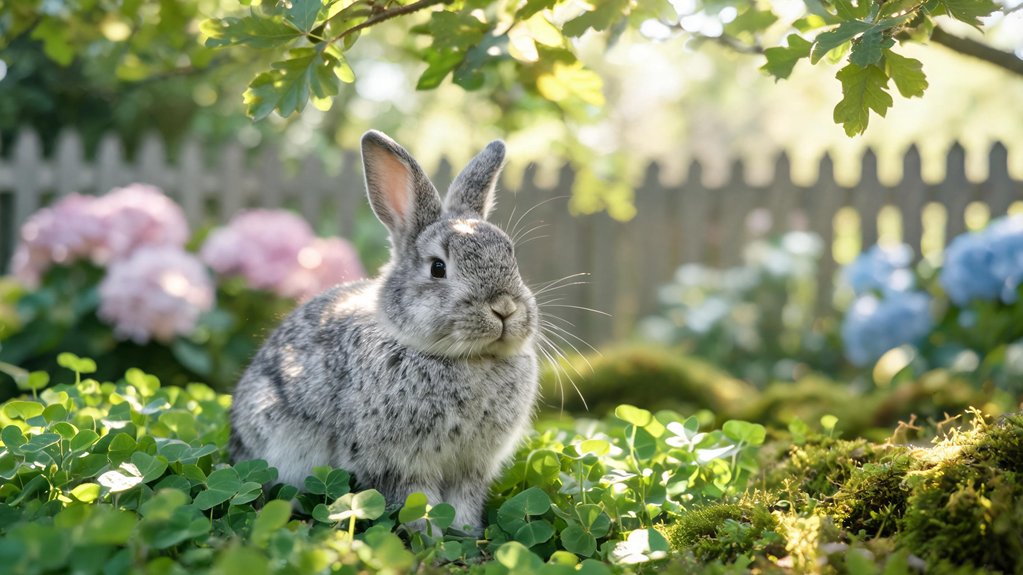
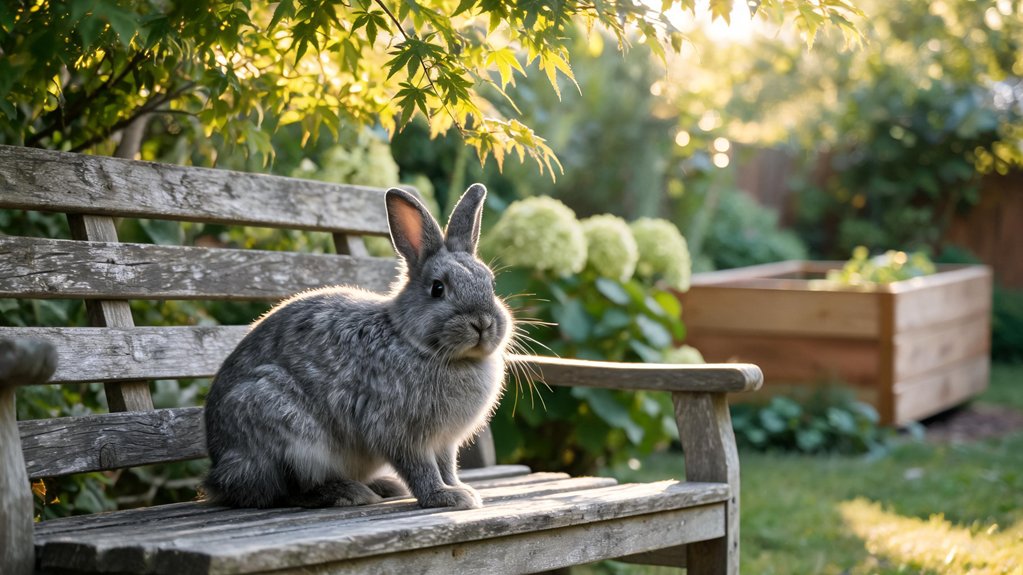
Confirm a cottontail by spotting a short, fluffy “cotton ball” tail, about 1.5–3 inches, brown on top with a bright white underside that flashes like an alarm. Next, check the ears—usually medium, under 4 inches, with a black border or margin. A white forehead “star” can show up on eastern cottontails, but it’s a hint, not a guarantee. Then match habitat: dense escape cover near grasses, shrubs, and garden plants, where it rests in shallow forms. Keep going, you’ll spot more details.
Swift Summary
- Identify cottontails by a short “cotton ball” tail: brown top and bright white underside that flashes during escape.
- Use the forehead “star” carefully: a white/light-brown center spot often occurs in eastern cottontails but can fade or be absent.
- Check ear traits: New England cottontails show short, rounded ears with a stronger black border; eastern ears have a slimmer black margin.
- Observe behavior: rabbits stay low in shallow ground “forms,” then sprint in short, zigzag dashes to nearby cover.
- Understand habitat: they prefer dense escape cover near forage, with home ranges roughly 5–15 acres and frequent use of brush and grass clumps.
Confirm a Cottontail With Key Markings
To confirm a cottontail (including the common “swamp rabbit,” which can look similar), start with the tail—because that’s your biggest, easiest field mark. Look for a short, fluffy tail, about 2 inches, brown on top and white underneath, like a cotton ball. short, stubby tail. That white underside stays visible in summer and winter. Next check the upper coat, usually reddish-brown to grayish-brown, with black speckling. Many cottontails show a rust patch at the nape.
Compare swamp rabbit vs cottontail: swamp rabbits often look coarser, more yellowish, with a tawny rump. Also notice white/grayish underparts.
Check for the Forehead “Star” (New England vs Eastern)
Check the forehead first, that “star” or blaze usually shows up as white (sometimes light brown) on eastern cottontails, but it fades as they get older and isn’t always there. white spot Then, look at the crown between the ears, because New England cottontails usually look darker overall, with a dark/black spot and black hair along the inner ear edges instead of a pale forehead highlight. But if you’re not sure—especially if the mark is faint or the ears seem narrow at the margin—call a licensed wildlife rehabilitator, and remember it’s illegal in many states to keep wild rabbits as pets.
Forehead Star Presence Test
Wondering if your rabbit is the Eastern cottontail or the New England cottontail? Look for the forehead star on the forehead, a white or light-brown spot, or blaze, right in the center. If you see it, you’ve got a strong hint toward eastern cottontail, not the New England cottontail. About half of Eastern cottontails show it, though it can be tiny, like a couple hairs. CloudFront-generated error pages can sometimes block access while you try to check this information, so you may need to retry later. And if it’s missing, don’t jump to conclusions. Some Eastern rabbits lack the mark. Use DNA or skull traits for certainty, not just european rabbit vs cottontail looks.
New England Darker Markings
If you’re using the forehead “star” to sort out an Eastern vs. New England cottontail, don’t stop there. Look for darker pelage, especially along the back.
New England cottontails often have dark brown or gray-brown guard hairs, plus black-tipped “penciled” speckling. Those black guard hairs cluster along the shoulder and flanks, making a shadowed, mottled look.
Eastern cottontails usually look paler, more solid reddish-brown or grayish-brown overall.
Next, check the ears. You may see black hair on inner edges and a more continuous dark ear border.
This matters for swamp rabbit and marsh rabbit vs eastern cottontail, too—please contact licensed wildlife rehabilitators.
Eastern Narrow Ear Margin
Before you decide which cottontail you’re looking at, take a close look at the ears and the “star” on the forehead together, not separately.
For the eastern cottontail rabbit, you often see longer, more pointed ears with less dense inner fur. That usually means the ear margin coloration looks narrower and lighter in front, with weak or no strong black edging.
For New England cottontail, you’ll more often find shorter, rounded ears, with a black line along the front edge, plus a black forehead spot between the ears.
Still, traits overlap, so confirm if needed—then help wildlife rehabbers.
Compare Ear Length and Black Ear Rims
When you’re trying to tell cottontails apart, start with their ears—ear length first, then the “black rim” look on the ear edges, if you can see it clearly. Eastern cottontail ears run about 2–3 in (5–8 cm), while desert cottontails stretch 3–4 in.
Those longer ears help with jack rabbit vs cottontail, because jackrabbits go much bigger, like ~125 mm.
Next, check cottontail rabbit ear traits: desert cottontails often show distinct black-tipped rims. New England cottontails have shorter, more rounded ears, and black rims may be less obvious.
If you’re unsure, contact a licensed rehabber—keeping a european rabbit or wild rabbit is illegal in many states.
Use the Tail Color for Behavior Clues
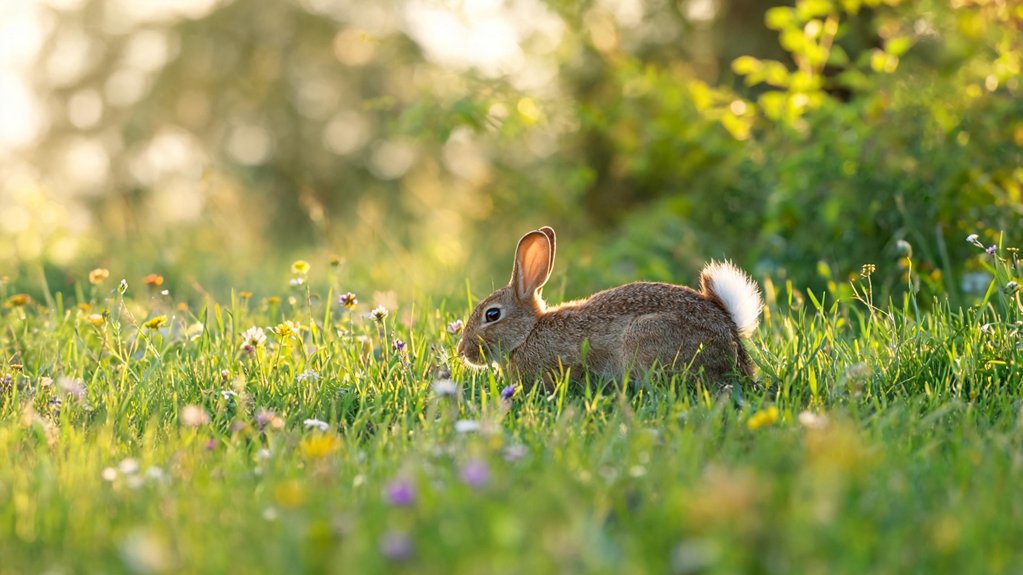
When you see a cottontail’s tail raised and showing that bright white “powder puff,” it’s usually an alarm signal, meaning, danger is near.
And when the rabbit starts moving fast and the white underside flashes on and off during runs, that tail-flash often shows it’s ready to escape, usually right before or during the sprint.
But if the rabbit goes still and the tail stays tucked, it’s likely using camouflage to hide, not announcing danger.
White Tail Signals Alarm
That bright white “cotton ball” on a cottontail’s tail isn’t just decoration—it’s a real alarm signal. When a cottontail rabbit feels danger, you’ll often see its tail raised, sometimes rigid, sometimes even quivering.
This white tail signals alarm by flashing that high-contrast patch to nearby rabbits, so they know to watch, freeze, or move away fast. You may also hear worry cries, and you might notice hind-foot thumping too.
In open spots like marsh edges, this line-of-sight warning works well. If you’re trying to tell marsh rabbit vs cottontail apart, use this behavior as a clue—then contact a licensed wildlife rehabilitator.
Keeping wild rabbits is illegal in many US states.
Tail Flash Indicates Escape
Once you spot the cottontail’s tail go from “raised alarm” to “bolt time,” you’re watching an escape signal.
The white underside stays hidden when it’s still, then flashes fast only when it bolts.
You’ll often see zigzag running, short dashes, then it stops under nearby cover within about 30–50 feet.
This quick tail flash can even momentarily throw off a hawk or coyote, since the bright moving target disappears when the rabbit tucks in.
If you’re comparing, remember brush rabbit vs cottontail and marsh rabbit vs swamp rabbit, not the snowshoe hare.
Please keep distance and report sightings to licensed wildlife rehabilitators.
Tell Cottontail Habitats Apart by Cover + Forage
To tell one cottontail habitat from another, look first at escape cover—dense hiding spots predators can’t easily push through—and then at forage, the grasses, forbs (non-grass flowering plants), shrubs, and crop plants they can nibble nearby.
You’ll spot early fields where grasses and clovers mix with low brush under ten feet. In shrub thickets, look for briars and honeysuckle, 3–6 feet tall, with briar tangles right beside open feeding strips.
In edge clearings, check for sumac and blackberry understory plus scattered light for ground plants. This is how you can compare, and better help, when weighing swamp rabbit vs eastern cottontail, brush rabbit vs desert cottontail, pygmy rabbit vs cottontail.
Find the Best Nesting Spots in Yards and Fields
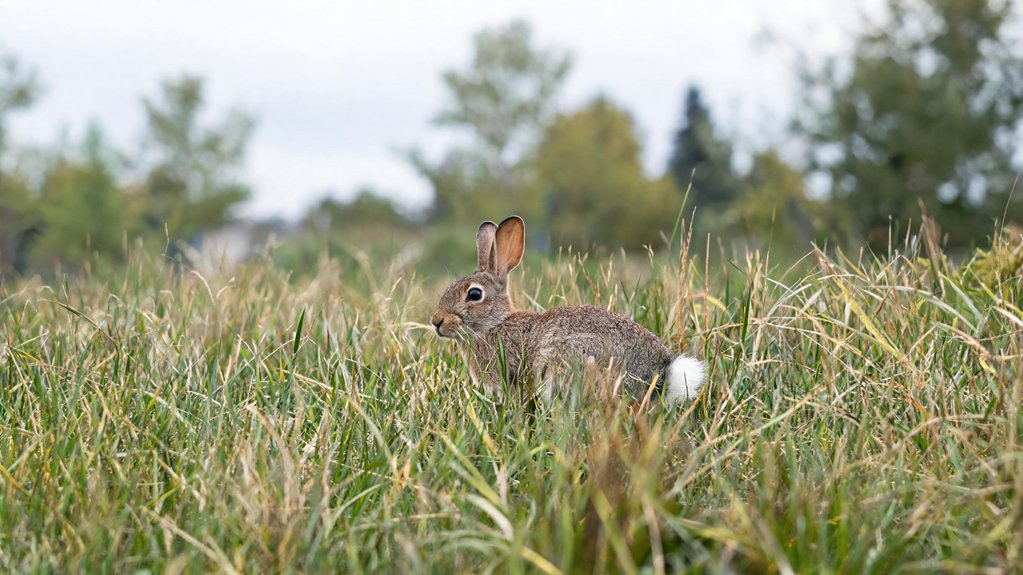
After you’ve figured out what cover and forage a cottontail needs, you can start spotting where it feels safest to raise a litter.
Look for shallow ground nests, a small dip or bare patch in soft soil, about 18 cm × 12 cm, lined with dry grass and fur.
In yards, check landscaped borders, vegetable beds, and foundation plantings, especially near shrubs and brush piles that give quick escape routes.
In fields, prioritize grasslands, hayfields, weedy edges, ditch banks, and unmowed strips—tucked near tall grass.
Help wildlife by mowing carefully mid-March–mid-September; keep pets away.
Ignore claims like volcano rabbit or korean rabbit—this is cottontail rabbit vs jackrabbit.

✔ NATURAL - Made from 100% natural Virginia-grown cotton

Premium Natural Cotton Material: Made of undyed, scent-free natural cotton with ultra-fluffy softness. This soft bedding fits the delicate skin of sugar gliders and squirrels. It serves as safe soft nesting material for birds, while also letting hamsters and rabbits create warm, cozy resting spots

Cleaner Pet Home: Discover absorbent, dust-free bedding for small animals and birds.
How Cottontails Use “Forms” to Stay Hidden
When cottontails feel safe enough to rest out in the open, they don’t curl up in random spots—they use “forms.”
A form is a shallow, nestlike depression in the ground, scratched or trampled into grass, weeds, or small plants, and often lined with dry grass and fur for warmth.
And that’s key: you’ll spot them mainly in dense cover, like thick grass clumps, brush piles, stumps, or under shrubs.
But they stay hidden by staying still, blending color, and keeping low to the ground from sunrise to sunset.
Understand Home Range Around Escape Cover
Once cottontails feel safe enough to settle into forms, you’ll understand their pattern fast: they live close to escape cover, and they don’t roam wildly.
Keep an eye on dense cover like briar thickets, brush piles, shrubby gullies, and field edges.
Their daily home range usually stays about 5–15 acres, with eastern cottontails often around 10 acres.
Where cover and food connect well, the range shrinks—sometimes under 5 acres.
You’ll see movement cluster along brushy fence rows and cut-back edge zones.
For safety, protect and maintain cover patches about 40 yards apart.
What Cottontail Rabbits Eat by Season
Cottontail rabbits don’t eat meat—ever. If you’re helping backyard wildlife, think “plants all year.”
In spring, you’ll see them graze grasses, clovers, weeds, and forbs (non-grass flowering plants), like dandelion and plantain.
They also nibble native herbs and wildflowers, and they may rely on leftover dried plants when new growth is scarce.
In summer, they favor tender greens, plus grasses, and they’ll raid gardens for beans, peas, lettuce, cabbage, and beets.
In autumn, they eat more seeds and fruits, including fallen apples.
In winter, they switch to twigs, buds, and bark.

VARIETY WITH COMPLETE NUTRITION: Oxbow Forage Wise Adult Rabbit Food offers the variety and texture of a mix diet without the drawbacks. Every piece is fortified, ensuring balanced vitamins, minerals, and fiber for daily rabbit health.

Premium USA-Harvested Seeds: Keep your pets healthy all year round with freshly grown cat grass, from seeds harvested right here in the USA

Break Monotony in Daily Feeding:Many rabbits lose interest when fed only hay for rabbits and rabbit pellets, this rabbit forage mix is designed to upgrade everyday rabbit food by adding natural foraging variety without replacing essential rabbit hay
Spot Winter Browsing on Twigs and Bark
You can usually spot cottontail rabbit winter browsing pretty fast, if you know what to look for. Check for clean, angled 45° cuts on small twigs, buds, and thin stems. They look like pruner cuts.
You’ll often see them low, under about 6 inches above bare ground. But snow helps rabbits reach higher, too.
Look for bark gnawing at the base of young trees and shrubs, with paired incisor imprints.
Look for bark gnawing at the base of young trees and shrubs, marked by paired incisor imprints from cottontails.
You may notice vertical strips up to about 2.5 feet, and even girdling—bark removed all the way around.
If you find it, prune below damage in spring, and contact a licensed wildlife rehabilitator.
Keeping wild rabbits is illegal in many states.

Sealed Packaging: Bunny chew sticks are grown naturally and processed through felling, pruning, washing, drying, sorting, and packaging, select premium bamboo, ensure dried and sealed for long-lasting freshness

100% Natural Apple Wood Material – Sourced from pesticide-free apple orchards, our chew sticks are non-toxic, safe for hamsters, guinea pigs, rabbits and other small pets. No additives, preservatives or artificial flavors, ensuring your furry friends can gnaw with confidence.

Delicious, low-calorie snack --- Delicious and nutritious, the delightful 3.5 oz. Bamboo Sticks by SunGrow are high in fiber and low in calories. The bamboo chews are irresistible to your pet and the perfect choice for their weight management.
How Mowing and Disturbance Change Cottontail Cover
Mowing and other land “tidying” change cottontail cover fast, and you can see the effects in how easily rabbits can hide and move. Frequent mowing lowers grass below safe cover, especially when it stays under about 8 inches.
But mowing can be useful, too. If you mow a yard or field, don’t strip it all at once. Keep some escape cover near food, like shrubs, hedges, briars, and brush piles, and protect those strips during nesting season, roughly February–September.
Try late-season mowing, and rotate areas, so rabbits always have shelter. If unsure, contact a licensed wildlife rehabilitator; keeping wild rabbits is often illegal.

7-in-1 Rabbit Grooming Kit: Not only gentle and safe for small animals, such as rabbit, hamster, guinea pig, and chinchilla; but also work great for larger animals like cats and dogs. Soft silicone small animal massage comb can help you protect your pet's skin and effectively keep their fur clean, healthly.

7-in-1 Rabbit Grooming Kit: Not only gentle and safe for small animals, such as rabbit, hamster, guinea pig, and chinchilla; but also work great for larger animals like cats and dogs. Soft silicone small animal massage comb can help you protect your pet's skin and effectively keep their fur clean, healthly.

Does it help with shedding and matted fur for rabbit? Yes, the MCTOURY Rabbit Grooming Brush tackles critical coat management. Its flexible silicone bristles remove over 99% of loose undercoat - the primary cause of deadly hairballs and GI stasis during molting seasons. It also gently loosens minor tangles to prevent mats and skin issues, turning each grooming session into a key health check-up.
Where Cottontails Go Near Water and Brushy Edges
When you picture where swamps rabbits—or any cottontail—feel safest, think of the edge between “open” and “hiding.” Right next to streams, ponds, wet ditches, and irrigated field drains, they use thick riparian cover—think willows, oaks, brushy thickets, and tangled vines—so they can feed in the grassy openings and slip back fast when something spooks them.
You’ll also spot them where brush borders open meadows, hedgerows, field margins, and old fields. Look for brush piles, briars, low woody clumps, rotten stumps, logs, stone walls, and viney windbreak bases near drainage. Foraging hits dawn and dusk, with quick zig-zag retreats into cover. Wild cottontails usually find enough natural forage along these edges, so supplemental feeding is often unnecessary and may be inappropriate in some settings.
Common Mis-ID Traps (Star, Ears, Tail)
When you spot a “star” on the forehead, don’t treat it like a must-have label, because many eastern cottontails don’t show it, and New England cottontails can be confusing at a distance.
Next, check your ear details, because ear length overlaps a lot between species, and the black edge on New England cottontails can get hidden if the ears are flattened or tucked in brush.
For a wildlife-friendly, accurate ID, use several field marks together, and if you’re not sure—call a licensed wildlife rehabilitator, since keeping wild rabbits is illegal in many US states. Domestic rabbits kept as pets are different from wild cottontails, and owners often house them in outdoor rabbit runs that offer larger exercise areas than standard hutches.
Star Mark Misinterpretation
Before you trust that “star” on a cottontail’s forehead, slow down a second, because it’s one of the easiest clues to misread—especially from a distance, in bad light, or in a quick glance.
Eastern cottontails may show a white or light brown blaze, but not every one does.
New England and Appalachian cottontails can show darker ear area spots that look like a pale forehead patch.
Age matters too, kits often fade as they molt.
Add agouti speckling, sunlight washout, and motion, and the star gets even less reliable.
If you’re unsure, contact a wildlife rehabilitator.
Ear Margin And Length Confusion
So you spot “cottontail” ears and think you’ve got it—but ear margin and length are some of the biggest mis-id traps.
First, don’t guess from ear size alone. Cottontail ears run about 2.5–3 in, while jackrabbits often show 5–7 in.
Second, check the rim. New England cottontails have a distinct black border, eastern ones show a narrow black margin near the tip.
In poor light, faded ears can blur, and jackrabbits’ black tips can look like that rim.
Finally, confirm tail length, about 1.2–3 in, not 2–4.5 in—then contact a wildlife rehabilitator; keeping wild rabbits is illegal in many states.
Reduce Risk If a Cottontail Is Near Your Home
If a cottontail hangs around near your home, you can cut the risk to your garden fast by focusing on exclusion first.
Install wire mesh fencing, with openings 1 inch or smaller, around beds and borders.
For cottontails, use poultry netting or hardware cloth 18–24 inches high, or 30–36 inches where snow is deep.
Stake or bury the bottom edge 2–6 inches so they can’t squeeze or dig under.
Then protect tempting plants: wrap young trees in 24–36 inch wire cages, secure with anchor pins, and add barriers before winter feeding starts.
Remove cover after snow fades.
Use labeled repellents, reapply after rain.
How to Tell Cottontails From Other Local Rabbits
When you spot a rabbit, check the ear rim and length first—cottontails usually have ears that look shorter and more rounded, not long and “jackrabbit-ish.”
Next, look at the forehead for a small white spot or blaze, then confirm the tail: you should see a fluffy white underside flash as it runs, with the top staying brown-gray.
But don’t trust just one clue—use the ear shape, the forehead spot, and that cottony tail contrast together, because swamp rabbits and other locals can look similar at a glance.
Ear Rim And Length
Look closely at the ears, because that’s usually the fastest way to tell a cottontail from a similar rabbit. Cottontail ears are typically under 4 in long, and often about medium size, with desert cottontails having longer ears (around 3–4 in).
Next, check the rim: New England cottontails show short, rounded ears with a distinct black border, while eastern cottontails have a slimmer black margin near the front edge and tip.
If you suspect a swamp rabbit, expect rounder, shorter ears.
If unsure, contact a licensed wildlife rehabilitator, since keeping wild rabbits can be illegal.
Forehead Spot Presence
Most cottontails are easiest to sort out by one quick facial clue—your eye catches a pale forehead spot, but it’s not a perfect ID.
Eastern cottontails often show a white or light brown blaze between the ears. Still, the spot can fade as they age, so older rabbits may look plain. Younger kits usually show a clearer mark, at least in the first weeks.
Also, some nearby species differ: New England cottontails may lack a pale spot, while Appalachian rabbits often show darker forehead markings.
If you’re unsure, contact a licensed wildlife rehabilitator. Keeping wild rabbits is illegal in many states.
Tail Color Identification
Next, check the tail—because a cottontail’s “cotton ball” look is one of the fastest ways to tell it apart from other local rabbits.
You’re looking for a short, fluffy tail, about 1.5–3 inches long, with a bright white underside. That white “flash” shows as it runs, against darker gray-brown top fur.
A marsh rabbit’s tail underside is dark bluish-gray, so the white flash feels weaker.
Also, cottontails keep a round, compact tail above the rump.
But don’t guess between eastern vs. New England—get help from a licensed wildlife rehabilitator.
Keeping wild rabbits is illegal in many states.
Frequently Asked Questions
Is a “swamp Rabbit” Different From an Eastern Cottontail?
Yes. Swamp rabbits differ from eastern cottontails: you’ll notice larger size, darker coarser fur, rounder shorter ears, and a stronger wetland tie. If you find one, don’t keep it—contact a licensed wildlife rehabilitator.
What Should I Do if I Find a Baby Cottontail Outdoors?
If you find a baby cottontail outdoors, first check for bleeding, wounds, coldness, or maggots; if none, place it back in the nest area and keep pets away. For help, contact a licensed wildlife rehabilitator—wild rabbits are often illegal.
How Can I Tell if a Cottontail Is Injured Versus Just Hiding?
You check a cottontail the way you’d scan a friend after a fall: quick, careful. Look for bleeding, open wounds, maggots, abnormal breathing, swelling, or can’t hop—those mean injury; stillness alone usually means hiding. Contact rehab.
When Do Cottontails Most Often Show up Near Houses and Yards?
You’ll most often see cottontails near houses and yards at dawn and dusk, when they forage in open lawns and gardens. They’re also active after sunset and before sunrise, while midday hides them in shrubs or dense cover.
Can I Legally Keep a Wild Cottontail as a Pet in My State?
You likely can’t legally keep a wild cottontail as a pet without permits in most U.S. states. Check your state wildlife agency rules; contact a licensed wildlife rehabilitator for guidance since wild possession is often prohibited.