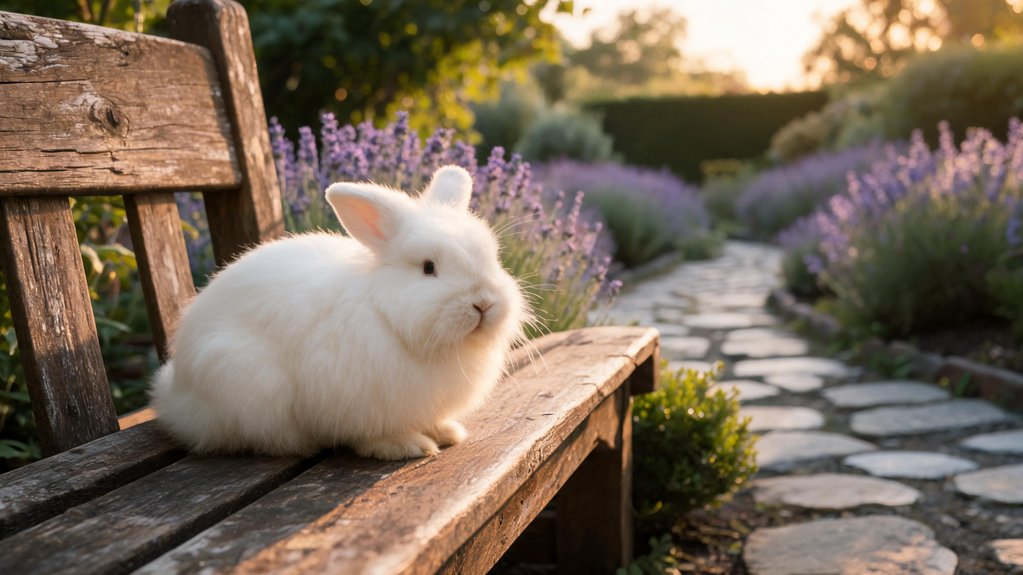
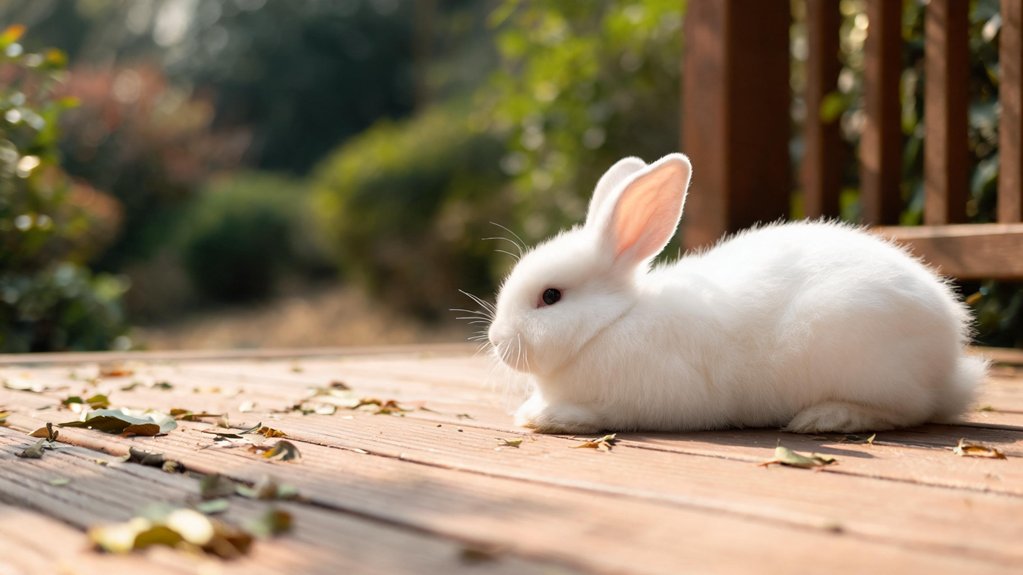
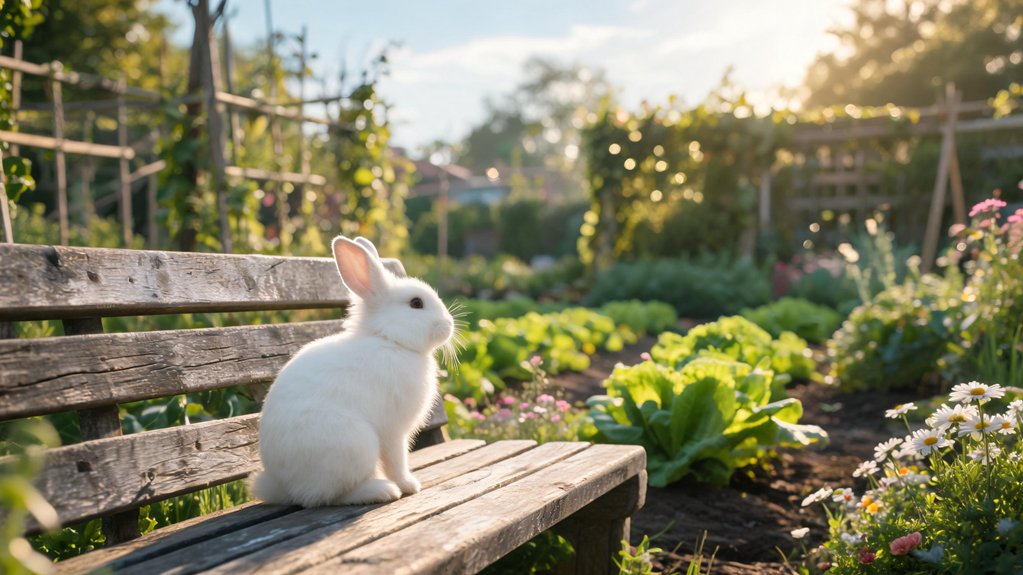
If you want a friendly, medium-to-large rabbit, the American Rabbit in American Blue fits great. You’ll see 9–12 lb bucks, 10–12 lb does, with a sturdy mandolin body and 16–20 inch length. Their coat should be rich slate-blue, solid from skin to tip, with no white hairs. Feed 80–90% grass hay nonstop, use timothy pellets ~1/4 cup per 5 lb daily, and keep treats small. Brush with “flyback” strokes once or twice weekly, daily during molts. Want the full care checklist?
Swift Summary
- American Blue rabbits are medium-to-large (about 9–12 lb bucks, 10–12 lb does) with a classic sturdy body.
- The coat is uniformly rich dark slate-blue, with no white hairs, no sandy/rust shading, and dense glossy “flyback” fur.
- Grooming uses gentle flyback brushing with the grain, weekly off-molt and daily during spring/fall molts, focusing on loose-fur removal.
- They’re typically calm and docile, handle safely with hindquarter support, and live about 8–12 years with good care.
- Health watchpoints include GI stasis, dental disease, and sore hocks; seek same-day vet care for anorexia or hunched lethargy.
American Rabbit (American Blue) Quick Facts
If you’re researching the American Rabbit (American Blue), you’re looking at a medium-to-large rabbit breed with that classic, sturdy look. The american rabbit typically weighs about 9–12 lb for bucks, and 10–12 lb for does, with a body length often around 16–20 inches. Plan for roughly 8–12 years with good care. The american blue rabbit stands out with rich, dark slate-blue fur, solid from skin to tip, no white hairs. dark slate-blue runs uniformly through the coat, which helps distinguish it from lighter blue-gray or mixed-toned “blue” rabbits. You’ll also notice short-to-medium, dense, glossy “flyback” fur, it smooths back fast when you pet it.
Origin Story and ARBA Recognition
American Rabbit’s story starts in Pasadena, California, where breeder Lewis H. Salisbury developed it in the early 1900s.
American Rabbit’s story begins in Pasadena, California, where Lewis H. Salisbury developed the breed in the early 1900s.
You’re looking at a multi-purpose farm rabbit, bred for meat and for fur quality.
He aimed for a consistent mandolin body shape and a deep, even blue coat.
He kept his exact founding crosses secret, so historians still guess.
Early on, exhibitors called it German Blue Vienna.
In 1918, Charles S. Gibson noted, “Formerly Called German Blue Vienna.”
During World War I, breeders renamed it to avoid German ties.
You can thank 1917–1918 showings and standards for ARBA-line recognition.
Size, Weight, and Ideal Body Type
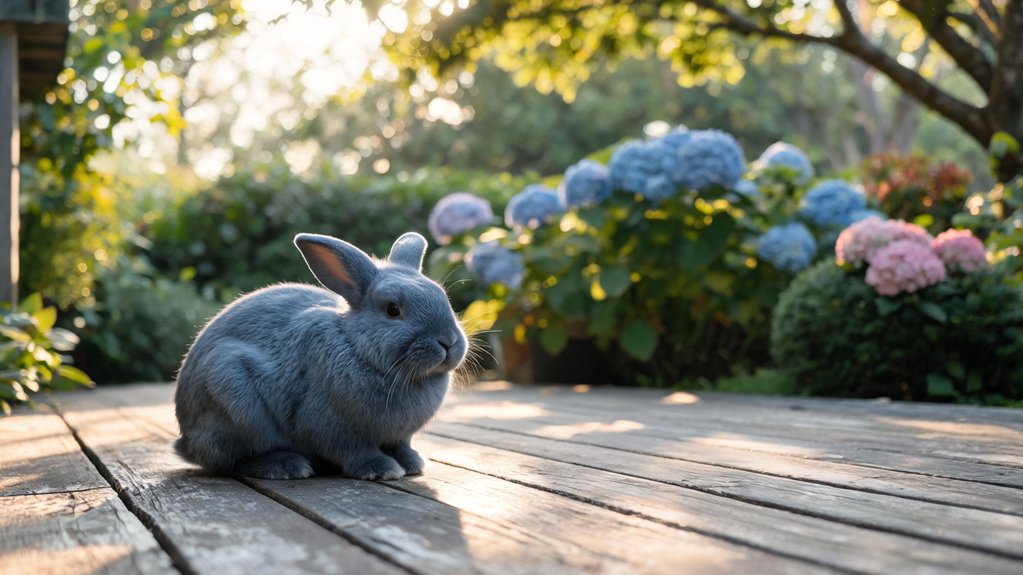
Once you picture an American as more than “a big bunny,” their size and body type start to make sense.
Aim for a medium-to-large rabbit, typically 9–12 lb, with about 16–20 inches long.
At the shoulder, expect roughly 14–16 inches. They were developed as early as the first years of the 1900s, which helps explain why this breed was historically selected for a substantial, showy body type.
You’ll notice the mandolin, or semi-arch, body type.
The topline rises gradually from the shoulders, peaks over the hips, then curves down toward the tail.
Bucks often run about 9–11 lb, while does are commonly 10–12 lb.
Because they’re substantial, give roomy space and soft footing to help prevent sore hocks.
American Blue Coat Color Standard
When you evaluate an American Blue, you start with the coat color, because that rich, dark slate-blue look is the breed’s defining feature. You want uniform color, with no white hairs, no sandy or rust shading, and no uneven patches. Look for slate-blue pigment running from skin to tips, not fading near the base. The undercolor should be slightly lighter, but still harmonious, so the whole fur depth matches.
Feel the flyback fur: dense, soft, fine, and silky, smooth and sleek, no matting. Then check eyes, nails, and footpads. In judging, color counts heavily, so get it right.
Comparing American Blue to White American Rabbits
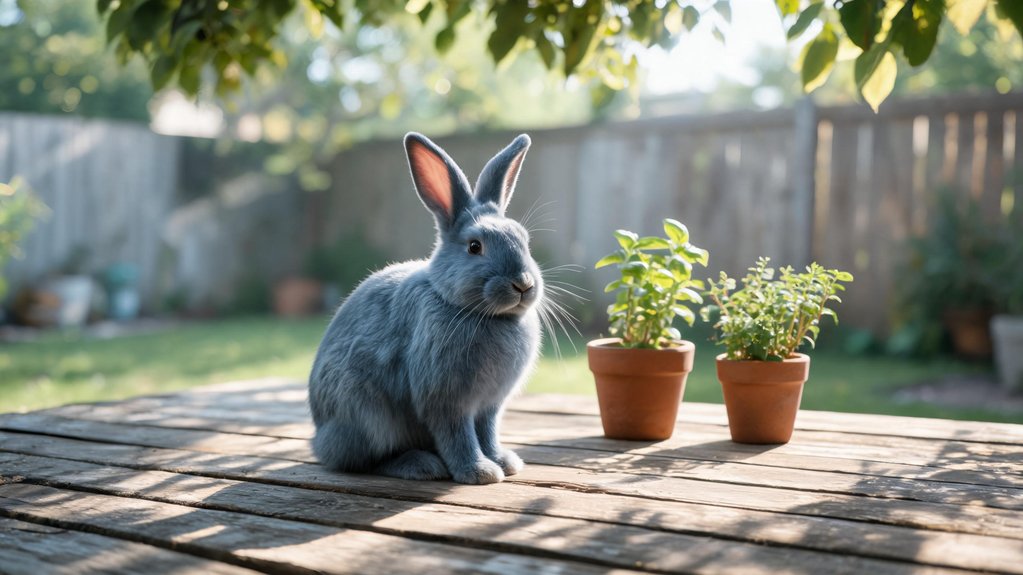
When you compare American Blue to White, start with coat standards: Blue is a colored, pigmented variety, while White is the albino/red-eyed white (REW) variety with no visible pigment.
Next, check eye color—White should show pinkish red eyes for REW, while Blue keeps the pigmented, colored-eye look—and remember that “blue-eyed white” rabbits are usually treated as sports outside the standard.
Finally, plan your breeding with that in mind, because mixing colors can change what shows up in the litter, and you’ll want to choose mates that match the right variety goals.
Coat Color Standards Compared
American Blue and American White may both fall under the American Rabbit name, but their coat color standards ask for very different “looks,” and you’ll notice that fast at show time.
For Blue, you aim for uniform, rich, dark slate-blue from nose to shoulders, flanks, and hindquarters, with no white hairs, sandy shading, or rust-colored tinges.
That deep, even color matters, because dull or uneven blue stands out.
For White, you present pure, clean white—bright and unmarked, with no colored strands.
You also protect it from staining, because sun can cast blue sandy, and white looks “dirty” quickest.
Care for each accordingly.
Eye Color Classification Differences
Eye color is one of the fastest ways to tell an American Blue from a White American, even before you look at the rest of the coat.
In Blue rabbits, you want bold, dark gray-blue eyes, inky enough to match the slate-blue look.
In White Americans, you’re looking for red-eyed, albino eyes—bright red or ruby.
You may also see pink tones, since it’s still the albino (reduced pigment) eye look.
But if a white rabbit shows blue eyes, breed guides treat that as nonstandard, so don’t count it for show.
Breeding Implications And Sports
Breeding American Blue and White American rabbits is basically a balancing act between genetics, show goals, and real-life management of “sports”—that’s when a rabbit shows an unusual color or eye pattern compared to its variety.
Blue Americans trace to blue lines, while White Americans started from white sports and got added White Flemish Giant ancestry, helping fix the albino, red-eyed white expression.
You share the same body type, size class, and six-class standard, so only the coat color steers show eligibility.
For show stock, you keep solid uniform blue in Blue lines.
For White lines, cull off-color sports, or redirect them to non-show use.
Temperament and Handling Tips
With their steady, calm nature, American Rabbits usually make you feel like you can breathe easier—docile, gentle, and often pretty laid-back rather than needy. They tolerate noise well, yet they may get skittish with unfamiliar people.
So, socialize slowly, use steady routines, and handle in quiet moments.
When you lift, keep hands firm and secure.
Always support the hindquarters, because skipping rear support can risk spinal injury from strong kicks.
Use one arm under the chest, the other cradling the hips and back legs, and hold the rabbit close.
Never lift by ears, scruff alone, or legs.
Lifespan and Factors That Affect Longevity
When you bring an American Rabbit home, plan on a lifespan of about 8–12 years with good domestic care. You can help them live closer to the top end, by focusing on housing, diet, and stress.
Keep your rabbit indoors if you can, because outdoor life often drops to about 3–5 years. Choose clean, spacious housing, secure and cool—aim below about 85°F with good ventilation.
Feed mostly hay, plus small amounts of leafy greens and quality pellets. Fresh water matters too.
Spay or neuter, get core vaccines, and schedule routine vet checks for early dental and gut issues.
Common Health Issues in American Blue Lines
Because American Blue rabbits (like other American rabbits) are usually larger and more laid-back, they can be more prone to a few health problems you should watch for closely.
First, GI stasis—gut motility slowing or stopping—can become life-threatening fast. Watch for fewer or no fecal pellets, anorexia, hunched posture, teeth grinding, and major lethargy. If appetite or feces stops, seek same-day vet care. Common causes include low-fiber diets, dehydration, pain, stress, obesity, and sudden diet changes.
GI stasis can become life-threatening fast—watch for fewer pellets, anorexia, hunched posture, teeth grinding, and urgent vet care.
Next, dental disease from overgrown teeth shows as drooling, messy chewing, weight loss, and selective eating.
Also, sore hocks—pressure sores—flare with wire floors or excess weight.
For does, uterine tumors are a high risk.
Grooming a Slate-Blue Coat
You’ll want to brush your slate-blue American Rabbit with gentle flyback motion, meaning you follow the way the fur naturally lays, lifting loose hairs without yanking.
But the real win is preventing white hairs from staining—keep up a once or twice a week routine off-molt, and switch to daily brushing during spring and fall molts until shedding really slows. A brush designed for routine grooming and loose-fur removal suits these frequent molt sessions well.
Work in short, systematic passes over the back, sides, chest, belly edges, and hindquarters, so the coat stays that rich, even dark blue close to the skin.
Brush With Gentle Flyback Motion
So you want that slate-blue flyback coat to look smooth, not messed up—and it starts with how you brush. You aim with the grain, so the fur that snaps back after a stroke stays aligned, silky, and glossy. Use a grooming comb or soft brush with rounded tips. Keep your setup calm, your feet non-slip, and your tool nearly flat.
Start on the back first, then go shoulder to hindquarters, short strokes, light pressure. Do the other side next.
Then lift the front to brush the belly gently. Finish with a hand check along spine, sides, and hindquarters.
Prevent White Hairs Staining
To keep a slate-blue American Rabbit looking clean, focus on what touches those light guard hairs, especially around the belly and hindquarters.
Keep the enclosure clean and dry, change litter often, and move the litter box so the back end stays away from pooled urine.
Use absorbent flooring, like fleece over puppy pads, so sitting spots don’t stay wet.
Check the fur near the vent and tail daily.
If you find dampness, gently spot-clean with warm water, then dry fully.
For irritation, use a vet-recommended barrier cream.
Lightly dust corn-starch powder on slightly damp fur to reduce clumping and staining.
Housing Setup for Comfort, Safety, and Odor Control
When you set up housing for an American Rabbit, focus on comfort, safety, and odor control as a team effort.
Aim for about three-fourths sq ft per pound of mature weight, and plan space at least four times their body length so they can stretch and stand tall.
Create zones: a litter corner, dry resting area, and a clean spot for water. Choose an absorbent, low-dust litter for the litter corner, since the material you pick strongly affects odor control and cleanliness.
Use solid resting platforms, plus washable flooring and a non-slip mat outside the litter box.
Ventilate well to prevent ammonia buildup, clean daily, and remove droppings often.
Secure latches, sturdy wire, and rabbit-proof cords, too.
Feeding Guide: Hay, Pellets, and Treats
Now that your American Rabbit’s home helps with comfort and odor control, let’s fuel that happy routine with the right foods.
Feed 80–90% grass hay, like timothy, oaten, or orchard grass. Offer it nonstop, and give a hay amount about equal to your rabbit’s body volume, or at least one big bundle daily. Timothy hay is a strong everyday choice because its long, high-fiber strands support steady digestion and help wear down continuously growing teeth. And yes, skip alfalfa for adult house rabbits. It’s often too rich, raising risks for weight and urinary issues.
Pellets stay around 5% total: timothy-hay-based, no grains or sugary bits. For adults, measure about 1/4 cup per 5 lb daily.
Treats stay ≤5%: 1–2 teaspoons veggies, or 1–2 ounces max fruit, just once or twice weekly.
Training and Enrichment for a Calm Rabbit
A calm American Rabbit doesn’t just “happen,” it’s something you build with everyday choices. Handle gently, support the chest and hindquarters, and keep your voice quiet. Use minimal restraint, and stick to a steady daily routine.
And when you train, try clicker training: pair a click sound with an immediate food reward, then mark calm moments like approaching you or sitting still.
Keep sessions short, about 3–5 minutes, with breaks.
Use a target (a stick or hand) to guide attention.
Next, enrich their space: tunnels, boxes, low climbs, and a digging box with soil or shredded paper.
Scatter hay foraging, plus puzzle feeders, reduces stress and boredom.
Typical United States Price and Buying From Breeders
When you shop for an American Rabbit from US breeders, you’ll usually see pet-quality bunnies priced around $30–80, while show-quality rabbits with champion bloodlines often run about $100–250.
But if you’re buying meat-focused rabbits or taking advantage of bulk deals, some sellers list them as low as $20–25 each—just confirm age and health first.
And if you’re buying from an ARBA-focused breeder, ask what “pet vs. show quality” means for your exact rabbit, because paperwork, markings, and spay/neuter records can nudge the price up.
Typical Price Ranges Nationwide
If you’re hunting an American Rabbit (and the rarer American Blue), your best starting point is a realistic budget, because prices vary a lot by quality and where you buy.
Most nationwide listings put American Rabbits around $20–$50.
Heritage American Blue from small breeders often lands near $30–$60.
Pet-quality rabbits from breeders commonly run $30–$80, while companion guides estimate about $50–$100.
If you buy breeder-stock more directly, expect $75–$250.
Show-quality and documented pedigree can push higher, often $100–$250+.
Compare age, purpose, and location.
Buying From ARBA Breeders
Starting with ARBA breeders is one of the smartest ways to buy an American Rabbit—especially if you want the American Blue variety—because you’ll be working with people who use breed-focused records and follow the ARBA (American Rabbit Breeders Association) framework.
Use the ARBA breeder listing to find rabbitries by breed, then contact them using the phone or email shown.
Verify the breeder’s ARBA membership status, check the breed specialization in the listings, and ask about birth dates and documentation.
Next, connect with the national American rabbit club links for extra directories.
Finally, plan pickup transport, and confirm health expectations before you bring your bunny home.
Who American Blue Rabbits Suit Best (and Who Should Skip Them)
Choosing an American Blue rabbit can feel exciting, especially if you want a big, calm rabbit with a sweet, steady vibe.
You’ll do best if you’re committed to daily care routines, gentle handling, and supervised grooming or health checks.
Their lower energy helps in quieter homes, and their docile nature can work well with older kids and respectful adults.
You’ll also want space, since their ARBA size means larger housing and several hours of floor time daily.
But skip them if you want a low-effort pet, have limited space, or rely on rough, unpredictable handling—young kids may trigger defensive nipping.
Frequently Asked Questions
Are American Blue Rabbits Actually Slate-Blue, or Is “Blue” a Broader Color?
You can verify the theory: American Blue rabbits are meant to be true slate-blue. ARBA’s variety label “Blue” stays broad, but the standard requires deep, even slate-blue down to the skin, with no white hairs.
What ARBA Disqualifies American Blue Entries From Shows?
You’ll get disqualified if your American Blue shows disease or altered appearance, lacks a legible permanent earmark, or gets mis-entered. Exhibitor misconduct, suspension, or fraudulent info also wipes your entry.
How Can I Confirm My Rabbit’s Eye Color Matches the Variety?
Visually verify eye color in good, natural light: compare your rabbit’s irises to ARBA variety photos. Blue should look bold dark gray-blue; White should show ruby/pink-red. Record what you see and confirm pedigree registration too.
Do American Blue Rabbits Shed Less Because of Their Flyback Fur?
No—you don’t get less shedding from flyback fur. American Blue rabbits shed year-round and usually shed more in spring and fall. Flyback fur just returns quickly and makes brushing simpler, especially during molts.
Where Can I Find Reputable Breeders or Rescue Contacts for American Rabbits?
You can find reputable American rabbit breeders by contacting ARBA’s breeder networks and local ARBA clubs through its office; for rescue options, check House Rabbit Society chapters or the House Rabbit Network directory.