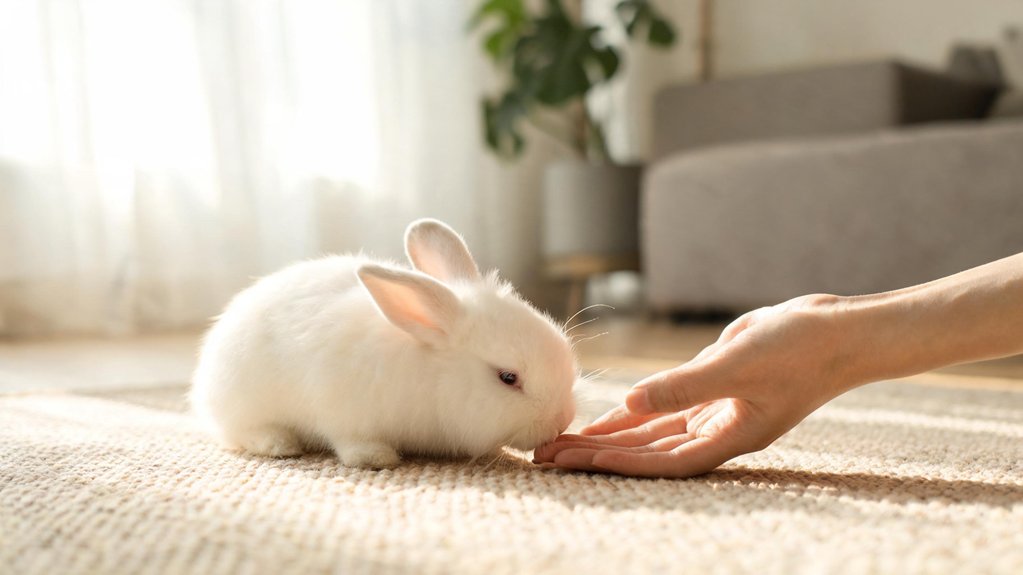
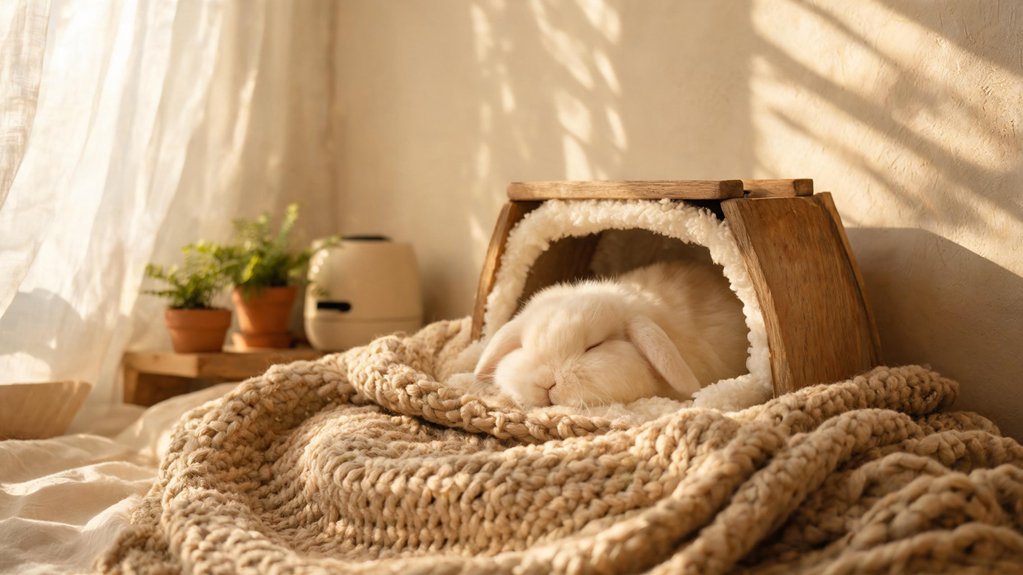
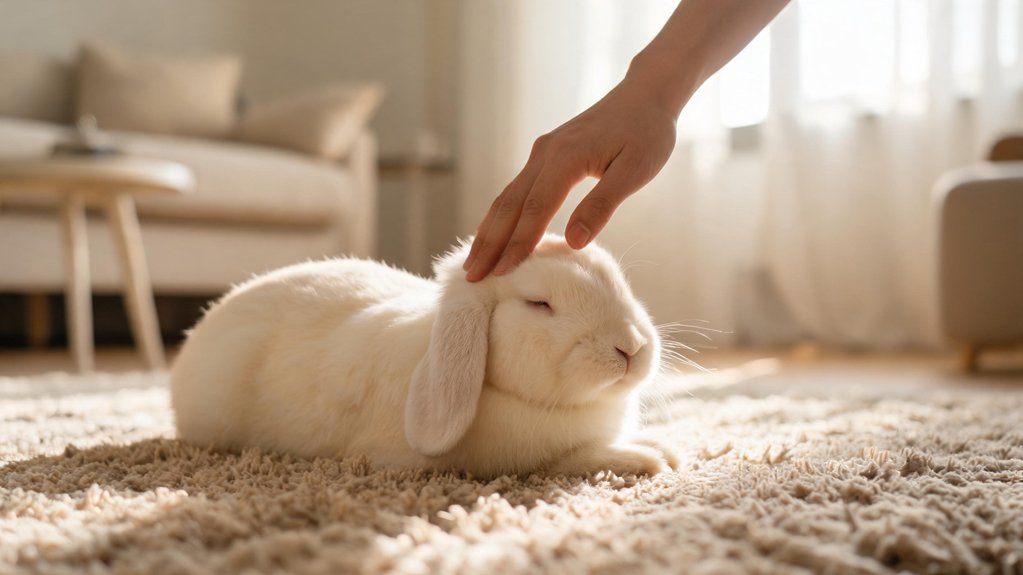
Pick your indoor setup by goals first. Start with a cage as your bunny’s cozy home base, not the whole home—aim for at least 3–4x their stretch length, plus enough height to “periscope” ears upright. Next, add a solid-floor pen with 24-hour access, about 10 ft x 6 ft x 3 ft for two small–medium bunnies. Give constant timothy hay, a deep litter box in one corner, and a hide. Then, only when you can supervise, free-roam in a rabbit-proof room with cord guards and blocked routes—there’s more to tune safely.
Swift Summary
- Choose housing based on rabbit-proofing and supervision: free-roam room, exercise pen, or cage-with-attached run.
- Plan minimum space: ~10ft x 6ft x 3ft for two rabbits; at least 32 sq ft (4×8) baseline.
- Ensure cage fit: length 3–4x fully stretched body length, and height allows upright ears without touching.
- Set up essentials everywhere: unlimited hay on an off-the-floor rack, litter tray, water bowl, and a secure hide.
- Protect feet with solid, non-slip flooring; avoid wire/slats and slippery surfaces to prevent sore-hock injuries.
Pick Your Indoor Rabbit Housing Goal First
First, pick your indoor rabbit housing goal before you buy anything, because it decides everything—space, setup, even where your bunny room (or bunny corner) goes. Use this indoor rabbit checklist: aim for at least 10ft x 6ft x 3ft permanent space for two small to medium rabbits, and more is better. Priority for physical and emotional health is what guides the layout, enrichment, and supervision you’ll be able to maintain day to day.
Start by setting your indoor rabbit housing goal—your space needs, setup, and bunny corner location all flow from it.
Next, plan 4+ hours daily movement, with 24-hour access to an attached run or pen.
Treat cages as resting areas, not the whole home.
Keep asking how to keep a rabbit indoors safely, choose a quiet spot, use secure barriers, and rabbit-proof wiring. That’s where house rabbit pros and cons feel real.
How to Choose Cage vs Pen vs Free-Roam
So, should you pick a cage, a pen, or a free-roam setup for your rabbit? Most indoor rabbit experts favor a large exercise pen or a rabbit-proofed free-roam room, and you use the cage as a secure “home base” only. Aim for more floor space, because a cage often offers just 4–8 sq ft, while pens can give about 16 sq ft or more, like 60+ sq ft when you can. Minimum 32 square feet (4×8 ft) is a commonly recommended baseline target for one rabbit. Choose based on your space, rabbit-proofing skills, and how often you can clean. If you’re busy, pick pen-plus-cage for safety, then expand.
Indoor Rabbit Housing: Pick the Right Cage Size
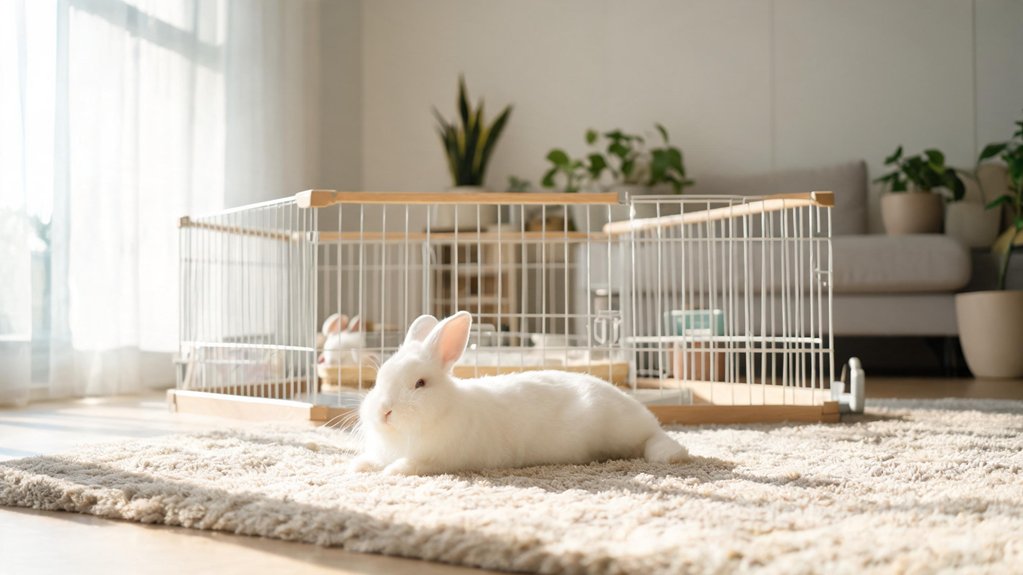
When you set up an indoor cage, don’t guess—start with minimum space guidelines based on your rabbit’s weight, and plan for more than the bare minimum whenever you can. Next, size the floor using the rabbit-length rule: aim for a cage length about 3–4 times your bunny’s fully stretched body length, so they can rest and make quick little hops. Minimum cage size Finally, pick a roomy height—about 16 inches minimum—so they can stand up on their hind legs with ears held comfortably, not pressed into the top.
Minimum Space Guidelines
To keep your indoor rabbit happy and healthy, you should size their “home” by floor space, not just by what fits in your room. Use minimum rabbit space targets, so your bunny can stretch, hop, and rest without feeling cramped.
For one rabbit, aim for about 8sqft base area, and add roughly 24sqft exercise space for daily time.
Many indoor rabbit pens use indoors rabbit pen size of 4ft x 2ft (about 8sqft) as a permanent floor base.
If you’re planning a bunny room setup guidelines style room, build bonded pair space to about 10ft x 6ft x 3ft, continuous.
Rabbit-Length Sizing Rule
Measure once, size right, and you’ll dodge a lot of stress—especially if you’re building a “bunny room” instead of using a tiny box.
Use the rabbit body-length sizing rule: stretch length from nose to rump (base of tail), when your rabbit rests relaxed.
For rabbit cage size, many guides aim for at least 3x that stretched length, so your rabbit can fully lie out and turn. Some use 2x as a bare minimum, but 3–4x is ideal for comfort.
For a typical small rabbit, that often lands near 3 ft, medium near 4 ft, large near 5 ft.
Height For Comfort Standing
A rabbit needs more than floor space—you also need enough height for “periscope” standing, where they rear up on their hind legs with their ears fully upright. When you keep rabbits indoors, plan rabbit cage height to match that behavior.
In the US, the Animal Welfare Act minimum interior height is 14 in, but that’s just legal, not comfy.
For comfort, aim for standing upright ear clearance: at least 16–17 in in the pen, and often around 1 m for pairs.
Make sure the ears don’t touch the roof, so they can stretch and hop safely.
Check weekly.
Adjust sooner.
Build a Solid-Floor Cage to Protect Feet
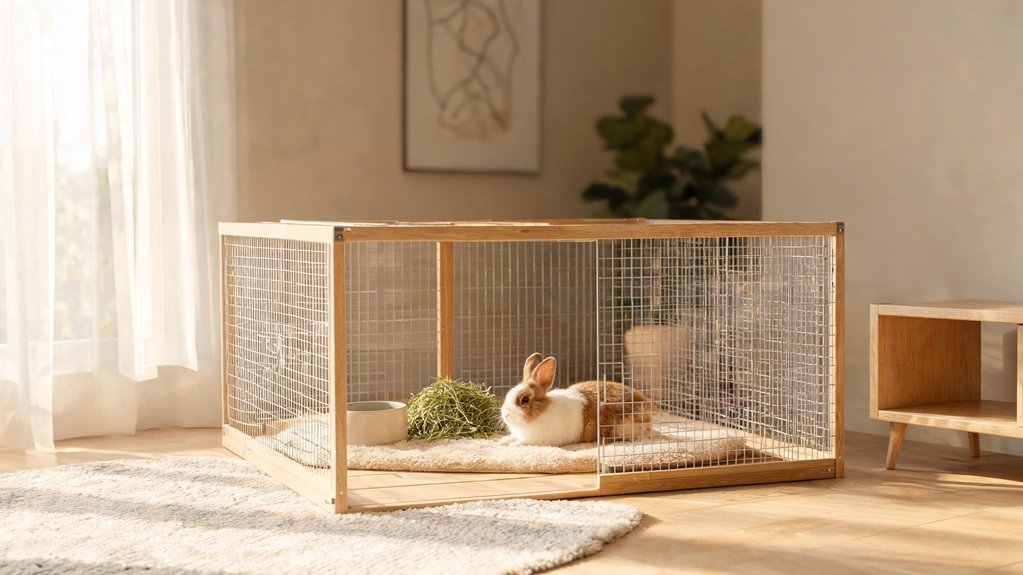
When you set up a “bunny room” indoors, build your cage around one big goal: protect those little feet.
Start by deciding: should rabbits be kept in cages, is it ok to keep rabbits in a cage? Yes—when the floor is right.
Skip wire, grid, or slats that pinch and rub. Choose a solid, dry, non-slip, non-abrasive base for what should rabbits have in their cage.
Use a washable, low-pile rug, rubber-backed mat, veterinary fleece, or textured vinyl.
Avoid slippery tile.
If upgrading, cover at least half the floor with locked-in solid boards.
Add soft pads for resting.
Mats chosen for comfort, grip, and safety give rabbits a surface that supports their feet.
Cage Essentials: Hay, Water, Litter, Hides
Start with the basics that keep an indoor rabbit healthy and comfortable: hay, water, litter, and a safe hide.
Start with the basics that keep an indoor rabbit healthy and comfortable: hay, water, litter, and a safe hide.
For what’s needed for a rabbit cage, give constant hay provision in cage—timothy (or other grass hay) via a hay rack off the floor. For daily feeding, choose fresh, sweet-smelling timothy hay, since hay quality directly affects a rabbit’s digestion and overall health.
Put a layer of hay over your rabbit litter box so they can eat and go at once.
Use a large tray, about 2–3 inches deep, with paper-based litter.
Place the box in the corner they already choose, and spot-clean daily.
Provide clean water in a heavy ceramic bowl or bottle.
Add at least one hide per rabbit, for calm rest.
Set Up an Exercise Pen for Daily Movement
Choose a pen size and layout that actually lets your bunny move, aiming for about 8–12 sq ft minimum, and more like 16+ sq ft if you can. Set it up with a height of roughly 30–36 inches, so your rabbit can’t hop over, and keep the center mostly open for a few straight hops and a comfy flop. Then add solid, non-slip flooring like linoleum or rubber-backed mats, plus secure barrier edges so there are no escape gaps wider than about 1.5 inches. A Midwest exercise pen offers a flexible enclosure suited to exercise and supervised play, whether indoors or outdoors.
Choose Pen Size And Layout
A good rabbit “bunny room” setup starts with the right exercise space, so your buddy actually moves every day. First, size it: for one rabbit, aim for at least 32 sq ft, often a 4×8 ft pen.
For two rabbits, give 40–48 sq ft total, like a larger shared pen, with extra room for quiet breaks. For bigger breeds, connect pens.
Do you need a cage for a rabbit, which is rabbit house? Yes, but daily movement comes from the pen. Next, pick 30–36 in height, or 36–42 in for jumpers.
Finally, plan a long running lane along a wall, and place doors so supervised laps continue. Keep latches secure.
Add Solid Flooring And Essentials
Once you’ve set up the pen size and layout, you’ll want to make the floor safe and comfy—because slippery surfaces make bunnies hesitate, and sore feet can follow.
Choose solid, dry, non-slip flooring, not wire or bare tile. Use sealed vinyl, linoleum, epoxy-coated concrete, plywood with vinyl/FRP, or hard plastic mats, and cover any wire grates.
Add traction, low-pile rugs or yoga mats, plus cushioning like veterinary fleece over absorbent layers.
Then place a big litter box, keep hay in reach, and offer steady water in a heavy bowl.
This helps you answer: is it ok to keep rabbits indoors, is it ok to have a rabbit in the house, is it ok to keep a rabbit in my bedroom.
Pen Layout: Litter, Hay, Water, Chew Toys
A solid pen setup makes indoor life easier for both you and your bunny.
Put an uncovered, roomy litter box in one steady corner.
Choose paper-based, non-clumping bedding, newspaper on the bottom, and timothy hay on top.
Add a low side so your rabbit can enter easily.
Keep the toilet area away from sleeping and resting zones.
Place hay in or just above the litter box, plus a mounted hay rack off the floor. A litter box with an integrated hay rack combines toileting and hay access in one setup, which saves space in a compact pen.
Set heavy ceramic or stainless water in a different corner, clean daily.
Offer safe chew toys and cardboard hay tubs for digging.
Add Traction-Friendly Flooring for Better Zoomies
Traction-friendly flooring is one of the biggest upgrades you can make for a happy “bunny room,” because good grip helps your rabbit sprint, pivot, and brake safely during zoomies. If you use solid, non-slip surfaces, you help them run normally, explore more, and play without skidding.
Skip polished wood, laminate, and tiles, which can cause slips, falls, and painful injuries. Instead, lay washable flat-weave rugs or mats with non-slip backing, especially in main run routes and door thresholds.
For extra safety, add fleece or cotton layers over grippy mats, and choose carpet tiles or short-pile carpet. Rugs made for rabbit spaces combine comfort, traction, and floor protection, so your rabbit gets a grippy, cushioned surface while your household floors stay guarded.
Upgrade to a Pen System for All-Day Space
Upgrade your bunny room with an all-day pen system, and you give your rabbit the kind of space they can actually use.
Aim for one enclosed area about 3m x 2m (or roughly 8 sq ft resting plus ~24 sq ft exercise) for two medium rabbits.
Keep it one single block, like a rectangle or long L-shape, so they can run, jump, and binky.
Use walls around 30–36 inches (75–91cm) high to reduce jumping out.
Set clear zones inside: resting hide, food and water away from litter, and one toilet corner.
Use secure latches, stable corners, and a door that fully opens.
Set Up a Rabbit-Proofed Room for Free Roam
Before you let your bunny roam free, pick one calm, quiet room in your home, ideally away from drafts and heaters or radiators, because rabbits hate temperature swings.
Define “no-go” areas for ovens, open flames, and hot appliances, blocking them with doors, baby gates, or solid barriers.
Secure door gaps, fireplaces, stairways, and routes to other rooms with panels so they can’t roam unsupervised.
Next, protect cords by routing them through split-loom covers or lifting them up.
Put non-slip rugs or textured mats down, cover baseboards, and remove plants, cleaning sprays, and soft plastics.
Create a Secure Nighttime Home Base
Choose a solid floor base for your nighttime setup, aiming for at least 8 sq ft of enclosed space, then add exercise space so they can stretch—cover wire floors with washable towels or Plexiglass to protect sore feet and joints.
And protect cables while they’re confined, because chewing can happen fast at night; route cords behind furniture, use cord covers, or place them out of reach.
But if you’re using pens, set the pen height to 30–36 inches, and keep gaps around 1.5 inches or less so your bunny can’t squeeze under.
Choose A Solid Floor Base
A solid, nonslip floor base gives your indoor rabbit the safest “nighttime home base” you can. Choose solid surfaces first, because wire mesh and hard floors raise the risk of sore hocks, painful foot problems.
You’ll also want traction, so your bunny doesn’t slip.
Cover at least half of any wire area with solid plastic, Plexiglas, or untreated wood.
For open pens, use textured vinyl, foam puzzle mats, or low-pile rugs, and add a fleece or grass-mat layer for cushion.
Keep it clean and dry, because damp spots invite bacteria.
Protect Cables During Nighttime
At night, protect your rabbit from chewing and shock, because cords can be deadly.
Set up a nighttime home base with no accessible mains or low‑voltage cables inside your pen or cage footprint.
Push furniture flush to the walls, so cable runs behind it stay out of reach.
Route cords behind or above furniture, and along skirting boards or high wall paths, not across the floor.
Never tuck live cords under rugs or loose carpets.
Use spiral cable wrap or split wire loom on exposed wires, and mount rigid PVC trunking or hard cable channels on baseboards for fixed cords.
In your bedtime routine, unplug and store all unprotected leads in closed cupboards, first.
Supervise Free-Roam Time and Watch for Traps
Supervise your rabbit’s free-roam time like it depends on you—because it does. Set a timer, and only let your rabbit explore when you can watch nonstop.
Before each session, do a quick visual check for new hazards, like dropped pills, food scraps, or leftover cleaning residue.
Keep toxic indoor plants, chemicals, and human medicines locked up.
Remove chewable risks, like small toys, foam, soft rubber, and thin plastic bags.
And block off kitchen areas near stoves and ovens.
Keep doors closed, prevent cat or dog access, and never use traps indoors.
If you can’t watch, switch to a secure pen. Rabbit playpens offer a contained space for play and movement, so your bunny can exercise safely when you cannot watch closely.
Bunny-Proof Cords, Furniture, and Escape Routes
Before your bunny gets a room to explore, take 15–20 minutes to block chewing trouble—because cords and “grab-and-run” escape paths are where accidents happen fast.
Cover every reachable electrical or phone cord with heavy-duty plastic cord covers, split-loom tubing, or PVC pipe, or lift cords off the floor and tuck them behind furniture.
Don’t let cords run under rugs.
Use spiral cable wrap, tubing, or metal channels along baseboards.
Shield baseboards with transparent strips, Plexiglas, or a sacrificial wood bumper.
Then block escape routes with modular pens or wire grids around risky areas.
For extra protection, choose safe cable protectors that are designed to stop rabbits from chewing through electrical cords.
Common Indoor Housing Mistakes (and Quick Fixes)
If your rabbit’s indoor setup feels “small,” you’ll want to adjust it fast—under-sized confinement can stop normal hopping and stretching, so aim for about a 2’×2’×4’ minimum enclosure and build from there with real run space.
Next, check the floor: if you’re using full wire flooring, add solid protection (like a washable towel layer or Plexiglass) so their feet don’t get sore.
And even when you’re using a bigger space, don’t skip bunny-proofing—fast fixes like closing gaps, moving temptations, and keeping cords covered can save you from a midnight escape.
Under-Sized Confinement Spaces
When your rabbit’s “home base” feels more like a hallway closet, you can run into real welfare problems fast.
First, don’t use undersized cages as a 24/7 home. Minimum floor space exists for rabbits that still get daily out-of-cage exercise, not full-time confinement.
If you’ve got a compact unit, switch to a bigger indoor enclosure—aim for at least 6 ft x 3 ft x 3 ft, and for a pair, think about about 10 ft x 6 ft x 3 ft.
Also, check height. Rabbits should stand upright with ears not touching the top.
Add a connected exercise pen for hours daily.
Wire Floors Without Protection
Bare wire floors can turn your “bunny room” setup into a foot-problem factory, even if the cage is big enough.
Wire without protection presses on narrow spots on your rabbit’s feet.
Over time, that can thin protective fur on hocks and soles, leading to red, inflamed, ulcerated skin, called pododermatitis or sore hocks.
But you can fix it fast.
Add solid, padded resting areas, and aim to cover at least half the floor with plastic, Plexiglas, or wood.
Increase soft, clean bedding.
Keep things dry and spotless, and call your vet if you see sores.
Skipping Full Bunny-Proofing
Skipping full bunny-proofing sounds harmless—after all, you’ve got a “bunny room.” But without a quick, thorough check, your rabbit can get into trouble fast, from chewed cords and risky outlets to toxic plants and tiny objects they love to sample.
Match Setup to Kids, Dogs/Cats, and Supervision Time
To match your rabbit’s setup to your household, start with one simple thing: how closely you can watch them.
Match your rabbit’s setup to your household by starting with one key factor: how closely you can watch them.
High supervision? Use a rabbit-proof single room for free-roam, with constant monitoring and daily out-of-pen play.
Moderate supervision? Choose a large pen, about 4’x4’, then let them out for several hours.
Low supervision? Use a spacious cage plus an attached pen, keep doors closed when you’re busy.
For young kids, add sturdy latches, use baby gates, and keep play short—adult only, rabbit on the floor inside the pen.
With dogs, separate completely or introduce only leashed, supervised, brief sessions.
With cats, use solid-sided pens or cages, block jumping, and confine at night.
Frequently Asked Questions
Do I Need a Cage if I Have a Bunny Room or Pen?
You don’t need a cage if you provide a fully rabbit-proofed room or secure pen with hay, water, litter, hides, and safe flooring. Still, offer a small carrier or enclosed hide for stress-free resting, especially when you’re away.
How Do I Keep a Rabbit Indoors Long-Term Without Constant Supervision?
You can keep a rabbit indoors long-term without constant supervision by rabbit-proofing one safe zone, using tall pens or doors to block access, checking daily for chewing and hazards, and offering hay, water, litter, hiding spots, and exercise.
What’s the Best Bunny-Proofing Checklist for a Rabbit Room?
Use this bunny-proofing checklist: block escapes, cover all wires, remove toxic plants, secure heat sources, close doors and baby-gate entrances, cover slippery spots, remove hazards behind furniture, add hiding and chew/dig options, keep temps stable.
Can Rabbits Safely Live Indoors With Kids and Other Pets?
Yes—rabbits can live indoors, but you must manage risk like a fortress. With kids, you’ll prioritize calm, gentle handling and constant supervision. Keep dogs/cats physically separated; never leave them alone together unsupervised.
How Often Should I Clean the Litter Area Inside a Pen?
You should spot-clean your rabbit’s litter area daily, scooping droppings and wet spots 1–2 times. Then fully refresh the litter box every 2–4 days, and deep-clean weekly with hot, soapy water.