Keep your rabbits comfy by aiming for 50–68°F (10–20°C), ideally around 60–65°F. If it drops near freezing, move the hutch indoors or into a secure, well‑ventilated shed fast. Put the hutch on raised, well‑drained ground, facing away from wind, and block drafts with breathable panels. Add 4–6 inches of dry straw/hay so they can burrow. Check water twice daily to prevent freezing. Stay alert to damp bedding and cold stress signs—there’s more good stuff ahead.
Swift Summary
- Aim for indoor/covered shelter temperatures around 50–68°F (10–20°C), and move rabbits indoors when consistently below ~40°F (4°C).
- Place the hutch on raised, well-drained ground and shield it from wind and rain with a solid back facing the cold wind.
- Use deep, dry bedding (about 4–6 inches) and avoid damp straw, which increases pneumonia and sore-hock risk.
- Provide breathable draft control—use tarps or panels with gaps; don’t fully seal the hutch to prevent condensation and ammonia buildup.
- Prevent frozen water by insulating bottles and checking water at least twice daily during freezes.
Winter Rabbit Care: Safe Temperature Ranges
When it comes to winter rabbit care, think “steady comfort” first. Aim for 50–68°F (10–20°C) in their space, with many rabbits happiest around 59–68°F. For routine comfort, stay near 60–65°F. If you’re wondering what to do for rabbits in the winter, watch the temperature, because below ~50°F (10°C) can be risky. Cold-sensitive and sensitive to heat stress, rabbits do best when their environment stays consistently within that safe 10–20°C band. Shelters should ideally stay above 32°F (0°C). And if you’re asking, “is my rabbit too cold,” check for shivering, cool ears, or lethargy—especially in young, sick, elderly, or post-surgery rabbits.
Pick the Right Spot for Winter Hutch Safety
Pick a winter spot that shields your rabbit from wind, rain, and sleet, with the solid back facing the cold or north wind and the front turned away from drafts. Set the hutch on a raised, well-drained area under roof cover, so snowmelt and water can’t pool or soak the bedding, and use a fitted cover with ventilation gaps if you need extra protection. Remember that a cover alone does not guarantee safe temperatures, so combine it with the right location and bedding. In winter, sleeping areas should be insulated with newspaper and plenty of hay, always keeping them dry. When frost really hits, move your rabbit indoors to a garage or shed setup that stays dry and warmer, especially if you notice your rabbit acting chilled.
Shield From Wind And Rain
Find your winter hutch spot like it’s your rabbit’s warm little home base—because wind and rain can steal heat fast.
To keep a rabbit warm in the winter, block bad weather first.
Face the back of the hutch toward the north or prevailing wind, and aim the front south or east for calmer air and a bit of sun.
Place it near a building or solid fence for a windbreak.
Raise the hutch 4 to 6 inches off wet ground, and check legs for stability, so ventilation stays sufficient even with wind-blocking materials.
Use three enclosed sides, a covered front, sealed cracks, and plastic panels to stop wind-driven rain.
What to do with rabbits in winter? Keep them dry.
Move Indoors During Frost
Once you’ve blocked wind and kept the hutch dry, you still need a winter plan for frost days.
During freezing weather near 0°C (32°F), move your rabbit’s hutch indoors or into a secure, well‑ventilated shed or garage. Aim for about 10–20°C (50–68°F).
If temps drop to around −12 to −9°C (10–15°F), bring them in fast, especially to protect ears from frostbite.
Use gradual acclimation, and keep air fresh with good ventilation.
Choose a predator‑proof space, not a drafty window corner.
Provide a small exercise area, so they stay active without overheating.
Place Away From Draughts
Place your rabbit’s hutch so it’s sheltered, dry, and not in a cold draft.
And choose a spot that blocks wind, rain, and snow, like a lee side near a wall or fence.
Put the solid back toward the prevailing or north wind, and face the front toward sun when you can.
Avoid low, open areas where cold air pools.
Raise the hutch at least 10 cm off the ground, and keep bedding away from damp spots.
But also don’t seal ventilation—cover sides lightly in winter, and check daily for pooled water or snow.
Insulate the Hutch Without Sealing It Up
To keep your rabbit warm, insulate the hutch in a way that still lets air move. You want less wind, less heat loss, but never a sealed box.
Use breathable covers and panels, like a fitted tarp over mesh at night, but leave a deliberate gap so moisture can escape.
Clip solid panels over wire for wind, rain, and snow, and add small ventilation holes.
If you add rigid side covers, install them with intentional edge gaps.
Prefer double-wall insulation, like polystyrene inside, plywood outside, or straw packed between.
Check daily.
Replace any damp straw fast.
Add Deep Bedding for Burrowing Warmth
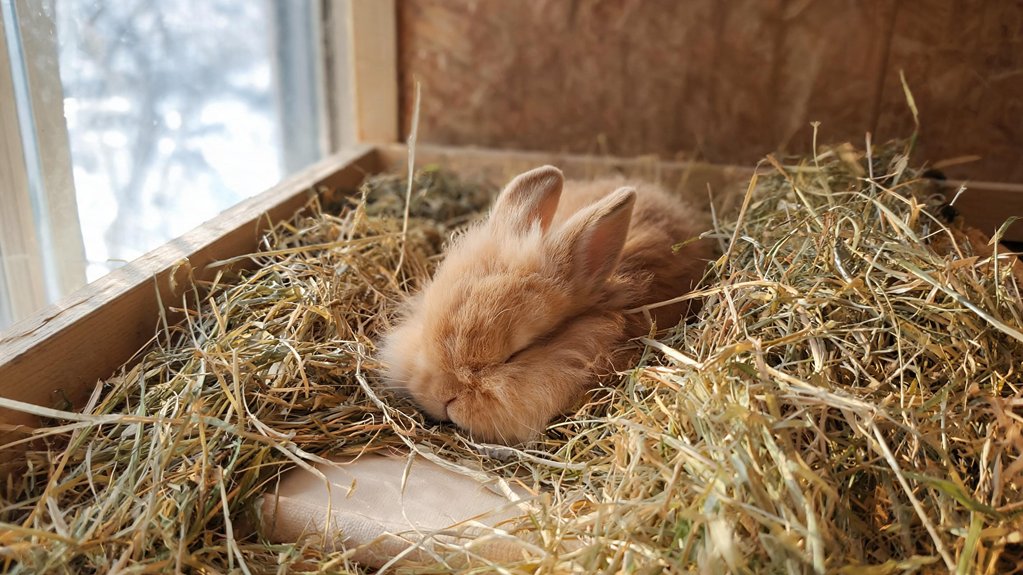
Deep bedding is what really helps your rabbit stay warm at night, and it also gives them a place to burrow.
In your outdoor hutch, build a deep, dry bed of insulating straw, hay, and absorbent liners.
Start with a dry base layer, then pile straw thickly—aim for 4–6 inches in the sleeping area, more if it’s very cold.
Pack it until the space feels full.
Straw’s hollow stems trap air, and your rabbit’s body heat warms the burrow pocket.
Check daily, remove any wet bedding, then top up clean straw or hay.
Wet bedding chills them fast.
Cover Hutches to Block Wind and Frost
When winter wind starts howling, you can keep your outdoor rabbit hutch much warmer by blocking frost and drafts with a weatherproof cover.
First, place a waterproof outer layer, like a fitted hutch cover or tarpaulin, over the shelter, and add an insulating layer underneath, like blanket, old carpet, or insulation board.
Add a waterproof fitted cover or tarpaulin, then layer insulation beneath to block drafts and keep your hutch warmer.
Cover the roof and down the sides, but leave a small ventilation gap at the top or side.
Cover most of the front at night in freezing weather, and uncover it in daytime for light and airflow.
Keep bedding dry, and keep the hutch raised about 10 cm off the ground.
Once the weather warms up again, remove the extra insulation so your rabbit doesn’t overheat, and consider a cooling mat for rabbits to keep them comfortable.
Use Clear Panels to Cut Drafts and Rain
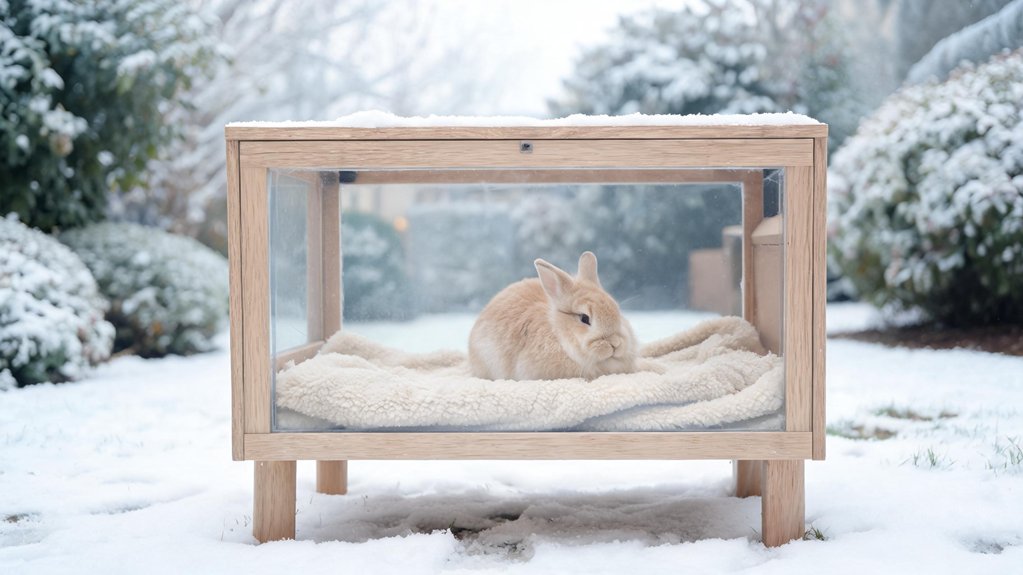
After you’ve blocked wind and frost with a weatherproof cover, you can cut drafts and driven rain even more by adding clear panels over the mesh. Choose outdoor-grade clear Perspex or plastic, rigid and weatherproof, so you still let in light. Pairing these panels with a weatherproof rabbit hutch gives rabbits protection from wind, rain, and frost while still allowing ventilation.
Mount panels on the windward side, especially near doors, and cover lower mesh areas where rain hits hardest.
Leave a few inches of open mesh above or below for airflow, so stale air doesn’t build up. Don’t seal everything tight, or trapped humidity can cause damp.
On dry days, open front panels for fresh air. Check fasteners weekly.
Keep Bedding Dry to Prevent Damp Illness
Keep bedding dry, because cold plus wet can make your rabbit sick fast.
Replace any wet bedding right away, and keep a deep, dry layer of straw in the sleeping area so it stays warm and won’t freeze.
But don’t trap damp air—improve ventilation (good airflow, without harsh drafts), and check daily for urine-wet spots so you can swap them before they turn into hutch burn (urine scald) or worse.
Replace Wet Bedding Promptly
Swap out any wet bedding as soon as you notice it, because damp mess chills your rabbit fast, especially outdoors, and it can also trigger damp-related illness.
Check daily, even in cold weather, because wet patches can freeze, then steal body heat and stress their immune system.
Remove saturated areas right away, then replace with fresh, clean, dry bedding.
Doing this cuts ammonia build-up from urine, which can irritate lungs and raise pneumonia risk.
Damp bedding also increases sore hocks, urine scald, and skin problems.
Keep housing waterproof and draft-proof, and ventilate well for cleaner, safer air.
Keep Straw Deep And Dry
Once you’ve removed any wet bedding right away, you’ll want to focus on the next big winter win: keep the straw deep and dry.
Spread rabbit-safe, dust-free straw thickly in the sleeping area, so trapped air in hollow stems insulates.
Aim for a deep layer, and add more during cold spells.
Let your rabbit burrow in a covered box, so warmth stays in.
Use straw as bedding, not hay—hay absorbs moisture and can freeze.
Add an absorbent underlayer, like paper-based litter, to wick damp away.
Keep hutches on raised legs, with waterproof roofs, and check often for leaks.
Improve Ventilation To Reduce Damp
Good ventilation matters, because in winter the moisture in your rabbit’s space builds up quickly. You want fresh air without strong drafts, so keep covers and tarps slightly open. Don’t fully seal your hutch.
Place the front away from prevailing wind, and make sure an air inlet above ear level, plus an outlet under the roof eaves. This lets warm, damp air escape.
When urine, respiration, and rain can’t get out, bedding turns damp, ammonia rises, and respiratory irritation follows.
Keep bedding dry, remove soiled areas daily, and aim for humidity below 60%.
Your rabbit stays warmer when the air stays dry.
Ventilate Properly to Prevent Ammonia Buildup
When winter weather moves in, don’t just focus on keeping your rabbit warm—make sure you ventilate properly, because ammonia builds up fast in closed hutches or sheds.
You want gentle, continuous airflow, not blasts of wind.
Add small, high vents or a ridge vent, so warm, damp, ammonia air escapes while your rabbit stays sheltered.
Keep vent openings covered with hardware cloth to stop predators and pests, and still allow airflow.
Also, clean droppings often, daily if you can.
And if you smell a strong “sharp” urine odor, don’t ignore it—improve airflow right away.
Protect Outdoor Runs From Rain and Snow
After you’ve got gentle airflow helping prevent ammonia buildup, turn your attention to keeping your rabbit’s outside run dry in winter, because wet fur chills fast.
First, install solid sloping roofing over the run, and extend the overhang past the sides to block driving rain and drifting snow. Use waterproof tarps or purpose-made covers, and secure them with eyelets, clips, or bungees so they won’t flap in wind.
Next, place the run in a sheltered spot, like near a wall or under an overhang. Add windbreak panels, and keep the run raised to avoid puddles and slush. Cold, damp conditions can make stiff joints more uncomfortable for older rabbits, so a dry, draft-free run also supports joint comfort during the winter months.
Prevent Frozen Water With Simple Bottle Hacks
To keep your rabbit’s water from freezing, start by insulating the bottle with a simple sleeve—bubble wrap, a pulled-on old sock, or pipe insulation works great, and it helps slow the freeze without hiding the water level.
Check water at least twice daily in freezing weather, and replace any frozen bottle right away so your rabbit never goes thirsty.
Also, don’t forget to check the metal spout too, because that can freeze first even when the bottle’s still liquid.
Insulate Bottles With Sleeves
A warm winter win is insulating your rabbit’s water bottles with a simple sleeve, so the water freezes more slowly and stays drinkable longer.
Start with a commercial thermal cover, ideally a snug, drawstring fit for common bottle sizes, it reflects heat away from cold air and reduces sun glare.
If you DIY, wrap bubble wrap around the bottle body, then slip on an old sock or fabric sleeve, and secure it with rubber bands.
Keep the drinking spout fully exposed so the valve works.
Then place the bottle inside the hutch, away from wind and precipitation, for best results.
In extreme cold, add heated bottles.
Replace Frozen Water Immediately
Even with insulated bottle sleeves, winter can still freeze your rabbit’s water fast—so you need a “swap it right away” plan.
Check water at least twice daily, then immediately when you see surface ice.
Keep prefilled spare bottles at room temperature indoors, ready to pour in the same spot fast.
When freezing starts, replace the whole bottle, not just the ice.
Use multiple water sources, like a covered bowl plus a bottle, so one stays drinkable between checks.
If the spout freezes or the ball won’t move, clear it or replace the bottle right away.
Avoid additives like glycerin; they don’t help much.
Feed for Winter Energy: Amounts and Timing
When winter hits, you can help your rabbit stay warm by adjusting feed in small, steady steps.
Increase total intake to meet higher energy needs, especially in severe cold, sometimes up to three times more than mild days.
Start by adding small amounts each day, not a big jump, to protect gut “flora” (helpful bacteria) and prevent upset tummies.
Keep hay first, always, with grass hay at about 80–85% of the diet, and free-choice.
Offer long-stem hay, too.
For pellets, use about 1–2 tbsp per kg body weight daily.
Feed greens in measured portions twice daily, but skip frosty foods.
Indoor vs Outdoor: When to Move Rabbits
Check the temperature each day, and if it’s dropping near freezing (32°F/0°C) or staying under about 50°F (10°C) for long stretches, plan to move your rabbit to a warmer indoor spot.
Move indoors for wet, windy cold right away—cold that’s damp hits harder and increases the risk of hypothermia (low body temperature) or frostbite.
But when you go back outside, do it gradually, starting with a few hours in sheltered weather and building up over several days so your rabbit can adjust without stress.
Check Temperature Thresholds Daily
Every day in winter, you should monitor temperatures, because rabbits can chill fast when the air keeps dropping.
Use indoor checks first. Keep your home room around 60–70°F (16–21°C), and don’t let it dip below about 50°F (10°C).
Record the day’s low and high on a simple note.
Then check outdoors.
If readings fall below 40°F (4°C) again and again, move your rabbit indoors right away.
Under 20°F (-7°C), treat it as urgent, and consider a vet call for warmth help.
Fast action protects health.
Move Indoors For Wet Cold
Move your rabbit indoors fast when winter turns wet and nasty, because “cold” alone isn’t the whole problem—dampness chills them much faster.
If rain, sleet, or snow soaks the hutch, or you spot draughty gaps and damp bedding, act right away.
Aim for dry, sheltered space before temps drop below freezing.
You should also move senior rabbits and any with chronic health issues indoors.
If you can’t use your main home, put the whole hutch in a car-free garage, shed, or enclosed porch.
Keep ventilation on, since warm stale air still harms.
Restore Outdoor Conditions Gradually
Once winter starts loosening its grip, you don’t want to throw your rabbit back outside all at once.
Start when daytime temps are consistently at least 50°F (about 10°C).
Begin with short, supervised daytime sessions, then gradually extend them as your rabbit stays calm and eats well.
Keep nights indoors at first, especially if temperatures drop fast.
Use a sheltered “in-between” spot first, like a shed or unused garage, with dry bedding and insulated, draft-blocked hutch placement.
Only move fully outside after several successful days, and skip any sudden cold snaps, wind, rain, or snow.
Watch for Early Signs of Cold Stress
Keep an eye out early, because cold stress in rabbits can start small and then move fast toward an emergency. Check your rabbit every few hours in winter.
Look for lethargy, less moving than usual, or hiding more. Watch their posture, too—if they hunch, crouch tightly, or curl into a ball, take it seriously.
Feel ears, feet, and nose. Cold, pale, bluish, or swollen ears or toes can mean circulation trouble or frostbite risk.
Also monitor appetite and droppings. Less eating or fewer droppings can follow.
Finally, notice breathing. Shallow breaths, weakness, wobbling, or collapse need urgent vet help.
Treat Hypothermia Immediately: Get Warmth Safely
If you suspect your rabbit has hypothermia, act fast—but do it safely.
Move them right away from the cold, away from damp hutches, snow, or rain, into a warm, dry, draft-free room.
Keep the space quiet, handle as little as possible, and use a ventilated carrier or box.
If they’re wet, towel-dry thoroughly.
Wrap in a warm, dry towel for insulation, then add deep straw or hay to reduce heat loss from the floor.
Warm slowly—don’t use direct hot surfaces, and never rapid warm-water baths.
Check a rectal temp; under 101°F needs help.
Watch breathing, gums, heart, and alertness.
Warm Safely: Towel-Wrapped Bottles and Pads
Warm help can be lifesaving, but you’ve got to do it safely—especially for a rabbit that’s cold or just recovering.
Use towel-wrapped hot water bottles or low-setting heating pads for gentle, local warmth.
Check the bottle surface with your hand first.
If it feels too hot, cool it down before wrapping.
Never place heat directly on bare skin.
Put a covered bottle or pad under part of a carrier or resting area, and leave the other side cooler, so your rabbit can move away.
If your rabbit is below 100°F (38°C), warm gradually toward at least 100°F.
Avoid Common Winter Hutch Mistakes That Backfire
Before you add any winter “helpers” to your rabbit’s hutch, pause and double-check what you’re blocking—because a few well-meant fixes can backfire fast.
Avoid fully covering the front with solid panels or tight tarps. You trap humid air, you get condensation, and breathing problems can follow.
Don’t blanket-wrap the hutch with no ventilation gaps. That stale air can also let ammonia build from urine.
Keep plastic, foam, bubble wrap, and thermal materials where chewing can’t reach them—chewing can cause serious stomach trouble.
Also, don’t move hutches into fully enclosed garages or sheds without openings.
Also, don’t move hutches into fully enclosed garages or sheds without openings—give your rabbit fresh air and airflow.
And don’t forget safe water checks every day.
Fix Condensation, Drafts, and Damp Bedding Fast
If your rabbit’s home feels damp or you spot droplets on the roof or cover, act fast: improve ventilation by leaving a hand-width gap or small opening, even in cold weather.
Then stop drafts immediately by turning the hutch away from prevailing wind, adding solid panels on at least three sides, and using a clear cover over a mesh door with airflow still allowed.
Finally, replace wet bedding the moment you notice it, and use a deep layer of hay or straw on top of a dry floor, because damp bedding saps warmth fast. Starting with a weatherproof outdoor hutch built for weather protection makes it easier to manage condensation and drafts all winter.
Stop Drafts Immediately
First, stop drafts fast, because cold air rushing into your rabbit’s sleeping spot can chill them even when the temperature isn’t “that bad.” Place the hutch where it sits away from prevailing winds, ideally under shelter or up against a solid structure like a shed wall, and point the front away from the dominant wind so air doesn’t blow straight through.
Next, block gaps and cracks in walls, doors, and joints. Cover wire mesh doors with plexiglass, wood panels, or similar rigid pieces.
Add tarps over roofs and vulnerable sides, but leave ventilation.
Finally, fit hutch covers or blankets with small airflow gaps, and use a draft-free inner nesting box.
Manage Condensation Build-Up
When warm, wet air from your rabbit’s breath and urine hits cold hutch surfaces, condensation can form fast—and damp bedding can follow.
Aim for balance: insulate the sleeping area, but keep moisture moving out.
Use mesh fronts or vents, not fully sealed sides.
Add a high-level vent or ridge vent so humid air escapes above your rabbit’s height, and keep humidity under about 60%.
Fix covers fast, too—leave a hand-width gap or built-in vent, roll front flaps up on dry afternoons, then remove covers briefly to air out.
Also check for roof leaks, and keep beds raised 18–24 inches.
Keep Bedding Dry Always
Keep your rabbit’s bedding dry all winter, because damp bedding chills them fast and can lead to sore feet and health problems.
Start with weatherproof, draft-free housing. Place the hutch away from driving wind and rain, face the back into the prevailing wind, use a sloped waterproof roof, and keep ventilation gaps so air doesn’t turn stale.
Raise the hutch at least 4 inches off the ground, in a sheltered spot, and stop any water leaks right away.
Then layer thick straw (10 cm+), add absorbent paper or pellets, and remove wet bedding daily.
Spot-clean toilet corners every day.
Winter Emergency Kit: What to Have Ready
A good winter emergency kit helps you act fast, so your rabbit doesn’t chill while you’re scrambling during a storm, power cut, or housing problem.
Keep a digital rectal thermometer (normal about 101–103°F), lubricant, and a pet-safe heating pad or disc.
Keep a digital rectal thermometer (101–103°F), lubricant, and a pet-safe heating pad or disc ready for emergencies.
Store non-electric backups: hot water bottle, microwavable pad, or heated stones.
Add straw and hay, extra dry bedding, fleece blankets, plus a weatherproof cover.
Prepare 3–5 days of hay, sealed pellets, and dried herbs, and several days of bottled water.
Pack syringes (1 mL and larger), Critical Care, plain pumpkin, simethicone, gauze, saline, and a flashlight.
Have a carrier ready.
Quick FAQ: Warming, Hydration, and Bedding in Winter
You can help your rabbit stay warm in winter by dialing in three basics fast: bedding, water, and safe extra heat.
How do you warm an outside rabbit? Keep hutches dry, insulated, and draft-free, aim for 50–68°F (10–20°C) inside if possible.
Raise the hutch off the ground, at least 4 inches.
Use deep straw in the sleeping area, topped up often.
Check water at least twice daily, and 2–3 times when it’s at or below 32°F.
Insulate bottles with a sock or towel.
Need extra heat? Consider a heated pad or lamp, with ventilation.
Watch for low energy.
Frequently Asked Questions
Can Rabbits Handle Snow Outside if Their Hutch Stays Dry and Draft-Free?
Yes—rabbits can handle snow outside if you keep their hutch dry, draft-free, and sheltered. You also give insulation and deep, dry bedding, plus space to run and a companion for shared warmth. Watch for dampness, wind, and cold drinking water.
What Bedding Is Safest for Winter—Hay, Straw, or Both?
Use both for the safest winter setup: dust-free straw gives the best insulating warmth for the nesting area, while dust-free hay adds comfort and serves as constant food. Layer them over an absorbent base, and change any damp bedding fast.
How Can I Tell if My Rabbit Is Too Cold Without Touching?
Rule of thumb: watch your rabbit closely—if it’s hunched, lethargic, stops hopping/binkying, eats less, has fewer droppings, breathes slower, wobbles, or seems limp, it’s likely too cold. Call your vet now.
Are Heating Pads Safe for Rabbits, and Where Should They Be Placed?
Yes—pet-safe heating pads are generally safe when they use low, thermostatic warmth. Place the pad under part of the bedding or carrier, never in direct contact with skin, and always give a cooler escape area.
Should I Move My Rabbit Indoors at the First Frost or Later?
Move your rabbit indoors at first frost. Sure, hardy bunnies brag online, but wind, wet bedding, and drafts happen. If it dips near freezing, bring them inside or to a fully insulated, dry, draft-free shelter. Check ears and noses.