You can tell a doe’s receptive by a dark pink, slightly swollen, moist vulva, plus lordosis—hind end up, tail lifted or to the side. A buck usually mounts from behind, then may “fall off” quickly. That mating triggers induced ovulation, so eggs release about 10–12 hours later, and conception can happen within 24 hours. After breeding, expect kindling in about 31–32 days. Provide a nest box around day 28–29, with hay/straw and quiet. Keep going—you’ll catch key nesting and welfare tips next.
Swift Summary
- Rabbits mate when the doe is receptive, showing a dark, moist vulva and a lordosis posture.
- The doe may pace and nest, then during mating flatten her body, lift hips, and raise her tail to the side.
- Breeding often happens in receptive cycles about every 16 days, but timing depends on induced-ovulation mating stimulation.
- Copulation triggers ovulation via a neuroendocrine reflex, typically with ovulation about 10–12 hours after mating.
- After mating, conception can occur within 24 hours, leading to pregnancy around 31–32 days and kindling when kits are born.
How Can You Tell a Doe Is Receptive?
How can you tell if your doe is actually ready to mate? In rabbit breeding, you watch for clear, kind-to-you cues.
First, check her vulva. When she’s receptive, it looks dark pink to reddish or even purplish, slightly swollen, and moist. When she isn’t, it’s pale and whitish, small, and dry.
Next, look for posture. If she “lordoses,” she flattens her body, lifts her hindquarters, and keeps her tail up or to the side. You’ll also see restless pacing, sniffing, and nesting digging.
Typically, the receptive window can repeat about every 16 days, so when can rabbits breed? Around those fertile days.
Also, you should never allow unplanned pairings without careful planning—spaying and neutering help prevent accidental litters, and they protect your bunny’s wellbeing.
For example, don’t assume cat-dog-style readiness; rabbits show specific signs like a raised pelvis and a willingness to allow mounting.
During the estrous cycle, a doe can pass through diestrus, early estrus, estrus, and late estrus before becoming most receptive.
Why Mating Makes Rabbits Ovulate
When you let a buck mate your doe, the physical stimulation to her reproductive tract tells her brain to release “GnRH,” which then triggers an “LH surge.”
That induced-ovulation reflex is why her ovulation isn’t on a regular schedule, and why it usually happens about 10–12 hours after copulation. In studies of double vaginal stimulation, rabbits show ovulation in about 73% of cases when a cannula is inserted twice with a short interval.
Induced Ovulation Triggered By Mating
Rabbits have a special reproductive setup: they don’t usually ovulate on their own. So when you ask how often rabbits breed during the rabbit mating season, know this: mating triggers induced ovulation. During coitus, your doe’s body runs a neuroendocrine reflex. mating triggers induced ovulation Sensory input from mounting and intromission, plus semen factors, pushes the brain to release GnRH, which then makes the pituitary dump LH. That LH surge tells mature eggs to release. You can’t “trick” this process safely, and accidental litters happen fast—spay and neuter help prevent them. Also, don’t mix species.
Ovulation Timing After Copulation
Once mating happens, your doe’s body starts its “after the deed” schedule, and that’s why ovulation follows copulation.
For ovulation timing after mating, expect it about 9–13 hours later, usually around 10–12.
Genital stimulation nudges the brain to release GnRH, which triggers an LH rise, and that LH surge helps an egg break free.
You’ll often see fertilization follow within hours, since sperm need about 6 hours to fully mature.
So, if you’re wondering how often rabbits mate, it’s frequent—but be careful.
And when can rabbits start breeding? Commonly around 4–6 months.
Spay and neuter to prevent accidental litters.
Reproductive Cycle Not Regular
Rabbits don’t follow a neat, calendar-like heat cycle. Instead, your doe’s reproductive cycle not regular, because rabbits are induced ovulators. That means her body waits, and then ovulation happens after mating signals.
When rabbits go into heat, she may be receptive, but ovulation won’t fully “lock in” until mounting and genital stimulation trigger the needed hormone wave.
During mating, sensory triggers boost GnRH, then your vet’s friendly “LH surge,” which pushes the ovaries to release eggs.
Also remember: keep cats, foxes, and other animals separate—accidental litters happen fast. Spay or neuter for safer companionship.
What Rabbit Mating Behavior Looks Like
When you’re trying to figure out how rabbits mate, look for a clear sequence of behavior—because it doesn’t just “happen.” First, a receptive doe (female) often gets more active and restless, she may chin-rub objects around her enclosure, and her vulva may look more reddish-purple and moist. That’s rabbit mating behavior looks like.
Next, ask: is it rabbit mating season? A buck may chase, circle, honk softly, and nuzzle the doe’s hind end, then mount fast. Copulation is brief, just seconds, often ending when the buck “falls off.”
Afterwards, he may grunt, and the doe stops chinning. Watch closely, and manage safely—spay/neuter helps prevent accidental litters.
How Long Is Rabbit Gestation?
When you’re wondering how long rabbit gestation lasts, plan for about 28–35 days after conception, with most pet does kindling around day 31–32.
After mating, you can’t always know when ovulation happened, so you track the pregnancy by expected day 31 to 32, and call your vet if there’s no nesting or kindling by day 32.
Get ready by watching for signs like nest-building, a tucked belly, and softer fur pulling, because spaying and neutering are the best way to prevent accidental litters in the first place.
Average Gestation Length Range
Most rabbit pregnancies last about one month—typically around 28 to 34 days from mating.
That’s why you can expect kits to arrive near day 31, give or take a few days.
If a doe goes clearly past about day 34, you should call your exotics vet, since longer gestation can mean serious trouble.
And if you’re wondering, “when can rabbits breed,” remember spaying and neutering prevent accidents—like when is a rabbit too old to breed, and accidental litters.
Avoid “where rabbits breed” setups, and don’t ignore rabbit passing out after mating.
Gestation Timing From Mating
After mating, a rabbit’s pregnancy usually runs about 28 to 34 days from the date she mated, so most does kindle around day 31, give or take a few days.
You can use a rabbit breeding calculator to mark your dates, but don’t guess if you can avoid it.
Next, follow the Pregnancy diagnosis timeline: palpation is most useful around day 10–12, with day 12 often best.
Nipples may enlarge later, around day 24.
If you don’t feel clear fetuses by days 14–18, think pseudopregnancy, failed implantation, or resorption.
If kindling hasn’t happened by day 32, schedule a vet check.
Kindling Signs And Preparation
Gestation—the time from mating to birth—usually lasts about 29 to 33 days in domestic rabbits, and for many does you’ll see kindling around day 31 or 32. You’ll want to help, not hover.
In the week before, watch for nesting: digging, carrying hay, fur-pulling from chest and belly, often 1–2 days before labor. The doe may act restless, pace, skip a meal, or withdraw.
Set a clean, chew-resistant nest box about day 28, with dust-free hay/straw bedding (two-thirds deep). Keep stress low.
Can rabbits go into heat? Yes—right after kindling, so spay/neuter prevents repeat “why aren’t my rabbits breeding” surprises and accidental litters.
When Do Nests Start, and What to Provide?
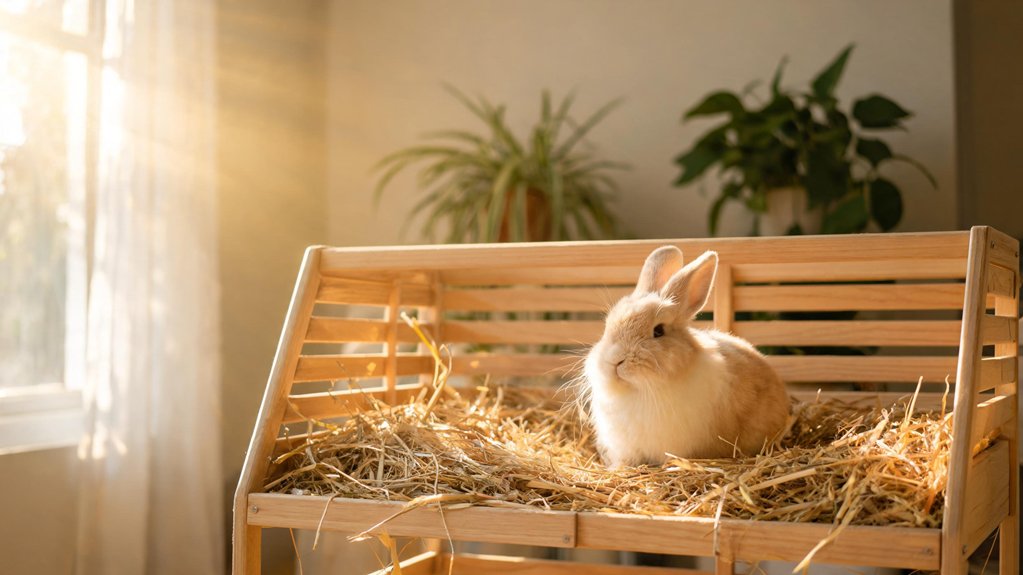
In the last days of pregnancy, your doe will start preparing a nest, and it’s your cue to get everything ready.
So, when do nests start?
In domestic rabbits, nesting digs often begin around days 25–26, then intensify in the last 1–3 days.
Provide a solid wooden nesting box in a quiet corner. Choose rabbit nesting boxes large enough for the doe to stretch out and turn around comfortably.
Line it with 2–3 inches of clean hay or straw as a base, then add extra rabbit nesting materials so she can shape a cup.
If she pulls fur, let her.
Keep it warm and dry.
Watch for frantic digging.
After spay/neuter, prevent accidental litters.
How Often Do Rabbits Nurse Newborn Kits?
Once your doe gives birth, you might feel like you “should” see her nursing more often, but you usually won’t.
After your doe gives birth, you may expect frequent nursing—but most does have only brief sessions, typically less often than you think.
Most does do a single nursing session per litter in a 24-hour period, the typical “nursing frequency per 24 hours.”
You might also see it once or twice daily, with nest visits often around once a day.
Individual bouts are brief, about 2–4 minutes, sometimes up to 5.
Kits need that day’s milk in one short time.
Track it on your rabbit breeding spreadsheet.
Watch rounded bellies and warm, calm kits.
Track Dates: From Mating to Kindling
After mating, you can’t “see” pregnancy right away, so your best tool is a simple date-tracking plan.
Mark the buck, and write the exact mating date.
Then add 31 days for the expected kindling date, since most domestic pregnancies run 31–33 days.
Also track the “kindling window” days 28–33, so you’re ready.
Many owners place a nest box at days 28–29, lined with clean hay or straw.
Watch for digging 6–8 days before birth, then fur pulling about 24 hours before.
If no kits by day 32, call your vet.
Can a rabbit and a cat mate?
Can a rabbit and a fox mate?
Can a rabbit and a hare mate?
Typical Litter Size in Domestic Rabbits
Typically, you’ll see domestic rabbit litters land around 4 to 12 kits, with many pet owners reporting about 5 to 8 kits per litter. Breed matters a lot, because small and dwarf rabbits often have fewer kits (around 2 to 4), while larger breeds may average more (often 6 to 10, sometimes higher).
But remember, you’re aiming to prevent accidental litters—spay and neuter help, since rabbits can breed again soon after mating, and kit counts can jump if the doe is well cared for.
Common Range Of Kits
Most domestic rabbit litters land between 4 and 12 kits per pregnancy, with 5–6 kits being a common average you’ll see mentioned by pet and welfare resources.
You should expect real variation, though. Some does manage just one kit, and others may reach around 14, especially in unusually large pregnancies.
For pet owners, plan responsibly for every scenario.
And remember, you can’t crossbreed safely—questions like can a rabbit and cat breed, can a rabbit and fox breed, or can a rabbit and hare breed aren’t how you should think about breeding.
Spay and neuter to prevent accidental litters.
Breed-Dependent Litter Size
Breed size can help you set expectations for how many kits (baby rabbits) you might see in a litter, but it won’t tell you the exact number—rabbit bodies still vary.
If you keep a small breed under about 5 lb, like a Netherland Dwarf or Polish, expect roughly 2–4 kits.
For small–medium rabbits around 5–6 lb, such as Holland Lop or Mini Rex, plan for about 3–5.
Medium pet breeds often run 4–6, while larger meat breeds may average 6–12.
Bigger breeds, like Flemish Giants, can reach double digits.
Spay and neuter help prevent accidental litters.
Factors Affecting Kit Counts
When you’re planning for what a litter *might* look like, you’ll want to think beyond just breed size—because the number of kits a doe (female rabbit) has depends on several everyday factors.
Most domestic litters run about 3–12 kits, and anywhere from 1 to 20 can happen.
First, your doe’s age and experience matter. First-time (primiparous) does often have smaller litters.
Second, her body condition, diet, and health matter, too. Underfeeding or illness can reduce ovulation and embryo survival.
Third, your buck’s fertility matters, including heat stress.
Finally, temperature, humidity, and daylight can lower conception and increase losses.
Avoid accidental litters—spay/neuter helps.
Can a Doe Get Pregnant Right After Giving Birth?
Yes, you can absolutely see a doe get pregnant again very soon after she gives birth, even if she just kindled a litter.
Yes— a doe can conceive again very quickly after kindling, as postpartum estrus may allow mating within hours.
Postpartum estrus means she can ovulate and accept mating fast, sometimes within hours, and conception can happen within 24 hours.
That’s why you must separate the buck right after kindling.
Otherwise, a nursing doe may carry a new pregnancy while still making milk, which can stress her body, especially with a big litter or poor body condition.
For pet safety, most non-commercial plans wait about 35–42 days, and spaying/neutering helps stop accidental litters.
How Can You Tell If Mating Worked?
Once your doe has been together with the buck, you’ll want to look for clear “mating worked” signs—because a quick, messy hookup doesn’t always mean pregnancy.
Usually the buck mounts from behind, thrusts briefly, then falls sideways or backward. That “fall-off,” often with a grunt or squeak, is the best immediate clue.
A receptive doe lifts her tail or raises her hindquarters, and it happens fast, often within about a minute.
Now watch days 0–14. By day ~9, uterine horns may swell to about 12 mm.
Day 10–14 gentle belly palpation can feel firm, grape-sized embryos.
Later, nipples may look pinker, and nesting begins. Help prevent accidental litters—spay and neuter.
Is Breeding Very Young or Older Does Risky?
If you breed a doe when she’s too young, or you keep breeding an older, intact rabbit, you raise the odds of pregnancy trouble—hard births can happen, and her body may not handle it well.
With a younger, still-growing doe, you’re more likely to see weaker kits, and her ability to care for the litter (mothering) may not be consistent.
With older does, fertility often drops, and the strain plus higher cancer risk in intact females makes welfare worse—so you should spay or neuter to prevent risky, accidental litters.
Increased Pregnancy Complications
Breeding your doe before she’s fully grown, or trying for a first litter when she’s already quite old, can turn a normal pregnancy into a risky one.
If she’s too young, her bones and pelvis may be underdeveloped, so kits can get stuck during delivery, and you could see straining with no kits.
Very young rabbits can also have gut or parasite problems that weaken her during pregnancy.
But if she’s older—especially over 12 months or past 3 years—birth can become difficult, too.
To protect her, plan safe timing, and discuss spaying to prevent accidental litters.
Reduced Welfare And Fertility
But when you breed a doe too early or too late, you can trade “maybe” for trouble—both for her comfort and for her ability to get pregnant again.
Very young does are still building bone and body size, so breeding before she reaches about 70–80% of mature weight can add stress, and fertility can dip over time.
Older does may also struggle, because fertility often starts falling after about 3 years, and body condition can swing.
Breed too often, and recovery suffers.
Serve your rabbit: spay/neuter prevents risky accidental litters.
Welfare-Friendly Rabbit Breeding: How Often Is Ok?
For most pet rabbits, welfare-friendly breeding means you slow way down—far below the “as many litters as possible” pace. Aim for no more than 2–3 litters per year. Some guidance allows up to about four, but treat that as an upper limit.
Next, plan recovery. After kindling, breed back around 35–42 days later only if your doe is in good body condition. Check her weight, energy, and appetite.
If she’s nursing a bigger litter or looks run-down around day 21, pause.
For extra safety, wait until fully weaned, then add 2–4 more weeks.
Should You Spay/Neuter to Prevent Breeding?
Spaying or neutering is one of the simplest ways to stop accidental rabbit litters, especially in homes where rabbits bond in pairs or groups.
Spaying or neutering is a simple way to prevent accidental rabbit litters in bonded pair or group homes.
You’ll thank yourself later.
First, talk to an experienced rabbit-savvy vet about timing, often around sexual maturity.
Spaying removes a female rabbit’s ovaries and uterus, reducing uterine and ovarian cancer risks and preventing painful infections.
Neutering does the same for males by reducing testicular cancer risk and hormone-driven behaviors like mounting, lunging, and urine spraying.
Then, you’ll lower stress and injury risk, and you can bond rabbits without “what if” worries.
FAQ: Mating, Pregnancy, and Nesting Tips
Wondering what happens after two bonded rabbits get “the invitation” to mate? You’ll see chasing, circling, sniffing, and chinning, then the buck mounts from behind.
The doe may flatten her body, lift her hips, and raise her tail to one side.
After mating, rabbits can breed year-round, and does ovulate when bred.
Gestation lasts about 28–33 days, often ~30–31.
Early signs include moodiness and a growing appetite.
Nesting starts about a week before, with a “hay mustache,” and fur-plucking.
Can a rabbit and cat mate? No.
Heat means estrus, and repeated receptivity can also mean false pregnancy.
Always consult a vet.
Frequently Asked Questions
Can Rabbits Go Into “Heat,” Like Cats and Dogs?
Yes, but not like cats or dogs. You won’t see a neat monthly heat. Your doe cycles between receptive and non-receptive phases, and mating can trigger ovulation. If you don’t spay/neuter, you risk accidental litters.
Can a Rabbit Mate With a Cat or Fox?
No—you can’t expect a rabbit to mate with a cat or fox; they’re like different locks, and the “key” won’t work. Plus, cats and foxes pose serious injury risks, so spay/neuter helps prevent accidental litters.
When Can Rabbits Start Breeding, as Pet Owners?
You can start breeding only after your rabbit is fully healthy and growing well—usually around 4–12 months depending on size (does earlier, bucks later). To prevent accidental litters, spay or neuter instead.
How Often Do Rabbits Breed and Can It Happen After Kindling?
After you watch a doe pop babies and then act ready again fast, remember: rabbits can breed right after kindling. Does may rebreed within 24–48 hours, but vets advise limiting to 3–4 litters yearly for health.
Should You Spay or Neuter to Prevent Accidental Litters?
Yes—you should spay or neuter to prevent accidental litters. Unspayed females can get pregnant soon, and males can cause surprise breedings. Book a rabbit-experienced vet, keep pairs separated until surgery, and act before 5 months.