Spot fleas by combing your rabbit with a fine flea comb, then check for pepper-like “flea dirt” near the skin. If you see red-brown staining when you dab comb debris on damp paper, it’s real. Weigh your rabbit first, then use a rabbit-safe, vet-approved spot-on based on exact weight—skip fipronil and all dog/cat products. For fast adult knockdown, a vet may use Capstar (30 minutes). Then wash bedding weekly and vacuum daily 10–14 days, because fleas live 3–5 weeks—keep going to learn the full plan.
Swift Summary
- Confirm fleas using a fine flea comb and check for red-brown “flea dirt” on damp white paper.
- Avoid fipronil and cat/dog flea products; ask an exotics vet to select rabbit-safe off-label doses by exact weight and age.
- Use a two-step strategy: Capstar/nitenpyram for fast adult kill, then a longer prevention like selamectin or imidacloprid/IGR.
- Treat in-contact pets and schedule follow-ups to cover eggs/larvae/pupae, often repeating around 2.5–3 weeks.
- Control the environment: vacuum daily, wash bedding weekly hot, remove clutter, and clean hutches/cracks with rabbit-safe products.
Spot Rabbit Fleas and Flea Dirt Fast
How can you tell if your rabbit actually has fleas, not just random bits of dirt? Look closely for tiny black pepper-like specks in the fur near the skin—those are flea dirt, or flea feces. And that’s how to tell if rabbit has fleas.
Next, how to check rabbit for fleas: use a fine flea comb, then tap debris onto white paper towel, add a few drops of water. If it turns red-brown, it’s flea dirt.
You may also see more scratching or overgrooming, often around ears and eyelids.
If you confirm it, what to do if rabbit has fleas starts with contacting a rabbit-savvy exotics vet. Early symptoms of skin parasites like itching, dandruff, or fur loss can look like other skin problems too, so a vet check is important.
Check for Anemia, Skin Damage, and Infection
Once you suspect fleas, check your rabbit right away for signs of anemia (low red blood cells), because heavy flea infestations can cause real blood loss.
Once you suspect fleas, check your rabbit right away for signs of anemia—heavy infestations can cause real blood loss.
Look at the gums, they should be pink, not pale.
Note weakness, low energy, and fast tiring.
Then inspect skin and coat, you may see hair loss, red bite marks, or crusty spots near ears.
Check for sores, swelling, heat, or oozing, which can mean secondary infection.
If lesions worsen, contact a rabbit-savvy exotics vet.
Do you call a rabbit with fleas?
Yes, you treat rabbit for fleas, plus the environment.
Confirm Rabbit Fleas With a Safe Comb
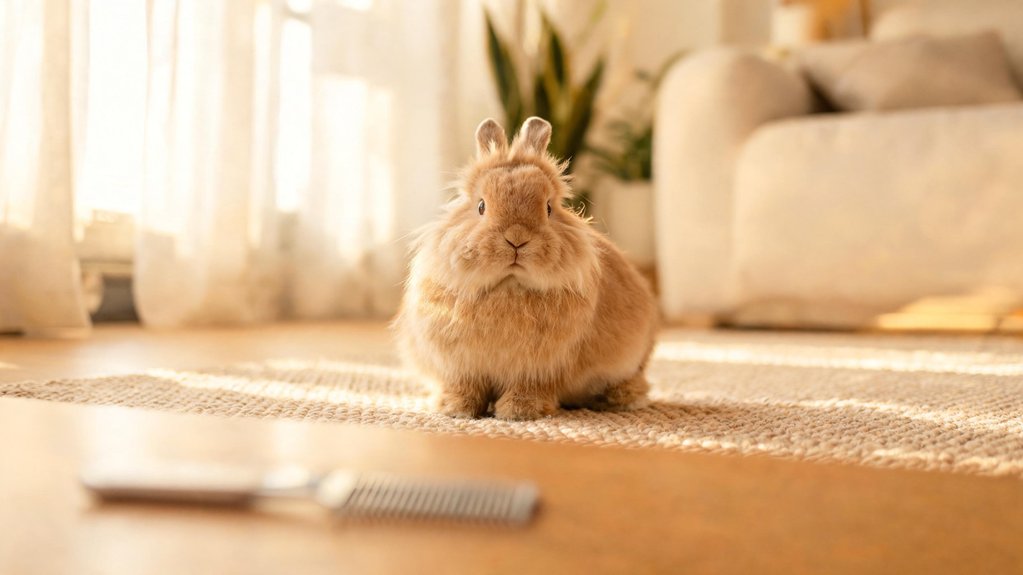
So, before you panic and reach for chemicals, confirm fleas the gentle way—by combing. You’ll help your rabbit without harsh stuff. Use a fine-toothed, non-toxic flea comb with close prongs, and keep sessions short at first. Put your rabbit on a towel-covered, non-slip surface, use bright light, and have a white tissue plus soapy water ready. Comb small sections from nose to tail base, wipe the comb onto the tissue, then inspect for tiny pepper-like specks. Because rabbits cannot vomit, formed hairballs can become dangerous if you over-handle grooming during flea checks. Tap specks onto a damp white surface, and watch for red-brown staining. Is Advantage safe for rabbits, do you need to flea rabbits? Skip chemicals, ask an exotics vet.
Pick Rabbit-Safe Flea Treatments (Age and Weight)
First, confirm your rabbit’s age and accurate weight, because “rabbit-safe” depends on the right drug and the right mg/kg dose, not the label meant for dogs or cats.
Then match the treatment to your rabbit—selamectin (Revolution), imidacloprid (Advantage), lufenuron (Program), or a vet-guided option like nitenpyram (Capstar)—and avoid fipronil products entirely.
Finally, calculate the correct spot-on amount from your rabbit’s weight, and if your rabbit is tiny, sick, or not eating or pooping, call a rabbit-savvy exotics vet before you apply anything.
Confirm Age And Weight
Next, weigh your rabbit on baby scales. Imidacloprid tubes split at 4 kg, with under 4 kg using the small tube. Selamectin uses strict mg/kg, so you must match the correct weight band—often 2.5 kg and up.
When in doubt, call a rabbit-savvy exotics vet.
Match Drug To Rabbit
Now that you’ve confirmed your rabbit’s age and weighed them on baby scales, it’s time to match the flea medicine to the right body-weight tube size and age limits.
Aim for rabbit-safe actives like selamectin or imidacloprid, only under a rabbit-savvy exotics vet’s direction.
For selamectin, don’t treat rabbits younger than 8 weeks.
Tube size often changes by weight: use the small-rabbit (≤2.5 kg) tube for lighter rabbits, and the cat/rabbit (2.6–7.5 kg) tube for heavier ones.
For imidacloprid (Advantage-type), vets often wait until about 3–4 months and ≥1 kg, and avoid fipronil products.
If your rabbit won’t eat or poop, treat it as urgent.
Calculate Correct Spot-On Dose
Getting the spot-on dose right matters as much as the medicine itself—so measure your rabbit carefully before you open anything.
Weigh your rabbit on a reliable scale, then use the correct pipette size for that weight band.
For rabbit imidacloprid, you typically match doses by pipette: under 4kg uses a smaller pipette, 4kg and up uses the larger one.
Put the entire pipette contents on the skin, usually the neck, at one spot.
If your rabbit is under 10 weeks, delay and call a rabbit-savvy exotics vet.
If your rabbit stops eating or pooping for 12 hours, treat it as urgent.
Use Imidacloprid for Rabbit Flea Control
Imidacloprid spot-on can be a solid option for treating flea infestations on pet rabbits, and it usually starts working fast.
You apply it externally only, not by mouth.
After you part the fur at the base of the skull until you see skin, you place the full pipette contents onto that exposed spot.
This spot is harder for your rabbit to reach, so less licking happens.
Fleas on treated rabbits should die within about one day.
Many rabbits stay clear for roughly a week.
For ongoing exposure, follow label timing, often every four weeks.
If your rabbit stops eating or pooping for 12 hours, get urgent vet care.
Follow Selamectin Timing for Rabbit Flea Life Stages

Selamectin timing matters a lot, because fleas don’t all live on your rabbit—you’re fighting adults and the eggs, larvae (the “wormy” stage), and pupae hidden in bedding, carpet, and furniture.
Fleas hide in bedding and furniture, so selamectin timing must target adults plus eggs, larvae, and pupae.
Since flea life cycles often run about 3–5 weeks, you’ll want a “two-phase” schedule.
For the first 3–5 weeks, ask your rabbit-savvy exotics vet about weekly selamectin timing so new adults keep getting hit as they hatch.
Then, once the environment calms down, switch to about monthly prevention.
Keep your plan consistent.
Also, keep cleaning—don’t skip that part.
If your rabbit stops eating or poops, treat it as an emergency.
Add Program (IGR) to Stop New Flea Eggs
Once you’ve lined up the timing for treating adult fleas with something like selamectin, you’ll also want to stop the next generation before it ever takes hold—that’s where an IGR (insect growth regulator) like Program (lufenuron) helps.
Program doesn’t kill adult fleas. Instead, it blocks flea eggs from developing, so new larvae never mature.
For best results, you use it consistently, usually monthly, and you give it with food to improve absorption.
Also, vacuum well and wash bedding, because you’re cutting off eggs in the environment too.
For safe, species-appropriate guidance, check with a rabbit-savvy exotics vet.
Use Capstar for Quick Kill, Then Follow-Up
You can use Capstar to get quick relief, because it kills adult fleas on your rabbit fast—often within about 30 minutes.
But since Capstar doesn’t keep working like a long-term “flea preventer,” you’ll need a safe spot-on or other vet-approved follow-up and you may have to repeat treatment if the infestation is heavy, only with your rabbit-savvy exotics vet’s guidance.
And yes, you should treat all pets in the home, so you don’t end up back at square one with new fleas coming from untreated animals.
Capstar Kills Adult Fleas
Capstar can knock down a flea problem fast—especially the adult fleas you can actually see crawling on your rabbit.
You give Capstar by mouth, with a rabbit-savvy exotics vet confirming the exact, weight-based dose, since it’s extra-label for rabbits (nitenpyram targets adult fleas only).
You should notice action in about 30 minutes, with major killing within several hours.
A single dose can eliminate up to around 90% of adult fleas in roughly 6 hours, helping you protect your rabbit while you arrange broader control.
But remember: Capstar doesn’t stop eggs, larvae, or pupae, so plan next steps.
Combine With Safe Spot-On
After the fast-acting flea knockdown, you’ll want a safe rabbit spot-on to keep new adult fleas from jumping on and biting.
Capstar handles the fleas you see. Now you prevent the next wave.
Ask a rabbit-savvy exotics vet which product fits your rabbit’s age and weight, because these meds are often off-label in rabbits.
Common follow-ups include selamectin (Revolution/Stronghold) for fleas and mites, or imidacloprid (Advantage and similar) for flea-only control.
Avoid fipronil.
Apply exactly as directed, usually once monthly for ongoing coverage, and treat in-contact pets and your home too.
Repeat Treatment As Needed
Once you’ve knocked down the fleas with a fast adult “kill,” you’ll need a plan for the next wave, because nitenpyram only wipes out adult fleas on the rabbit and doesn’t stop eggs or larvae in your home.
Use Capstar first, then repeat only if fleas reappear, and only with your rabbit-savvy exotics vet guiding dosing.
Capstar starts killing within about 30 minutes, and works for adults for only a short time.
Because eggs hatch later, schedule follow-up around 2.5–3 weeks.
Treat all fur-bearing pets too.
Vacuum well, wash bedding hot, and empty the vacuum outside.
If your rabbit stops eating or pooping for 12 hours, call urgently.
Avoid Fipronil, Collars, and Toxic Dog Products
When you treat fleas on a rabbit, skip fipronil, flea collars, and any dog or cat flea product that isn’t specifically made for rabbits.
Fipronil is highly toxic to rabbits, and even small spot-on amounts can trigger seizures, tremors, diarrhea, drooling, and loss of appetite, sometimes days later.
Fipronil is highly toxic to rabbits—small spot-on doses can cause seizures, tremors, diarrhea, drooling, and appetite loss, even days later.
And never use flea collars.
They can be chemically risky, and they also create a strangulation hazard if they snag.
Instead, call a rabbit-savvy exotics vet for a rabbit-approved plan.
Also keep treated cats and dogs away from your rabbit for several days.
Treat the Rabbit Flea Environment and Bedding
Next, you’ll need to treat the flea “home,” not just your rabbit—fleas lay eggs in bedding and rugs, so vacuuming and laundering are your best tools.
Pull out all rabbit blankets, liners, and soft fabrics, then wash them in hot water weekly and run them on a high-heat dryer cycle.
And don’t forget the rest: vacuum carpets and sofas well, then treat hutches and hard-to-reach cracks only with rabbit-safe options that your rabbit-savvy exotics vet approves.
Remove Bedding Thoroughly
To get rid of fleas on your rabbit, you’ll also need to treat the spot they live in—so start with bedding, because flea eggs and larvae can hang out there even after you treat the fur.
Daily, remove soiled bedding fast, then toss it right away in a sealed bag or container. Replace it with fresh, clean, dry material to keep humidity low.
Then wash all rabbit bedding weekly in hot water, and run it through a hot dryer cycle. Skip scented detergents and fabric softener.
Coordinate bedding changes with your vet-approved flea plan to prevent reinfestation.
Vacuum Carpets And Sofas
After you swap out bedding and keep your rabbit’s sleeping spot clean, you’ll want to tackle the rest of the flea hangout, too—carpets and sofas. Vacuuming removes adult fleas, eggs, larvae, pupae, and “flea dirt,” from fibers and seams, so your rabbit doesn’t keep getting exposed.
Vacuum slowly in crisscross passes, especially where they rest. Focus on edges near baseboards, wall corners, and under rugs and furniture.
Use upholstery tools for sofa cushions, tufted areas, and cracks. Do this daily or every other day for 10–14 days, then keep maintenance vacuuming.
Empty the vacuum bag or canister outside.
Treat Hutches And Cracks
Once you’ve cleaned up the area around your rabbit, focus on the hutch itself—the spots fleas love most, like floors, corners, and hidden cracks.
Remove all poop, leftover food, fur, and bedding first.
Scrub inside with hot water and a rabbit-safe cleaner, then sweep corners and joints with a dustpan.
Leave the door and roof open so everything dries fully and vents.
Then disinfect cleaned hard surfaces using rabbit-safe products, following the label, and never rush contact time.
Wash bedding in hot water, then dry on high.
Finally, treat cracks and gaps with a vet-recommended environmental flea spray.
Avoid over-application.
Gently Groom and Reduce Stress During Treatment
Start by keeping the whole process calm, because stress can make rabbits kick, freeze, and fight you harder. Crouch at ground level, and handle from the floor with one gentle hand supporting chest and forelimbs, the other supporting hindquarters and hind paws.
Secure all four feet against your body or a stable surface. Never lift by ears.
Use a soft-bristled brush, then a wide-toothed comb, then a fine comb.
Finish with a flea comb to remove flea dirt, focusing on ears, chin, armpits, and perineal area.
Finish with a flea comb to lift flea dirt—especially around ears, chin, armpits, and the perineal area.
Keep sessions brief, watch for rapid breathing or tooth grinding, and pause to recover.
Plan Rechecks and Fix Failed Control Fast
Plan on doing veterinary rechecks on a schedule, because fleas can bounce back fast if you miss even a small pocket of eggs or larvae.
At each visit, you’ll do skin and coat checks for flea dirt, scabs, and irritation.
The vet will also watch for anemia, itching, and infection risk in heavily infested rabbits.
And between visits, you check gently at home for mild scratching, bumps, or hair loss.
If treatment failed, fix the gaps right away: clean cages and fabrics, vacuum, and treat every in-contact rabbit, plus cats and dogs.
Never use fipronil or flea collars on rabbits.
Also, if your rabbit stops eating or pooping for 12 hours, go emergency.
Frequently Asked Questions
How Can I Tell if My Rabbit Has Fleas Versus Mites?
You can tell by checking fur and skin: fleas leave black “pepper” flea dirt and fast insects, with bite sores and patchy hair loss. Mites cause heavy dandruff-like flakes or thick crusts, often along the back or in ears.
Is Advantage (Imidacloprid) Safe for Rabbits Without a Vet?
About 10% of pets get fleas at some point, so you’ll want to be careful: Advantage (imidacloprid) may work in rabbits, but don’t use it without a rabbit-savvy vet—wrong dose or age can harm them.
What if My Rabbit Stops Eating or Pooping After Treatment—What Should I Do?
If your rabbit stops eating or pooping after treatment, treat it as an emergency: call a rabbit-savvy exotics vet right now. While you wait, keep them warm, quiet, and monitor stool and belly closely.
Do I Need to Treat My Dog or Cat Too?
Yes—treat your dog and/or cat too, right away. Fleas spread between pets, so only treating your rabbit won’t break the cycle. Contact a rabbit-savvy exotics vet and follow their species-safe plan.
What’s the Safest Way to Clean the Hutch and Bedding After Fleas?
Clean the hutch by removing your rabbit, sealing bedding in bags, vacuuming loose debris, then scrubbing with mild soap and hot water. Wash bedding and liners on hot, dry fully, and disinfect weekly with rabbit-safe products.