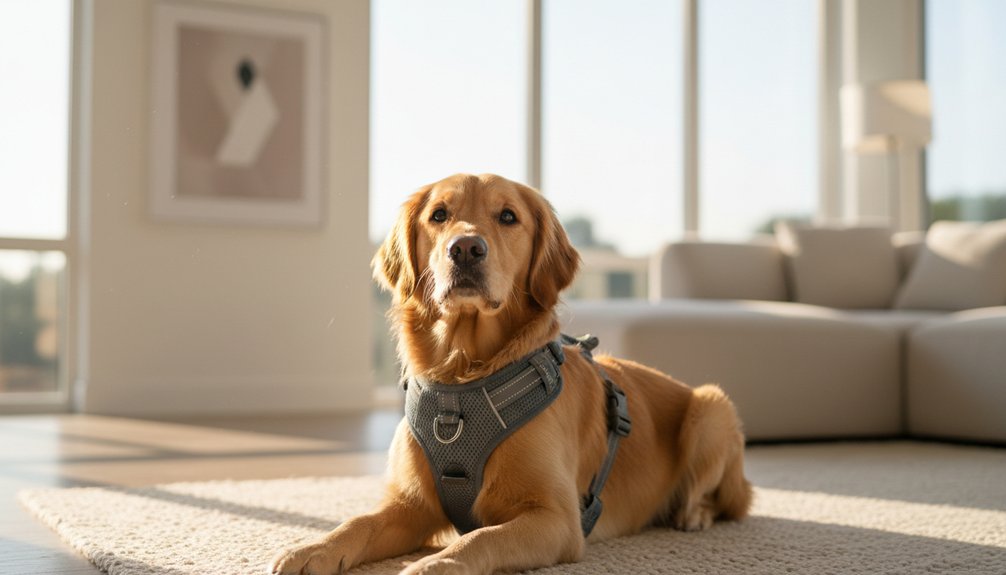
Yes, the Alsatian and German Shepherd are the same breed; the name “Alsatian” was adopted in Britain after World I to avoid German associations and was later dropped in 1977. Both share identical standards for size, coat, and temperament, whether show or working lines. Puppies cost roughly $800–$2,000 in the U.S., £700–£1,200 in the U.K., and ₹18,000–₹25,000 in India, depending on lineage and health screening, to guide your safe selection process, more details await you below.
Swift Summary
- German Shepherd Dog and Alsatian are identical breeds; the differing name stems from historical anti‑German sentiment, not from any physical or genetic distinction.
- The UK renamed the breed “Alsatian” after WWI, reverting to “German Shepherd Dog” in 1977; most kennel clubs now list it under the original name.
- Breed standards, size, coat colors, and temperament are the same for both names; naming does not influence intelligence, loyalty, or working ability.
- Puppy prices vary by market and lineage: US pet‑quality $800‑$2,000; reputable US breeders $1,500‑$3,500; UK £700‑£1,200; premium lines exceed $5,000.
- Reputable breeders provide health certifications (hip/elbow radiographs, eye exams, DM, MDR1, etc.) and pedigree paperwork regardless of whether the dog is called an Alsatian or German Shepherd.
Are Alsatian and German Shepherd Actually the Same Breed?
Really, are Alsatian and German Shepherd the same breed? You’ll find the answer in registries: German Shepherd Dog is a breed, with Alsatian listed as a name. Alsatian was adopted in Britain after World I to distance the breed from its German origins.
No genetic, physical, or temperament distinction exists, so difference between german shepherd and alsatian, difference german shepherd and alsatian, alsatian vs german shepherd difference, and difference between german shepherd vs alsatian are, confirming is german shepherd and alsatian same breed and german shepherd different to alsatian still.
When you ask why is a german shepherd called an alsatian, history explains naming, not lineage.
Owners comparing an alsatian dog vs german shepherd, a black alsatian puppy, or alsatian dog price should focus on health, temperament, not name. Much like choosing a collar that balances daily comfort and control, weighing a dog’s health and temperament matters more than the label on its papers.
State that are german shepherd and alsatians the same, are same breed.
Why Was the Breed Called “Alsatian” During WWI?
You’ll notice that during WWI, intense anti‑German sentiment in Britain turned any overt German label into a commercial liability for the breed. To avoid this, kennel officials adopted the name “Alsatian,” borrowing the contested Alsace‑Lorraine region as a neutral, European reference. Owners who travel with their German Shepherd often find that a sturdy portable dog bed keeps the dog comfortable in hotels, cars, and campsites.
This rebranding preserved the dog’s reputation while subtly sidestepping the wartime hostility you’d encounter in the press and market. The UK Kennel Club eventually restored the original name in 1977, ending the Alsatian era.
Anti‑German Public Sentiment
Why did Britain discard the name “German Shepherd” in 1919? You learned that wartime anti‑German feeling made “German” a market liability, so the Kennel Club stripped it to protect registrations.
Opinion treated anything German as hostile, prompting boycotts of products and dog breeds. Renaming the dog “Alsatian Wolf Dog” let owners adopt a working companion without fearing accusations of unpatriotic loyalty. The Kennel Club registers the breed in the Pastoral group, aligning with the FCI standard.
You can see the decision focused on preserving registrations for families and rescue services that relied on the breed’s intelligence, not on its abilities. Club records note that the “German” label would have deterred handlers, endangering police and military use.
This name‑laundering echoed rebranding of dachshunds and other German breeds, a broader cultural effort to erase visible German ties while serving the public.
Reference To Alsace‑Lorraine
Britain rejected the German label for the shepherd dog in 1919 because anti‑German feeling made the name a market liability, prompting the Kennel Club to seek a neutral geographic tag.
You’ll notice they chose Alsace‑Lorraine, a border region that straddles French and German heritage, because its ambiguous identity softened any overt German association.
The area’s contested history after the 1871 Franco‑Prussian War kept it in public awareness as a symbol of compromise, which fit the Kennel Club’s branding goal.
By adding “Wolf Dog” they added drama, then later dropped it for commercial sensibility.
You, as a caretaker, can appreciate how this naming strategy protected the breed’s reputation while honoring a region that embodied shared service.
You’ll also find this compromise mirrors your own collaborative values.
What Prompted the UK to Switch Back to “German Shepherd”?
Although the name Alsatian had been entrenched for decades, the easing of anti‑German sentiment after World II gradually dismantled the political need for a substitute label. You saw that post‑war reconciliation reduced the stigma attached to German nomenclature, making the original term more acceptable.
Meanwhile, breeders and club members launched persistent campaigns, arguing that “German Shepherd Dog” matched the breed’s documented origin and avoided pedigree‑record confusion. Their lobbying persuaded the Kennel Club to amend its registers: in 1936 it listed Alsatian (German Shepherd Dog), and in 1977 it reversed to German Shepherd Dog (Alsatian). The breed’s popularity was also boosted by Rin Tin Tin, a German Shepherd who became a silent‑film star in America during the 1920s.
Do Physical Traits Differ Between Alsatian and German Shepherd?
You’ll find that the breed standards for Alsatians and German Shepherds are exactly the same, so the label you use doesn’t alter the dog’s prescribed shape or structure.
The coat colors you see—black‑and‑tan, sable, solid black, or the recessive long‑stock variety—are shared across both names, with no exclusive pigmentation tied to either term.
Likewise, the height and weight ranges overlap completely, meaning a male or female of either label fits within the 60–65 cm (male) or 55–60 cm (female) and 22–40 kg parameters established for the single breed. Because these dogs often accompany their owners on trips, packing food, bowls, and leashes in a dog travel bag keeps essentials organized on the go.
Breed Standards Identical
Since the term “Alsatian” is simply a historic label, the official breed standard treats both names as one and specifies the same measurements and proportions.
You’ll notice that the height range—60‑65 cm for males, 55‑60 cm for females—is identical, as is the weight span of roughly 23‑41 kg.
The body‑length‑to‑height ratio of about 10:8.5 to 10:9, the long square muzzle, domed forehead, almond‑shaped dark eyes, and erect ears all appear in AKC, KC, FCI, and UKC standards without distinction.
You’ll also see the same neck—strong, clean‑cut, moderately long—smooth topline, deep capacious chest, and low‑set bushy tail that reaches the hock in every description.
Because the standard makes no allowance for “Alsatian‑only” variations, any physical deviation you encounter stems from individual breeding lines, not from a separate conformation rulebook.
You can trust this.
Coat Color Variations
When you look at the range of coat colors in dogs called Alsatian and those called German Shepherd, you’ll see that the palette is identical—both names describe a single breed with the same standard hues and markings.
You’ll recognize the black‑and‑tan saddle, where a back contrasts with tan legs, chest, and facial accents. Variations include black‑and‑red, black‑and‑cream, black‑and‑silver, and sable, each following breed standard.
Rare dilutes such as blue, liver, Isabella (lilac), and wolf‑gray appear infrequently and are recorded as faults in show rings, though they thrive in working roles.
White dogs exist but are excluded from conformation standards.
Across all patterns—saddle, blanket, bi‑color, or panda—the black facial mask remains a hallmark, reinforcing that coat genetics are identical regardless of name you use.
Size Measurements Overlap
Although the names differ, the size specifications for Alsatians and German Shepherds are identical. When you compare a male’s height at the withers, you’ll find it falls between 60 and 65 cm (24‑26 in); females range 55‑60 cm (22‑24 in).
Weight expectations overlap as well: most males weigh 30‑40 kg (65‑90 lb) and females 22‑32 kg (50‑70 lb), with kennel clubs permitting a ±2.5 cm variance.
Body length should exceed height by roughly 10‑17 %, creating the breed’s rectangular silhouette. Whether you encounter a show‑line or working‑line dog, both adhere to these measurements, even though topline angulation may differ.
Recognizing this overlap helps you assess health and suitability without bias toward the name used. By measuring each puppy against these standards, you guarantee responsible placement and support for families seeking a well‑balanced companion today.
Do Temperament and Working Ability Vary by Name?
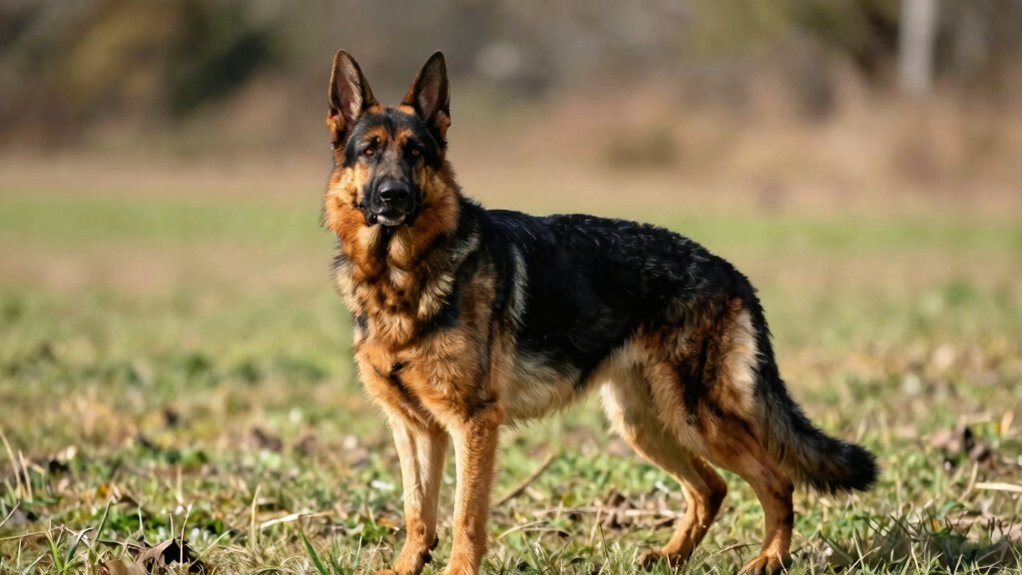
How much does a name influence a dog’s temperament and work capacity? You’ll find that the label Alsatian or German Shepherd doesn’t alter innate traits; genetics, breeding line, and selection do.
Both names describe the same breed with core qualities—intelligence, loyalty, courage, protectiveness, and trainability. Working‑line dogs exhibit high drive, requiring police, military, or service tasks, while show or family lines tend toward calmer, balanced temperaments.
Differences arise from breeders’ goals, not terminology. Poor temperament usually traces back to inadequate socialisation or weak genetics, not nomenclature.
When you choose a puppy, focus on lineage, health testing, and early training to ensure the dog can serve reliably in protection, assistance, or companionship roles. Your commitment to proper care will maximize the dog’s potential and wellbeing.
How Do Kennel Clubs List Alsatian Vs German Shepherd?
You’ll see that major kennel clubs list the breed under the official name German Shepherd Dog (GSD), with “Alsatian” appearing only as a historical footnote.
The UK Kennel Club originally renamed the breed to Alsatian Wolf Dog after World War I, shortened it to Alsatian over the decades, and then reverted to German Shepherd Dog in 1977.
Today, AKC, FCI, CKC, UKC and the Kennel Club all register the breed as German Shepherd Dog in their herding or pastoral groups, mentioning Alsatian solely as an alternate, legacy term.
As naming conventions for the breed show, German Shepherd is capitalized, and the abbreviation GSD is written in all capitals.
Official Breed Names
Because major kennel clubs around the world officially register the breed as the German Shepherd Dog, the name “Alsatian” now shows up only as a historical or alternate reference in UK‑focused material.
You’ll see the AKC list the breed as German Shepherd Dog, often abbreviated GSD, and the FCI record it as GERMAN SHEPHERD DOG (standard No. 166).
The UK Kennel Club also registers the dog under German Shepherd Dog, placing it in the Pastoral group, while British texts note Alsatian merely as an alternate name.
Australian and New Zealand clubs file the same breed in herding or working categories.
All official documents use the English translation of Deutscher Schäferhund, ensuring uniformity across registries.
Refer to these codes when guiding adopters, guaranteeing clear breed understanding today.
Historical Naming Changes
While anti‑German sentiment during World I forced the British Kennel Club to drop “German” from the breed’s name, it first introduced the term “Alsatian Wolf Dog” in 1919 to emphasize the dog’s imposing appearance.
By the mid‑1920s you’ll notice the club dropped “Wolf” after public fear grew, listing the breed simply as “Alsatian” to soften its image and encourage families to adopt it.
During the post‑World II era you’ll see German references re‑emerge, because European clubs kept using “German Shepherd Dog,” prompting the British Kennel Club to adopt a dual format—“German Shepherd Dog (Alsatian)”—in the late‑20th century.
You benefit from this history by recognizing both names in paperwork, training guides, and welfare programs, ensuring you honor the breed’s service legacy while fostering compassionate, accurate communication.
For every dog lover.
Registry Listing Practices
The early‑century renaming from German Shepherd to Alsatian left a lasting imprint on modern breed registers, so today most clubs record the dog under the official title German Shepherd Dog and regard Alsatian only as a colloquial alternative.
You’ll see the AKC list German Shepherd Dog in the Herding Group, with registration forms lacking an Alsatian field. The UK Kennel Club places German Shepherd Dog in the Pastoral Group and mentions Alsatian only in notes.
FCI members record the breed as Deutscher Schäferhund, English‑language German Shepherd Dog, under Group 1 Sheepdogs, defining short‑ and long‑haired varieties a and b.
All databases follow these standards, treating Alsatian as a historical nickname, not a separate entry, which streamlines your paperwork and guarantees consistent pedigree tracking for the dogs you serve.
What Is the 2026 Price of a German Shepherd/Alsatian Puppy by Country?
If you’re budgeting for a German Shepherd (Alsatian) puppy in 2026, the cost will vary widely depending on country and the breeder’s reputation.
In the United States, typical pet‑quality puppies fall between $800 and $2,000, while reputable breeders charge $1,500–$3,500 and elite show or imported lines exceed $5,000. The median listing hovers near $1,880.
In the United Kingdom, family‑pet puppies generally cost £700–£1,200; mid‑range averages are about £681, and higher‑pedigree dogs reach £1,500–£2,000.
India’s market shows standard pet‑quality prices of ₹18,000–₹25,000, with reputable sources at ₹21,000–₹51,450 and premium show or KCI‑registered stock between ₹45,000 and ₹80,000.
Entry‑level options may appear as low as $100, £500, or ₹5,000, but lower prices often reflect reduced health guarantees. Budget for hidden costs such as vaccinations, microchipping, and initial vet checks, since these expenses are often not included in the advertised price.
Choose wisely, prioritize health, and support ethical breeders throughout.
Red Flags When Evaluating German Shepherd Breeders
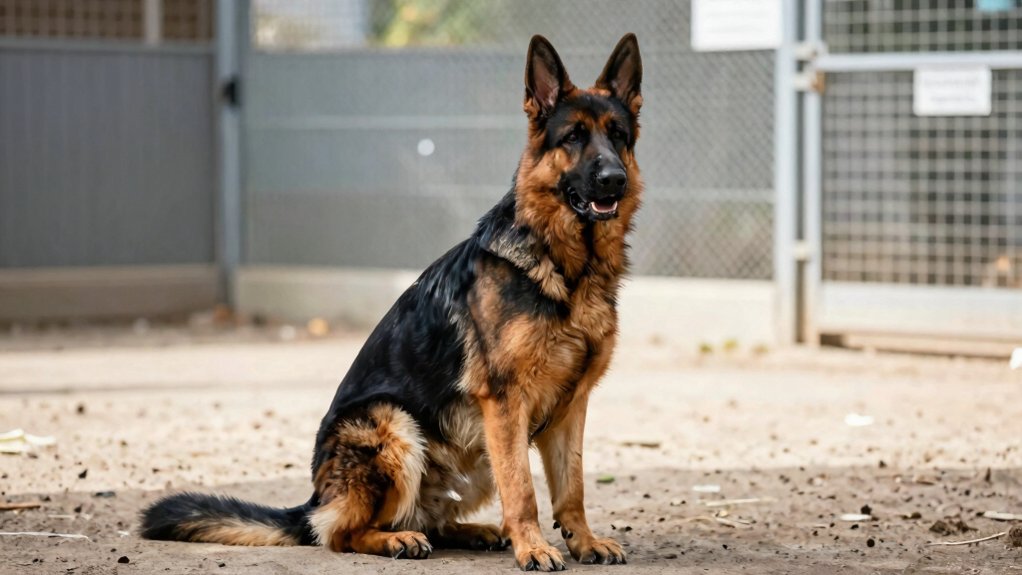
Because many prospective owners are enthusiastic to bring home a German Shepherd, spotting red flags early can prevent heartbreak and health problems. You should demand a full, in‑person tour; breeders who limit meetings to parking lots or refuse live video likely hide poor conditions.
Beware of constant puppy availability, multiple litters, or exotic size/color claims—these signal profit‑driven, high‑volume operations that neglect maternal recovery and temperament.
Ask detailed questions about the breed standard, topline, and genetics; vague answers or dismissal of club guidelines reveal insufficient knowledge.
Insist on written contracts, registration papers, and a clear return policy. A responsible breeder will screen your home, offer post‑sale guidance, and stay engaged with the dog’s lifelong welfare. For the trip home, a sling carrier keeps a young puppy close to the body, which helps it feel secure during the ride.
Your diligence protects both the puppy and families you’ll serve.
Which Health Tests Should a German Shepherd Puppy Have?
Three core health screenings every German Shepherd puppy should undergo are hip and elbow radiographs, a Degenerative Myelopathy DNA test, and an all‑encompassing eye examination.
Additional checks should be performed for haemophilia, MDR1, and other breed‑specific genetic disorders. You’ll request BVA/KC or OFA hip films after twelve months, with final certification by twenty‑four months, and elbow images through the same schemes.
Verify that both sire and dam hold hip grades A‑C and elbow scores 0‑1, evidence recorded in CHIC.
Collect a cheek‑swab for the SOD1 DM panel and store results in the health registry.
Arrange a certified ophthalmology exam to spot cataracts or retinal dysplasia.
Finally, order haemophilia A/B coagulation assays and an MDR1 drug‑sensitivity test to safeguard future treatment plans for the wellbeing of your dog.
How to Verify a Breeder’s Reputation and Documentation
After confirming that your German Shepherd puppy has undergone the recommended health screenings, the next step is to verify the breeder’s reputation and documentation. Begin by searching the kennel name online, checking breed club listings, veterinary endorsements, and forum feedback for consistent positivity.
Review the breeder’s website and social media for past litters, testimonials, competition results, and long‑term owner follow‑up. Confirm AKC or national registry membership and any H.E.A.R.T program affiliation.
Visit the facility: note cleanliness, ventilation, secure fencing, and adequate space. Observe puppies and parents for sound coats, normal movement, and confident, well‑socialized temperaments.
Request registration papers, pedigree charts, and microchip numbers, ensuring they match contract details. Insist on a written agreement outlining responsibilities, health guarantees, and legal protections for both buyer and puppy. Once your puppy comes home, choosing the right dog leash for everyday walks and training will help you build good habits from the start.
Adoption Vs Purchase: Which Is Smarter for a German Shepherd?
How do you decide whether to adopt or purchase a German Shepherd? Both routes can bring a healthy, well‑adjusted companion into your home, yet they differ markedly in cost, predictability, and ethical impact.
Adoption fees typically range from $50 to $800 and include spay/neuter, core vaccines, microchip and an initial exam—services that could cost $800‑$1,200 if bought separately.
Purchasing a puppy often costs $800‑$3,000 and usually excludes those health services, raising your upfront outlay.
An adult rescue offers known size, temperament and any existing health issues, reducing uncertainty. Rescue groups typically screen applicants carefully and may require a home visit before releasing a German Shepherd to its new family.
A breeder can provide genetic testing for hip dysplasia, but temperament remains a guess.
Choosing adoption also reduces shelter intake and saves a life, aligning with a service‑oriented mindset.
It also fosters compassion and responsible pet stewardship.
Ongoing Costs of Owning an Alsatian/German Shepherd
When you’ve decided between adopting or purchasing a German Shepherd, the next step is to grasp the ongoing expenses you’ll shoulder. Expect food and treats to run $900–$1,950 annually, roughly $75–$162 per month, with lifetime feeding costs near $7,700 over a ten‑year span.
Routine veterinary care, including exams, vaccines, preventatives and dental maintenance, typically totals $440–$2,120 each year. Preventative heartworm, flea and tick medication alone often costs $240–$720 yearly, and dental cleanings amortized add up to $750 annually.
Insurance premiums add $400–$1,500 annually, while common orthopedic or myelopathy treatments can exceed $4,000 per incident. Grooming, toys, supplies and equipment usually require $2,660–$4,850 per year.
Altogether, a healthy adult German Shepherd costs about $150–$300 monthly, but serious health issues may push lifetime expenditures beyond $45,000. Understanding German Shepherd purchase prices alongside these recurring expenses helps owners build a realistic budget before bringing a puppy home.
Frequently Asked Questions
Can an Alsatian Be Registered as a German Shepherd in All Countries?
Over 85% of worldwide kennel clubs list the breed solely as German Shepherd Dog, so you’ll register any Alsatian as a German Shepherd everywhere, truly consistently ensuring your dog meets unified standards and serves responsibly.
Do Coat‑Color Preferences Affect Alsatian/German Shepherd Puppy Prices?
You’ll notice that buyers favoring rare coats—like solid black or white—pay more, because scarcity drives demand; however, you should focus on health, temperament, and responsible breeding over color alone to serve those you love everyday.
Is There a Difference in Lifespan Between Alsatian and German Shepherd Lines?
About 51% of German Shepherds die by age ten, so you’ll see no lifespan gap between Alsatian and German Shepherd names; working‑line dogs typically outlive show lines by roughly two years, when given proper care.
Are There Legal Restrictions on Importing Alsatians to Certain Countries?
Yes, you must comply with each nation’s import rules—age, rabies vaccination, microchip, documentation, and possible quarantine—since most countries treat Alsatians like any other dog under health and disease‑prevention regulations. you’ll also need certified veterinary records.
Can Mixed‑Breed Puppies Be Marketed as Alsatian or German Shepherd?
Like a chameleon wearing a lion’s mane, you can’t label mixed‑breed puppies as Alsatians or German Shepherds; doing so misleads buyers, breaches consumer law, and undermines the trust you aim to uphold ethically daily work.