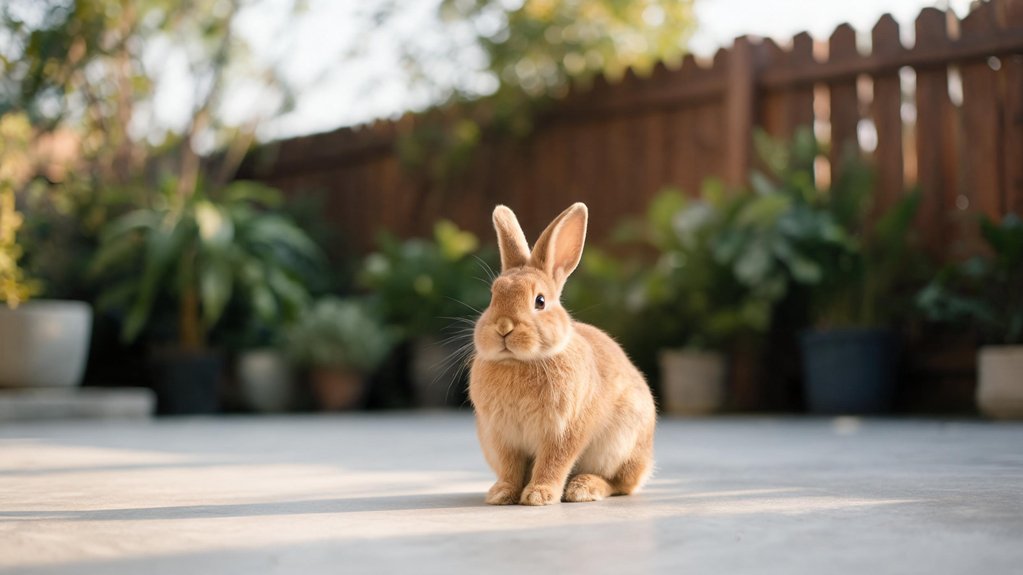
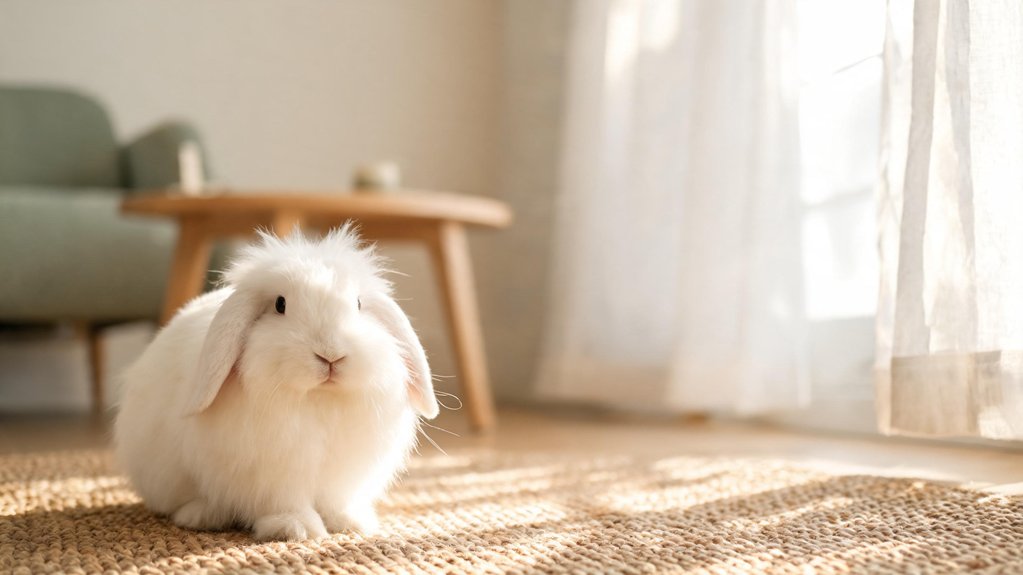
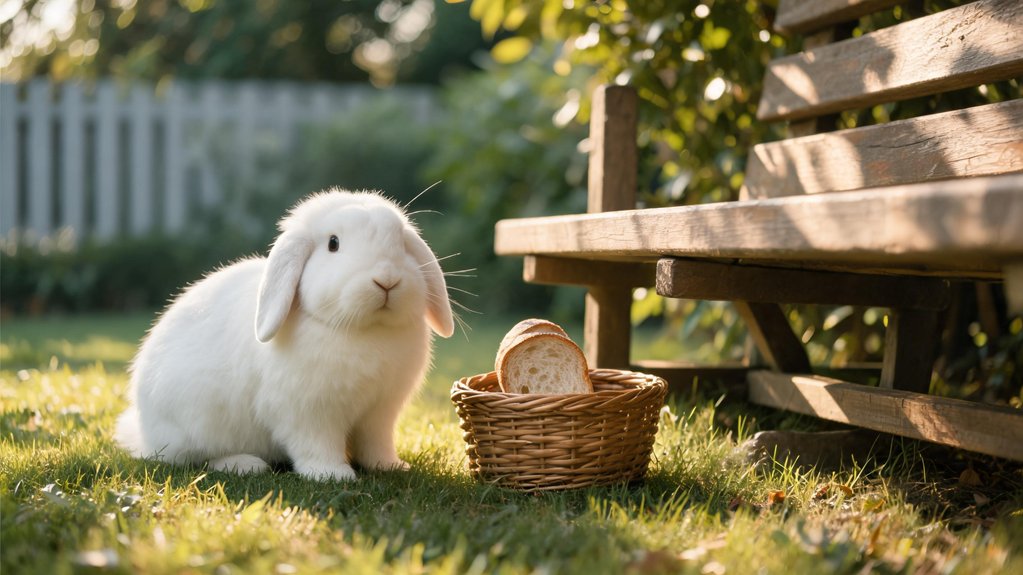
Your pet rabbit should eat mainly unlimited grass hay every day, all day—this keeps digestion moving and helps wear down teeth. Add safe fresh grass only if you can source it cleanly, start small, and offer it alongside hay, not instead. Give leafy greens and veggies daily, about a large handful 1–2 times, aiming for 3 types. Feed measured timothy pellets, about 5–10% of food, after hay morning and evening. Keep fruit rare, and always call a rabbit-savvy vet if they won’t eat—then you’ll know more.
Swift Summary
- Feed unlimited fresh grass hay daily as the main diet, targeting about 75–80% of total food to prevent gut stasis.
- Provide leafy greens and safe veggie variety daily, aiming for a large handful once or twice daily with at least three green types.
- Offer fiber-rich timothy pellets as a measured supplement, about 5–10% of intake, fed after hay morning and evening if needed.
- Limit fruit treats to occasional small portions (roughly 5–10% max), due to sugar content.
- Ensure clean water is always available and seek a rabbit-savvy vet urgently if eating drops or digestion slows.
What’s the Right Pet Rabbit Diet? (Quick Summary)
If you want your pet rabbit to thrive, focus on a simple rule: give lots of high-fiber grass hay (and/or grass), then add fresh leafy greens daily, and keep pellets to a small amount. That’s the core of rabbit food, and it answers what should rabbits eat. Aim for roughly 80–90% hay/grass, about 10% leafy greens, and around 5% concentrated pellets. 85–90% grass hay is a good general target, with pellets kept as a smaller portion to support healthy digestion. Fiber supports gut movement, and chewing helps keep teeth in check. Offer at least three leafy greens each day. Choose timothy pellets with no seeds or sugary bits. Don’t change foods suddenly. And yes, you can help by serving safe things rabbits can eat: small treats of fruit, rarely. Timothy hay is an ideal daily staple because its long, coarse stems supply the fiber rabbits need to keep their digestion moving and their teeth worn down.

SOFT TEXTURE & SWEET FLAVOR: With its soft texture and naturally sweet flavor, Orchard grass hay appeals to rabbits, guinea pigs, and small herbivores; This high-fiber hay supports healthy digestion while encouraging natural chewing behaviors


PROUDLY GROWN IN THE USA: Harvested fresh from Oxbow?s family of farms by our expert hay growers˜
Start With Unlimited Grass Hay Every Day
Start by giving your rabbit unlimited grass hay every day, and keep it available in the cage, pen, and exercise space. This isn’t just “food,” it’s the high-fiber stuff that helps keep digestion moving, supports healthy gut bacteria, and makes cecotropes the way rabbits need (cecotropes are nutrient-rich droppings they re-eat). The grass hay fiber supports healthy intestinal motility and chewing activity, which also helps keep teeth properly worn down since rabbit teeth grow continuously. If you limit hay, you put your rabbit at higher risk for stomach and gut trouble—so make hay your everyday baseline. When shopping for daily feeding, look for fresh, sweet-smelling hay that is free of mold and dust.

HAND-SELECTED TIMOTHY HAY is the first ingredient of this nutritious diet developed by a small animal nutrition expert

DAILY BUNNY PELLETS: Formulated with 100% of your pet’s daily recommended vitamins and minerals, this balanced rabbit food supports whole-body health, including strong immunity, healthy growth, and vibrant energy levels for rabbits
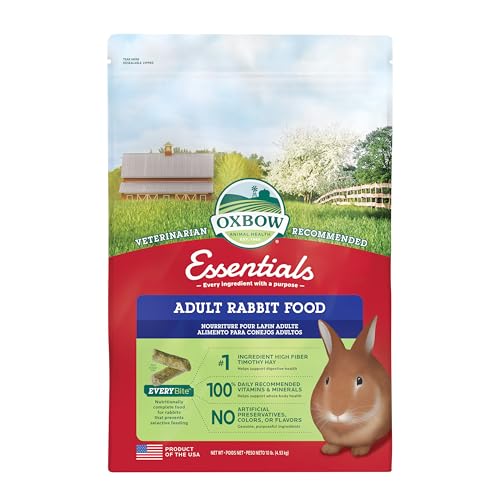
COMPLETE NUTRITION IN EVERY BITE: Oxbow EVERYBite foods are specially formulated to deliver balanced, complete nutrition in every serving; Each bite ensures your rabbit gets the essential vitamins and minerals needed for a healthy, active, and happy life
Unlimited Grass Hay Access
Unlimited grass hay should be your rabbit’s everyday “main meal,” and you can think of it as the foundation of good rabbit eating.
When you’re asking what do rabbits eat, remember this food for rabbit: unlimited grass hay access.
Offer fresh, high-quality hay every day, all day.
Aim for hay as roughly 80–90% of their total food, so they can graze often.
Keep a constant supply in a hay rack, and refill when it’s low.
This steady chewing supports natural tooth wear, encourages calm foraging, and helps keep energy balanced.
Just skip guessing—pellets and treats stay limited. When comparing commercial rabbit food products, such as those covered in the Science Selective guide, remember that hay should still make up most of the diet.
Daily Hay Supports Digestion
Daily hay isn’t just “filler.” When you give your rabbit fresh, high-quality grass hay every day, you help keep their gut moving the way it’s meant to—because rabbits rely on long-fiber hay to maintain normal digestion.
And that long, tough fiber keeps things flowing, since it helps stimulate the smooth muscle in the intestines.
Plus, steady hay intake supports cecal microflora, the helpful gut bacteria that help form cecotropes.
So when you ask what’s good for rabbits to eat, start your list of rabbit food with unlimited timothy or meadow hay. Because hay makes up the bulk of a rabbit’s daily diet, it helps to understand suitable hay choices before you stock your supply.
Yes, things rabbits eat beyond hay matter, but hay is the digestion MVP.
Add Fresh Grass Safely (If You Can Source It)
When you add fresh grass, verify it comes from a place with no pesticides, herbicides, or chemical fertilizers, and keep it clean, dry, and dust-free.
Offer only a small amount at first—think a limited handful or a small cut piece—then build up over about 10 days while you watch for normal appetite and firm poop.
If the grass looks weathered, slimy, or moldy, remove it right away, because mold and spoilage can upset their digestion and breathing.

Soft Leafy Texture For Daily Chewing: This 2nd cutting timothy grass hay offers a tender, leafy structure that appeals to rabbits and guinea pigs that prefer a softer hay. The balanced mix of leaf and stem encourages steady chewing and natural foraging, helping pets stay engaged throughout the day. Ideal for hay feeder guinea pig setups or loose feeding routines within small pet supplies

Natural High-Fiber Herbal Blend: A premium mix of dried dandelion flowers and herbs including plantain, mint, calendula, and chrysanthemum. A natural source of fiber designed for rabbits, guinea pigs, hamsters, chinchillas, and other small herbivores as part of their daily diet

ADULT RABBIT FOOD: Large variety of grasses and vegetables in every bowl to provide the balanced variety of nutrients that pet bunnies need, with great taste they’ll love.
Verify Source And Safety
Fresh grass can be a great addition—if you can source it safely. Verify the source before you offer it, and remember, do rabbits use their hands to eat? Yes, they often nibble and pull grass with their front paws.
But safety comes first. Choose chemical-free grass, with no pesticides, herbicides, or fertiliser. Skip roadside verges, dog-walking spots, and any area with feces.
Ask for garden records, or pick an organically managed lawn. Cut by hand or pluck, and feed right away.
Throw out grass that smells off, is damp, dusty, moldy, or slimy.
Offer Small Amounts First
Start with a small “test portion” of fresh grass, because your rabbit’s gut needs time to adjust.
Give about one small handful per rabbit per day, once or twice, and never replace the hay you already feed.
Offer grass right after picking or cutting, and keep lawn-mower clippings out completely.
Over 10 days to 3 weeks, increase the grass slowly in tiny steps.
Check droppings daily.
If stools get soft, or you see less poop, slow down or step back.
Keep fresh grass alongside constant, quality hay, and watch appetite, water, and activity.
If diarrhea persists, call your vet.
Remove Weathered Or Moldy Grass
If your rabbit has been eating from the same grass pile, take a quick check now, and swap anything questionable for clean hay right away.
Weathered or moldy grass can be unsafe.
If you see dampness, dust, a sour smell, slimy or clumped pieces, or visible mold, don’t offer it.
Remove it from the enclosure, then thoroughly clean the rack or bowl before refilling.
Moldy feed is best kept in a sealed bag, so a vet can assess it if needed.
Then, offer fresh grass or grass hay that’s dry, non-wilted, and promptly eaten.
Avoid lawn clippings.
Choose Leafy Greens and Veggies for Daily Variety
Leafy greens and veggies are where you give your rabbit daily variety, and you don’t have to guess—just follow a simple routine.
Aim for a large handful of safe greens once or twice daily, alongside unlimited grass hay, the main food.
Offer at least three different green types each day, like romaine, endive, watercress, or spring greens.
Wash everything well to remove soil and pesticide residue.
Mix in herbs for extra flavor—basil, dill, cilantro, mint, or sage.
For crunch, add small amounts of celery, green beans, or cucumber.
Keep higher-oxalate greens like spinach only 1–3 meals weekly.

Delicious Pie-Shaped Treat For Small Pets.

NATURAL SNACK made with a limited number of whole ingredients

The information below is per-pack only
How Many Pellets Should a Pet Rabbit Get?
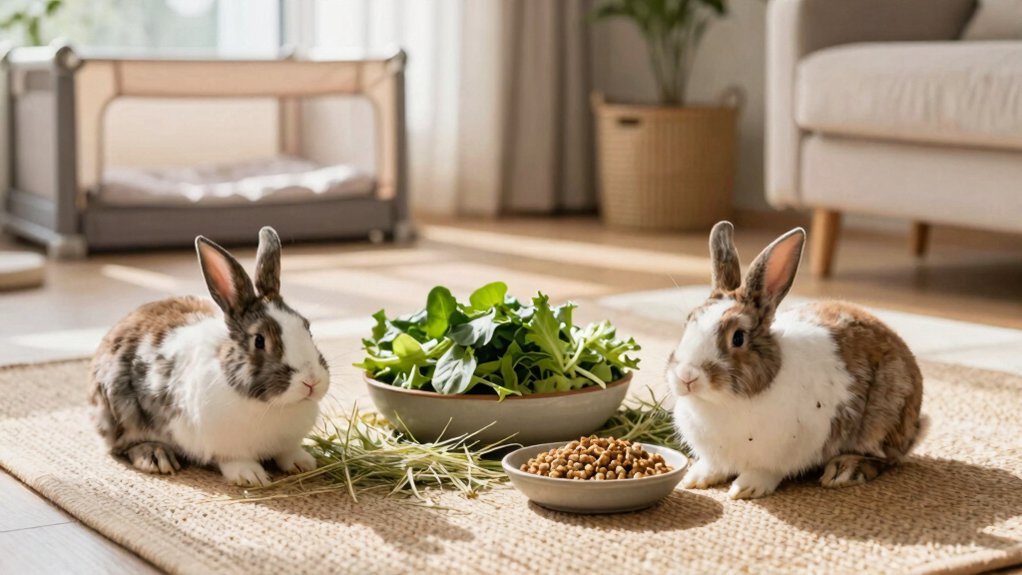
Measure your rabbit’s pellets each day, aiming for about 1/4 cup plain timothy-based pellets per 4–5 lb of body weight, and remember pellets should only be a small, rationed part of the diet (hay and leafy greens do most of the work).
Choose fiber-rich timothy pellets, then adjust the amount by weight—about 1/8 cup for 2–4 lb rabbits, 1/4 cup for 5–7 lb, and up to about 1/2 cup for 8–10 lb—so your rabbit stays at a healthy weight.
If your rabbit’s age or health changes, or they’re gaining weight fast, cut back and talk to an avian/rabbit-savvy vet if you’re unsure.

PREMIUM QUALITY: Lixit water bottles have been a standard for over 35 years. It features a thick high quality water bottle that is BPA free.
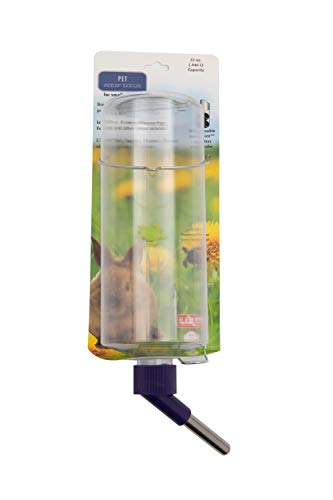
PREMIUM QUALITY: Lixit water bottles have been a standard for over 35 years. It features a thick high quality water bottle that is BPA free.

Great for small animals: pet hamsters, rats, and small birds will love this Lixit critter Brites water bottle!
Measure Pellet Portions Daily
Pellets should be a small, measured part of your rabbit’s day, not “whatever’s left in the bowl.”
A good rule of thumb for adult rabbits is about 1/8 to 1/4 cup of pellets per 5 lb of body weight per day, and many people aim closer to 1/4 cup per 6 lb. Then measure daily.
Instead of an open bowl, portion the amount once, then divide it into one or two feedings.
Feed pellets after hay in the morning, and again in the evening.
Many healthy diets keep pellets near about 10% of intake, not more than 20%. Adjust if weight changes.
Choose Fiber-Rich Timothy Pellets
Choosing the right amount of fiber-rich timothy pellets is one of the easiest ways to keep your rabbit healthy.
For most adult rabbits, offer just a small daily portion, about 1/4 cup per 5 pounds of body weight.
This keeps hay and leafy greens doing the heavy lifting, since pellets are a concentrated supplement.
Look for plain, timothy-based pellets, high in fiber, and lower in calcium.
Feed them once daily, in a clean bowl.
If your rabbit’s hay intake drops, ease off pellets.
For growing or changing needs, ask your vet.
Adjust Amount By Weight
Once you’ve picked a plain, timothy-based pellet, the next step is to get the amount right for your rabbit’s weight. As a helpful starting point, aim for about 15–20g pellets per kilogram body weight per day, and keep pellets near 5% of their total food.
Measure once, then feed once or twice daily, not free-fed.
For example, a 2kg rabbit usually maxes around 30–50g pellets per day, while a 3kg rabbit often lands around 45–60g.
But adjust for activity, age, and body condition.
Weigh monthly, and call a rabbit-savvy vet for special cases.
Treats and Fruit: How to Keep It Occasional
Fruit treats should be occasional, not daily, because they’re high in natural sugar.
Keep hay roughly 80% of the diet, and limit fruit to about 5–10% total food.
For most rabbits, offer 1–2 tablespoons mixed fruit per 5–6 pounds body weight, at most once or twice per week.
Or use 1 teaspoon fresh fruit per 2 pounds, and stay under 10%.
Serve tiny portions, like 1 large strawberry or one grape cut in half.
If you’re introducing a new fruit, start with a very small test.
And skip fruit for overweight rabbits.
Always wash, cut small, and remove seeds.

Satisfying taste and texture combo

SOFT TEXTURE & SWEET FLAVOR: With its soft texture and naturally sweet flavor, Orchard grass hay appeals to rabbits, guinea pigs, chinchillas, and small herbivores; This high-fiber hay supports healthy digestion while promoting natural chewing behaviors

Balanced Daily Nutrition: Orchard Grass Hay provides a soft leafy texture and natural fiber profile that aligns with daily feeding routines for rabbits, guinea pigs, and other small pets. This hay supports grazing and foraging behavior by offering a familiar structure pets enjoy. Its balanced calorie levels make it easy to include as part of everyday meals, helping owners maintain consistent feeding habits with a single dependable hay choice
Feed Fresh Water and Set a Simple Daily Routine
After you’ve set up hay and occasional fruit treats, make water your next daily “must-do.”
After hay and occasional fruit treats, prioritize fresh, clean water—always available to prevent dehydration and gut slowdown.
Give your rabbit fresh, clean drinking water all the time, not just at certain hours, because dehydration and gut slowdown can happen fast.
Check the water at least twice daily, refill it, and replace it at least once a day, sooner in heat, or if it looks cloudy.
Clean bowls daily, and rinse away slime or debris.
Use a heavy ceramic bowl to prevent tipping.
For safety, you can offer a bottle too.
Also, don’t mix supplements into water.
And keep times consistent.

ESSENTIAL INGREDIENTS FOR A HEALTHY, ACTIVE LIFESTYLE: Made with high fiber Oxbow Timothy Hay to support healthy digestion

Balanced Daily Nutrition: These Timothy hay pellets provide a natural fiber rich option created for adult rabbits, guinea pigs, and other small pets needing a dependable daily food. The uniform pellet texture supports consistent eating habits, offering an easy way to build routine feeding while helping pets enjoy a familiar taste that fits naturally into their everyday meals without extra prep or mixing required

This formula uses whole natural ingredients and supplements to provide complete and balanced nutrition that covers all of your rabbits needs for a healthy and active lifestyle in every bite - no selective feeding of colorful treats.. This includes:
Adjust a Rabbit Diet for Age, Pregnancy, and Lactation
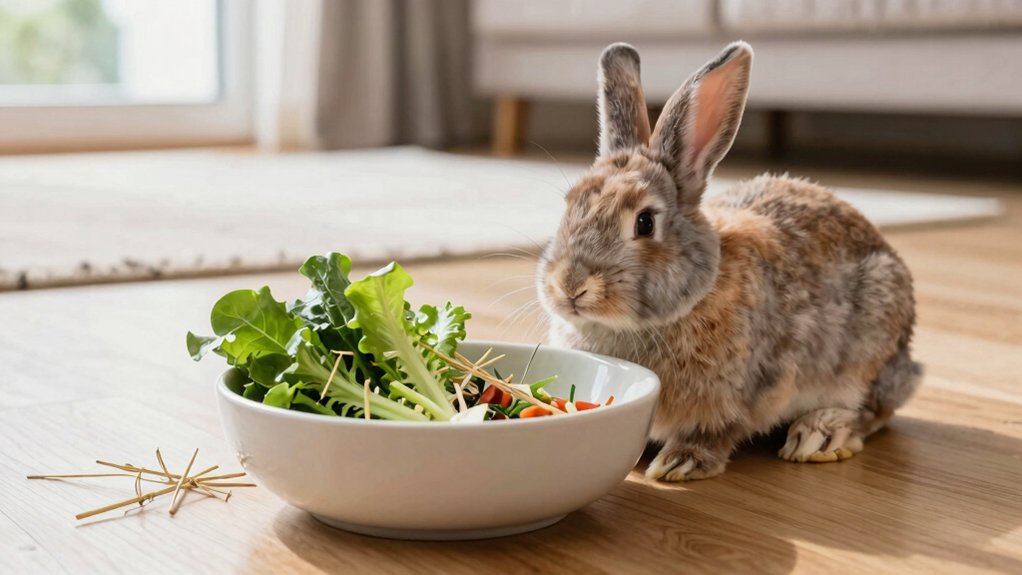
As your rabbit changes through life, you’ll adjust the “base menu” to match what her body needs—especially during pregnancy and lactation.
For growth, rely on alfalfa hay and alfalfa pellets at first, then gradually add grass hay so chewing and gut fermentation (hindgut digestion) build strong habits.
Between 7 weeks and about 7 months, keep alfalfa-based foods and limit fruit and no risky veggie surprises until around 12 weeks, then introduce greens slowly, one type at a time.
During pregnancy, prioritize constant good grass hay for fiber.
For lactation, keep hay and leafy greens plentiful, and monitor her weight closely.

Nutrition Powerhouse - Elevate your little animals' vitality thanks to the rich protein, calcium, and vitamins in every nibble of alfalfa leaf. This young rabbit food improves dental hygiene, digestion, coats, muscles and bones.

【HIGH QUALITY METAL MATERIALS】The BESNEW rabbit feeder and food box are crafted from high-quality metal materials,bite-resistant and durable.There is no need to replace it frequently,which would increase costs.

MINIMIZE WASTE AND MESS WITH THIS HANGING ALFALFA AND TIMOTHY HAY DISPENSER - Frustrated about the mess of alfalfa and hay strewn about your pet's cage? Are you so done cleaning off the hay mixed with pee and poop? This hanging alfalfa and timothy hay dispenser will change the way you feed and clean after your pet rabbits, guinea pigs, and chinchillas.
Adult Maintenance Targets: Protein, Fiber, and Fat
Once your rabbit’s past the growth and life-changing phases, you can fine-tune the “base menu” around adult maintenance targets, especially protein, fiber, and fat.
Aim for pellets that sit near 12–14% protein, because adult diets don’t need the higher protein found in baby formulas.
Next, prioritize fiber. Feed pellets with at least 18% fiber, and often 20–25% fiber, while your rabbit still enjoys unlimited grass hay.
Finally, keep fat modest.
Choose pellets with about 2–5% fat.
Serve pellets in a small daily amount, then let greens and hay do the heavy lifting. Since pellets are only one part of the diet, it helps to compare commercial pellet options carefully before choosing a product.

The information below is per-pack only

【Versatile & Adjustable Design】Perfect for a wide range of small pets including rabbits, guinea pigs, hedgehogs, squirrels, tortoises, hamsters, and gerbils. The included stainless steel chain with buckle allows easy hanging and adjustable height to fit your pet’s habitat perfectly

ENCOURAGES FORAGING & HAY CONSUMPTION: Sprinkle this tasty topper on rabbit food, guinea pig food, or chinchilla food to boost hay intake; Packed with healthy ingredients, it supports natural foraging and keeps pets like bunnies and guinea pigs happy
Common Feeding Mistakes That Cause Gut Stasis
Gut stasis is one of those scary rabbit problems that usually has a diet “pattern” behind it.
First, don’t skimp on grass hay. If hay runs low, gut movement slows, and digestion hangs around in the cecum too long.
Don’t skimp on grass hay—low hay slows gut movement, leaving digestion to linger too long in the cecum.
Aim for 75–80% of daily food as grass hay or roughage.
Next, limit pellets. Too many, especially with little hay, raises risk.
Also, be cautious with treats and sweets, like fruit, nuts, and baked goodies, because high carbs can trigger sudden trouble.
Finally, change foods gradually. Add leafy greens slowly, and keep fresh water always available.

CAPACITY: Large 32-ounce water bottle designed for small pets including rabbits, hamsters, guinea pigs, ferrets, chinchillas, mice, rats, and gerbils

Leak-Proof Nozzle: U.S. patented Choco Nose design prevents water leakage; provides a dry and mess-free cage environment while keeping pets’ water clean and fresh.

Ships in random colors magenta, lime green, and orange
Unsafe Foods for Rabbits (and Why They’re Risky)
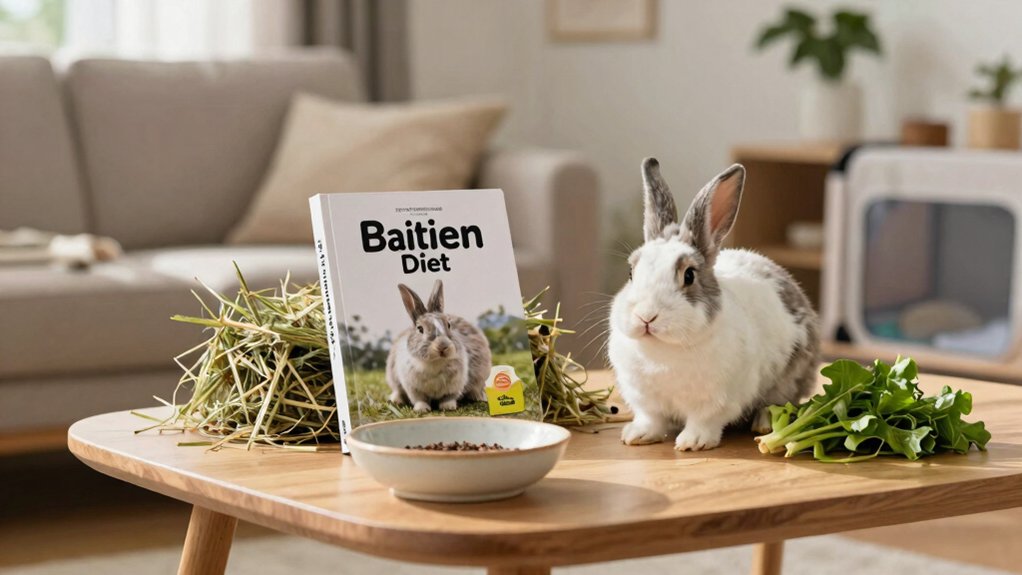
When you’re trying to prevent gut stasis, diet safety matters just as much as portion control—because one “small” unsafe food can upset digestion fast.
Unsafe foods include sugary, processed treats like candy, yogurt drops, crackers, and breakfast cereals.
They’re high in sugar and fat, and they can trigger diarrhea and disrupt normal cecal fermentation.
That’s the fermentation in the cecum that helps process fiber.
Also avoid chocolate completely, even a tiny amount—it’s toxic.
Keep rabbits away from toxic plants, too: avocado, rhubarb leaves, potato green parts, tomato leaves, apple seeds, and many garden flowers like foxglove and poppies.
When in doubt, don’t serve it.
My Rabbit Won’t Eat: What Should I Try First?
If your rabbit won’t eat, treat it like a true emergency, not a “wait and see” situation. Call a rabbit-savvy vet right now. If your bunny goes about 6 hours without eating, gut stasis risk jumps fast.
Look for fewer droppings, no droppings, or tiny pellets, plus lethargy or belly pain—these mean don’t delay.
While you arrange care, keep fresh long-stem hay ready, offer leafy greens, and give clean water in a bowl and bottle. Offer higher-water greens if it’ll take them.
If it feels cold, warm gently. Avoid force-feeding or meds without vet advice.
Frequently Asked Questions
What Should Rabbits Eat Every Day for a Healthy Digestive System?
Feed you rabbit high-quality grass hay every day (unlimited), plus leafy greens daily (about 1 cup per 2 lb body weight), and a small measured amount of plain timothy pellets (about 1/4 cup per 5 lb). Use fresh water always.
Do Rabbits Use Their Hands to Eat, or Do They Eat Differently?
No, you don’t see rabbits using “hands” to eat. They graze and collect food with their mouth, lips, incisors, and cheek teeth, gnawing and chewing while their forelimbs mainly help them balance and stay steady.
Can Rabbits Eat Carrots or Lettuce as a Daily Vegetable?
You can’t make carrots a daily vegetable; give them only as an occasional small treat due to sugar. Lettuce can be daily leafy greens—skip iceberg, choose romaine/leaf/bibb, and keep portions modest.
How Much Fruit Is Safe, and How Often Can I Offer It?
Offer fruit only small portions: about 1 teaspoon per 2 lb body weight (or 1–2 tablespoons per 5–6 lb) max. Keep it an occasional treat—1–3 times per week. Avoid fruit for young or overweight rabbits.
Why Does My Rabbit Refuse Pellets but Eat Hay and Greens?
Your rabbit refuses pellets while eating hay and greens because pellets feel selective, rich, or unpalatable. Stress, a brand change, dustier pellets, or mild tummy discomfort can trigger refusal. If appetite or droppings drop, call an exotics vet.