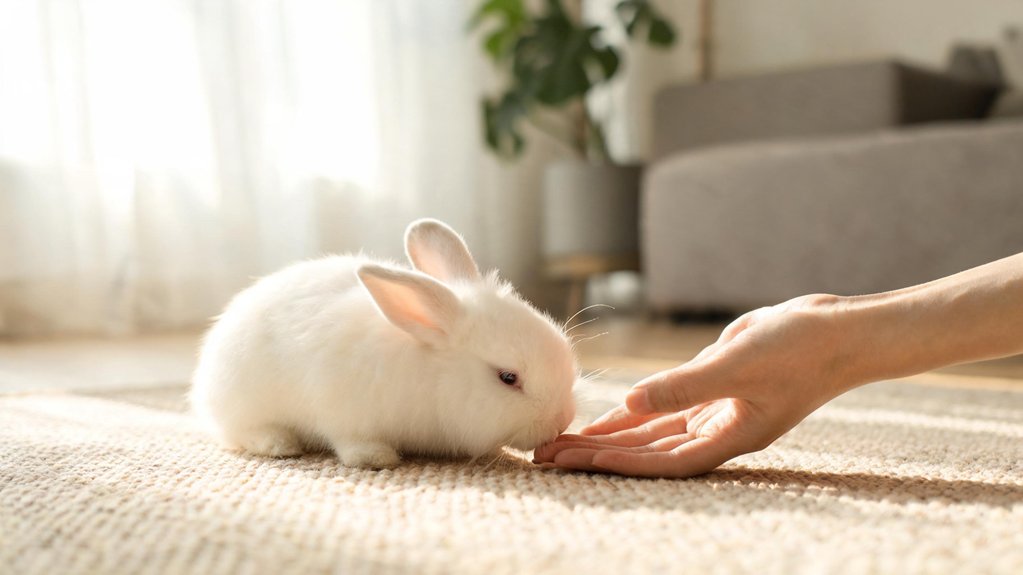
Set up a quiet training zone, then use gentle positive reinforcement. Pair a clicker (or “yes”) with pea-sized rabbit-safe treats, and click within 1–2 seconds of correct nose contact. Start with target touch, then build recall by using one cue like “come,” luring with a target, marking the moment they touch, and rewarding right away.
Teach standing by rewarding upright balance on a non-slip surface. For litter training, use flat boxes first and reward every hop in. Keep sessions brief, lasting 2–5 minutes. There should be no punishment—there’s more you can teach next.
Swift Summary
- Start in a quiet, familiar space using rabbit-safe rewards and brief 2–5 minute sessions to keep learning stress-free.
- Pair a consistent marker (clicker or “yes”) with treats so the rabbit understands exactly when they did the right behavior.
- Use precise timing: mark within 1–2 seconds of correct nose or target contact, then reinforce immediately.
- Teach easy shaping tricks first, like targeting or hand nose-touch, gradually increasing difficulty and rewarding clear, instant contact.
- Build reliability by training recall and litter-box use in controlled areas before adding distractions and more advanced tricks.
Set Up Positive Reinforcement Rabbit Training Safely
To set up positive reinforcement rabbit training safely, start in a quiet, familiar space where your rabbit already feels calm and secure—such as its usual playpen, exercise area, or a designated training zone. Creating a comfortable environment minimizes stress and encourages successful learning sessions. Use tiny, rabbit-safe rewards like pea-sized greens, fresh herbs, or a small amount of normal pellet or forage to incentivize positive behavior without overfeeding. positive, reward-based training is also a great way to avoid triggering stress or fear during learning. Keep training sessions brief, lasting about 2 to 5 minutes, and schedule multiple sessions throughout the day to maintain your rabbit’s engagement and focus. Minimize all distractions, avoid loud noises or sudden movements, and provide access to a hide or tunnel where your rabbit can retreat and feel safe if needed. Observing your rabbit’s body language is crucial: if your bunny freezes, hides, growls, or breathes rapidly, pause the session immediately to prevent stress or fear. This careful, solution-focused approach helps build efficient training routines, making your rabbit more responsive and well-behaved over time.
Rabbit Clicker & Target Training: Marker Timing
Pair your marker—such as a clicker or a clear “yes,” indicating “that’s it”—with high-quality treats to establish a strong positive association.
Deliver the reward within approximately 1–2 seconds after the rabbit’s nose makes contact with the target or investigative surface, ensuring the rabbit quickly connects the behavior with the reinforcement. Precise timing enhances the rapid learning process and reinforces clear communication between you and your rabbit.
When shaping target contact, proceed gradually. Click at the exact moment the rabbit’s nose touches or thoroughly investigates the target, rather than after the rabbit wanders away or completes the entire routine. positive reinforcement helps the rabbit feel safe enough to keep offering the correct behavior.
Maintaining this accuracy is crucial for effective training. If you miss the optimal timing, reset and try again, because consistent, accurate clicks are essential for successful target training.
Incorporating these timing strategies with quality treats and a patient approach will accelerate your rabbit’s learning, making your training sessions more efficient and productive.
Pair Click With Treats
Once you’ve selected a reliable training tool such as a clicker, a short, distinct sound that signals “Yes!” or a consistent verbal cue, you’re ready to enhance your rabbit’s training experience. Pairing this sound with high-value treats creates a powerful association that accelerates learning and encourages desired behaviors. Start by muffling a sharp clicker or choosing a clear, consistent word to avoid startling your bunny—this ensures a relaxed training environment. Begin with one click or verbal cue immediately followed by a tiny, enticing treat, repeating this pairing approximately 10 to 15 times. Incorporate a brief pause, such as quietly saying “treat,” to help your rabbit link the sound directly to the food reinforcement. Timing is crucial for effective training. As your rabbit demonstrates specific behaviors, promptly click or verbalize within 1 to 2 seconds to reinforce the behavior accurately. This precise timing reinforces positive actions and helps prevent confusion. With consistent practice and strategic use of clicker training paired with delicious treats, you’ll find that rabbits are more trainable than you might expect—making your efforts worthwhile and your interactions more rewarding. Adding sharp marker timing helps the rabbit clearly understand which exact moment earned the reward, reducing hesitation and speeding up learning.
Reward Immediately After Touch
Reward your rabbit immediately after the touch, as timing is essential for effective training. In your rabbit tricks practice, wait just 1–3 seconds after the rabbit’s nose or body makes contact with the target. Use a precise marker, such as a clicker or a consistent verbal cue, at the exact moment of contact. Then, deliver a small, healthy treat right away to reinforce the desired behavior.
This approach ensures the clear association between the touch and the reward, preventing accidental reinforcement of unrelated actions like grooming or follow-away movements.
Aim for calm, focused training sessions to maximize learning efficiency and strengthen your bond with your rabbit. Keep rewards modest to avoid overfeeding and maintain your rabbit’s health and energy levels.
Shape Target Contact Slowly
Slowly shape the contact, and you’ll see your timing click into place quickly, transforming your training sessions into more effective and confident interactions with your rabbit.
Begin by precisely marking the moment your rabbit orients toward the designated target, such as when it looks at your hand, establishing a clear behavioral cue.
Then, gradually raise your training bar by requesting a small step closer to the target, stopping short of a full nose-to-target contact.
Keep your training sessions brief, ideally lasting between 3 to 5 minutes, and repeat these exercises frequently to maintain your rabbit’s confidence and eagerness.
For precision, only reward when your rabbit makes instant, clear nose contact with the target; avoid rewarding delayed or uncertain movements.
If you click even 0.5 seconds late, your rabbit might associate the reward with the wrong action, hindering progress.
To refine your timing and improve your training accuracy, incorporate a tennis ball into your practice sessions as a reliable tool for honing your clicker skills and ensuring consistent reinforcement.
This method ensures tailored, efficient, and positive reinforcement strategies, leading to faster, more reliable contact behaviors.
Teach Litter Box Use Before Big Tricks
Set up multiple “success zones” with highly accessible litter boxes in the corners your rabbit naturally favors, ensuring consistent placement to establish reliable litter training.
Begin with a small, confined room or pen to minimize confusion and enhance your rabbit’s focus on specific areas, creating an ideal environment for foundational training.
As soon as your rabbit sniffs, circles, or hops into the litter box, immediately reward this behavior with a high-value treat to strengthen the positive association.
Use treats the exact second they eliminate to reinforce the connection between the litter box and a rewarding outcome.
Once your rabbit demonstrates consistent litter box use, you can confidently introduce advanced training exercises such as recall and targeting within this calm, predictable space, building a solid foundation for more complex tricks.
Set Up Litter Success Zones
Before you teach any big tricks, it’s essential to establish effective litter success zones that align with your rabbit’s natural preferences. Observe your rabbit closely to identify locations where it consistently urinates in puddles or deposits fecal pellets, typically in corners or low-traffic areas. Position the litter box directly in these high-usage spots, placing it in a corner with a clear, unobstructed view to help your rabbit feel secure and comfortable.
Ensure the litter box is flat and barrier-free, allowing your bunny to stretch and turn easily for maximum comfort. Size the box appropriately—large enough so your rabbit can comfortably move and reposition inside. When choosing a box, consider easy-to-clean designs that make daily scooping and regular cleaning quicker, helping keep your rabbit’s litter zone hygienic. If your living space is larger or contains multiple rooms, add additional litter boxes near common areas such as the hay rack to reinforce positive habits and maintain cleanliness throughout the environment.
To optimize training success, confine your rabbit to a controlled area initially, allowing familiarization with the designated litter zone. Gradually, move the litter box 2 to 6 centimeters daily towards the desired final corner, ensuring a smooth transition. This gradual process minimizes stress and encourages consistent litter use, making your rabbit’s litter training more efficient and reliable, ultimately contributing to a cleaner, more hygienic home environment.
Reward Box Use Immediately
Once your rabbit has established a successful litter zone, you can make the rewarding process immediate and highly effective with a dedicated reward box. Keep a small bowl or cup filled with high-value treats—such as fresh veggie bits, preferred hay, or other small, enticing foods—positioned right next to the litter box.
Use this reward system every time your rabbit enters the favored corner to reinforce the positive behavior.
When your rabbit first hops into the designated corner, offer a tiny treat even before urination occurs. If urination or droppings happen in the box, give an additional treat before your rabbit exits.
This immediate and consistent praise helps accelerate the formation of a reliable litter habit.
Be sure to use very small portions of treats to prevent unintended weight gain, and select foods your rabbit already loves to maximize the effectiveness of training.
This targeted reward approach creates a powerful, solution-focused method for ensuring your rabbit maintains proper litter habits quickly and efficiently.
Build a Recall Cue Using a Target or Treat Lure
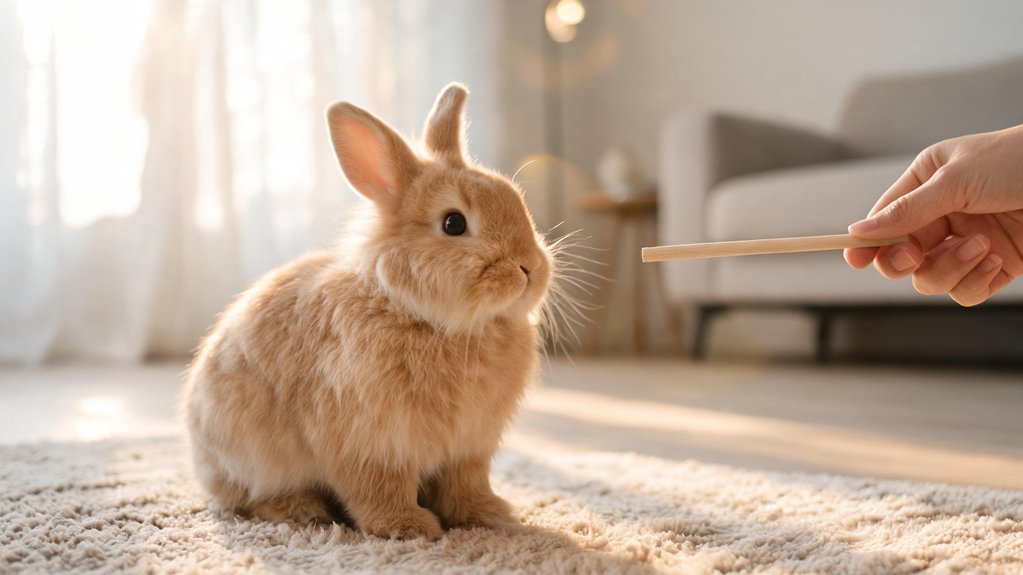
How do you transform a simple “come” command into a dependable, fail-safe recall cue for your rabbit? First, SELECT a single, concise cue such as your rabbit’s name or the word “come,” ensuring it’s clear and easy to remember. Pair this cue with a high-value, irresistible treat as your primary reward, and absolutely avoid using the cue during any form of punishment or correction. Starting during a calm, relaxed free-roaming session lasting 1 to 2 minutes, limit your attempts to just a few to prevent overwhelming your rabbit and to establish a positive association.
Next, reinforce the recall by pairing the cue with a target or treat lure held just a step away, which serves as an effective visual or tactile prompt to guide your rabbit. Say the cue once in a cheerful, upbeat tone, then move the lure directly toward your rabbit to entice it to follow. Mark the behavior—using a happy, distinct word—and reward immediately within 2 to 3 seconds when your rabbit turns toward you, noses or sniffs the lure, or hops closer.
Gradually increase the distance during training sessions, ensuring your rabbit’s success rate remains high before progressing to more challenging recall distances.
This method leverages positive reinforcement and strategic cue pairing to foster a reliable, lifelong recall system. By consistently applying these training steps—using a clearly identifiable cue, high-value rewards, and gradual distance increases—you create a trustworthy recall cue that ultimately enhances your bond and ensures your rabbit’s safety in various environments. Invest in this proven approach to enjoy peace of mind and a happy, well-behaved pet.
Target Training Basics: Lure, Touch, Follow
Target training is one of the most effective, engaging, and joyful methods to teach your rabbit to respond intentionally using positive reinforcement techniques. By incorporating carefully selected rabbit-safe equipment such as a high-quality target wand, a chopstick with a soft, lightweight ball attached, or even a standard ping-pong ball mounted on a pen, you create a safe and appealing training environment.
Sit comfortably on a non-slip, flat surface that provides stability, ensuring your rabbit feels secure during training sessions.
Utilize tools like a clicker or a concise, consistent marker word such as “yes” to clearly communicate successful behavior. Immediately after the click or marker, deliver a small, desirable treat within five seconds to reinforce positive association and encourage your rabbit’s participation.
Focus on essential training behaviors: employ a lure by holding food near the target tip and gradually moving it away to guide your rabbit’s head or body, prompting engagement. For the touch behavior, be patient and wait for your rabbit to make nose contact, then click precisely at the moment of contact before rewarding.
To teach follow, slide the target a few inches, rewarding your rabbit for taking single steps toward it. This progressive approach fosters reliable responses, enhances your bond, and accelerates your training success with your rabbit.
Teach Stand and Hop/Jump Steps
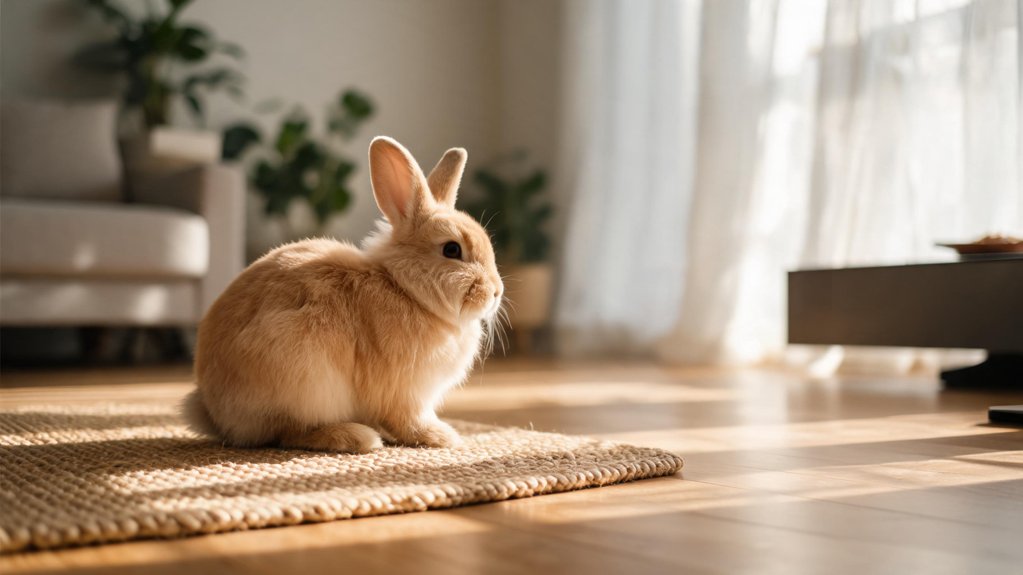
After your rabbit is comfortable with basic target work, you can start implementing “stand” and simple hop or jump steps using the same positive reinforcement strategy. Place a small, high-value treat—such as a crunchy pellet or a favorite vegetable—above their head, slightly forward of the nose line to encourage natural upward movement.
Use a high-value treat above their head to cue “stand,” encouraging natural upright balance with positive reinforcement.
Ensure the training surface is non-slippery, such as silicone mats or padded flooring, so their hind feet can grip firmly and securely during exercises.
Allow your rabbit to explore the training area freely for at least 30 seconds initially, helping them feel safe and confident in the environment. Begin with the tiniest upright lift, gently encouraging them to raise their body into a standing position.
Reinforce the moment you observe their balance and stability, then pause to let them settle. Only increase the duration of standing when they can do so briefly without wobbling, and gradually raise the treat height in tiny, incremental steps to promote confidence and proper posture.
For hop or jump training, start by placing a low bar or board on the ground to serve as a target stepping point. Gradually raise the bar or board by 0 to 5 centimeters, watching carefully for signs of discomfort or hesitation.
This approach ensures your rabbit learns to jump or hop confidently at different heights, enhancing agility and coordination.
Properly training your rabbit with these controlled steps can transform their natural movement into a reliable, enjoyable activity, making it suitable for agility competitions, enrichment routines, or improving overall mobility—delivering a fun, engaging, and healthy experience with every step.
Add Verbal Cues After the Behavior Is Reliable
Once your rabbit demonstrates consistent performance of the desired behavior in short, focused training sessions, it’s the ideal time to incorporate a clear verbal cue. Begin by pairing a short, distinct word such as “come” with your bunny’s action immediately as it occurs, creating a strong association. This initial phase helps your rabbit understand that the cue directly links to the behavior, enhancing the effectiveness of your future commands.
After the association is solid, gradually shift the verbal cue to occur just before your rabbit performs the behavior, which sets the stage for more reliable responses. Use a calm, gentle tone—never loud—to deliver the cue, maintaining a consistent voice to reinforce learning.
When you say the cue, pause briefly to see if your rabbit responds. If the behavior occurs, immediately mark the exact moment with a clear “yes” or a clicker sound, then offer a small, high-value treat within a few seconds to reinforce the desired action.
Repeat this process consistently: cue, behavior, marker, and reward, ensuring your rabbit understands the cue predicts a reward. Avoid rewarding behaviors that happen without the cue, as this can create confusion.
Implementing this structured, solution-focused approach enhances your rabbit’s training reliability and accelerates your journey toward a well-behaved, responsive companion.
Fix Common Rabbit Training Stalls (No Punishment)
If your rabbit suddenly stops performing a trick you’ve just taught, it’s important to identify and address the underlying cause rather than blaming your training methods. Begin by ruling out health issues, stress factors, and environmental influences, as these can significantly impact your rabbit’s ability and willingness to perform. If your rabbit shows signs of avoiding food, the litter box, or physical contact, promptly consult a qualified veterinarian to ensure there are no health concerns.
To enhance your training success, minimize distractions by creating a calm, focused environment and consider using a smaller training pen to maintain your rabbit’s attention. Make sure the litter box is appropriately set up, clean, and accessible to promote desired behaviors.
Once you’ve addressed these factors, reduce your training criteria by returning to the last mastered step, and keep training sessions brief, lasting only 2 to 5 minutes to prevent frustration and promote positive reinforcement.
Return to the last mastered step and keep sessions brief—2 to 5 minutes—to prevent frustration and reinforce success.
Monitor your rabbit closely for frustration cues such as thumping or turning away, which indicate it’s time to pause or reassess. In clicker training, ensure your click occurs within one second of the correct behavior, followed immediately by a treat to reinforce learning.
It’s crucial to avoid punishment and instead reset the training session calmly without clicking to maintain a positive and stress-free environment. This approach will help foster a trusting relationship and improve your rabbit’s training progress effectively.
Frequently Asked Questions
Can Rabbits Go up and Down Stairs After Training?
Yes, you can train a rabbit to confidently navigate stairs, including both going up and coming down. Begin training on the lowest step using a non-slip surface to ensure your bunny’s safety and stability. Use high-value treats such as small pieces of fresh vegetables or specially formulated rabbit training treats to reward each careful hop and reinforce positive behavior.
Supervision is crucial throughout the training process to prevent accidents and ensure your rabbit feels secure. Be attentive to signs of uncertainty, soreness, or shakiness, and be prepared to pause or stop the training if your rabbit shows discomfort. With consistent, patient training and the right supportive environment, your rabbit can become comfortable and skilled at managing stairs, making your home more accessible and safe for your beloved pet.
Can You Train a Rabbit to Come When Called?
Yes, you can effectively train a pet rabbit, including common domesticated breeds like Dutch, Himalayan, or Netherland dwarf rabbits, to reliably come when called with consistent effort and proper techniques. Start training in a quiet, distraction-free environment such as a secure indoor room or a fenced outdoor enclosure to enhance focus. Utilize a clear, consistent verbal cue like “come” along with a gentle, inviting tone, and immediately reward your rabbit with high-value treats such as fresh vegetables, bunny pellets, or specialized rabbit treats that motivate and reinforce positive behavior.
To ensure successful training sessions, keep them engaging, brief, and positive—ideally 5 to 10 minutes per session—while gradually increasing difficulty by introducing mild distractions. Regular use of praise and delicious rewards will build a strong associative bond with the command, leading to faster response times. Adopting this method will not only improve your rabbit’s recall skills but also strengthen your bond, making it easier to manage your pet in everyday situations like grooming, vet visits, or outdoor exploration, ultimately ensuring a safer and more enjoyable companionship.
Are Rabbits Hard to Train With Positive Reinforcement?
No, rabbits are generally not difficult to train using positive reinforcement techniques. With consistent, targeted training sessions, you will observe swift progress in teaching essential behaviors such as litter box use, basic commands like sit or come, and handling skills.
To maximize training success, keep sessions concise—around 5 to 10 minutes—and immediately reward your rabbit with treats or praise to reinforce desired behaviors. Patience is crucial, as each rabbit has its own learning pace. Investing in high-quality training supplies and understanding your rabbit’s individual temperament will ensure a smoother training process and foster a well-behaved, happy pet.
What’s the Best Way to Stop Accidents Without Punishment?
Stop accidents without punishment by implementing spotless, scent-safe cleanups combined with proactive setup strategies. This approach minimizes stress and encourages correct behavior through positive reinforcement, fostering a healthier environment for your pet and peace of mind for you.
Limit your pet’s accessible space to reduce the likelihood of accidents and provide a sturdy, appropriately sized litter box that encourages consistent use. Reward your pet immediately for correct bathroom habits, which reinforces positive behavior and promotes long-term compliance. Gently redirect your pet during misses to guide them toward proper elimination spots without creating anxiety. Only expand the accessible space once your pet demonstrates steady, successful use of their designated areas, ensuring ongoing progress and reducing accidents over time.
When Should I Add Verbal Cues for Tricks and Recall?
Add verbal cues only after your rabbit reliably performs the trick or comes when called. First, say the cue clearly while the behavior occurs, then immediately click and treat to reinforce the association. This timing ensures your rabbit understands exactly which action is being rewarded, accelerating learning and consistency.
Next, incorporate the verbal cue just before you expect the behavior to happen, gradually building the connection so your rabbit responds promptly to the cue alone. For recall training, start by cueing when your rabbit is nearby, ensuring adjustments are made in manageable stages to foster reliable responses. Using these step-by-step strategies with consistent, positive reinforcement will optimize your training results and help you develop a well-behaved, responsive rabbit.