You can get rid of rabbits humanely by blocking their access first. Look for chewed stems near the soil, droppings in clusters, and gnawing on bark about 2–2.5 ft high. Then install a rabbit fence about 24 in tall with 1-inch-or-smaller mesh, bury the bottom about 6–12 in, and add an outward apron to stop digging. Protect seedlings with 18–24 in mini cages, then reapply a rabbit-safe taste/odor repellent before spring damage and after rain on schedule.
Swift Summary
- Identify rabbit damage by checking for angled stem cuts near the soil, bark gnawing 2–2.5 feet high, and clustered pea-sized droppings.
- Prevent access with humane fencing using 1-inch mesh or smaller, about 24 inches tall for cottontails, with the bottom buried or tight.
- Reinforce the fence base with a buried trench and L-shaped apron to stop digging and seal gaps at seams, corners, and gates.
- Protect vulnerable plants using mini wire cages or trunk guards (hardware cloth cylinders) and keep seedlings covered until established.
- Use humane repellents labeled for rabbits, apply before spring feeding, and maintain reapplications while combining deterrents with exclusion.
Identify Rabbit Damage and Fence Entry Points
Before you try to chase rabbits away, you’ve got to figure out exactly what they’re doing in your yard. Look for clean, angled cuts on stems, about a 45° slant, plus grass chewed to the crown in small patches. Look for droppings that are usually easy to spot. Check low plants first, within 6 inches of soil, and scan for pea-sized round droppings in clusters.
Next, inspect bark gnawing 2 to 2.5 feet high, plus twigs clipped with smooth edges.
Finally, find fence gaps, burrow holes near edges, and spots where rabbits travel.
This helps you plan what keeps rabbits out of garden, and how to stop rabbits from digging under fence.
Install Humane Rabbit Fencing to Block Access
Choose fencing with 1-inch mesh or smaller so young rabbits can’t squeeze through, and set the barrier about 24 inches tall for cottontails (up to 36 inches for jackrabbits). 2-foot chicken wire fence With this kind of mesh, make sure the bottom edge is tight or buried a few inches so rabbits can’t dig in and get underneath.
Bury the bottom roughly 4 inches deep, or bend it outward and pin it down like a skirt, so they can’t dig underneath.
Then add targeted mini enclosures around your most tempting plants, using a short 24–36 inch guard or a small pen, so you block access where it matters most.
Choose Proper Mesh Size
To keep rabbits out of your yard, start with the right fencing mesh size—because rabbits can squeeze through surprisingly small gaps. For the best way to keep rabbits out of your garden, use 1-inch or smaller welded wire (1×1) or 1-inch poultry netting, especially along the bottom 1.5–2 feet. If young rabbits are a problem, go tighter: 19–25mm mesh, or even 1/4 inch for highest security. Burying the bottom about 6 inches (or using a 12-inch surface apron) helps prevent rabbits from digging under the fence. When you ask how to get rid of rabbits permanently, choose sturdy metal mesh, then learn how to install rabbit fence with no ground gaps at posts and gates.
Bury Fence Bottom Securely
After you’ve picked the right tight mesh, burying the fence bottom is what keeps rabbits from digging their way in.
Dig a trench 6–12 inches deep, about 6 inches wide, along your fence line, and clear a 1-ft path first.
Set the mesh so it sits directly under the fence or slightly in front, then create an L-shaped apron—bend the wire outward 90° and extend it 6–12 inches flat into the rabbit approach zone.
Bury the bottom 4–6 inches under soil, backfill, and tamp.
Anchor every 2–3 ft.
This is the best way to keep rabbits out of garden, helping how to prevent rabbits in yard and how to get rid of rabbits without killing them.
Add Targeted Mini Enclosures
A few well-placed mini enclosures can do a lot to keep rabbits out of your garden without turning your whole yard into a fortress.
If you’re wondering how to remove rabbits from yard, start small: wrap vulnerable beds with mini perimeter fencing using 1-inch wire mesh, 24–36 inches tall for cottontails.
Then, add movable panels around new seedlings, right after planting.
Place plant cages—18–24 inches high—around choice vegetables.
But if you’re doing how to get rid of rabbits under shed, block the entry path with tight mesh.
This helps you get rabbits out of your garden, gently and permanently.
Bury and Reinforce the Fence Base Correctly
When you set your fence, bury the base about 6–12 inches deep, and if you’re aiming for extra security, think “deeper and wider” so rabbits can’t dig under it.
Bend the bottom mesh outward like an apron—about 12–18 inches away from your yard—so it works as a digging block, and pin or stone it down where it meets the ground.
Then reinforce seams at overlaps, check for any gaps or lifted spots after the first week, and repair them right away so rabbits can’t sneak through.
Bury Fence Base Four Inches
To keep rabbits out, bury your fence base about 4 inches deep along the entire yard perimeter. This is a key step in how to get rabbits out of your yard, and it helps with how to get rid of rabbits in the garden.
Dig a narrow trench, recess the mesh base below grade, then backfill firmly. Use 4–6 inches where rabbits pressure is high, especially in sandy soil, and tamp it tight so there are no soft spots.
Keep the burial continuous, including corners and gates. When you do this, you’re choosing the best way to keep rabbits out of your yard, humanely.
Bend Bottom Outward Six Inches
Bend the bottom of your rabbit-proof fence mesh outward about 6 inches, like you’re making a little L-shape that blocks digging at the fence line.
This is a key step in how to get rid of rabbits in your backyard humanely, because it stops typical burrow starts right at the barrier.
You’ll also learn how to get rid of a rabbit without harm by making escape harder, including how to get rabbits out from under shed.
Are rabbits bad for your lawn? Yes, they can nibble, so cover the wire with 2–3 inches of soil or mulch.
Then anchor the apron every 2–3 feet.
Reinforce Seams And Repair
First, you’ll want to reinforce the seams and repair the fence base, because that’s where rabbits usually try to “cheat” in.
When you’re learning how to get rid rabbits humanely, check every joint, corner, and low spot.
Overlap panels, then attach extra hardware cloth across worn areas at ground level, sealing tiny gaps.
For gaps or eroded trenches, backfill with firm soil or gravel until the bottom sits tight.
Are rabbits bad for your yard? Yes, they burrow and squeeze under weak edges.
Add U-shaped pins, then cover with mulch.
Inspect weekly, and reinforce seams and repair before they learn.
Use Mini Wire Cages for Vulnerable Plants
Use mini wire cages to protect your most vulnerable plants, because a hungry rabbit can wipe out seedlings fast.
If you’re searching for how to get rid of rabbits in my yard or how to get rid of a rabbit without harm, start here.
Cover tender greens like lettuce, peas, and beans right after sowing or transplanting.
Choose chicken wire or hardware cloth with 1-inch openings.
Build cages about 18–24 inches tall, and bury the bottom edge 1–6 inches, or pin it tight.
Use U-shaped pins to remove gaps at soil level.
Secure the frame with stakes, then lift cages after a couple months.
Rabbit fencing made for exercise areas can also serve as a secure enclosure that keeps rabbits away from your garden beds.
Choose Rabbit-Resistant Landscaping for Your Yard
When rabbits keep nosing around your garden, you can make the whole yard less tempting—before you ever need to chase them away. Choose rabbit-resistant perennials and flowers: blanket flower, butterfly weed, Russian sage, yarrow, sedum, plus cleome, geraniums, periwinkles, and wax begonias avoided.
Keep rabbits guessing: plant rabbit-resistant perennials like blanket flower, butterfly weed, Russian sage, yarrow, and sedum.
Add aromatic and strongly flavored herbs in clusters, like lavender, rosemary, sage, marigolds, and alliums such as chives and ornamental onions.
Plan shrub and hedge structure with dense, resistant plants like boxwood, yew, cotoneaster, spirea, viburnum, and holly.
Aim for 70–80% resistant plants, then tuck in the rest wisely.
Plant Deterrents Along the Garden Perimeter
Along your garden perimeter, you can make the “edge” feel unappetizing to rabbits—before they ever reach your favorite plants.
Plant a 1–2 foot herb strip of lavender, rosemary, sage, mint, oregano, thyme, and chives. Their pungent oils and strong smells wash over feet and noses, and rabbits usually back off.
Then add continuous alliums, like ornamental onions and daffodils, in a belt. Use clumps near paths or fence breaks for a stronger scent line.
For texture, border with fuzzy lamb’s ear or spiny yucca. Dense grasses help too, creating a soft barrier.
Apply Humane Taste and Odor Repellents Safely
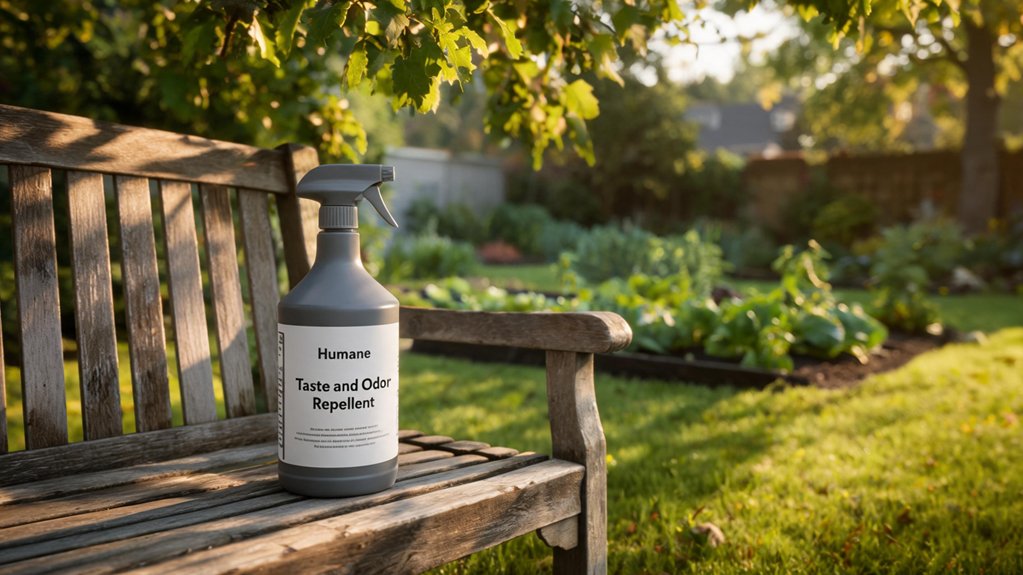
Choose a repellent label that says it’s for rabbits and that use around pets and food crops is allowed, because “safe” depends on the exact product directions.
But don’t wait: apply before spring damage starts, then spray or set the repellent per label timing, often right in dry weather and again about a week later, with monthly touch-ups.
After rain, reapply as directed, since wet smells and coatings wash off fast and rabbits move in when the barrier fades.
If you also keep pet rabbits, place a comfortable, non-slip rabbit mat inside their enclosure, away from any repellent application, so their resting area stays clean and uncontaminated.
Choose Food-Safe Deterrents
Start by picking food-safe deterrents that work through taste and smell, not harm.
Choose products made for edible crops, with ingredients like hot pepper (capasaicin), garlic, whole-egg solids, or botanical oils.
Read the label first, because many odor products are meant for perimeter areas, not directly on parts you’ll eat.
For taste repellents, spray or brush onto leaves, and reapply after rain or heavy watering.
For extra staying power, use an approved sticker such as an anti-wash-off spreader.
Around beds, set odor deterrents to discourage visits.
Apply Before Spring Damage
Before rabbits start nibbling your first new shoots, put your humane taste-and-odor repellents in place.
Apply early, before browsing begins, or at the first signs of feeding, so rabbits don’t set up a regular route.
Position taste repellents directly on leaves and stems, and odor repellents around soil and perimeter beds.
Spray plant-based options on vulnerable plants after testing one leaf first for leaf safety.
For granular odor, sprinkle a wide strip around shrubs and plots, especially in dry weather.
Choose label-approved products for edible crops, wear gloves, and wash up after handling.
Then schedule repeat spring touch-ups.
Reapply After Rainfall
After a rain, your humane taste-and-odor barrier can get washed away, so don’t assume it’s still working.
When heavy rain, sprinkler irrigation, or heavy dew strips residue, you need to reapply.
Do it right away, or within 24 hours after the storm, for good coverage.
For milder mist or a quick shower, spot-touch on only the plants rabbits hit.
If rainfall runs over about 1/2 inch, or lasts more than 15 minutes, plan a full re-spray.
Follow your label for dilution, coverage, and “don’t apply if rain is expected” timing.
Time Repellents Before Browsing Starts
Because rabbits snack hardest when light fades, you’ll get the best results if you use repellents on a schedule that matches their routine. Apply before browsing starts.
Aim for early morning and dusk, when cottontails feed most.
Put treated barriers on soil, ground cover, bark mulch, and the plant edges before rabbits target them.
For tender new shoots, treat in early spring as soon as plants emerge, and again if labels say.
Expect an initial weekly run for 3 weeks, then shift to monthly.
If rabbits test the area, reapply every 2–3 weeks.
Use only on dry leaves.
Remove Cover and Hiding Spots Around Beds
Once you’ve started using repellents on a schedule, it helps to make your beds less “rabbit friendly” by removing cover and hiding spots right near them.
Now, clear brush, junk, and debris within 15–30 feet of beds.
Move brush piles to distant edges.
Keep weeds and leaf piles out.
Next, mow tall grass closely, and thin vine thickets or groundcover that forms escape cover.
Prune shrubs, hedges, and low branches so foliage doesn’t rest on the ground.
Finally, block gaps under sheds, decks, and porches.
Inspect weekly, then remove any new hiding spots quickly.
Protect Edible Crops With Raised Beds and Mesh
Build solid raised bed walls first, aiming for at least 24 inches high so rabbits can’t reach or climb up, and add an extra-tall 36 inches if jackrabbits are around.
Next, install hardware cloth or fine mesh lids or side panels, using 1/4-inch gaps (small openings) to keep rabbits out while water still drains.
But don’t forget to secure the mesh tightly to the frame and at the edges, because loose spots are the first places rabbits will test. If you keep pet rabbits separately, a properly sized outdoor rabbit cage keeps them secure and away from your crops.
Build Solid Raised Bed Walls
Start by treating your raised bed like a mini fortress for your veggies. Build solid walls that stand 24–36 inches above the surrounding soil, aiming higher (around 36–48) if snow drifts. Use rot-resistant lumber, masonry blocks, or recycled plastic boards, and keep any gaps under 1 inch.
Add a welded wire or poultry netting layer with 1-inch openings for young rabbits. Then seal junctions tightly, stapling or wiring every 4–6 inches.
Finally, pin the bottom edge within 0–2 inches of soil, or bury a skirt 3–10 inches to block digging—helping you get rid of rabbits humanely.
Add Mesh Lids Or Panels
Add mesh lids or panels over your raised beds, and you’ll block rabbits from getting to the tasty leaves while still letting in sun, air, and rain.
Use fine wire mesh with 1-inch openings or smaller.
For tougher protection, choose 1/4-inch hardware cloth.
Fit panels like tight lids on beds under 24 inches, or add 18–24 inches of height above crop level for young plants.
Flat or slightly pitched covers help stop climbing.
Secure every edge with stakes or U-shaped anchors, overlap seams, and add clips at joints.
For extra help, place mesh cloches over seedlings.
Wrap Trunks and Shrubs to Prevent Bark Gnawing
Wrapping your young trees and shrubs is one of the simplest humane ways to stop rabbits from gnawing bark, because a solid barrier makes it too awkward for them to reach the stem.
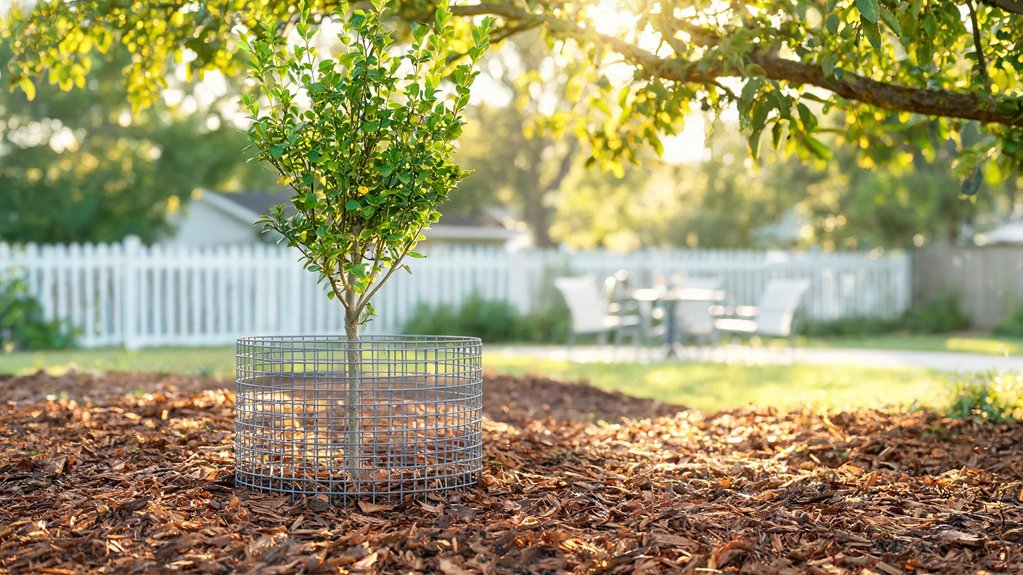
Install hardware cloth cylinders (¼-inch mesh) or poultry netting (1-inch mesh) around trunks and stems, 18–24 inches tall.
Push the guard about 1 inch into soil or mulch, and keep 1–4 inches of space from the bark.
Aim to start by early-to-mid November.
Check after heavy snow, and remove paper or corrugated wraps in mid- to late March to prevent rot.
Add Temporary Enclosures During Peak Rabbit Times
If you notice fresh nibbles or rabbit droppings, you can protect the plants fast with temporary enclosures, especially during the times rabbits love most.
Rabbits forage at dawn and dusk, so you should deploy barriers in the early morning and early evening, then close and secure them through those hours.
Set up your barriers at dawn and dusk, then close and secure them through those peak foraging hours.
Use wire fencing about 24–36 inches tall, with mesh around 1 inch, so even juveniles can’t squeeze in.
Bury poultry netting 4–6 inches into soil, and add a bent “lip” to block digging.
Focus on low plants 0.5–2 feet high, using small cages for clusters.
Remove once pressure eases.
Fix Rabbits Returning After Rain or New Growth
After a rain or a fresh growth spurt, rabbits often come back fast—because the smell of repellents washes off, barriers get shifted, and tender new leaves suddenly taste “just right.”
Your goal is to reset what got disrupted right away, not weeks later.
Reapply odor repellents after rainfall, and restock taste deterrents on leaves.
Rotate types over the season so rabbits don’t get used to one smell.
Then check your fence bottoms, because rabbits slip under gaps.
Keep barriers about 60–90 cm tall, and bury wire 10–15 cm deep.
Use netting or jugs on new shoots.
Avoid Common Humane Rabbit Control Mistakes
Before you try one more “rabbit fix,” slow down and watch for the mistakes that keep bringing them back.
First, don’t underbuild exclusion. Use fencing around 18–24 inches tall, with openings under 1 inch, and stake it tight or bury the bottom several inches, add an outward-bent apron.
Inspect weekly, patch any holes fast. Properly installed garden fencing offers a reliable physical barrier that keeps wild rabbits out of yards and planted areas, so you don’t have to depend on repellents or traps.
Next, don’t rely on repellents as a one-time solution.
Apply before damage starts, follow label dilution, don’t put taste products on edible crops, and rotate if the label allows.
Skip risky trapping.
Know local rules before you relocate.
Also, skip ultrasonic gadgets and basic scare lights.
Best Humane Method Combos for Your Garden Layout
To get rabbits out of your yard for good (humanely), you’ll get the best results by pairing a solid barrier with smart garden layout choices.
First, enclose the whole edible area with 2–3 ft chicken wire or mesh, openings 1 inch or smaller, stake it tight, then bury the bottom about 6 inches.
Skip piecemeal beds—cover the entire garden, including gates and edges.
Skip piecemeal beds—cover the entire garden, including gates and edges, so rabbits don’t find easy entry points.
Next, zone your food: plant lower-preference crops near the inside, then add perimeter rings of strong-smelling alliums and marigolds.
For new seedlings, use netting or cloches, keep it until plants toughen up.
Rabbit Damage Log: Track Fixes and Results
When rabbits keep chewing, you don’t want guesswork—you want proof you can act on. Start a damage log, each event gets the same fields: date, time, garden area, plant species, damage type, and severity score (0–5).
Add bed ID or GPS, plus the property zone, like vegetable plot. Note season, weather, and observation type: sighting, fresh damage, old damage, tracks, or droppings.
In notes, describe what you see: 45° cuts, bark gnawing, pellets, burrows, or height (under 50 cm). Then log every fix, like exclude, protect, audit, correct, replace.
Track results weekly, so you know what worked.
Quick Answers to Common Humane Rabbit Questions
You can tackle rabbits in your yard without hurting them, and the key is knowing which humane tools actually work for your situation.
How to get rid of rabbits permanently? Focus on exclusion: install 2–3 ft fencing, use 1-inch or smaller mesh, and bury the bottom 6–12 inches.
How to get rid of a rabbit fast? Stop feeding them, remove cover, then add temporary scare devices and repellents.
What keeps rabbits out of garden? Tight barriers, less hiding spots, and taste/odor repellents applied often.
How to get rabbits out of your backyard? Combine fencing, plant guards, and motion sprinklers.
Frequently Asked Questions
How Do I Find Where Rabbits Enter My Yard and Garden?
Inspect your fence line, gate gaps, and fence-to-ground contact for loose boards or missing mesh. Look for 3–4 inch soil mounds, 4–6 inch holes, droppings, fur, and tracks. Check damaged plants within 2–2.5 feet of entry routes.
What Fence Height and Mesh Size Works Best for Young Rabbits?
Use 80–100 cm (about 3–3.3 ft) tall rabbit-proof wire and 19–25 mm mesh for young rabbits. About 1 in (25 mm) openings let them slip through. Bury 15–20 cm or add an apron to block digging under.
How Deep Should I Bury the Fence Base to Stop Digging?
Bury the fence base 6–12 inches deep; if rabbits dig hard, go 10–12 inches or about 1 foot. Bend the bottom 6 inches outward into an L-shape apron so they can’t tunnel under.
Which Plants Can I Use as a Rabbit-Resistant Border Along My Beds?
Use rabbit-resistant borders like lavender, catmint, thyme, oregano, sage, lamb’s ear, artemisia, hardy geranium, yarrow, iris, hellebores, columbine, and foxglove—these scents, textures, and leaves help deter browsing and protect your beds.
Do I Need to Reapply Repellents After Rain or New Growth?
Yes—you need to reapply repellents after rain or heavy irrigation, and again when new growth appears. Rabbits test fresh, untreated leaves. Follow the label schedule; expect repeat applications to keep coverage effective.