Yes, you can feed rabbits strawberries, but only as a tiny, occasional treat. Offer fresh, plain strawberries only—skip jam, syrup, chocolate, and anything processed. Keep it small: about 1 teaspoon for a 2 lb rabbit, once or twice a week at most, after they’ve been steady on hay for two weeks. Strawberry leaves are usually okay too, but feed only small amounts since they contain oxalates. If you see mushy poop, stop and stick to hay—keep going to learn more.
Swift Summary
- Yes, rabbits can eat strawberries, but only as an occasional treat in tiny portions.
- Feed fresh, plain strawberries (no jam, sugar, syrup, chocolate, or processed varieties); wash and cut into small bites.
- Offer strawberries once or twice weekly, and start with about a teaspoon to test for normal stools.
- Strawberry leaves are generally safe, but give them in small amounts due to oxalates.
- Stop treats immediately for soft or liquid droppings or missing droppings, and rely on grass hay and leafy greens.
Can Rabbits Eat Strawberries (Yes, in Moderation)?
Yes—you *can* feed your rabbit strawberries, but only as an occasional treat.
Yes—you *can* feed your rabbit strawberries, but only as an occasional treat, in small, fresh portions.
If you’re wondering “can rabbits eat strawberries,” the answer is yes, in moderation. adult rabbits can have fresh strawberries in small amounts as an occasional treat.
Keep strawberries small, plain, and fresh—skip any processed ones with added sugar.
Serve about half to one whole strawberry, once or twice per week, for healthy adults.
For smaller rabbits (3–4 lb), aim for around 1 tablespoon per serving.
For larger rabbits, use up to 2–3 tablespoons.
Fruit sits behind hay and leafy greens.
Introduce slowly, start with a tiny bite, and watch poop and appetite.
Can Rabbits Eat Strawberry Leaves?
Yes, you can feed strawberry leaves, and they’re a genuinely good snack because they’re fibrous and lower in sugar than the fruit. Still, oxalates (natural plant compounds) mean you should keep it occasional, so start with a small handful in your daily leafy-greens mix and watch poop quality for a day or two. leafy greens are part of the roughly 10% veg/day portion of a rabbit’s diet, alongside safe plants and herbs. Only use leaves from unsprayed plants, wash well to remove soil and residues, and skip anything wilted, moldy, or slimy.
Nutritional Value Of Leaves
Strawberry leaves can be a healthy extra for pet rabbits, as long as you treat them like a supplement, not a main food.
You’ll be boosting fiber, which keeps their gut moving and supports healthy “good gut” bacteria.
You’ll also add vitamins A, C, and K for immune support, vision, and bone health.
Plus, you’re giving B vitamins to help energy metabolism, and minerals like calcium and potassium for muscle and nerve function.
Fresh leaves add water, which helps hydration.
And dried leaves work well in winter, adding variety and foraging fun.
Serve small portions with daily greens.
Because rabbits can eat any part of the strawberry, including the leaves, they can safely enjoy these as a treat when offered in moderation.
Oxalate And Sugar Considerations
When you give strawberry leaves, keep two things in mind: oxalates and sugar, and both affect your rabbit’s pee and gut. Strawberry leaves contain oxalic acid.
Oxalates can bind with calcium, forming calcium oxalate, which may raise the risk of bladder or kidney “stones.” Because sludge and stones are often calcium-based, limit high-oxalate plants, and don’t make leaves a daily habit.
Now sugar. Fruit sugar can cause loose droppings and disrupt cecal fermentation, so keep strawberries as occasional treats. Since leaves are usually lower in sugar than fruit, offer only small amounts.
Safe Foraging And Preparation
After you’ve thought about oxalates and sugar, you’ll feel a lot more confident figuring out how to offer strawberry leaves safely.
Foraging first: only use unsprayed plants, from gardens or wild patches you trust, because pesticides and fungicides can cling to leaves.
If you use shop-bought berries, rinse well, and feed the leaves too if they look clean.
Start small, a few leaves or a tiny pinch, then watch appetite and poop for changes.
Offer strawberry leaves as an occasional treat, not daily forage.
Always discard wilted, moldy, or dirty bits, and store unwashed berries in the fridge until use.
Strawberry Nutrition for Rabbits: Sugar and Fiber
With strawberries, the big thing to remember is sugar. Fruit sugars run higher than the grass hay and leafy greens you should feed as staples.
A medium strawberry can have around 0.6–1.5 g sugar, so you must keep portions tiny.
Fiber in strawberries is only moderate too, so it can’t replace hay, the real gut “engine” for rabbits.
Stick to occasional treats, about 1 teaspoon per 2 lb body weight, and only fresh, unsprayed berries.
Too much, especially dried fruit, risks loose droppings and even stomach slowdown.
Potential Benefits of Strawberries as a Rare Treat
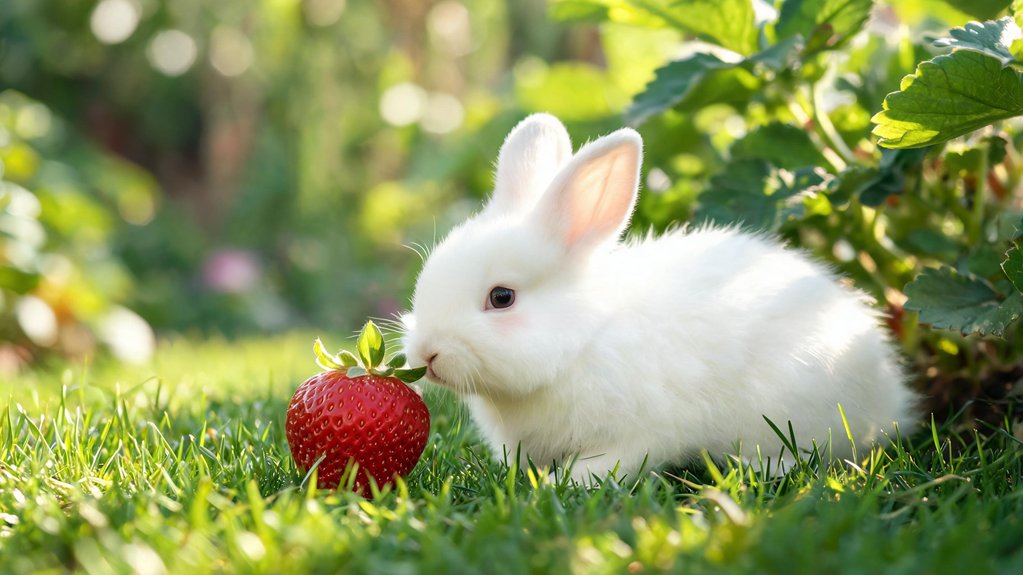
Strawberries can be a sweet, safe rare treat for your rabbit, and they bring a few nice perks when you keep the portion tiny. Because they’re mostly water, you can support hydration while still protecting gut health, since hay stays the main fiber.
The juicy bite also helps if your rabbit drinks less from the bowl. Strawberries add helpful micronutrients and antioxidants like anthocyanins.
Plus, the taste and texture add sensory fun, so your rabbit stays interested in food and foraging. For extra variety, offer just a small strawberry top too. Use it for bonding, too.
How Much Strawberry Is Safe for Rabbits by Body Weight?
When you’re choosing a strawberry treat size, think “tiny, measured, and occasional”—because strawberries are tasty, but they’re also higher in sugar than a rabbit’s usual foods like hay and leafy greens.
Keep fruit portions inside one daily fruit cap.
As a simple guide, offer about 1–2 teaspoons of fruit per 2 lb (0.9 kg) body weight, or 1–2 tablespoons mixed fruit per 6 lb (2.7 kg).
For a 2–3 lb rabbit, try ¼–½ of a medium berry.
For 4–5 lb, a small marble-sized strawberry is plenty.
Adjust down for dwarf rabbits, too.
How Often Can Rabbits Have Strawberries Each Week?
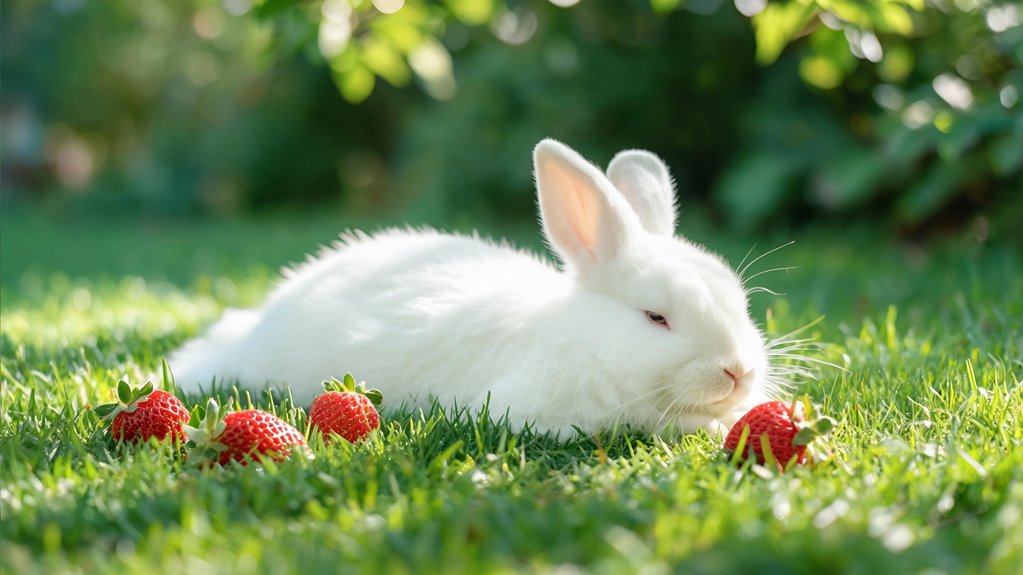
For most adult rabbits, aim to offer strawberries just 1–2 times per week as a treat, not a daily snack. Strawberries are sweet, so you keep them occasional to protect their gut and teeth, and to prevent gradual weight gain.
Space treat days out by at least 2–3 days, and never do consecutive days.
Better yet, give a small berry after your rabbit has had plenty of hay, so fiber stays the main meal.
Many guides also suggest avoiding fruit for rabbits under 7 months, and skipping it if they’re obese, have dental issues, or stomach troubles.
Start small, then watch stools.
Which Parts of Strawberries Are Safe to Serve?
You can usually feed your rabbit almost every *unprocessed* part of a fresh strawberry plant, but it helps to know what to choose. Offer a small treat: strawberry fruit flesh and the tiny seeds. Rinse well first to remove possible pesticide or fungicide residue.
And yes, strawberry leaves and green tops are non-toxic, often a better fibrous snack than the sugary berry. But remember leaves contain oxalic acid, so keep portions moderate.
Stems are safe, yet tougher—trim very woody ones.
Strawberry flowers are safe too.
Avoid jam, syrup, sweetened dried berries, and baked desserts.
How to Prepare Fresh Strawberries for Rabbits
Before you offer a strawberry, wash and trim it well, because little bits of dirt and residue can hide in the dimples and under the leafy cap. Rinse under cool running water, gently rub the skin, and check that leafy top for debris.
Skip soap, detergents, and produce wash—plain water is best. Pat dry, then cut the berry into small, bite-sized pieces for easy chewing and to help you manage the treat amount.
Serve it plain, at room temperature, and remove it after a few hours to prevent spoilage.
Offer only fresh, raw berries—no frozen, cooked, canned, or sweetened products.
How to Introduce Strawberries Safely Without Upset Stomachs
When you’re introducing strawberries, start slow so your rabbit’s gut can handle the extra sugar.
First, confirm your rabbit eats unlimited grass hay and gets leafy greens daily, with pellets kept small.
Then, offer fresh strawberry only after at least two weeks on steady hay.
For the first test, give about 1 teaspoon of chopped fruit or one small bite, no more than once per week.
Wait 24–48 hours.
If stools look normal, you can slightly increase to about 1–2 tablespoons per 5 lb body weight, at most twice weekly.
Don’t stack other sweet treats that day.
What Signs Mean You Should Stop (Diarrhea, Gas, or Reduced Appetite)?
Stop giving strawberries right away if you notice any digestive red flags like mushy or liquid poop, messy droppings, or no droppings at all.
Stop strawberries immediately if you see mushy, liquid, messy, or missing droppings—pause fruit and prioritize hay and fresh water.
If stools soften within 12–24 hours, pause fruit treats, and focus on unlimited grass hay plus fresh water.
And if you see sticky, messy, or “soft stool” cecotropes (night droppings), treat it as gut upset from sugar.
But don’t wait if you also notice gas, like gurgling stomach sounds, a tight belly, or your rabbit pressing their abdomen.
Reduced appetite, hay refusal, or hiding means stasis risk.
Call a rabbit-savvy vet same day.
Who Should Skip Strawberries or Strawberry Leaves?
If your rabbit has any of these risk factors, skip strawberries and strawberry leaves for now, and focus on the solid basics—unlimited grass hay, fresh water, and a daily leafy green.
First, hold off if they’re young, like 7–12 weeks old. Their gut bacteria aren’t mature, so sugary, new foods can cause life‑threatening GI trouble.
Next, avoid strawberries if your rabbit is overweight, or already gets lots of sugar, because fruit can drive weight gain and stress teeth.
Also skip them for rabbits with GI disease, chronic stasis, or sensitive digestion, since fruit can throw off gut movement.
Finally, be cautious with urinary problems.
What to Avoid: Canned, Frozen, Jam, and Chocolate
But please skip every processed strawberry you see at the store, because canned, frozen, jammy, and chocolate-covered options are just not rabbit food.
Canned strawberries and syrupy desserts bring extra sugar, preservatives, and additives that can trigger gas, diarrhea, and stomach upset.
Frozen strawberries can include similar additives, and the cold can upset digestion.
Also, thaw them to room temperature only, and even then keep them rare.
Avoid jam, jelly, and syrups, since their heavy sugar content can disrupt gut bacteria and raise dental risk.
And never feed chocolate, including chocolate-covered strawberries. Rabbits housed outdoors also need a proper enclosure fit that gives them enough room to move, which supports regular digestion alongside their hay and fresh greens.
Quick FAQ: Common Questions About Feeding Strawberries to Rabbits
You’ve already got the “no processed strawberries” rule down, so now let’s clear up the most common questions about serving fresh strawberries to your rabbit.
Yes, you can offer strawberries and strawberry leaves, but only as occasional treats.
Yes, you can offer strawberries and strawberry leaves, but only as occasional treats for rabbits.
Start with adults only, and at about 1 small strawberry (or half a large), once or twice a week.
Keep treats under roughly 5% of daily intake, and never replace hay.
If you see soft stool, gas, bloating, or reduced appetite, stop.
Wash, remove seeds, and introduce one fruit at a time.
Strawberry leaves can be a safer leafy alternative.
Frequently Asked Questions
Can Baby Rabbits Safely Eat Strawberries?
No—don’t feed baby rabbits strawberries yet. Stick to unlimited grass hay, daily leafy greens, and age-appropriate pellets. Wait until your rabbit is at least 12 weeks (often longer) and ask your vet before any fruit.
Are Dried Strawberry Leaves as Safe as Fresh Leaves?
About 1 in 10 rabbit owners underestimate oxalates, so don’t. Dried strawberry leaves can be as safe as fresh if unsprayed, but feed tiny, occasional portions, since drying concentrates oxalic acid. Always keep unlimited grass hay and daily greens.
Can I Feed Strawberries Instead of Leafy Greens Sometimes?
Yes, you can, but don’t swap strawberries for leafy greens. Offer 1–3 small berries as an occasional treat (up to 1–2x weekly), while keeping daily hay and leafy greens as the main diet.
What’s the Best Way to Cut Strawberries for Smaller Rabbits?
When my dwarf rabbit gulped a big chunk, I learned the hard way: cut strawberries into pea-sized pieces or thin quarters. Wash well, trim leaves, chop small, and serve just a tiny bite so they chew slowly.
Do Strawberry Leaves Cause Diarrhea or Gas in Some Rabbits?
Yes—strawberry leaves can cause diarrhea or gas in some rabbits, especially if you introduce them suddenly or overfeed them. Feed small amounts, wash well, and watch droppings; stop if stools soften or your rabbit seems bloated.