You’ll find White German Shepherds uncommon but not rare, with their white coat stemming from a harmless recessive gene that doesn’t impact health. The AKC recognizes them as purebreds for all activities except conformation shows, where color standards historically disqualified them. These intelligent dogs thrive in sports and family life just like their colored counterparts. Stick around to uncover pricing tips and how to spot reputable breeders for your perfect pup.
Swift Summary
- White German Shepherds are uncommon but not extremely rare, with availability varying by breeder.
- They are recognized as purebred by the AKC but disqualified from conformation shows due to color standards.
- The white coat results from a recessive gene and does not cause health issues or physical defects.
- They share the same typical lifespan and health risks as standard-colored German Shepherds when properly bred.
- White Shepherds are intelligent, active family pets suitable for various performance events despite show restrictions.
Are White German Shepherds Actually Rare?
While you might think white German Shepherds are exceptionally rare, they’re actually uncommon rather than extremely rare. You’ll find white shepherd for sale listings online, though white german shepherd puppies for sale often involve longer waits. Breeders focus on all white german shepherd lines to guarantee color, making white shepherd puppies from white german shepherd breeders in demand.
The white coat results from two copies of a recessive gene, so white German Shepherds are less common but not truly rare.
Consider the american white shepherd or solid white german shepherd as you weigh white shepherd price and white german shepherd cost. How much is a white german shepherd? Expect higher white german shepherd puppy price for purebred white german shepherd pups than standard white german shepherd vs german shepherd mixes. Once you bring one home, a well-fitting dog collar supports everyday comfort and control.
Full white german shepherd or all white german shepherd for sale options exist, but avoid piebald german shepherd or white german shepherd with blue eyes if seeking pure white german shepherd traits. Whether pursuing white german shepherd adoption or white german shepherd puppies for adoption, know are white german shepherds rare? Yes, but manageable.
Are white german shepherds dangerous? No. Are white german shepherds recognized by akc? No for conformation. Are white german shepherds real? Yes. Are white german shepherds healthy? Mostly. Problems with white german shepherds? Minimal.
Is white german shepherd a breed? Separate. White german shepherd pros and cons? Vary. What’s wrong with white german shepherds? Nothing much. Long haired white german shepherd? Rarer.
How the White Coat Gene Works in Shepherds
You’ll see that white Shepherds arise when a dog inherits two copies of the recessive allele at the E locus. This pattern means any colored parent can carry the gene without showing it, shaping how the trait passes through generations.
Rather than creating new pigment, the gene masks the dog’s true black-and-tan or sable markings with a pale cream coat. Owners raising a white puppy can keep it safe during training with an indoor dog playpen that creates a contained space inside the home.
Coat color is primarily cosmetic so white German Shepherds are healthy purebreds despite being disqualified from conformation shows.
Recessive Allele Expression
If you’re wondering why some German Shepherds look white, it’s because of a recessive allele at the MC1R gene that turns off black pigment production in the hair. This allele functions when present in two copies, disabling the receptor that normally signals for dark pigment.
Instead, your dog’s hair cells default to producing pale cream tones. Crucially, this gene masks underlying colors without altering skin or eye pigment. You’ll notice dark eyes and noses, confirming these aren’t albino animals.
The gene simply hides base patterns like black-and-tan beneath a white coat. Serving others means understanding this distinction. It’s an expression-only trait with no inherent health risks.
Your white shepherd remains healthy and vibrant, carrying standard pigment genetics hidden from view. This genetic mechanism is known as recessive allele expression.
Genetic Inheritance Patterns
Because the white coat gene sits at the Extension (E) locus, it controls pigment through a simple Mendelian system where dominant E alleles signal normal dark color and recessive e alleles disable it.
You guarantee healthy litters by understanding that white Shepherds carry two e alleles, guaranteeing every puppy inherits one. When two carriers mate, they risk producing white offspring despite appearing colored themselves.
You must recognize that this white allele works independently of other color genes like sable or black-and-tan. The dog’s underlying pattern remains hidden beneath the white coat.
You can serve future generations by testing breeding stock to reveal these hidden recessives before mating. This careful approach prevents unexpected results and helps maintain the health and integrity of your breeding program for these beautiful animals.
The gene responsible for the white coat is a natural recessive trait that does not link to health issues like deafness.
Color Masking Mechanisms
How does the white coat gene mask the German Shepherd’s true colors? You’ll find the e/e genotype at the MC1R locus blocks black or brown pigment production. This nonfunctional receptor stops melanocytes from making eumelanin, leaving only diluted phaeomelanin in the hair.
While the dog’s underlying genetics—like black-and-tan or sable patterns—remain intact, the white gene acts as a masking agent. It creates epistasis, hiding those standard colors from view.
You won’t see albinism here, because the dog’s skin, nose, and eyes retain their dark pigment. The coat appears white, but the blueprint for standard Shepherd markings stays hidden beneath.
This specific regulation means your animal can carry standard colors while presenting a pristine, solid white coat. The white coat results from a recessive masking gene, not albinism.
Why the White Coat Was Historically Disqualified
You’ll see that breed standards shifted when clubs labeled white a defect to preserve a “wolf-like” look. You won’t find any working flaws driving this; it was purely about aesthetics and uniformity. Owners who travel with a white German Shepherd can also rely on a portable dog bed to keep their dog comfortable on road trips and outdoor adventures.
Now you’re ready to explore how those policies formalized the exclusion.
Historical Breed Standard Changes
As you explore how the white coat became disqualified, remember that this shift wasn’t sudden—it emerged from early 20th-century standard changes in Germany and North America that progressively excluded white dogs from registration and conformation shows.
You’ll see that Horand von Grafrath carried the white gene, and early U.S. registrations welcomed them through the 1950s.
Then, 1933 German amendments barred white coats to prioritize working traits, setting a precedent.
By 1968, the AKC adopted similar rules, disqualifying white dogs from shows while still allowing registration.
These changes shaped breeding lines for decades.
You can honor this history by understanding why standards shifted, helping others appreciate the breed’s evolution while supporting healthy, diverse populations today.
Disqualification Driven by Aesthetics
Although breed clubs codified white as a disqualifying fault, they did so largely to preserve an aesthetic ideal rather than to protect health. You see they prioritized dark pigment and traditional patterns as the visual ideal for type. Consequently, you find they labeled white coats as “weak pigment,” viewing them as cosmetic defects.
Clubs framed white as dilution undermining the iconic working-dog image. You also witness how misconceptions linked white color to weakness, deafness, and impurity without scientific proof. They branded white dogs as flawed to protect perceived breed integrity.
While clubs barred white Shepherds from conformation rings to maintain uniform dark show images, they permitted registration and allowed participation in performance events like herding trials. This distinction proves the disqualification focused strictly on appearance, not the dog’s actual working ability or health.
Are White Shepherds Recognized by the AKC?
Did you know that the American Kennel Club does register White German Shepherds as purebred German Shepherds, yet it refuses to recognize them as a separate breed or allow them in conformation shows?
You can register your white Shepherd as a German Shepherd Dog, but you can’t show it in the AKC conformation ring. The AKC considers the white coat a disqualifying fault.
However, you can still compete in obedience, agility, rally, tracking, and herding events. Your dog can earn performance titles even without conformation eligibility.
This limited recognition means you get official registration but no show ring participation. Many owners serve their communities through performance work despite this aesthetic exclusion.
The AKC maintains this stance to uphold traditional breed standards while acknowledging white Shepherds as purebred animals under its registry system. For owners who keep their white Shepherd in a large home, extra-wide dog gates designed for larger openings can help create safe boundaries across wide spaces.
Do White German Shepherds Have Health Problems?
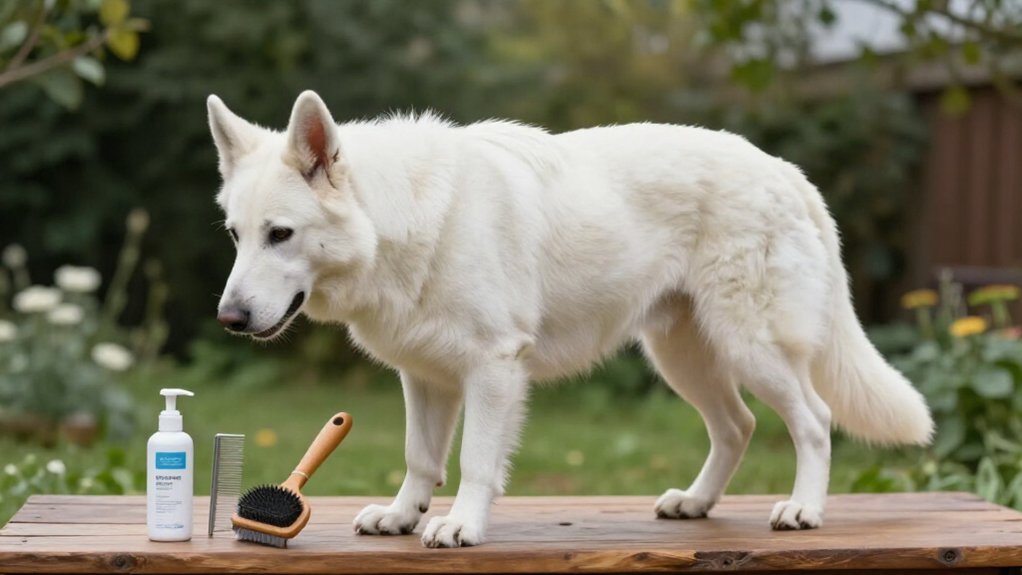
Since the AKC limits your white Shepherd’s show eligibility, you might wonder if its coat color signals deeper health issues. You’ll find that the recessive white gene affects only pigment, not organ or skeletal function.
Your dog shares the same health profile as standard German Shepherds, so its lifespan typically reaches nine to thirteen years.
You should know that this color gene sits separate from loci linked to hip dysplasia or deafness. Reputable sources confirm no scientific evidence ties the white coat to structural or temperament defects.
Your dog remains a normal-pigmented companion, distinct from albinism.
Since coat color doesn’t drive health outcomes, focus on breeder selection and routine screening. Watch for sunburn risks on lightly pigmented skin, but rest assured that your Shepherd isn’t inherently compromised. If you regularly walk your Shepherd alongside another dog, leash couplers let you manage both animals with a single leash.
Common Health Conditions Affecting White Shepherds
You’ll find that White Shepherds face common health risks like hip dysplasia and bloat, just as standard German Shepherds do.
While these conditions can impact their quality of life, knowing them helps you plan for better care. For dogs with joint sensitivity, choosing soft-sided dog carriers that emphasize comfort and flexibility can make vet visits and travel less stressful.
With proactive management, you can help your dog live a healthy, average span of about 12 to 14 years.
Common Health Risks
What’re the common health risks for White German Shepherds? When you serve these dogs, monitor for hip and elbow dysplasia, which cause pain and arthritis.
Watch for degenerative myelopathy, a spinal disease leading to paralysis.
Protect them from gastric dilation-volvulus, a life-threatening bloat common in deep-chested breeds.
Address gastrointestinal issues like pancreatic insufficiency or inflammatory bowel disease with careful diet management.
Screen for eye conditions like pannus and cataracts to preserve vision.
Manage allergies and skin conditions to reduce discomfort.
Prevent spinal stenosis and disc disease by maintaining healthy weight.
Although white coat coloration doesn’t increase neurologic risk, regular veterinary checkups help catch issues early.
Lifespan Expectations
Although White German Shepherds typically live 9–13 years like their standard-colored counterparts, you can extend their time with you by managing breed-specific health issues. You support them best by maintaining a healthy weight to reduce joint strain, which promotes mobility and systemic health over time.
You should schedule regular vet visits to catch orthopedic or endocrine problems early. You ensure their diet meets their working-breed metabolism needs for better body condition.
You engage them in structured exercise to support cardiovascular fitness without repetitive high-impact activities. You monitor their hips, elbows, and spine since large-frame conformation increases mechanical stress.
You select breeding lines focused on robust health to minimize cardiac or neurologic disorders. You commit to quality care that directly influences their longevity. Your dedication helps them reach the upper end of their lifespan potential.
By staying proactive, you maximize meaningful moments together. You create a life where they thrive physically and mentally. Your consistent effort truly makes a difference in their health outcomes.
You serve your shepherd with thoughtful, attentive care every day.
How Long Do White German Shepherds Live?
If you own a White German Shepherd, you’re likely curious about how long your dog will stay by your side. Generally, you can expect a lifespan of 9 to 14 years, closely overlapping standard German Shepherd ranges. Many owners see their dogs reach 10 to 12 years with good care. Females often live slightly longer than males.
To support their longevity, you must prioritize genetic quality and responsible breeding. Keep your dog at a lean weight to reduce joint stress and prevent chronic issues. Provide consistent, high-quality nutrition and regular veterinary screenings.
Guarantee adequate daily exercise and mental stimulation to maintain cardiovascular health. On walks and hikes, a lightweight rope leash gives you secure control while letting your dog move comfortably, which helps keep daily exercise consistent. While hereditary conditions can shorten life, proactive management helps your servant companion thrive longer.
You’ll often see healthy whites reaching 12 to 15 years. Exceptional cases even hit 18 years when you provide love and proper healthcare.
Do White Shepherds Make Good Family Pets?
Thinking about your White Shepherd’s long lifespan leads you to contemplate their role in your home. These dogs possess high intelligence and deep loyalty, making them excellent companions for those who serve others.
You’ll find them gentle, protective, and sweet, with a slightly softer demeanor than standard German Shepherds. Their strong bonding tendency ensures they form close emotional attachments with your household group.
When properly socialized early, White Shepherds become patient, attentive, and playful with your children. Though they may accidentally knock over toddlers due to their boisterous energy.
They’re also compatible with other pets when introduced properly, though you’ll need to manage their high prey drive around smaller animals.
Their strong requirement for early, consistent socialization prevents unwanted aggression or overprotectiveness toward strangers.
You’ll appreciate their trainability and rapid learning capacity, enabling advanced obedience and household manners that support your service-oriented lifestyle. Because they often accompany you on swims, hikes, and muddy outings, a waterproof dog collar can stand up to water, rain, and mud without losing its fit or strength.
Do White Shepherds Excel in Sports and Work?

Why do White Shepherds excel in sports and work? You leverage their high intelligence, trainability, and athletic structure comparable to standard German Shepherd lines. Although coat color restrictions affect conformation shows, they don’t diminish working capacity or sport potential.
You utilize them in police, military, herding, search-and-rescue, therapy, and service work. Their focus, calm temperament, and strong scenting ability support success in high-pressure duties like tracking criminals or detecting narcotics.
You appreciate their loyalty and determined work ethic for reliability as guard dogs.
You enter them in obedience trials, agility courses, flyball, and Schutzhund. Their muscular build and coordination benefit agility events. You channel their high drive and energy levels during multi-hour sessions to meet exercise needs, and you keep them hydrated on the go with portable dog water bottles made for outings away from home.
Structured sports reduce behavioral issues by providing outlets for their mental and physical energy. You harness their problem-solving skills for complex task chains, fostering consistent partnerships in long-term working roles.
How Much Do White Shepherd Puppies Cost?
When you look at White Shepherd puppies, expect to pay between $800 and $3,000, with most reputable breeders charging $1,500 to $2,500 for health-tested lines. You’ll find general ranges around $1,000 to $1,500, though rarer white coats often push costs higher.
If you seek quality lines from tested parents, budget accordingly since show-quality or fully registered pups can reach $3,000 or more. Extensive care like vaccines, microchipping, and starter kits often bundle into these prices. Starter kits can also include a reflective dog leash to improve visibility during low-light walks.
While adoption offers cheaper options from $150 to $2,500, purchasing from responsible breeders ensures better health and temperament support for your service work goals. Planning your budget carefully helps you provide the best start for your future working partner.
Where to Find Reputable White Shepherd Breeders
To find reputable White Shepherd breeders, start by turning to established clubs like the WGSDCII and AWSA, which provide vetted contact lists for serious fanciers. These organizations, including the WGSDCA and UWSC, guarantee breeders uphold quality standards and prioritize the health of their puppies.
You should also explore curated directories from the White Swiss Shepherd Club of America or the Pedigree Database to find verified kennels.
Look for breeders who openly share OFA hip and elbow certifications along with genetic screenings for degenerative myelopathy.
Prioritize those actively participating in breed-specific activities, as they demonstrate genuine dedication to serving the community and preserving the breed’s integrity.
This careful selection process helps you find a healthy, well-bred puppy from a responsible, service-oriented source.
Is Buying a White German Shepherd Worth the Price?

If you’re considering buying a White German Shepherd, expect to pay anywhere from $1,000 to $3,500 depending on whether the breeder includes health testing and genetic screenings. While standard Shepherds average $1,881, white coats command premiums due to rarity.
You must weigh this cost against their companion value. Since white genetics don’t cause health issues, your focus should be on the breeder’s OFA and cardiac exams.
You won’t compete in AKC conformation, but you can serve others by training them for obedience or herding. These dogs offer the same loyalty and lifespan as traditional colors.
Ultimately, you justify the price through their service potential, not just their striking coat. Guarantee your investment supports responsible breeding practices.
Frequently Asked Questions
Are White German Shepherds Considered a Separate Breed?
Like a bridge between breeds, you see that white German shepherds aren’t separate breeds under the AKC, but they are distinct recognized breeds elsewhere. You serve dogs by honoring all their unique colors and histories.
Can White Shepherds Compete in AKC Conformation Shows?
You cannot enter white Shepherds in AKC conformation rings due to coat disqualification rules. You register them for pedigree records. You join performance or specialty clubs to showcase their abilities publicly.
Do White Shepherds Have Higher Sunburn or Skin Cancer Risks?
Yes, white shepherds face higher sunburn and skin cancer risks. Protect them by limiting midday sun exposure and applying dog-safe sunscreen to lightly pigmented areas like their nose and ears.
Are White German Shepherds Better Suited for Specific Tasks?
Yes, you’ll find white German Shepherds excel in service, search-and-rescue, and herding. Their calm focus, high visibility, and strong protective instincts make them ideal for tasks requiring steady, reliable performance in diverse working environments.
Why Are White German Shepherds More Expensive Than Other Colors?
Why the price tag? You pay more for white German Shepherds due to their rarity, specialized breeding, extensive health testing, and added training or registration value, ensuring you get a premium companion ready to serve.